





Polylinguality and Transcultural Practices
Editor-in-Chief: Uldanai M. Bakhtikireeva, Doctor of Science (Philology), Ph.D., Professor
ISSN: 2618-897X (Print) ISSN: 2618-8988 (Online)
Founded in 2004. Publication frequency: quarterly
Open Access: Open Access  APC: no article processing charge
Peer-Review: double blind. Publication language: Russian, English
PUBLISHER: Peoples’ Friendship University of Russia named after Patrice Lumumba (RUDN University)
Indexation: White List RCSI, Russian Index of Science Citation, DOAJ, Google Scholar, Ulrich's Periodicals Directory, ERIH PLUS, Dimensions
The journal "Polylinguality and Transcultural Practices" (PTP) is a peer-reviewed academic journal in the field of interdisciplinary research on Russian-foreign bilingualism, translingualism, transcultural practices, and aesthetic phenomena reflected in translingual (Russian-language) literature mostly in the Russian and English languages and art of the indigenous peoples of the Russian Federation, post-Soviet countries, and the world.
The journal's objectives are:
• to promote the exchange of knowledge between Russian and foreign researchers in the field of mass bilingualism, multilingualism, processes of transculturation and individual – i.e., literary translingualism, including literature written in the Russian language and translated literature of the peoples of the Russian Federation, post-Soviet countries and the world;
• to acquaint readers with new research revealing the mutual adaptability and fluidity of diverse linguistic and cognitive world views in everyday practice, fiction writing and translated literature, and the arts of the peoples of the Russian Federation and post-Soviet countries;
• to expand the geography of special thematic issues dealing with the study of ethno-linguistic features, literatures of indigenous peoples and, in particular, their Russian-speaking branches, and specificity of translating cultural lacunae, i.e., accidental lexical gaps, from the languages of the peoples of the Russian Federation and other countries into Russian;
• to publish research results revealing socio-cultural phenomena of traditional crafts and aesthetic phenomena of contemporary art of the indigenous peoples of the Russian Federation.
Along with original articles, PTP publishes essays, reviews, overview articles, and reports on scientific projects. Both Russian and foreign scholars act as co-editors of thematic issues.
The journal strictly adheres to Russian and international standards of publication ethics as formulated in the Declaration of the Council for Ethics in Scientific Publications of the Russian Academy of Sciences and the recommendations of COPE (Committee on Publication Ethics).
You can find the rules for article formatting, archives and additional information by following the relevant hyperlinks.
Email: ptpj@rudn.ru
English and Russian are publication languages.
Favorite articles

Studying Transnational and Translingual Professional Communication
Vol 22, No 2 (2025)
The Chechen in Modern Chechen Literature: Prose by Elbrus Minkailov
Vol 22, No 2 (2025)
Ecphrasis as a Transcultural Marker
Vol 21, No 4 (2024)
English to Italian, Italian to English
Vol 21, No 4 (2024)
Cōgitō, ergo sum: Interview with Eduard Mizhit
Vol 18, No 2 (2021)
Omnilingual Aspirations: The Case of the Universal Declaration of Human Rights
Vol 18, No 1 (2021)
Transculturalism and Its Manifestation in the Poetics of Lyric Texts
Vol 18, No 1 (2021)
Dolgan Invitation to the Tundra: the Artistic World of Ogdo Aksenova
Vol 17, No 3 (2020)
Post-Colonial “Writing Back”
Vol 17, No 3 (2020)
Translingual Writers: Introductory Notes
Vol 16, No 1 (2019)
Language Biographies of the Respondents of Moscow Region Chuvash Diaspora
Vol 16, No 1 (2019)
Literary Translingualism: What and Why?
Vol 16, No 3 (2019)
Yone Noguchi’s Impersonation in “The American Diary of a Japanese Girl”
Vol 16, No 4 (2019)
Frontierwhorlroamer: Eugene Jolas’s Cosmopoetics
Vol 16, No 4 (2019)
Reading War and Peace as a Translingual Novel
Vol 16, No 4 (2019)
Literature in Solving the Problems of Polycultural Education
Vol 15, No 2 (2018)
Worms in the Well, or Protest Realism of Amir Makoev
Vol 15, No 2 (2018)
MULTILINGUALISM IN THE REPUBLIC OF KAZAKHSTAN: VIEWPOINT FROM THE OUTSIDE
Vol 15, No 3 (2018)
TRANSLINGUALISM: COMMUNICATIVE BRIDGE OR “CULTURAL BOMB”?
Vol 14, No 1 (2017)
“IN A DOUBLESHARP LANGUAGE”: INTERVIEW WITH ELENA ZEIFERT
Vol 14, No 1 (2017)
TRANSLINGUALISM AND ITS APPLICATION
Vol 14, No 2 (2017)
CAN NATURAL BILINGUALISM BE HARMFUL?
Vol 14, No 2 (2017)
COLLABORATION WITH PARENTS IN BILINGUAL ACQUISITION
Vol 14, No 2 (2017)
ROMANI LANGUAGE DEVELOPMENT OF PRESCHOOL ROMA CHILDREN
Vol 14, No 4 (2017)
ON THE POSITIVE EXPERIENCE OF BASIC READING TEACHING DURING WEEKEND SCHOOL DAYS
Vol 14, No 4 (2017)
LITERARY BILINGUALISM: PRO AND CONTRA
No 5 (2015)

Current Issue
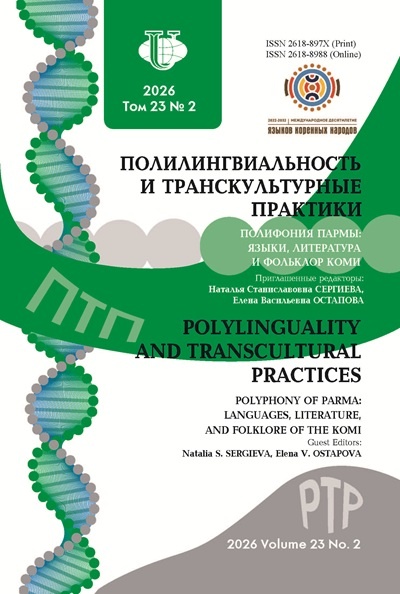
Vol 23, No 2 (2026): POLYPHONY OF PARMA: LANGUAGES, LITERATURE, AND FOLKLORE OF THE KOMI
- Year: 2026
- Articles: 18
- URL: https://journals.rudn.ru/polylinguality/issue/view/2155
- DOI: https://doi.org/10.22363/2618-897X-2026-23-2
Full Issue

POLYPHONY OF PARMA: LANGUAGES, LITERATURE, AND FOLKLORE OF THE KOMI
 237-246


Language Processes
Modern Komi-Permyak Literary Language: Functioning Problems and Main Development Trends
Abstract
The research is devoted to the analysis of the state of the modern Komi-Permyak literary language. Literary language serves the communicative needs of society in all spheres of its activity. The presence of a literary form of a language indicates the level of its development, its potential, and the cultural level of the people as a whole. The relevance of the research topic stems from the need for an in-depth study of the language situation in the Komi-Permyak Okrug under modern conditions. The aim of this work is to identify and analyze some of the most evident development trends of the modern Komi-Permyak literary language and the problems associated of its functioning. This study utilizes descriptive and analytical research methods. It has been revealed that at present, despite a considerable period of its formation, the literary Komi-Permyak language has many unresolved problems that hinder its full-fledged development. It is noted that under modern conditions, the literary Komi-Permyak language lives and develops in various spheres; it is most in demand in the sphere of education. Today, its functioning as a language of official communication and as a language of science is extremely limited. Despite the presence of certain problems, some trends in the development of the literary Komi-Permyak language can be noted, namely, the creation of Komi-Permyak linguistic and literary terminology, a tendency toward neologization, which can be characterized as a rational, targeted effort to expand the lexical resources of the literary language, and a desire to enrich the vocabulary using its own linguistic resources. A positive trend in the development of the modern Komi-Permyak language is the formation of a religious style associated with the translation of liturgical books into the Komi-Permyak language. The role of the Internet in expanding the boundaries of the language’s functionality and its further development is noted. The study emphasizes the importance of the Komi-Permyak language as a component of cultural heritage capable of preserving national identity and ensuring the continuity of generations.
247-258
Postpositions and Prepositions in the Nerdvinsky Dialect of the Komi-Perm Language: Structural and Functional-Semantic Aspects
Abstract
This paper examines the structural and functional-semantic aspects of specific postpositions in the Nerdvinsky dialect, which belongs to the southern dialect group of the Komi-Perm language. It also highlights borrowed prepositional constructions that are actively used by speakers in this area. The Nerdvinsky dialect is a peripheral dialect located in the southern part of the Komi-Perm Okrug. Prolonged geographical proximity to Russian vernaculars is the primary reason for the high degree of various borrowings. The relevance of the study is determined by the dialect’s underrepresentation in linguistic research. Komi-Perm dialectology lacks specialized studies that assess the preservation of native grammatical paradigms and the extent of usage of foreign linguistic elements in local vernaculars. Contemporary data from the Nerdvinsky dialect enable such an analysis based on the use of native postpositions and borrowed prepositions in speech. The aim of the research is to analyze the structural and lexico-grammatical forms of postpositions in the Nerdvinsky dialect and to identify the patterns of Russian preposition usage in native-language communication. The materials comprise field recordings collected by the authors between 2024 and 2025 within the dialect’s geographical area. The primary research methods involved synchronous analysis of dialect material, as well as phonetic and morphological word analysis. The postpositional system of the dialect is characterized by the disintegration of the serial postposition with the stem выл- [vyl-] and its transition into a case marker, cf.: ы·блын < ыб вылын [y·blyn < yb vylyn] (meaning ‘in the field’); ы·блӧдз < ыб вылӧдз [y·blödz < yb vylödz] (meaning ‘up to the field’). A number of simple postpositions tend to incorporate additional formants, cf.: сы код'ӧм vs. сы код' [sy kod'öm vs. sy kod'], сы код'а vs. сы код' [sy kod'a vs. sy kod'], сы код'ӧма vs. сы код' [sy kod'öma vs. sy kod']. All examples have the same meaning ‘as he/she (does)’. The semantics of these additional markers is akin to that of derivational suffixes found in content words. The influence of Russian leads to palpable changes at the grammatical level. In speakers’ speech, Russian prepositions are frequently used instead of the expected native postpositions or semantically corresponding case forms, e.g.: чэ·рэз мы·р-то чапка·лӧ [che·rez myr-to chapka·lö] (meaning ‘(he/she) throws (smth.) over the stumps’); сэ·кс'ин' до крэщэ·н'ийа [se·ks'in' do kreche·n'ija] (meaning ‘from that time until Epiphany’). The borrowing of entire prepositional constructions is observed, preserving the original grammatical forms of case, gender, and number. The data from the Nerdvinsky dialect reveal both general trends characteristic of Komi-Perm dialects and unique features of this specific area regarding the use of postpositions and Russian prepositions.
259-271
The Izhma Komi: As Kyy as a Part of Life
Abstract
The modern Komi language is a multi-layered and complexly organized dynamic system, with a standardized literary variant and dialectal forms. The Izhma dialect is one of 10 dialects of the Komi language. Despite a fairly comprehensive scientific description of the Komi literary language and its dialects, the interaction between the literary language and dialects, as well as the acceptance or rejection of the literary language by dialect speakers, has not yet been adequately addressed in the scientific literature. These issues have not only scientific but also practical and social significance for local linguistic communities that use dialects as their primary language of communication. The purpose of this article is to analyze the linguacultural attitudes of Izhma Komi dialect speakers, residents of the Izhemsky district of the Komi Republic, within the broader context of the ethnolinguistic situation in the Komi Republic. The article analyzes the opinions of Izhma respondents on the interaction between the Izhma dialect and the literary Komi language, which were collected during a field study conducted in the summer of 2025, as part of an assignment of the Research Center for the Preservation, Revitalization, and Documentation of the Languages of Russia at the Institute of Linguistics of the Russian Academy of Sciences to clarify the state of languages of Russia. Local projects aimed at the development and intergenerational transmission of the Izhma dialect and culture are also examined. As the study showed, the Izhma dialect is defined by its speakers as a language, either as ас кыы , as kyy , ‘our language’, or изьва кыы , iz'va kyy , ‘Izhma language’. Its opposition to the literary Komi language has existed historically and continues to this day. The state of both the Izhma dialect and the Komi language as a whole is affected by the depopulation of the indigenous population and an intense language shift toward Russian, especially among children and young people. Despite this, recognizing their responsibility for the preservation, development, and transmission of the Izhma dialect and culture, the Izhma Komi people initiate, implement, and actively participate in local linguacultural projects.
272-288
Komi-Russian Language Contacts in the Data of Pechora Phraseology
Abstract
The issue of Finno-Ugric influence on the Russian dialects of the European North has been addressed in numerous studies. However, the dialects of the Lower Pechora (the speech of the Russian old-resident population of the Ust-Tsilemsky District of the Komi Republic, which for several centuries was in close contact with the Komi and the Nenets) have not yet received a systematic description in light of this problem. This determines the relevance of the study, the object of which is phraseological units with word components of Ural (Finno-Ugric and Samoyedic) origin, and the subject is semantic, derivational, figurative and expressive features of the components of phraseologisms, the analysis of which allows us to confirm close interlanguage contacts. The purpose of the article is to identify phraseological units with borrowed and substrate words-components of Ural origin in Pechora dialects. The sources of the material were dialect, phraseological and paremiological dictionaries of the dialects of Lower Pechora. The study allows us to conclude that inter-language Komi-Russian contacts contribute to the penetration of words of Finno-Ugric and Nenets origin not only into the lexical language layer, but also into the phraseology of North Russian dialects, which indicates a high degree of their development by the borrowing subsystem. Integrating into the idiomatics and paremiology of the dialect, they replace the components of all-Russian phraseologisms and form dialect variants, participate in the creation of phraseological units that give the Pechora dialect uniqueness and originality.
289-298
Pause as a Means of Creating Subtext in Komi Prose Works
Abstract
In modern linguistics, scientists are very interested in the study of sounding speech and the specifics of its intonation. The paper focuses on one of the components of intonation, namely the pause, which plays an important role both in spontaneous live speech and in the written text. Its special place among other elements of intonation lies in its key role in ensuring the communicative effectiveness of the transmitted message. The paper deals with the study and description of the pause in Komi prose works. The object of our research is the pause as an element of intonation, capable of carrying an important semantic load in speech. The main objectives of the study are to analyze the motivational side of pausal inclusions, identify the means of transmitting pauses in the text of a prose work and classify them in a functional and semantic aspect. The sources of the empirical base of the work were the texts of the original Komi fiction, on the basis of which a rich textual material was collected for the study of intonation features, including pauses characterizing the character’s speech. The text of the artwork reflects the specifics of the use of linguistic means of transmitting pauses in the speech of the interlocutors. The study allowed us to conclude that for the most part they are transmitted through author’s remarks, word breaks, their repetition in the character’s remark, font highlights of lexemes, speech-like placeholders, as well as the use of graphic, including punctuation, features in the text. When classifying pauses, their characteristics, multi-level parameters, such as position in relation to semantic connection, physical nature, and function were taken into account. The analysis allowed us to identify many types of pauses used in the text. A distinctive feature of each of these varieties is their spontaneity and unpredictable nature. The author’s style, the unique sound organization of speech created by writers for their characters, and the author’s attitude to the images formed have a significant impact on the representation of the linguistic characteristics of pauses in the characters’ speech.
299-314
Linguistic Representation of the Emotion of Joy in Modern Komi Prose
Abstract
The paper deals with the study of the linguistic representation of the emotion “joy” in the Komi literary text. The representation of emotions is one of the significant parts of the linguistic worldview of any language, and is the subject of close attention in modern linguistics. The issue of the expression of emotions in the Komi language has not been the subject of special study to date, so addressing this research topic is relevant and timely. The descriptive-analytical method is used in the analysis and description of the theoretical positions of scholars, the method of semantic analysis and distributive technique are used in identifying the features of linguistic means representing the emotion of joy. The study revealed that emotions can be represented in language at different levels. Within the framework of this work, our interest in studying them is focused on describing the means of expressing the emotion of joy and its lexical meaning. The research material is based on the texts of modern Komi fiction, where it is the context, along with the analysis of verbal and non-verbal parts, that makes it possible to accurately determine the emotion being represented. This paper presents an analysis of emotionally colored lexical units that are used as mechanisms for verbalizing the emotion “joy” in the Komi language, the means of expressing emotional meaning are considered, the features of the representation of the emotion “joy” in the text of modern Komi prose are described. The transmission of emotions in the text space is carried out through a complex interaction of verbal and paralinguistic means. These tools make it possible to express a wide range of emotive meanings, including evaluative, pictorial-gestural and interpretative, and the contribution of para-linguistic elements to the representation of emotions is as significant as verbal ones. The analysis revealed a group of emotives with a positively colored meaning that conveys the emotion of joy. The description of non-verbal means of communication, including gestures, facial expressions, and body movements, allowed us to determine the correlation between verbal and non-verbal manifestations of the emotion of joy. It has been established that the dominant role in the transmission of non-verbal information is made up of verbs, mostly verbs denoting various movements. The highest degree of joy is often expressed not through direct nomination, but through detailed metaphorical descriptions.
315-329
“Bow” (“Poklon”) in Komi Speech Etiquette Formulas
Abstract
The research is devoted to the study of a fragment of Komi verbal etiquette - etiquette expressions and speech etiquette formulas (SEFs) of the Komi language that include the lexeme “bow” (“poklon”). Komi verbal etiquette is a relevant area of contemporary linguistic research, requiring not only preservation but also comprehensive study and systematic investigation that takes into account the poly-ethno-linguocultural specifics of the Northern and Volga-Kama macro-regions of the Russian Federation, shaped by intercultural and interlingual contacts. The aim of the work is to describe significant elements of Komi speech etiquette - SEFs containing the lexeme “bow” (“poklon”), and to identify the peculiarities of their functioning in oral and written communication, as well as their linguistic expression, semantics, and structure (constructions). The material was collected primarily from records of etiquette units in works of Komi literature, in written artistic speech, in lexicographic sources, in dialectal texts, and in the Electronic Corpus of the Komi Language (ECKL, www.komikorpora.ru). The main research methods are descriptive, as well as methods of component and distributional analysis. The study enriches the knowledge about Komi speech culture and Komi verbal etiquette, revealing the sources of new etiquette speech units and the peculiarities of their use and development. It has been established that Komi etiquette was strongly influenced by Russian etiquette traditions; the borrowing of etiquette speech expressions with the lexeme “bow” contributed to the enrichment of Komi speech etiquette and the expansion of means of expressing courtesy and politeness. The main etiquette situations for using SEFs are greetings, farewells, and expressions of gratitude, used when one wishes to show special reverence, respect, or attention to a particular person, or to acknowledge their merits. SEFs with the lexeme "bow" in the Komi language are used as colloquial etiquette formulas, as well as in the opening and final (farewell) formulas of private and business correspondence. The expression of respect, courtesy, and attention through SEFs can be directed both directly to the addressee and indirectly, through the addressee, to a third party (the recipient of the bow).
330-342
LITERARY SPACE
Komi Literature in the 1920s: The Main Trends in the Development of Poetry, Prose and Drama
Abstract
The study provides a review and analysis of the Komi literary process of the 1920s in order to identify and define general trends and individual characteristics in the development of the national literature during this period. The objectives are to trace the chronology of literary events; to examine the main principles behind the creation and development of Komi poetry, prose, and drama; and to determine the role of writers such as V. Savin, V. Chistalev, V. Lytkin, M. Lebedev, and P. Doronin in the formation of Komi literature. The research is based on comparative, descriptive, and cultural-historical methods which allow for the most comprehensive presentation of the literary life of the Komi region in the first post-revolutionary decade. The 1920s are considered a separate period in the history of Komi literature. The material for the analysis comprised poetic, prose, and dramatic works published in author’s books and periodicals - in the journals Ordym (“the Path”), Komi mu (“the Komi Land”), and in collections and almanacs as Parma Jol (“Forest Stream,” 1922), Voj tӧv shuvgӧm (“the Noise of the North Wind,” 1921), Gӧrd pӧlyan (“the Red Pipe,” 1921), Komi gizhysyas (“Komi writers,” 1926). The analysis demonstrates that the 1920s were one of the most important, albeit complex and ambiguous periods that influenced the formation and subsequent development of Komi literature in the 20th century. An unprecedented surge in the creative activity of both young and experienced writers, and the development of all kinds and genres of literature occurred simultaneously with the tightening of state control over the literary process, by the end of the decade and the intensification of creative unfreedom, culminating in the mass repression of Komi writers in the 1930s.
343-353
The Yuletide Story Genre in the Works of the Komi Writer M.N. Lebedev
Abstract
This study aims to fill gaps in the study of M.N. Lebedev’s pre-revolutionary literary legacy. The material used is little-known works by the writer, dating back to his early creative period: the “scary” the Yuletide story “Ivan the Naked” (1900) and “At Christmastide” (1911). The research problem is the specific plot structure of the works, which reveal the writer's active reliance on known versions of Christmastide plots. The plotline of the first story is extremely close to one of the most productive and popular forms of Komi folklore - hunting tales associated with the regulation of the behavior of hunters during certain calendar periods, including a ban on hunting activities during Christmastide. The second story draws on the tradition of Russian Christmastide fiction, including a particular example - N.M. Zagoskin̕s cycle of stories “Evening on the Khopra,” in which the narration is from the perspective of characters belonging to the landed gentry. The use of various socio-cultural sources is explained by M.N. Lebedev’s attempt to capture the perception of Christmastide by different strata of contemporary society: popular ideas about the sacred significance of Christmastide time and the loss of ritual significance of Christmastide traditions by the educated “district aristocracy”.
354-365
The National Music and Drama Theatre of the Komi Republic: History and Modernity
Abstract
This article explores the key milestones in the history and the current state of the National Music and Drama Theatre of the Komi Republic. The relevance of this work is determined by the need to introduce historical data about the theatre into academic discourse and to study previously unexplored material. Analyzing this material will expand the scientific understanding of the cultural life of the Komi Republic. The article attempts to comprehend the reasons for the theatre's founding, the formation of its repertoire, and the renewal of its productions. It identifies the theatre's role in the development of national drama and culture, and reveals its uniqueness and distinctive character.
366-376
FOLKLORE AND TRADITIONAL CULTURE
The National Identity of the Komi Joke
Abstract
Considerable attention has been paid to the issue of Komi-Russian linguistic and intercultural relations in the works of linguists and sociologists. Recently, more substantial research in folkloristics has also emerged. Komi folklore demonstrates unique examples of the appropriation of foreign (in this case, Russian) folklore texts. This is not a mechanical appropriation, but rather a semantic correlation of Russian texts to the pragmatics of the Komi language. In this aspect, Komi jokes have remained unexamined, although it was in them that the problem of inter-language interaction manifested itself quite clearly. In the contemporary Komi folklore environment, jokes are as widespread as genres like the bylichka (supernatural folk tale) or legends. Their thematic range is not very diverse; in fact, the majority of the jokes reflect the everyday realities of village life: incidents involving people known to the storyteller, jokes about nicknames, cycles of jokes about village “jesters” (local wits/fools), and the like. However, the largest and most popular topic of jokes can rightfully be called the linguistic topic. This theme unites jokes of the Komi itself, jokes about Komi distorting Russian speech, and Russian jokes about Komi. Both series, in one way or another, are built around a speech situation in which a Komi person uses the Russian language.
377-389
Stories about Yuletide Fortune-telling in the Tradition of the Vishera Komi
Abstract
The study examines fortunetelling practices of the second half of the 20th century based on new expedition materials. Using a comparative descriptive method, for the first time, oral stories about fortunetelling of one local tradition are analyzed - Vishera Komi (Kortkerossky district of the Komi Republic). In this tradition, the Yuletide period is called Vezha ‘Holy’, Vezhadyr ‘Holy period’; in the popular consciousness it is marked as a liminal time when a communication channel with the other world can be easily established. In the folklore tradition of the Vishera Komi, this process is called a gadaitch, a word borrowed from Russian and adapted. Informants either do not name some types of fortune-telling in any way, or prefer to name them by action: кыызысьні ‘to obey’, видзедчині ‘to look at’, сотні ‘to burn’, etc. Most often they try to cast spells on the eve of calendar milestones: on the night of St. Basil's Day or on the eve of Epiphany. Field data from the beginning of the 21st century make it possible to identify a corpus of Yuletide ritual practices, both known to other Komi and Northern Russian traditions, and specific only to Vishera Komi. These include fortune-telling by girls with a bread shovel. Oral stories about fortune-telling reflect current trends in folklore traditions, characterized, on the one hand, by the loss of some fortune-telling, and on the other hand, by the penetration of new phenomena from the Russian tradition and their adaptation to a foreign language environment. Apparently, spiritualistic seances with evocation of spirits, fortune-telling with books and notes related to the spread of literacy among rural residents are among the latest in Komi traditions. Of particular interest are the stories about fortune-telling that came true, when girls married precisely those whose image they saw during fortune-telling rituals.
390-399
Verbal Magic in the Hunting and Fishing Practices of the Komi-Zyryans
Abstract
Due to the fragmentary knowledge about Komi-Zyryan verbal magic, the incantation tradition of hunting and fishing has not yet been the object of special research. The author attempts to present a general picture of the existence of verbal-magical knowledge in the fishing and hunting life. Understanding verbal magic as a wide range of irrational techniques and methods of verbal influence on the surrounding world, the author summarizes the experience of research in the field of the Komi incantation tradition. This tradition is closely connected both with magical knowledge and the regulation of linguistic behavior in fishing and hunting activities. The material for the study was provided by currently available publications, unpublished archival sources, and the results of the author’s own field research over recent decades. When collecting field material, we used the methods of interviewing and participant observation. The methods of structural, semantic and pragmatic analysis were applied in the study of folklore narratives. Methods of comparative and structural-semantic analysis were used to study ritual descriptions. The analysis incorporates not only information on the incantation tradition but also a wide range of folklore and ethnographic data concerning ideas about fishing and hunting, associated rituals, and mythology. The general picture of the existence of verbal and magical knowledge constructed by the author includes a broad spectrum of irrational techniques and methods of verbal influence on the surrounding world - everything connected both with magical knowledge and the regulation of linguistic behavior in fishing and hunting activities. This expanded understanding of verbal magic is presented as a promising approach for the further study of the Komi incantation tradition.
400-413
Bilingual education
Environmental Approach in Higher Education as a Condition for the Forming of Ethnocultural Competence of Future Primary School Teachers
Abstract
The authors of this article present various Russian perspectives on the implementation of an environmental approach at different levels of education, identify the structural components and types of educational environments, and identify the role of the university educational environment in developing the professional ethnocultural competence of future teachers working at the primary education level. The results of a diagnostic assessment of primary school teachers in the Komi Republic to determine the level of ethnocultural competence are analyzed. The authors have have provided a description of the concept of “ethnocultural educational environment”, the components of the ethnocultural educational environment of the university are identified such as: target, normative-legal, theoretical-methodological, substantive, procedural, diagnostic-resultative blocks, a model of the ethnocultural educational environment of the Department of Primary Education of the Institute of Pedagogy and Psychology of the University, implementing the environmental approach, is designed and described in Pitirim Sorokin Syktyvkar State University and aimed at developing ethnocultural competence in future primary school teachers.
414-434
Features of Applying a Contrastive Approach in Training Students to Teach Russian in the Context of Komi-Permyak-Russian Bilingualism
Abstract
The research describes the features of training future teachers to teach Russian in the context of Komi-Permyak-Russian bilingualism. It is characterized by the following types: coordinative (since speakers are fluent in both languages in society), active (since speakers use both languages during instruction, at home, and in communication with peers), contact (speakers maintain contact with both native Russian speakers and native speakers of their native language), and parallel (some students acquire Russian based on their native language). During the ascertaining experiment, it was found that language arts teachers proficient in both Komi-Permyak and Russian, in the process of teaching Russian, use the native language to compare similar and different linguistic phenomena and conduct preventative work to overcome interference errors. Our study is devoted to the application of contrastive approach techniques in the practice of preparing bilingual students for teaching Russian. The study focuses on the application of methods within the contrastive approach, particularly examining the possibilities of using contrastive analysis when studying morphological topics and describing corresponding techniques. Based on this, the author’s model of a lesson fragment is presented, and the topics of lessons developed during classes with students are outlined.
435-447
INTERVIEW
448-458
INFORMATIONAL ARTICLES
Komi-Language Journal of Science and Education
Abstract
The article presents an informational review of the scholarly and educational journal Komi Philology of Sytyvkar State University named after Pitirim Sorokin, and examines the publications of the main sections of 14 issues of the journal for 2020-2025: “Linguistics,” “Literary Studies,” “Folklore Studies,” and the “Study of the Komi Language and Literature in Schools.” The study was based on articles in the journal written in the Komi and Komi-Permyak languages. The paper analyzes these works to determine their relevance and role in the development of Komi philology and education.
459-474