






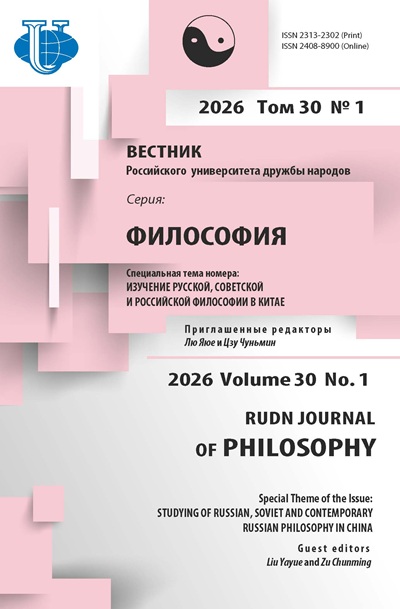
Vol 30, No 1 (2026): STUDYING OF RUSSIAN, SOVIET AND CONTEMPORARY RUSSIAN PHILOSOPHY IN CHINA
- Year: 2026
- Articles: 23
- URL: https://journals.rudn.ru/philosophy/issue/view/2065
- DOI: https://doi.org/10.22363/2313-2302-2026-30-1
Full Issue

STUDYING OF RUSSIAN, SOVIET AND CONTEMPORARY RUSSIAN PHILOSOPHY IN CHINA
Features of the Reception of Russian Philosophy in China: Slavophiles and Religious Thinkers in the Contemporary Transcultural Discourse
Abstract
The work is devoted to the study of the methodology of research by Chinese specialists of the foundations and specifics of Russian philosophy, especially the issues of Russian religious philosophy, which allow Chinese colleagues to identify the uniqueness of Russian culture and the peculiarities of the national mentality. The purpose of the study is to identify the specifics of the Chinese reception of Russian religious philosophy as a form of transcultural dialogue, in which its holistic spiritual view is considered as a heuristic resource for a critical analysis of the problems of the world’s modernization and the search for solutions that lie outside the paradigm of purely rational Western thinking. The study also covers the institutional and substantive aspects of this reception, which are rooted in the recognition of the spiritual value and philosophical originality of the Russian Orthodox religious tradition. The paper shows that the study of Russian religious philosophy by Chinese scholars has its own characteristics related to research goals, methods, works, and conferences. The interpretation of the main issues of Russian religious philosophy in the context of China’s spiritual culture (such as the idea of conciliarity, all-unity, integral knowledge, the Russian idea, etc.) deserves attention. It is worth noting that Chinese experts believe that studying Russian religious philosophy not only provides a better understanding of the Russian civilizational code, but also helps Chinese people to recognize the commonality of the political and socio-cultural development of the two countries, as well as to better comprehend their own history. Studying Russian religious philosophy provides a deeper understanding of Western philosophy and a “key” for its competent criticism based on different worldviews. Translations of the works of Russian religious thinkers (primarily N.A. Berdyaev, V.S. Solovyov, the slavophiles, and others) are used to analyze Orthodoxy as a foreign cultural element in China’s spiritual culture. The paper provides some examples of how Chinese scholars have adopted Russian religious philosophy. The results of the study can be used in the preparation of lectures on the history of Russian and foreign philosophy. The scientific novelty of the work lies in the comprehensive analysis and study of the above-mentioned concepts based on the works of Chinese scholars from the 1990-s to 2025.
 9-31
9-31


Study of Soviet and Russian Philosophy of Science and Technology in China
Abstract
Chinese research on the philosophy of science and technology in Russia (and the Soviet Union) has gone through three stages: 1) “taking the Soviet Union as its teacher”; 2) “viewing the Soviet Union as an enemy”; 3) “using Russia as a reference”. After the collapse of the USSR, research fell silent for a while, but in recent years there has been a trend towards their revival. In the 1960s, a group of reform-minded philosophers proposed a very instructive interpretation of the philosophy of science centered on epistemological centrism. At the beginning of the 21st century, new development trends appeared in Russian philosophy of science and technology, such as pluralism, the theory of sociocultural context and humanism, while a philosophical paradigm of science and technology with Russian specifics was formed, especially the turn in technological philosophy. In China, Russian-Soviet philosophical research of science and technology developed over decades, resulting in the formation of three generations of academic leaders in the person of Gong Yuzhi, Sun Mutyan and Wan Changsun. The main result of their work was a trilogy of works, which is based on “Traces of History”, “Mind in Search” and “Search at a Fork in the Road”. The trilogy shows how the philosophy of science and technology in Russia completed the role change under the guidance of Marxist philosophy and gradually moved to the research path of combining internationalization and localization, while facing the need to solve the problem of marginalization of disciplines and theoretical innovations.
32-46
Russian Nihilism and Chinese Thought: The Experience of Integration in the Context of Tradition
Abstract
The exploration of nihilism in the context of traditional values concept formation concept in Russia and China is currently very relevant both because of the socio-cultural challenges facing both civilizations, and in connection with their foreign policy environment, the processes of globalization and polarization. Nihilism as a worldview paradigm arises in an era of crises, but despite the fact, that the political situation in the world may well be understood as a systemic crisis, the scientific community still does not pay due attention to the issues of modern nihilism as an element of intercultural communication. The authors aim to trace the mechanisms of Russian nihilism’s reception by Chinese thought and its unique integration into the socio-cultural environment of traditional society. The use of interpreting method of nihilism phenomenon through the Russian philosophy prism allows us to identify the essential features of its genesis, spiritual foundations, and axiological meanings. The comparative method, which includes both conceptual and historical-philosophical analysis, allows for a comprehensive theoretical coverage of the phenomenon of nihilism and the related concept of "nothing" within the traditions of Chinese and Russian thought. This perspective is necessary due to the unobviousness of the mutually exclusive presence of nihilism and traditional values within the framework of a same worldview situation. The authors conclude that if Russian philosophy understand nihilism as a radical denial of spiritual values, which are recognized as traditional, and therefore seeks to overcome it, then the situation in Chinese philosophy, which does not make a strict differentiation of ideal and material, unlike Western philosophy. It makes it possible to integrate the nihilistic project into the traditional value system, which corresponds to the principle of harmony of opposites and is reflected in Chinese religious and philosophical doctrines. However, the concept of “nothing” itself should be understood in the traditional Taoist, Confucian or Buddhist way, which will allow us to speak about specifically Chinese nihilism, regarding which Western European nihilism, adopted at the beginning of the 20th century through the influence of Russian thought, is an anti-traditional and destructive phenomenon. Thus, both Chinese traditional philosophy and Russian philosophy, appealing to spiritual values and the principle of all-humanity, are developing a way to overcome the type of nihilism that is characteristic of Western European thought. This method is based on an understanding of the continuity and organic fusion of tradition and modernity.
47-62
Some Difficulties of Perception of Russian Philosophy in China
Abstract
For the first time in the research literature, the problems that hinder the correct understanding of Russian philosophy of the 19th and early 20th centuries by Chinese researchers are examined. Attention is drawn to the lack of serious grounds for believing the beginning of Russian philosophy earlier than the 18th century. The reasons why Chinese researchers accept the false interpretation of the religiosity of Russian philosophy as accurately following the teachings of the Orthodox Church are analyzed. In reality, Russian thinkers recognized traditional church Christianity as a false, distorted form of the teachings of Jesus Christ and expected a radical spiritual coup that would replace it with true Christianity, revived by the true teachings of Christ. The too formal and sharp opposition of Westernism and Slavophilism in Chinese literature is criticized; the opposition of these directions must be recognized as conditional and therefore not very fruitful for assessing the ideas of the most complex and original thinkers. Contrary to the opinion of Chinese historians of Russian philosophy that the “Russian idea” means an absolute denial of the significance of Western culture and Western philosophy for Russia and its historical development, it is proved that the most accurate expression of the “Russian idea” was given by Dostoevsky, and it is associated with the recognition of Russia as the only true heiress of the great culture created by Europe. The historical destiny of Russia lies in the creative and original development of European culture, while we must deny only a new, liberal Europe, which itself renounced the cultural traditions of old Europe. It was concluded that the correct interpretation of Russian philosophy of the 19th - early 20th centuries should be based on the discretion of its dependence on European philosophy and, in particular, on German philosophy of the early 19th century. In contrast to the prevailing point of view, it is shown that Russian culture should be perceived in unity with traditional European culture; the goal of cultural interaction between Russia and China should be China’s adoption of this universal model of culture for the more fruitful development of its own national traditions.
63-80
Gender Dimension of Social Justice Theories in Russian Philosophy: An Analysis of Applicability in the Chinese Context
Abstract
The research is devoted to the analysis of Russian theories of social justice with a focus on their gender dimensions and on assessing the possibilities of their application in the contemporary context, including Chinese philosophical discourse. The relevance of the research is determined, on the one hand, by the crisis of liberal models of justice and the growing interest in the spiritual and moral foundations of social order, and, on the other hand, by the development of gender studies, which reveal the patriarchal presuppositions of classical theories. The methodological basis of the research is formed by the principles of comparative philosophy, historical-philosophical and conceptual analysis, as well as feminist critique, including the critique of androcentrism. The study examines the ideas of the Slavophiles, the philosophy of all-unity of V.S. Soloviev, secular concepts of justice, and the ideas of modern Russian philosophers, as well as the works of Chinese researchers analyzing conciliarity, Sophia, the Eternal Feminine, and the “Russian idea.” It is shown that the Russian tradition forms an original spiritual and moral understanding of social justice based on the ideas of love, solidarity, responsibility and the limited use of force, while at the same time reproducing patriarchal models of gender roles and marginalising women’s experience by refusing to understand it in terms of justice. It is revealed that in Chinese reception these concepts are interpreted as a spiritually collectivist project of justice alternative to liberal individualism, while their gender presuppositions become the object of critical re-interpretation. The article substantiates the interpretation of Russian theories of justice as a valuable historical and philosophical resource which, under the conditions of intercultural dialogue and gender-sensitive critique, can be creatively adapted for discussing social, including gender, justice in contemporary China. The novelty of the research lies in combining a gender analysis of Russian philosophy of justice with an examination of its Chinese reception, which makes it possible to go beyond the usual “West - Russia” dichotomy and to inscribe the Russian tradition into a three-sided dialogue “West - Russia - China”. The research clarifies the place of the Russian philosophical tradition in global debates on justice and demonstrates the heuristic potential of its gender-sensitive and intercultural interpretation.
81-97
Three Paradigm Shifts in the Study of the History of Russian Philosophy in Contemporary China
Abstract
This work examines three paradigm shifts in contemporary Chinese studies of Russian philosophy. The first shift in the scientific paradigm took place in the context of “from Marxism to Orthodoxy”. From a Marxist point of view, Russian philosophy in contemporary Chinese science is studied by Professors Jia Zelin and An Qinian. Their attention is mainly focused on Russian philosophy of the Soviet period. At the same time, Professors Xu Fenglin and Zhang Baichun, who are also considered outstanding Chinese researchers of Russian philosophy, prefer to approach Russian philosophy from the perspective of Orthodox Christianity. Professor Zhang Baichun’s research on Khoruzhiy’s philosophical asceticism has broadened our understanding of practical philosophy in Russian Orthodoxy by establishing the philosophical paradigm of “synergetic anthropology”. The second paradigm shift can be characterised by the words “from Orthodoxy to religious philosophy”. The interest of Chinese scholars in Orthodox paradigms has spread to the field of religious philosophy. Xu Fenglin and Zhang Baichun, while researching Orthodoxy, also studied Russian religious philosophy. In recent years, young Chinese scholars engaged in the study of Russian philosophy have been paying increasing attention to contemporary Russian philosophers, one of whom is Professor I.I. Evlampiev. Professor I.I. Evlampiev characterised Russian philosophy as a search for ‘true Christianity’. The third paradigm shift is associated with the transition ‘from religious philosophy to political philosophy’. For example, Chinese scholars have been translating and researching the works of Ivan Ilyin for twenty years. In recent years, under the influence of the contemporary Russian philosopher Alexander Dugin, a significant amount of research on Russian Eurasianism has also appeared in China. According to Chinese scholars, the successes of Russian political philosophy are directly linked to its ancient origins. Therefore, the field of classical studies is also directly linked to the study of Russian philosophy, and Chinese scholars hope to expand cooperation with Russian specialists in this area.
98-112
Study of the Philosophical Legacy of S.S. Khoruzhy in China
Abstract
Research examines the development and reception of the philosophical legacy of Sergei Sergeevich Khoruzhy Khoruzhy (1941-2020) in China, including in the context of an international academic conference held in Haikou, China, commemorating the fifth anniversary of the philosopher’s passing. The conference featured engaging presentations and scholarly discussions organized around the following key thematic sections: 1) overall assessment and future prospects of Khoruzhy’s philosophical work; 2) Khoruzhy’s research in the history of Russian philosophy; 3) the study of spiritual tradition within the framework of hesychast anthropology; 4) synergic anthropology and its applied aspects; and 5) comparative analysis of Khoruzhy’s ideas and other philosophical concepts. The scholarly discussions presented here reflect the process of reception and interpretation of Khoruzhy’s teachings within the Chinese academic community. The influence of Khoruzhy’s ideas has long extended beyond scholars specializing in Russian philosophy, gaining global reach and, in particular, finding substantive continuation and creative development in China thanks to the creative efforts of Professor Zhang Baichunand his colleagues.
113-126
HISTORY OF PHILOSOPHY
The Reception of F.W.J. Schelling’s Philosophy in the Later Work of A.F. Losev
Abstract
The issue delivers an analysis of schellingian motives in the later works by A.F. Losev. The author brings information about Losev’s retrospective evaluation of Schelling’s influence on the formation of his own philosophical approach, it’s specific character and it’s grade. The author shows that all the main investigation projects of the later Losev which have been realized during several decades of systematic studies have their ground in the same conceptual model which bears from Schelling’s idea of potencies as various form of quantitative difference between opposite factors. Losev refers to Schelling both explicitly in his commentaries on the history of philosophy and implicitly in his attempts to clear and to elaborate Schelling’s dialectical concepts. In his monumental project of his “History of the ancient aesthestics” Losev uses Schellings theory of potencies as the main instrument for the conceptualizing ancient Greek culture with it’s emphasis on the real and the corporal. In the context of his sigh theory it makes him able to draw an integral theory of verbal and plastic expression which synthesizes the most imporrtant innovations of semiotics, structural linguistics and information theory. In his studies on the European aesthetics it delivers him a matrix for his typology of styles in the art history. Schelling’s method of potencies is for Losev both a mean of hermeneutics and a conceptual tool for the elaboration of the system of categories of culture. The key reference in both contexts is Schelling’s theory of symbol. Thea author proves his hypothesis throgh the intertextual analysis of Losev’s works from 1970-1980s published in his life time and posthumously. Manifold parallelisms in these texts without any explicit cross references build a specific connection of meanings which make it possible to reveal a religious metaphysical background of the scientific language of Losev’s later works. The study creates precinditions for the more differentiated understanding of the discursive strategy of the later Losev and demonstrates their consistency and continuity in regard on the earlier works from 1920s.
127-143
Leibniz’s Monadology, African Communalism, and the Quest for Social Order in Africa
Abstract
This paper examines Leibniz’s monadology and the problems it poses for social order in Africa. Leibniz describes monads as self-sufficient, self-contained, perfect, independent, and individualistic entities. The monads, in Leibniz’s words, are windowless. As such, there is no relationship or communication among them. Consequently, a lack of cordial relationships, communication, unity, and cooperation in contemporary societies is responsible for many of the problems and disorders that ravage many African societies, especially Nigeria. Various issues, including terrorism, kidnapping, corruption, rape, and ritual killings, plague many societies across the continent. The main source of these problems stems from the monads’ perspective on society. These acts are perpetuated by narcissistic and egocentric individuals who fail to recognise the necessity for coexistence and cooperation, thus creating a socially disordered and disorganised environment that undermines humans’ hopes, aspirations, and desires to lead a good, meaningful, and fulfilled life. Consequently, a disordered society, characterised by violence, conflict, and similar challenges, results in underdevelopment, injustice, intolerance, and crises, among other issues. Social disorder thrives in a society that trivialises interrelationships, intersubjectivity, collectivity, solidarity, mutuality, cooperation, and inclusiveness among its people. The study, therefore, contends that the continuation of monadic existence among Africans amounts to an inevitable social disorder. The paper concludes by emphasising the necessity to embrace the communalistic values and virtues of traditional African society, where the self and the other are fused ontologically, epistemically, socially, and morally, to foster social order and development in Africa.
144-158
Literary Nationalism in Central Asia: The Role of Soviet Uzbek Writers in the Creation of Post-Soviet National Identity of Uzbekistan
Abstract
The research examines the issue of literary nationalism in Central Asia through the case of Uzbekistan. Employing a constructivist approach, authors analyze how the Uzbek SSR’s writers influenced the formation of a post-Soviet canon of Uzbek national heroes, thereby establishing the continuity between different forms of nationalism. The research traces the development of Uzbek national self-consciousness from the late 19th century, when the Jadid movement sought to modernize the educational system in Turkestan. The driving force of nation-building in Uzbekistan became the Soviet nationalities policy, whose primary objective was the consolidation of a vast number of premodern communities along a single - namely, national - criterion to successfully implement the overarching state project of industrialization. In particular, the research addresses the impact of the primordialization of national identities in the 1930s on Soviet citizens’ perceptions of their national self-identification and identifies the main challenges encountered by the nation-building project in the Uzbek SSR. In the socio-cultural and historical context, the research elucidates the role played by the three major Uzbek writers in the development of national self-consciousness within their republic, providing, in broad terms, the biographical information necessary for understanding the topic. The primary focus is placed on an analysis of three novels - “The Treasures of Ulughbeg” , “Navoi” , and “Starry Nights” - devoted to the late medieval history of Uzbekistan. According to the authors, it was in these such works that writers popularized specific historical figures who would become cultural pillars of nationalism in Uzbekistan after the USSR collapse.
159-176
Philippa Foot on Hypothetical and Categorical Imperatives
Abstract
Philippa Foot entered the history of 20th-century academic ethics primarily as the author of the article “The Problem of Abortion and the Doctrine of Double Effect” (1967), in which she first introduced the “trolley problem” - a thought experiment that has been frequently used to justify various moral intuitions ever since. However, other works by Foot are also well-known in the British-American philosophy. This article examines two earlier works by the British philosopher, “In Defense of the Hypothetical Imperative” (1971) and “Morality as a System of Hypothetical Imperatives” (1972). In these works, Foot addresses a large number of quite diverse issues, but her main line of reasoning is a critique of Immanuel Kant’s doctrine of categorical and hypothetical imperatives and is aimed at debunking of this dichotomy. This article highlights the most significant theses put forward by Foot and reproduces her key arguments. On the basis of everyday language the British philosopher compares hypothetical imperatives and categorical imperatives with the imperatives of etiquette and morality, respectively, and seeks to show that the requirements of etiquette have the force of a non-hypothetical imperative in some situations. On the other hand, Foot questions the extent to which our perception of moral imperatives as categorical imperatives, i.e., those that we must follow regardless of our interests and desires, is justified. She also addresses the issue of the connection between moral beliefs and moral motivation, putting the necessity of this connection into question. This article critically analyzes Foot’s main line of reasoning, challenging the validity of several arguments and indicating the necessity to clarify certain positions as well as demonstrating that Foot’s criticism of Kant misses its goals in many respects.
177-188
KANT AND NEO-KANTIANISM
The Adjustment That Didn’t Happen: The Duty to Promote the Happiness of Others in Kant’s System of Ethics
Abstract
Labouring upon the groundwork of “critical” ethics, Kant opposed its principle, the categorical imperative, to the principles of naturalistic morals, and, among others, to the principle of personal happiness. But in the system of concrete ethics in the Metaphysics of Morals the “happiness of others” emerged in the basis of this system, as one of the two objectively practical “ends-duties”. In this regard, historians of thought often claim that in his old age Kant made eudaimonistic “adjustments” to his ethics. Our paper aims to find out, by means of an analysis of the concept of happiness in Kant’s practical philosophy as well as of Kant’s arguments against the moral theory of Eudaimonism, whether there really is a contradiction between the principles of moral philosophy as laid down in the Groundwork of the Metaphysics of Morals and the principle of promoting the happiness of another / others, as one of the basic ethical principles in the “Metaphysics of Morals”. Such a contradiction turns out to be in fact nonexistent: The Groundwork considers promoting the well-being of others as a typical case of a specific class of ethical norms; the Critique of Practical Reason, the reflections of which complete the justification of Kant’s ethical doctrine, recognizes that the principle of happiness can become an objective practical law, if it is complemented by the happiness of others. At the same time, however, it remained unclarified how it is possible to affirm and justify the ethical principle of promoting the happiness of others in the context of a doctrine that invariably rejects the naturalistic grounding of morality on the feeling of pleasure from the reality of the object of the will. Although our examination of Kant’s texts shows that the principle of promoting the good of one’s fellowman was already formulated in his ethical groundworks as legitimate within the system of practical philosophy, the question of possible ways to justify it within this system remains nevertheless open. Our hypothesis in this regard is that, the extension of the principle of happiness indicated by Kant, the ground of determination in the maxim of the person obeying to it is not the concept of an empirically determined object of one’s demand, but the concept of another human being in need, or humanity in the person of the other human being. The principle remains the same, but its basis, which was in individualistic eudaemonism empirical, becomes transcendental.
189-206
The Axiological Foundations of the Social in the Philosophy of P.I. Novgorodtsev
Abstract
The specific feature of P.I. Novgorodtsev’s philosophy of law is that it advocates the fundamental role of society along with the absolute value of the individual. However, the value side of social life is not always specifically thematized by him, although it logically follows from his general axiological attitudes. The social in the doctrine of russian philosopher receives a specific value meaning: firstly, society is a field of interaction between autonomous individuals, secondly, the prerequisites for the formation of society are laid in the absolute value of the individual, thirdly, the social is a collective carrier of social values. The axiology of the social forms important consequences in the understanding of social unities, such as the nation and the state. The combination of the supranational ideal and national values proves to be the basis for Novgorodtsev’s balanced conception of the relation between the individual and the social.
207-217
Adolf Trendelenburg on an Early Writing by Hermann Cohen
Abstract
Friedrich Adolf Trendelenburg (1802-1872) wrote a testimony in 1865 for a student prize essay by Hermann Cohen (1842-1918), who later became the founder of the Marburg School in philosophy. The topic was: “How philosophers have defined and executed chance and the accidental.” The prize essay, framed by a motto from Kant’s Critique of Pure Reason, was written in the first half of 1865 in Berlin. It has been lost but served as the basis for Cohen’s dissertation, with which he received his doctorate in Halle in the autumn of the same year. However, there he confines himself to a specific area of his subject: antiquity. Trendelenburg’s testimony is the only source on Cohen’s much broader studies regarding the question of chance. It reports significant discussions, e.g., on Democritus, Spinoza, and Kant’s fourth antinomy.
218-226
Some Aspects of Application of Leon Petrażycki’s Socio-Philosophical Ideas in the Field of Legal Education
Abstract
The relevance of the research is determined by the need to find solid foundations rooted in Russian intellectual culture for organizing a system of legal education that would meet the internal needs of Russians. To this end, the key provisions of Leon Petrażycki’s Legal Policy (Civilpolitik) are evaluated by methods of a critical interpretation of sources and comparative analysis. Petrażycki is the founder of Russian legal realism, a striking phenomenon of world legal thought in the late 19th and first half of the 20th centuries, which had a significant impact on the philosophy and sociology of law in Europe and the United States. In particular, it is showed that for Petrażycki’s Legal Policy legal education is not only a tool for ensuring the stability of society and the connectivity of individuals within a social group and between different social groups, but also represents an objective process of legal norms’ impact on the collective and individual psyche, which results in legal reality. It models how the Legal Policy axioms of love and moral progress, as well as the methods of legal deduction and induction can be applied for improvement of legal education today. At the same time, the shortcomings of Legal Policy are revealed and ways of correcting them are proposed by referring to the ideas of followers of Petrażycki - Pitirim Sorokin and Boris Vysheslavtsev. Thus, it is shown that Petrażycki’s legal pedagogy, which does not take into account the significant motivational impact of unconscious psyche contents on the behavior of individuals and the masses, can be supplemented by Vysheslavtsev’s Psychagogy, which considers these factors. In addition, it substantiates why Psychagogy has a good heuristic potential for solving the main task of Legal Policy - the improving current legislation. It is demonstrated that the methods of empirical verification of the effectiveness of legal education proposed by Petrażycki, which have desperately found their way into the practice of law enforcement monitoring in the Russian Federation, can be specified and supplemented by applying the six criteria of the moral and legal thermometer proposed by Sorokin.
227-242
SOCIAL PHILOSOPHY
The Impact of Digital Transformation on Human Religious Life and Its Critique from the Perspective of Orthodox Anthropology
Abstract
The author examines the main trends in the digitalization of religion, focusing on the processes that occur within Christianity. The article emphasizes that with the onset of the process of modernization and secularization in the 19th century, the Christian Church faced the issue of finding forms of existence in the new reality. Today, this task is still relevant and is aimed at finding the “golden mean”, that is, a solution in which it is possible to preserve the fundamental principles of Christianity without abandoning the achievements of scientific and technological progress. The author notes that the complexity of the task lies in the fact that the digitalization process is built on a special algorithmic type of thinking and a rationalistic coding language, which is opposed to a religious type of thinking with super-rational and spiritual elements. At the same time, the article analyzes how the introduction of digital technologies into religious life can transform the essential characteristics of not only the Church, but also a person. The author emphasizes that the anthropological risks of the current stage are associated precisely with an attempt to minimize the sacred element in religious life. Modern digitalization not only changes technologies, but also restructures anthropological and socio-cultural contexts. This position is substantiated in the article using criticism of information and digital progress from Orthodox anthropology. The emphasis is on the views of Sergey Horujy and Metropolitan John (Zizioulas), as well as modern theologians, sociologists of religion and church leaders. At the same time, the key risks and challenges of digital transformation are described. The author examines them in the framework of anthropological degradation, through the loss of the spiritual dimension by man and the destruction of deep aspects of human freedom and unity of personality.
243-253
Globalized Class Struggles: A Marxist Approach to Contemporary Geopolitics
Abstract
In this paper, I argue that Marxism offers the most appropriate paradigm for analysing and shaping contemporary geopolitics. The advantage of a Marxist approach is that it goes beyond merely descriptive analysis and can suggest and achieve long-term, effective solutions to the problems considered. I start by highlighting the adequacy of the Marxist paradigm for addressing the challenges of geopolitics and International Relations (IR), and I critically discuss two misinterpretations of Marxist theory: the claim that it neglects either the national or the international level. Then, I proceed to introduce the conception of Globalized Class Struggles (GCS). Against the view that takes class struggle (in singular) to refer only to the struggle between the bourgeoisie and the proletariat, I maintain that class struggles (in plural) are not reducible to that essential form, and that they include a wide range of further multisided confrontations between various antagonist actors. After pointing out what can be considered as the economic foundation of (GCS), I identify the main involved classes on the basis of the centre / periphery dichotomy, and I briefly illustrate the usefulness of (GCS) through selected examples. Further, I examine the Marxist principle of Proletarian Internationalism (PI) by developing an interpretation of it as grounded in the dialectic between the local and the global levels. Indeed, I claim that such an understanding of (PI) can appropriately address both intrastate and interstate geopolitical challenges. The analysis finally focuses on the normative potential of Marxism in general and (PI) in particular. The suggested Marxist approach to contemporary geopolitics is, admittedly, on the side of the working classes worldwide, especially in the peripheries, where they are engaged in fierce anti-imperialist struggles.
254-267
ONTOLOGY AND EPISTEMOLOGY
Conceptual Origins of the Transhumanist Paradigm in the Alchemical Tradition
Abstract
This work analyzes alchemical doctrine through the lens of ideas that correlate with the theoretical constructs of transhumanism. It is shown that alchemy, a complex and contradictory cultural phenomenon that existed in various civilizations over long periods of their historical and cultural development, currently occupies a unique niche in the heritage of philosophy, chemistry, and natural science in general. The activities of a small circle of initiates striving to master “perfect knowledge” were focused on the holistic study of the entire diversity of the surrounding world: from phenomena of cosmic and biological scale to the study of the composition of inorganic matter, understanding the causes of disease, and finding ways to treat them. A deeper dive into alchemical sources reveals that the human desire to modify the surrounding world and oneself, one’s biological nature as a controlled process, has very deep historical roots. For centuries, the primary focus and cherished goal of alchemists was to bring about fundamental qualitative changes within a body or object (either inanimate or animate), its “rebirth” and transition to a new, more perfect level. From the author’s perspective, the ideological and conceptual legacy of previous eras, with its focus on understanding the laws of the universe, uncovering the secrets of life’s origins, and solving problems of human perfection, life extension, immortality, and so on, has not yet been exhausted. The alchemical tradition, an integral part of the spiritual and material history of humanity, represents an important, yet not fully understood and not fully overcome, legacy of the past, a worldview doctrine that retains its heuristic potential to this day. The study emphasizes that in the current complex and conflict-ridden historical situation, humanity, having begun to widely and actively utilize the fruits of convergent technologies, is rather carelessly immersing itself in the grip of technocratic thinking, not fully realizing the sociocultural consequences. Transhumanism, being the conceptual successor of alchemy and drawing its inspiration from contemporary creative and constructive activity, is the most radical project of postmodernism, oriented towards mastering “perfect knowledge” and concentrating all-encompassing power over nature and man in the hands of those who succeed in mastering this knowledge.
268-282
Technological Singularity: A Nuanced and Contextual Approach to Potential Scenarios
Abstract
In this text it is discussed the concept of Technological Singularity. This concept, which is understood in the academic literature as a hypothetical scenario in which AI becomes uncontrollable, is one of the most recurrent subjects in Philosophy of Technology. While the majority of approaches to Technological Singularity are characterized by dualistic portrayals of such a scenario, this study’s novelty lies in the fact that it presents an alternative to such dualistic portrayals. In contrast to the often presented as binary scenarios between an utopian paradise and a dystopian nightmare, this text introduces a different hypothesis. Precisely, the main hypothesis presented in this text is that the Technological Singularity, if ever becomes a reality, must not be understood in such a dualistic manner. Instead, this study explores the possibility of middle-term scenarios that take into consideration nuanced approaches in different contexts. By doing this, the discussion covers various dualistic scenarios, and suggests middle-term possibilities that bridge the gap between these dualistic extremes while presenting the possibility of a Singularity characterized by contextual intelligence. According to this study, this would be a more efficient scenario. The reason behind such efficiency lies in the fact that a Technological Singularity characterized by contextual intelligence would better achieve its goals, by being aware of the context in which it takes place. This reasoning remains speculative, and based on literature review and logic reasoning. This is the consequence of the fact that the idea of a Technological Singularity is speculative in its nature, and therefore cannot be tested empirically yet.
283-292
The Problems of Consciousness in the Studies of M.K. Mamardashvili and A.M. Pyatigorsky
Abstract
The research devoted to the studies of Merab Mamardashvili and Alexander Pyatigorsky, their philosophical approaches to understanding consciousness. M.K. Mamardashvili and A.M. Pyatigorsky first presented the “metatheory of consciousness” in the joint work “Symbol and consciousness” (completed in 1974, published in 1982). The basics of their “metatheory” are the description of the “structure of consciousness” and the search for “universal synthesizing category”. Mamardashvili and Pyatigorsky saw in consciousness universal combination of content and form, sought to substantiate consciousness as sphere of symbols and interpretations. They called the general direction of their research work “symbology” and believed that different symbol systems are formed in the process of understanding. The book “Symbol and consciousness” became the basis for further researches by Mamardashvili and Pyatigorsky. Mamardashvili preferred to focus on the relationship between consciousness and individual self, relying on Western European tradition of philosophy. In “Cartesian meditations”and “Lectures on Proust”, he developed the concept of consciousness, moving from the “metatheory of consciousness” to “real psychology”, by which he understood concrete consciousness turned to the phenomena of life. Pyatigorsky chose different research way: on the basis of “metatheory of consciousness” he developed “observational philosophy”, substantiated the concepts of “observer” and “observation”. For Pyatigorsky, observation process is impersonal, and external observer is the structure of consciousness and the object of observed thinking. Pyatigorsky created “observational philosophy”, combining phenomenology and Buddhist theory of consciousness. Mamardashvili did not abandon personality as metaphysical center of cognition and continued to develop philosophical tradition coming from R. Descartes.
293-307
Background Knowledge: Does it Exist?
Abstract
Philosophy, traditionally focused on rational thinking, encounters a paradox when analyzing background knowledge - unarticulated, implicit cognitive experience that governs explicit knowledge. The article explores how philosophy, as a second-order reflection, approaches a phenomenon that by definition remains beyond conscious awareness. It briefly examines classical concepts of knowledge (positivism, analytic philosophy) and their crisis in the 20th century, which led to an inclusive redefinition of the notion of knowledge. The focus is on Michael Polanyi’s theory of tacit knowledge, divided into practical (“know-how”) and conceptual dimensions. The study demonstrates that background knowledge serves as a key explanatory resource in the social sciences and humanities, replacing natural science’s causal models with genetic retrospections. However, its ontological status remains problematic: being non-reflective, it retains the features of a “round square” - existing as a cause of explicit knowledge while denying its own cognizability. The author reveals contradictions between the non-alternative nature of background knowledge and the necessity of its critical evaluation. Through the lens of the metaphysics of grounding, background knowledge is interpreted as a historically conditioned foundation of cognitive experience, whose compelling force is revealed only retrospectively. The article proposes an approach linking epistemology with historical ontology, where background knowledge exists as “past-in-the-present,” mediated by collective reflection. This approach responds to philosophy’s aspiration to overcome the gap between rational critique and the unarticulated foundations of knowledge.
308-320
The Ontology of Education in Relation to the Metaphysical Aspect of Human Existence
Abstract
The research examines the issues related to determining a strategy for the development of university education in the present and in the future. Based on the concepts of contemporary philosopher Bill Readings, the problem of the mission and idea of the modern university is discussed. In this regard, the main stages of historical development of the university education system and the university ideas relevant to each stage are given. The particular attention is paid to the role of humanities education in its structure. It is shown that teaching is now becoming increasingly important not only and not primarily for the purpose of imparting the “ready-made” knowledge, but primarily to encourage the students to think deeply and independently, while developing the ability to apply the knowledge gained in a broadly understood practical context. Another important issue is the relations between the humanities knowledge, particularly philosophical knowledge, and the real cultural requirements for it. This article presents a conception of the German philosopher Max Scheler that actualizes the principles of connection between the historically emerged forms of knowledge and education. This concept helps clarify the situation of educational development in the realities of contemporary culture and its prospects. In this context, the very idea of modernity is analyzed that, as shown, is related to the idea of relevance. Modernity is not a property of some general abstract chronology; it lies in the interaction of various independent attitudes and mutually influencing activities. The contemporary practices shall retain their original heterogeneity, conditioned both by the time of their origin and by the planes of existence implied. The myth of modernity encompasses the concepts of multi-temporality and multiple localities. Particular attention is given to the metaphysical aspect of human existence that contributes to the establishment of a person’s essential attitude to the true foundation of things in its connection with education and the humanization process of human existence, cognition, and the world.
321-334
SCHOLARLY LIFE
335-339