





Russian Language Studies
Editor-in-Chief: Viktor M. Shaklein, Doctor of Philology, Professor.
ISSN: 2618-8163 (Print) ISSN: 2618-8171 (Online)
Founded in 2003. Publication frequency: quarterly.
Open Access: Open Access.  APC: no article processing charge.
Peer-Review: double blind. Publication language: Russian, English
PUBLISHER: Peoples’ Friendship University of Russia named after Patrice Lumumba (RUDN University)
See the Journal History to get information on previous journal titles.
Indexation: White List RCSI, Russian Index of Science Citation, Scopus, ANVUR, Google Scholar, Ulrich's Periodicals Directory, Dimensions, DOAJ
The journal “Russian Language Studies” is specialized in actual problems of the Russian language and methods of teaching Russian as a foreign, non-native, and native language under the conditions of Russian, closely related and unrelated linguistic environment.
The journal presents a platform for Russian and foreign scientists, reflects not only linguistic, but also cultural, historical, social aspects of learning and teaching Russian.
The mission of the journal is to give the opportunity to specialists in Russian philology from different countries and regions to objectively inform international scientific community about modern research in the Russian language, its functioning in the multipolar world and to draw the scientific attention to these problems.
The aim of the journal is to create scientific, research, educational and information space for presenting the achievements of Russian and foreign scientists in Russian language studies and methods of teaching Russian as a foreign language.
The targets of the journal are:
- Delivering the achievements of Russian and foreign scientists in Russian language studies, publishing the results of scientific centres in developing and keeping the Russian language in the multipolar world;
- Characterizing theoretical papers on Russian language functioning in Russia and abroad;
- Pointing out the problems in methods of teaching Russian as a foreign, non-native, and native language;
- Analyzing modern trends in Russian language teaching at school and university;
- Reflecting problems of learning and teaching Russian as a foreign language and keeping the Russian language in diasporas;
- Problems of developing Russian as a language of science;
- Presenting Russian national policy in the Russian language and methods of its teaching;
- Demonstrating media-didactic and electronic means of teaching Russian.
Next issues of the journal are planned as thematic ones and are devoted to the most actual problems of Russian language studies. Thematic issues are announced at the journal site.
The journal publishes scientific articles (theoretical, academic and research, methodical), review articles, book reviews, annotations, scientific reports about Russian and foreign scientists.
The journal publishes only original articles that have not been published before. Self-plagiarism is not allowed.
The journal has an international status proved by the editorial board and reviewers including outstanding scientists from Russia, the United States, Belarus, Spain, Italy, Latvia, Finland, Germany, Great Britain.
The journal is published every three months with 4 issues a year.
Electronic versions of issues of the journal are available on the site in the open access.
Announcements More Announcements...
Dear colleagues,Posted: 15.06.2021
Please use APA style in References. You can find the specific rules of formatting references in a special section «Formatting a Reference List». We kindly ask you to follow the rules of formatting references. |
|
|
Dear authors!Posted: 23.12.2020
We are planning to devote one of our issues of 2021 to the topic «The Russian language in the world wide web». Paper submission deadline: February, 1, 2021. |
|
|
Dear readers,Posted: 04.12.2020
An important event occurred in the life of our journal.After the expert evaluation "Russian Language Studies" is included in the international database SCOPUS. Scopus is expected to reflect the journal's content (starting with the articles from the 2019 issues) in 2021. |
|
|
Current Issue
Vol 24, No 3 (2026): Lexical and grammatical trends in the modern Russian language
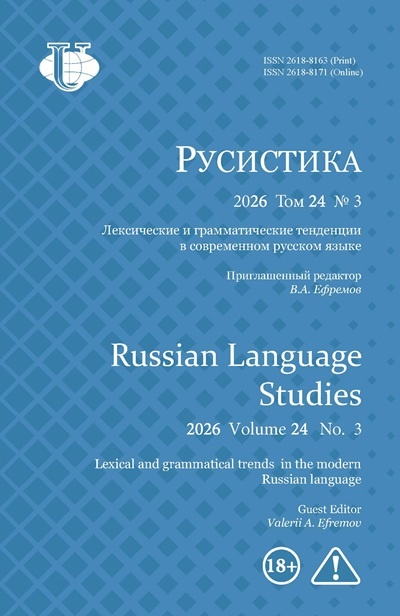
- Year: 2026
- Articles: 9
- URL: https://journals.rudn.ru/russian-language-studies/issue/view/2175
- DOI: https://doi.org/10.22363/2618-8163-2026-24-3
Full Issue

Articles
The derivational potential of Russian verbs in modern internet discourse
Abstract
In modern Russian-speaking internet discourse, affixation remains one of the most productive ways of word formation. Prefixation and suffixation are active in verbal derivation. A frequent verbal derivation is the formation of aspectual pairs. Cases of secondary imperfectivization are also of particular interest. The research attempts to systematize the main word-formation models of verbal derivation in internet discourse and identify current trends in verb formation. The research material was selected from various social media platforms without thematic restrictions. Research methods included content analysis, word-formation, structural-semantic, contextual scientific analysis, and online survey. The study proves that verbal neologisms not only preserve the traditional meanings of prefixes and suffixes established in academic works but also acquire new semantic components due to the specifics of the digital space. The analysis of derivational processes based on the classical system of verbal affix meanings reveals that internet communication adapts traditional morphological models to its current pragmatic tasks: self-expression, emotional emphasis, and phatic and communicative functions in the digital environment. The authors conclude that the rich derivational potential of verbs indicates users’ adaptation to virtual space and demonstrates the flexibility of Russian morphological system. This makes internet communication expressive, creative, and precise. Future research prospects include the analysis of verbs related to artificial intelligence (промптить ‘to prompt’, перегенерить ‘to regenerate’) or the study of age-related characteristics in the use of expressive affixes.
 319-333


Combinations of coordinating conjunctions in modern Russian speech
Abstract
The relevance of the topic stems from the special attention to grammatical semantics in modern linguistics, including the phenomena of the so-called “minor” syntax. The research draws attention to the previously unstudied phenomenon of combining coordinating conjunctions in one row and at providing the first description of four cases of this combination. The study analyses constructions obtained through queries in the Russian National Corpus where 1) the repeating conjunction ни… ни ‘neither … nor’ is followed by the additional conjunction и ‘and’; 2) the same row contains the additional conjunction да и ‘and’; 3) the same row contains the pair of conjunctions но и ‘but at’; 4) the repeating conjunction то ли … то ли … ‘or … or’ is supplemented by the conjunction a ‘but’. We show that all constructions introduce the expletive conjunction to perform additional functions: rhythmic alignment of the phrase (и ‘and’), emphasizing the closedness of the row (in all cases), expressing the speaker’s hesitation (да и ‘and’), adding a concessive or adversative-identifying connotation (но и ‘but and’), and emphasizing the highest point of the gradation scale (а ‘but’). We also confirm that the described constructions have different frequency (the first and the fourth are widespread; the second and third are significantly less frequent), but all of them are particularly relevant in the modern Russian language. Some of them were first recorded only in the 20th century; others have long been known, were not frequent previously, but from the middle of the 20th century demonstrate a noticeable increase in usage.
334-349
Therapy-speak as a form of Russian language medicalization
Abstract
The relevance of the study is determined by the increasing medicalization in modern Russian society caused by the following factors: the COVID-19 pandemic, the spread of “new ethics” and “new emotionality” concepts, and the growing popularity of psychotherapeutic services. The psychological terms entered everyday speech and communication, which gave rise to the phenomenon of психояз ‘therapy-speak’. The study is aimed at analyzing the linguistic nature of therapy-speak as a form of modern Russian language and speech medicalization. The research material includes data from the Russian National Corpus (subcorpus “Social Networks”), the Integrum electronic archive, and the lexicographic resource “New Words in Russian Vocabulary” (ILR RAS). The contexts of the analyzed units were extracted through word and collocation search combined with content analysis elements. The study employs traditional methods of semantic, component, contextual, lexicographic, and partially linguistic-cognitive analysis. The research shows the genesis and evolution of the term психояз ‘therapy-speak’ in the Russian language. The historical continuity of the phenomenon is revealed; the first wave of determinologized psychoanalytic lexis occurred in Russian in 1990s (комплекс ‘complex’, либидо ‘libido’, фрустрация ‘frustration’, нарциссизм ‘narcissism’, etc.). Therapy-speak is qualified as a traditional case of specialized lexis determinologization. The distinction between therapy-speak1 (incorrect use of psychological terms in everyday speech) and therapy-speak2 (metaphorical transfer of psychological terminology to phenomena unrelated to psychology) is introduced and substantiated for the first time. The author proves that “new ethics” is an important factor for psychological lexis actualization.
350-363
Animacy variation in the IT-sphere technical terms in Russian speech: typology, peculiarities, and accompanying processes
Abstract
Based on the vocabulary of the IT sphere, the study examines forms and constructions that are inconsistent in expressing the grammatical category of animacy in modern Russian speech. The relevance of the study is determined by insufficient research in grammatical variants whose differences are manifested only in the accusative case, causes and conditions for such variation in the names of humanoid devices (e.g. создать робот / робота ‘to make a robot’; подключить голосовой помощник / голосового помощника ‘to turn on the voice assistant’). The aim of the study is to identify the features of grammatical variation of technical terms regarding (in)animacy in the 2010s and 2020s, marked by the emergence of new cases of fluctuation in the accusative case. The material includes the Russian National Corpus and the electronic media bank “Integrum”. The author extracted contexts containing nouns with varying accusative case forms, including compound nominations such as робот-водолаз ‘robot-diver’. The methodology of the article includes morphological, semantic, and linguistic-cognitive analysis. The study is the first to present corpus data on the fluctuations in the accusative case of compound nouns whose components express animacy / inanimacy in different ways within the language system. As a result, two types of animacy-related variations, lexical-grammatical and grammatical, have been established; features of variation in technosphere nouns, including compound nouns which nominate human-like programs have been revealed; a hypothesis about (mutual) animacy / inanimacy agreement within compound substantives in the Russian language have been suggested for the first time in scientific literature. The author concludes that the grammatical category of animacy is still forming in the Russian language. The prospects for the research lie in examining the accusative case of new nominations featuring the first component ИИ- ‘AI-’.
364-378
The language of the technosphere in a dynamic aspect
Abstract
Technological development driven by digitalization, artificial intelligence, and state support for engineering education, determines the relevance of the studies of new words and meanings in lexis and phraseology of techno sphere. The aim of this study is to identify functional and pragmatic features of the semantics of words and phraseological units related to the sphere ‘Engineering and Technology’ and developing figurative meanings. The material for the study includes words with the component “техно- ‘techno’” in modern Russian language and the associative semantic field of units in the “Concept for Technological Development of Russia until 2030”. The productivity of this word-formation model creates pragmatically marked language units that are semantically unrelated to the technical terminological system and characterize a person’s emotional and evaluative attitude towards technology and equipment. The author used both traditional methods of word-building and semantic analysis of lexical units and corpus and automated data processing methods. Basing on the text “The Concept of Technological Development of Russia until 2030”, the author shows the connection between the associative semantic field visually represented with a word cloud and the semantic field, demonstrates similarities and differences of the two fields. The associative-semantic field “Technology and technologies” broadens including collocations “technological sovereignty” and “technological leadership”, units reflecting the modernity. Synonymic, antonymic, and paronymic relations within the structure of the associative-semantic field under study are also analyzed. The broad combinability of the lexical units технологический (technological) and технологии (technology), which destructs the original semantics of the words, is described. The set expressions with the adjective технологический (technological) are characterized in a dynamic aspect. The technosphere vocabulary closely interacts with the lexicon of various fields of knowledge, having the strongest ties with the digital field. The study makes some predictions about the future development of technosphere vocabulary, which integrates into various areas of humanities and social sciences. The prospects for the research could be a systemic dictionary description of the technosphere vocabulary.
379-391
Word-building innovations in modern Russian media
Abstract
The research is carried out in line with the current anthropocentric trend in linguistics and studies active word-building processes in modern Russian language. The need to analyze the results of these processes, innovations in mass media texts, predetermines the relevance of this study. The aim of the study is to analyze modern media neologisms in linguocognitive, linguo-pragmatic, and sociocultural aspects. The research material consists of neologisms from the texts of printed and electronic Russian media, television and radio broadcasts of the last decade. The author used descriptive and classification methods, structural-semantic, word-building and contextual analysis. The research demonstrates sociocultural conditionality of productive word-building ways and models, identifies productive traditional and innovative ways of word-building based on proper names, characterizes the functional dynamics of word-building affixes of evaluative neologisms. Social conditionality of word-building innovations manifests itself in their word-building structure: in the semantics of word-building models, affixes and motivating stems characterizing modern social realities. Proper names as bases of derivational processes are of particular importance in socio-cultural and linguo-cognitive aspects. Word-building and contextual means of expressing evaluation in neologisms are characterized in the linguo-pragmatic aspect. The results obtained are important for derivatology, neology, pragmalinguistics, media linguistics, and lexicography.
392-407
Slang markers with positive evaluation: the dynamics of competition
Abstract
The research studies the renewal of evaluative vocabulary with slangisms spreading in the digital environment and for the first time provides a systematic description of new frequent markers of positive evaluation (имба (from imbalanced ‘the best’, кульно (from cool), сасно ‘attractively’). The aim of the study is to identify the mechanisms of grammatical, semantic, pragmatic, and stylistic adoption and competition of new markers of positive evaluation among themselves and with the original круто ‘cool’. The study material included data from the Russian National Corpus, examples from spontaneous speech and online communication, media metric studies, and slang dictionary entries. The material was processed with corpus methods of content analysis and discourse and semantic analysis. The research established that the slang units undergo a full cycle of grammatical adaptation and are semantically differentiated by emotional (aesthetic, hedonistic, and psychological) and rational (utilitarian and teleological) evaluations; reaching the peak in frequency, they lose expressiveness and elevate their stylistic register to the colloquial norm. We show that the competition between slang markers of positive evaluation is functional and semantic and is not driven solely by speech fashion, shifts in cultural codes, and subcultural sources of borrowing. For the first time, slang units are examined systematically; their word-formation potential and specialization by types of evaluation are analyzed; a dynamic model of generation change in evaluative slang is proposed. The author concludes that the renewal of evaluative vocabulary is subject to compensatory dynamics: new borrowings fill the niches after the previous markers lose their expressiveness. The prospects for the study are in analyzing their perception by people of different ages and social groups and in comparison with the negative evaluative and ambivalent slangisms of the 2020s.
408-422
Historical consonant alternations in the new Russian verbs paradigms
Abstract
Historical consonant alternations in the Russian verbal paradigm (e.g., pustit - pušču) have lost their phonetic motivation, making it relevant to study their productivity in the adoption of new words. Given the active development of the lexicon, investigating how native speakers form the 1st person singular of new verbs allows us to assess the dynamics of the grammatical system. The aim of the study is to determine whether native Russian speakers preserve historical alternations in the paradigms of new verbs with the second conjugation type and to identify the strategies of making up new forms in situations of grammatical uncertainty. The material consisted of 21 new verbs (neologisms and jargonisms) with stems ending in m’, v’, p’, f’, t’, s’, st’, d’. A stimulus-based survey was conducted using Google Forms with 311 respondents regarding the 1st person singular form. It was followed by manual processing and codification of the answers, including the separation of phonetic and orthographic aspects of alternations. A hierarchy of alternation stability was established: it is highest for labial-stem verbs (spamlyu - 99%) and lowest for *-s’-* stems (flekshu - only 30% of responses). Within the same type of alternation, the frequency and familiarity of the verb (the latter identified through respondents’ comments) influence their productivity in forming the 1st person singular. We revealed high-frequency non-alternating forms, occasionalisms (e.g., freindlu, forschu); the use, in case of difficulty, of a form from a cognate verb whose paradigm lacks alternations (haypuyu instead of khayplyu from khaypit’); refusals to make up a form; periphrases. A divergence between spoken and written norms was found: speakers preserve alternations phonetically while graphically they standardize the stem (poschu instead of poshchu). Historical alternations in new verbs show declining productivity and compete with models of similar paradigm unification, remorphologization of 1st person markers, and derivational substitution. The process is determined by the stem type and verb frequency, and by the conflict between phonetic intuition and orthographic analyticity in the written form.
423-438
Neologisms with the suffix -oid in modern Russian language
Abstract
The main derivational models of neologisms with the suffix -oid in contemporary Russian language are considered. The relevance of the study lies in the need to identify the pragmasemantic features of these neoderivatives in comparison with previous stages of linguis tic development. The aim of the research is to systematize and describe the word-formation models of neologisms with the suffix -oid, to determine their main discursive domains, and to uncover the linguistic-cognitive mechanisms of the ongoing changes. The empirical basis of the study comprises data from the Russian National Corpus, neographic printed and digital sources and open-access Internet resources. The methodological framework is based on the synchronic-diachronic approach, which makes it possible to account for innovative phenomena in close connection with preceding stages of language evolution. The analysis demonstrates that the derivational model involving the suffix -oid has expanded beyond the domain of terminological word formation into the sphere of pragmatically marked derivation. The strictly denotative function of naming objects in the surrounding world is increasingly replaced by the designation of persons according to their belonging to a particular group. The motivating bases include proper names (anthroponyms, ethnonyms, various types of toponyms, etc.) as well as common nouns denoting well-established linguistic concepts or linguistic-cultural types. In modern speech, the formant -oid performs a classification function and serves as a marker of negative evaluation. The linguistic-cognitive basis of this pejorative shift is rooted in the prototypical semantics of similarity, which is interpreted by the nominator as a deviation from a perceived norm or standard. As a result, neologisms with the suffix -oid are a means of axiological stigmatization and are used within the framework of hate speech to articulate the opposition between “in-group” and “out-group.” The prospects for the study are seen in further monitoring of new words with the suffix -oid in various discursive practices and in determining the productivity of the word-formation model.
439-452