






RUDN Journal of Law
Editor-in-Chief: Oleg A. Yastrebov, Doctor of Laws, Doctor of Economics, Professor
ISSN: 2313-2337 (Print) ISSN: 2408-9001 (Online)
Founded in 1997. Publication frequency: quarterly.
Open Access: Open Access . APC: no article processing charge
Peer-Review: double blind. Publication language: Russian, English
PUBLISHER: Peoples’ Friendship University of Russia named after Patrice Lumumba (RUDN University)
Journal History
Indexation: White List RCSI, Russian Index of Science Citation, RSCI, DOAJ, Crossref, Google Scholar, Ulrich's Periodicals Directory, Dimensions
RUDN Journal of Law is a scientific periodical devoted to fundamental and sectoral studies in the field of law.
The journal publishes materials that satisfy the requirements of scientific novelty and relevance – scientific articles, review articles, analytical reviews of modern legislation, both in Russia and abroad, reviews of monographs.
Aims and Scope:
- to publish the results of original scientific research on a wide range of issues of modern development of the state and law in the modern world;
- to promote scientific exchange and cooperation between Russian and foreign legal scholars, specialists, including representatives of related fields;
- to acquaint readers with the latest areas of research in the field of legal science both in Russia and abroad, their practical implementation;
- publish the results of scientific research on interdisciplinary problems that reveal the interaction of law, economics, politics, culture, communications, etc .;
- to promote the study of the peculiarities of legal systems by various socio-cultural communities, including student youth.
Materials presenting the analysis of the latest legislation and law enforcement practice, including articles on current issues of public and private law, specifics of realization of certain institutions of law, are welcome. A special feature of publication is rubrics covering issues of genetics and law, law and genomic study, as well as legal research methodology.
The journal publishes reviews of the most important scientific events, reviews textbooks which are recognized among the wider legal community, announcements of new scientific literature. In addition, the journal welcomes articles in English with extended translation.
The journal is intended for researchers, teachers at law schools and faculties, post-graduate students, practicing lawyers, as well as a wide range of readers interested in legal issues; it is addressed to Russian and international audiences.
A feature of the journal is the regularly announced thematic issues devoted to the most significant scientific problems. Both Russian and foreign scientists can be invited co-editors of such issues. A versatile in-depth study of the problems of the right to clarify the positions of scholars and specialists on controversial, complex presentation of various scientific schools on complex issues of jurisprudence, the development of an optimal research methodology.
The journal strictly adheres to the international edition of the publication ethics, compiled in the COPE document (CommitteeonPublicationEthics) http://publicationethics.org
Announcements More Announcements...
Special IssuePosted: 26.01.2026
Dear authors, A special issue of the "RUDN Journal of Law" is planned for 2026 (No. 4, December). The deadline for submission is July 1, 2026. Exemplary topics for research articles - https://disk.yandex.ru/i/vFPhb6JnzqRiEA
|
|
|
Current Issue
Vol 30, No 3 (2026)
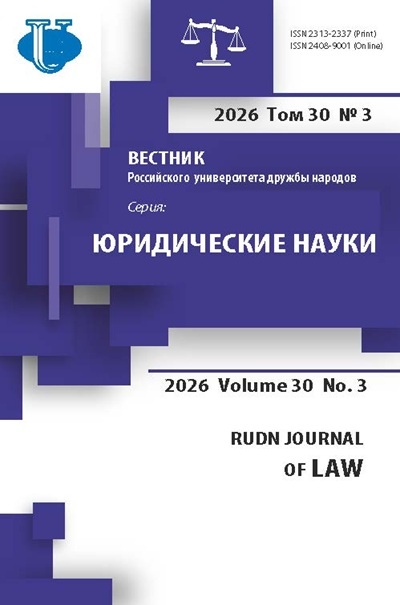
- Year: 2026
- Articles: 15
- URL: https://journals.rudn.ru/law/issue/view/2174
- DOI: https://doi.org/10.22363/2313-2337-2026-30-3
Full Issue

STATE AND LAW IN CONTEMPORARY WORLD
The Relationship Between Internal and External Forms of Law
Abstract
The article focuses on the relationship between internal and external forms of law. The author argues that implementing the leading principle of the rule of law - the priority of law over statute - is substantially complicated in Russia by the absence of а well-founded conceptualization of law in the legal literature that could serve as reliable criteria for assessing the legal nature of statutes. The paper argues that objective law, understood as an internal form composed of legal principles together with the universal rights and freedoms of individuals enshrined in international and domestic norms, can fulfill this role. The process through which objective law moves from potentiality to actuality generates four external forms: positive law, individual law, concrete law, and factual relations. Accordingly, external manifestations such as statutes, individual rights, and concrete legal entitlements should conform to objective law.
 457-470


Law and Morality: Problems of Distinction and Reconciliation in Modern Society
Abstract
The article argues that a clear distinction between law and morality is crucial both for understanding the nature of law and for the practice of legal regulation. It is shown that law and morality are usually distinguished by purely formal criteria: the scope of regulation, the source of normativity, and the type of sanctions attached to violations. However, their substantive differences are more important. Morality is grounded in the idea of solidarity; it emphasizes a person’s membership in a community, mutual assistance, responsibility, and the priority of common interests. At the same time, moral requirements are non-operational and situational. By contrast, law is designed to secure individual freedom and autonomy. It structures social interaction on the basis of formal equality, governs formal, role-based relations rather than interpersonal ones, and provides individuals with the possibility of moral self-determination. Because legal requirements are formal and operational, they can and should be enforced by public authorities. Moral considerations are nonetheless always present in legal regulation to some extent, but they must not obstruct the application of legal principles. Contemporary neo-constitutionalism, however, proceeds from the assumption of a deep, essential connection between law and morality and seeks to define and justify law in moral terms. The article analyzes the problems that arise in the interpretation of constitutional texts, the formulation of new human rights, and the rethinking of legal responsibility and argues that only a sufficient degree of law’s independence from morality ensures the proper functioning and development of both law and morality.
471-490
Neil MacCormick’s Legal-Philosophical Theory: A Critical Analysis
Abstract
A nuanced understanding of the theory of Neil MacCormick, one of the leading figures in contemporary analytical jurisprudence, is crucial for enriching the ontological and epistemological foundations of modern Russian legal theory. MacCormick has exerted a significant influence on current scholarly debates in analytical jurisprudence and has advanced theoretical and practical arguments that are important for the development of a positivist conception of law. The aim of this study is to develop a critical assessment of his legal theory by reconstructing the premises and core elements of his theory. The research employs a range of philosophical, general scientific, and specialized methods, including dialectics, formal logic, and systemic, historical, and biographical approaches. It is shown that MacCormick’s views took shape within the specific intellectual environment of Anglo-American academic discourse during the contemporary stage in the development of analytical philosophy and jurisprudence. An analysis of the contemporary scholarly debate surrounding MacCormick’s views, together with the author’s critical observations, shows that his theory, which evolved from positivism to post-positivism, presents problems of theoretical positioning and related shortcomings. The study concludes that MacCormick offers a narrowly liberal understanding of law that does not take into account the diversity of existing legal systems. At the same time, he successfully identifies key regularities in the functioning of contemporary law, case law and legal argumentation, as well as the specific features of supranational regulation in its interaction with national legal orders.
491-504
Biological (Bioresource) Collections as an Object of Philosophical and Legal Analysis
Abstract
The article offers a philosophical and legal analysis of biological (bioresource) collections as a unique phenomenon of the technosocial reality of the Anthropocene. It argues that the adoption of the Federal Law “On Bioresource Centers and Biological (Bioresource) Collections” necessitates reconsideration of the legal nature of these objects beyond traditional sector-specific approaches. The objective of the study is to outline conceptual foundations for a legal regime for biocollections that that responds to contemporary challenges and reflects Russia’s cultural and historical characteristics. Methodologically, the work is based on an interdisciplinary synthesis: an ontological approach makes it possible to view biocollections as a hybrid formation that inextricably combines natural reality and technological innovation, while axiological analysis reveals value priorities (natural truth, solidarity, intergenerational justice) that set the boundaries of legal intervention. Historical and philosophical reconstruction is used to reveal the relationship between legal consciousness and attitudes toward nature in the Russian cultural tradition, and the theory of legal regimes is applied to structure the set of legal instruments for achieving socially significant goals. The article shows that biocollections fulfil fundamental functions as a materialized repository of the biosphere’s memory, a source of genetic potential, and a critical component of the bioeconomy’s infrastructure. In this context, the category of “sustainability” is proposed as the guiding teleological principle of legal regulation, integrating the requirements of bioecological integrity, sociotechnological security, intergenerational stability, and socioeconomic relevance. The resolution of the “security-accessibility” antinomy is addressed through the concept of regulated accessibility, which presupposes differentiated legal regimes according to the types of samples and their intended uses. Particular attention is paid to conceptualizing biocollections as a public good and an element of national identity. Drawing on ideas from Russian philosophy (pochvennichestvo, sobornost), it is argued that the loss of collections constitutes not only a scientific loss but also a symbolic one, a rupture in the biosocial fabric of the people’s existence. The article concludes that legal ideology must genuinely shift from treating collections primarily as property to regarding them as a national treasure that demands special mechanisms of protection and management in the interests of present and future generations.
505-514
Fiction and the Reflection of Political-Legal Patterns of Authoritarianism: M.D. Simashko’s Novella “Emshan”
Abstract
The aim of the study is to substantiate the scholarly value of examining fiction within the theory of state and law and to identify the patterns of authoritarian rule reflected in M. D. Simashko’s novella “Emshan”. The research employs general scientific methods (analysis, synthesis, induction) and specialized methods, particularly hermeneutical and legal-dogmatic approaches, which made it possible to treat the literary text as a source of legal ideas and interpret them, as well as the historical-legal which was method used to reconstruct the context of the functioning of political power in the narrative. The study identifies the following patterns of authoritarian political domination reflected in the fictional narrative: the acquisition and retention of power based on the “law of force”; the formation of a closed ruling elite; the need for continuous legitimation through foreign-policy successes; the systematic elimination of close associates; an instrumental attitude toward law; the leader’s subjective loneliness; and the problem of succession to supreme power. The article concludes that “Emshan” is not only a literary remove the coma, but also a philosophical and legal study that reveals the nature of authoritarian political power, and that the patterns it depicts transcend the specific historical context and are significant for understanding fundamental issues concerning the functioning of society’s political and legal organization.
515-527
LAW AND DIGITAL TECHNOLOGIES
Digitalization of Public Administration: Analysis and Recommendations for Improving Efficiency
Abstract
In the context of the development of digital technologies, public administration is undergoing fundamental changes aimed at improving efficiency, transparency, and the quality of interaction with citizens. However, the implementation of the digital government concept faces a number of challenges: an outdated regulatory framework, information security and cybersecurity risks, the need to protect personal data, and the necessity of eliminating the digital divide between different social groups. Therefore, the adaptation of legal regulation and the optimization of public administration digitalization processes are of particular importance. The aim of the study is to formulate practical recommendations for eliminating key barriers and improving the efficiency of interdepartmental cooperation, based on a comprehensive analysis of public administration digitalization processes. The empirical basis of the research consists of scientific publications on the stated topic, as well as official data and reports from relevant government agencies The methodological basis includes comparative legal and formal legal methods, statistical analysis, and the methods of analysis and synthesis. Ensuring the stable operation of digital services, together with the transparency of interaction procedures between public authorities and citizens, is a determining condition for building public trust in state electronic platforms. The implementation of a multi-layered personal data protection system, complemented by systematic efforts to enhance the digital competencies of the population significantly increases the resilience of communication channels in the event of cyberattacks and unexpected technical failures. Designing information systems according to a modular principle opens up the possibility of promptly reconfiguring the infrastructure to meet the evolving needs of both users and public authorities, while reducing implementation time and conserving resources. The integration of engineering and technical developments with educational programs lays a solid foundation for the progressive transformation of digital public administration. An integrated approach combining technical solutions and educational initiatives is a prerequisite for the formation of a sustainable and trustworthy digital environment; a multi-level data protection system combined with digital user training programs serves as an effective mechanism for ensuring the reliability of digital government services; the modular architecture of digital platforms provides a high degree of flexibility and adaptability in line with contemporary needs.
528-547
Ecosystem in Modern Law: Theoretical Approaches and Legal Regulation
Abstract
Based on the analysis of how the concept of “ecosystem” has emerged and evolved in science from natural ecosystems to digital ecosystems, this article identifies ambiguities in the interpretation of the concept in contemporary scholarship and current legislation and establishes the relationship between a digital platform and an ecosystem. An ecosystem, understood as a type of socio-economic system, is considered a form of partnership, a set or complex of services, a level of development of digital interaction, a business model, and an environment for innovation and digital development. The development of ecosystem theory in modern science makes it possible to regard the ecosystem approach as an independent method of scientific analysis. The article systematizes the features and structure of ecosystems, their levels and types, and the main problems and priorities for legal regulation. The interdisciplinary character of the ecosystem concept dictated the use of interdisciplinary methods; the study employs historical and comparative analysis, system analysis, classification, and formalization. In summary, an ecosystem, including a digital ecosystem, may be regarded in legal scholarship as an intersectoral legal institution encompassing norms from information, administrative, financial, banking, civil, and other branches of law that collectively regulate interactions within and between ecosystems, ensure sustainable economic development, freedom of competition, and the safety of participants. The paper draws attention to a transformation of the fundamental principles that underlie the understanding of socio-economic ecosystems in the context of digitalization, particularly in the justification of the mediation mechanism in digital interactions within the ecosystems. The transnational character of modern ecosystems is also substantiated. The article argues that treating the ecosystem as a single, autonomous object of legal regulation is inappropriate; instead, regulatory attention should focus on three aspects of its functioning: corporate, competition-related, and consumer-related. Finally, the paper substantiates the need for preventive state intervention that combines information-security measures with policies aimed at stimulating ecosystem development.
548-564
CONSTITUTIONAL AND MUNICIPAL LAW
Constitutional Law Enforcement: Structural and Substantive Analysis
Abstract
The relevance of the topic stems from the fact that constitutional law enforcement remains a controversial legal institution that has not yet been fully examined by constitutional law scholars and legal theorists. In this article, the authors offer a structural and substantive analysis of constitutional law enforcement in Russia in the context of the transition to a new stage of constitutional development. Reconsideration of the nature of constitutional law enforcement requires overcoming complex legal, political and ideological contradictions. The purpose of the study is to develop an integrated approach to constitutional law enforcement and to construct a comprehensive concept of this institution. Appropriate methods of scientific inquiry were employed to examine existing concepts of constitutional law. The study is based on rational and methodological approaches aimed at clarifying traditional concepts of constitutional law enforcement in the humanities that are grounded in the principles of natural law. The results include a formulated definition of constitutional law enforcement and an analysis of its various types, which contributes to a deeper understanding of the application of constitutional norms. In addition, the authors examine constitutional law enforcement in the context of its relationship with the concept of a “living constitution.” The article identifies and analyzes several forms of constitutional law enforcement - direct, derivative, exclusive, and interpretative - thus providing a more nuanced view of how constitutional norms are implemented by different actors.
565-582
Legal Regulation of Artificial Termination of Pregnancy: From the Russian Tsardom to the Russian Federation
Abstract
Russian legislation currently does not recognize a right to artificial termination of pregnancy (abortion); it only regulates the procedure for its performance when a woman decides not to carry her pregnancy to term within the framework of determining whether to become a mother. A woman’s independent decision to seek medical intervention to terminate her pregnancy results in a conflict between private and public interests. The purpose of this study is to identify the causes of the intensifying conflict between the interests of a pregnant woman who faces the choice of preserving or ending the life of a child, and and the interests of the state, which seeks to preserve the nation and promote its population growth. The study employs dialectical, formal legal, specific historical, and other research methods. The author analyzes the specifics of the Russian legislator’s understanding of the right to abortion and the dynamics of its entrenchment in the legal sources of different periods, from Tsardom to the modern Federation. It is noted that changes in attitudes toward human reproductive potential depended on the socio-political configuration of each historical era: initially, the role of public institutions (primarily the Russian Orthodox Church) was strong, later it weakened, and more recently it has begun to grow again, which has inevitably influenced and continues to influence the degree of conservatism or liberalization of regulation in this sphere. The study concludes that there is a need to reassess the broader understanding of women’s reproductive freedom and to ensure its adequate reflection at the legislative level in Russia.
583-598
INTERNATIONAL LAW. FOREIGN LAW
Legal Aspects of the Implementation of International Treaties in the Chinese Legal System under the 2023 Foreign Relations Law of the People’s Republic of China
Abstract
International treaties, as an important source of international law, serve as a means of interaction and regulation of international relations of sovereign states across various spheres. At the same time, they exert a significant influence on national legislation, creating interaction between international and domestic legal systems that often involves specific practical complexities and challenges. For this reason, each national legal system must determine the place and legal status of the international treaties it has concluded, as well as other specific features of their implementation. This article provides a legal analysis of a fundamental and comprehensive normative act, the 2023 Law of the People’s Republic of China on Foreign Relations, and examines the formal-legal and other characteristics of the position of international treaties within China’s national legal system under this Law. Special attention is given to the key provisions of the document (including an analysis of the principle of good-faith performance of international legal obligations), their legal significance and their practical implementation by such bodies as the National People’s Congress, its Standing Committee, and the State Council. The article also explores the mechanisms through which domestic legislation interacts with China’s international treaty obligations, assesses the hierarchy of legal sources, and identifies legal gaps and challenges that arise in the course of their application. On the basis of comparative legal analysis, it concludes that China’s national legal instruments require further refinement to ensure the effective fulfilment of its international obligations and proposes possible directions for improving legislative mechanisms.
599-616
Land law, natural resources law, environmental law, agrarian law
Improving the Definition of Permitted Land Uses: Harmonization of Land and Urban Planning Legislation
Abstract
The article examines different interpretations of the legal term “type of permitted use of land plots” found in legal literature. It analyzes land and urban planning legislation that regulates the conceptual framework and the procedure for establishing and changing the type of permitted use of land plots. A historical and legal analysis is conducted to trace the evolution of the legal regulation of the concept of “type of permitted use of land plots.” The article explores the characteristics of the type of permitted use of a land plot as a legal category and assesses the role of judicial practice in enforcing the procedure for establishing and changing such types, as well as in developing uniform law enforcement practice.
617-630
CRIMINAL LAW AND CRIMINOLOGY
The Internal Security Inspectorate and Penitentiary Policy in Poland: Lessons from Legal Transformation
Abstract
Combating offenses in prisons requires a scientifically grounded balance between security measures and operational-investigative activities (OIA). The reforms in the Republic of Poland (2010-2026), which culminated in the creation and subsequent emergency liquidation of the Internal Security Inspectorate, illustrate the crisis that can arise from departmental isolation of operational units within the penitentiary system. Objective: using a comparative legal analysis, this study identifies systemic shortcomings of the autonomous model of operational-investigative services in the Polish penitentiary service and determines the limits of the permissible expansion of the operational-investigative powers of the Federal Penitentiary Service of Russia. Materials include regulatory legal acts, statistical data, and scientific literature from both countries. Methods combine formal-dogmatic, historical-legal, and comparative legal approaches with systemic analysis of empirical data. Findings: it was found that granting the Polish Prison Service secret-service powers without without granting it the status of a body of inquiry resulted in the rejection of its materials by the courts; financial incentives for agents led to an increase in false reports; and the separation of the Internal Security Inspectorate provoked conflict with the police and shifted priorities toward recording minor offenses. Conclusion : security in correctional facilities should rely on integration of the penitentiary service into the broader national law-enforcement system. The Russian model, based on interagency coordination within a unified legal framework and informed by scientific review of reforms, demonstrates a high degree of resilience to systemic crises.
631-648
REVIEWS. DISCUSSION FORUMS
649-664
665-672
673-678