





Vestnik RUDN. International Relations
Editor-in-Chief: Konstantin P. Kurylev, Dr. of Sc. (Hist. Sciences), Professor
ISSN: 2313-0660 (Print) ISSN: 2313-0679 (Online)
Founded in 2001. Publication frequency: quarterly.
Open Access: Open Access . APC: no article processing charge
Peer-Review: double blind. Publication language: Russian, English
PUBLISHER: Peoples’ Friendship University of Russia named after Patrice Lumumba (RUDN University)
Journal History
Indexation: White List RCSI, Russian Index of Science Citation, RSCI, Scopus, Google Scholar, Ulrich's Periodicals Directory, ERIH PLUS, DOAJ, Dimensions
Vestnik RUDN. International Relations is a leading Russian bilingual (English /Russian) IR journal, published by RUDN University since 2001.
What we focus most on are pressing global issues and the history of international relations, foreign policy and diplomacy, regional security in Asia, Africa and Latin America, the "North-South" relationship and cooperation within BRICS, SCO and CIS, as well as international academic cooperation. Thematic scope of the Vestnik RUDN. International Relations is reflected in the following section titles: "International Economic Cooperation", "Applied Analysis", "Bilateral Cooperation", "Scientific schools", "History of International Relations", "Profiles", "International Academic Cooperation".
The journal accepts for consideration articles by postgraduate and doctoral students, candidates for PhD and doctors of science. Articles by students and undergraduates of higher educational institutions are not considered.
Our authors are known Russian scholars of international affairs who represent leading metropolitan and regional universities, as well as institutes of Russian Academy of Sciences, and also experts from foreign countries, including those from the top European, US and Asian universities. Many researchers of RUDN-University have come from the CIS countries, Asia, Africa and Latin America, explore foreign policy issues of their states and add their local/nation-specific perspective in addressing current global issues.
Announcements More Announcements...
Call for papers: "Regional Studies in a Fragmenting International System" (No. 1 2027)Posted: 15.08.2026
|
|
|
Call for papers: "Regional Studies in a Fragmenting International System" (No. 1 2027)Posted: 12.05.2026
|
|
|
2027 Thematic DossierPosted: 04.04.2026
|
|
|
Current Issue
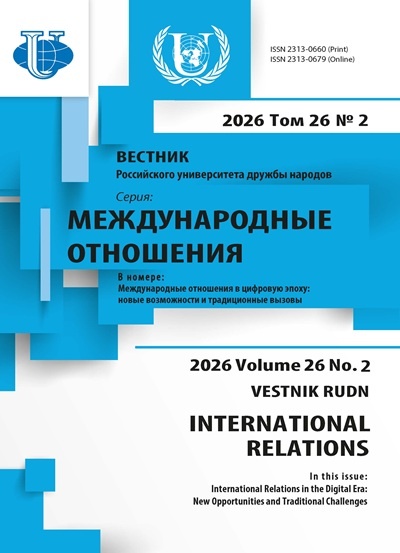
Vol 26, No 2 (2026): International Relations in the Digital Era: New Opportunities and Traditional Challenges
- Year: 2026
- Articles: 15
- URL: https://journals.rudn.ru/international-relations/issue/view/2140
- DOI: https://doi.org/10.22363/2313-0660-2026-26-2
Full Issue

THEMATIC DOSSIER
Algorithmic Asymmetry: Space, power and Time in the History of Digital Diplomacy
Abstract
The article provides a historical and analytical study of the development of digital diplomacy as a distinct domain of diplomatic practice, examining it first at the moment of its emergence and then as it evolved within the digital environment in which diplomatic activity takes place. The paper examines the dynamics of terminology: from the earliest conceptualizations to later debates about the substance and scope of digital diplomacy as an independent phenomenon. Particular attention is given to the processes of differentiation and conceptual displacement between “public diplomacy” and “digital diplomacy,” which makes it possible to trace how their hierarchy, semantic contours, and spheres of application have changed over time. The article also proposes an original periodization of the history of digital diplomacy based on a chronological analysis of key events, institutional reforms, and technological shifts from the 1990s to the mid-2020s. This periodization reveals a gradual progression from the experimental stage of MFA-led digital communication to the phase of institutionalization, and subsequently to the stage of algorithmization of diplomatic practices. The concept of algorithmic asymmetry is central to the study. The analysis demonstrates that algorithms not only project influence across time and space with different speeds and densities but also create asymmetric conditions for states with varying levels of adaptability, technological capacity, and digital creativity. Algorithmic asymmetry manifests itself in three dimensions: spatial, temporal, and power-related. In conclusion, the article emphasizes that digital diplomacy evolves within a constantly reconfiguring digital environment, while algorithms increasingly shape the dynamics of international engagement. The resulting ranking of states reflects only a temporary configuration of the field, since under conditions of algorithmic asymmetry, a state’s position is determined by its receptivity to innovation, its capacity for adaptation, its strategic mastery of digital regimes of power, and its ability to translate the properties of digital platforms into a resource of foreign-policy influence.
 197-215


Competition of regulatory paradigms in the field of AI: Liberal and state-centric models and their promotion in the OECD and ITU
Abstract
In recent years, competition for leadership in artificial intelligence (AI) has become a major element of geopolitical rivalry between the United States of America (USA) and the People’s Republic of China (PRC). Alongside the struggle for leadership in technological solutions, the main foreign policy efforts of these states focus on establishing an international AI governance regime. This has led to a clash between two approaches: a liberal model based on ethical principles, legal regulations, and the open market, and a state-centric approach emphasizing sovereignty and national security. The former is promoted by the USA and the European Union, while the latter is advanced by the PRC. Within the liberal framework, there is also a competition between the US market-driven approach and the EU’s regulatory approach. The theoretical framework of the study consists of regime theory and structural power theory. These approaches make it possible to examine the competition among the three models in international institutions and to trace their transformation. For this purpose, the study applies discourse and content analysis to official documents of the USA, the EU and the PRC as well as to materials of the Organisation for Economic Co-operation and Development (OECD) and the International Telecommunication Union (ITU) for 2017-2025. In the current system of global governance, the OECD acts as the normative core for representatives of the liberal bloc, while the ITU serves as the main space for competition between liberal and state-centric approaches. The authors conclude that, as geopolitical tensions increase, all models begin to gravitate toward stricter sovereignty-oriented approaches and shift their priorities away from ethics, human rights and market regulation. This is confirmed by consistent changes in discourse both at the level of national strategies and in international organizations. Under the influence of these factors, the global AI governance regime is becoming more fragmented. International organizations, such as the OECD and the ITU, are becoming key instruments in the struggle for structural power by establishing international standards.
216-227
Digitalization of the Caspian region: Current trends and new opportunities
Abstract
Digitalization is becoming a crucial factor in shaping the development of the Caspian region today. In recent years, the Caspian littoral states have adopted strategic and policy documents aimed at advancing the digital sphere. This process is intensifying, transforming political and socio-economic relations within the subregion and creating new opportunities for interaction. The relevance of the study is driven by the need for a comprehensive analysis of digitalization in the Caspian region and a critical assessment of its implications. The aim of the research is to identify the key factors, directions, and consequences of the digital transformation of the subregional system of international relations. The methodological framework of the study includes historical-analytical and comparative methods, the method of socio-political analogies, and political analysis. Theoretically, the research is grounded in rational choice theory, which makes it possible to identify the factors influencing the decisions of the Caspian states to prioritize digitalization as a reflection of the region’s deeper transformations. Within the systems approach, the Caspian region is considered as an integral structure in which new linkages between states are being formed. The study also examines the impact of external environment, including the activities of extra-regional actors and the participation of the Caspian states in international organizations, as well as national regulatory frameworks in the field of digitalization and the role of international legal mechanisms governing the digital sphere. The object of the study is the processes of digitalization and its impact on the development of the Caspian region. It is demonstrated that the emerging subregional system of international relations is characterized by multiple development scenarios, presenting both new opportunities and risks. The conclusion provides an assessment of current trends in digitalization in the Caspian region and identifies the key factors determining its future trajectory. It is argued that digitalization represents a long-term trend that is already transforming the region and will continue to have a significant impact on its future development.
228-239
Integrating digital technologies into the collective security system of Central Asia and Russia: Developing a multi-level threat neutralization model
Abstract
The study addresses the pressing issue of transforming the collective security architecture in the Eurasian region amidst digitalization and the emergence of new transnational threats. An analysis of contemporary challenges reveals that existing integration structures, such as the Collective Security Treaty Organization (CSTO), the Shanghai Cooperation Organisation (SCO), and the Eurasian Economic Union (EAEU), demonstrate limited effectiveness in countering modern hybrid threats. These include cyberattacks on critical infrastructure, environmental disasters, and energy crises. The acuteness of these problems is further amplified by increasing technological fragmentation and the emergence of new forms of transnational crime. The primary aim of this work is to develop a comprehensive model of a digital subregional security for the states of Central Asia and Russia. This model integrates advanced technological solutions with institutional mechanisms of the Eurasian associations. The scientific novelty of the research lies in the synthesis of institutional analysis and technological modelling. The proposed model accounts for both vertical and horizontal linkages between national agencies and integration structures. The methodological foundation comprises a comparative analysis of the competencies and architecture of Eurasian organizations, supplemented by the design of a multi-level coordination system utilizing artificial intelligence, blockchain, and the Internet of Things technologies. The study’s results include the identification of systemic gaps in the coverage of modern threats by existing security mechanisms, the development of a hierarchical security management model-the Digital Subregional Security Template (DSST), the establishment of specific performance indicators for the implementation of digital solutions, and the proposal of adaptive financing mechanisms considering the differentiated capabilities of participating states. A particular value lies in the focus on practical implementation through the creation of pilot zones. This distinguishes the present research from theoretical developments in the field of regional security, and ensures the integration of its findings into the operations of relevant government agencies and integration associations.
240-255
Digital diplomacy of Russia and India in the context of adaptive soft power approaches
Abstract
The article is devoted to the study of the activities of Russia and India in the context of the digitalization of international relations. These countries are examples of states that are dynamically transforming their foreign policy tools to meet the demands of the digital era, and the systematization of their experience has significant heuristic potential. It is noted that the systematization of the analysis of the state’s activities in the field of digital diplomacy as a key element of soft power strategies can be carried out in three main areas: 1) forming horizontal communications, 2) using instruments and technologies, and 3) creating regulations. Through these areas, the adaptive potential and competitiveness of Russia and India in using and regulating digital technologies can be explored using comparative methodology. The review of the Russian digital diplomacy model covers both significant achievements (the Ministry of Foreign Affairs’ well-developed social media digital network, media activity in the online space, countering disinformation, digital cooperation with friendly states, and a proactive agenda in the areas of cybercrime and the regulation of artificial intelligence technologies), as well as the associated challenges, primarily caused by restrictions and sanctions pressure. India’s digital diplomacy has been successful in using online tools to engage with the diaspora and modernize consular services. The article also examines not only the Ministry of External Affairs of India’s activities on social media but also the impact of the popularity of Prime Minister Narendra Modi’s accounts on shaping the global agenda. It also highlights the promotion of Indian digital technologies such as India Stack and UPI. In conclusion, it is noted that the cyber diplomacy of Russia and India is primarily aimed at countering the militarization of the digital space.
256-271
Cybercrime in Latin America: Challenges for building effective security in the world’s most vulnerable region
Abstract
The issue of cybercrime in Latin America has reached critical levels, against a backdrop of the region’s technological lag, fragmented security strategies, and a growing reliance on foreign technological solutions. According to the 2024 Global Cybersecurity Index, the region ranks last globally (35.12 points), behind even African countries (37.25). This contradiction is exacerbated by the rapid annual growth in cyberattacks (25%) and limited public access to secure internet services (62%). The study aims to systematize the key challenges hindering the development of an effective cybersecurity system, focusing on infrastructure limitations, workforce shortages, and geopolitical competition for digital influence. The scientific novelty of the work lies in its combination of methods, including network influence analysis to visualize zones of technological dominance (the USA, China, the EU, Russia) and content analysis of 18 national cybersecurity strategies. The empirical foundation incorporates data from the International Telecommunication Union, the Inter-American Development Bank, IBM, and documents from regional organizations, such as the Organization of American States (OAS) and MERCOSUR. The results of this study reveal polarized approaches, ranging from centralized management systems (Brazil, Costa Rica) to hybrid models of digital sovereignty (Venezuela, Cuba), which blend national priorities with reliance on foreign technologies. The dominance of companies like Huawei (70% of 4G networks) and Microsoft (cloud solutions) has exacerbated vulnerabilities in critical infrastructure. The reactive nature of measures is exemplified by Costa Rica, which saw a 446% increase in cybersecurity funding after 2022’s cyberattacks. The key conclusion of the study underscores the need for regional cooperation and harmonization of standards under the OAS framework through harmonized standards (CSIRT Americas) and enhanced public-private partnerships. Only 23% of organizations employ AI for data protection (17% below the global average). The study contributes to discussions on balancing geopolitical interests and collective security by proposing a more adaptive model for Latin America. Its core elements include targeted investments in fiber-optic networks, workforce training, and the integration of international best practices adapted to local contexts, with an emphasis on bridging the digital divide.
272-285
BRICS
Political and legal aspects of BRICS cooperation in the field of artificial intelligence: Towards the development of an alternative regulatory approach
Abstract
Global artificial intelligence (AI) governance is currently framed as a bipolar confrontation between the ‘Brussels’ and ‘California’ approaches. The article argues that the BRICS countries are attempting to craft a third path-an alternative model of AI governance rooted not in unification, but in an ‘overlapping consensus.’ Drawing on political ontology and a comparative analysis of national strategies, the authors demonstrate how the twin imperatives of digital sovereignty and resistance to technological hegemony can bridge the initial regulatory diversity among member states. The methodology combines discourse analysis of key BRICS documents with a case study approach, revealing the emerging architecture of a hybrid ‘soft law’ regime. Empirically, the study draws on frequency and contextual analysis of three core concepts-‘sovereignty,’ ‘inclusiveness,’ and ‘fairness’-across BRICS summit declarations from 2020 to 2025. The findings indicate a clear conceptual shift: from a predominantly political discourse on sovereignty in 2020, to its progressive digitalization and embedding within the technological agenda by 2025. The rising salience of terms tied to technological autonomy and digital security underscores this shift. The ‘overlapping consensus’ model proves workable for states with different politico-economic systems and technological capabilities. It enables them to maintain regulatory sovereignty, manage heterogeneity without resorting to rigid harmonization, and establish flexible coordination frameworks. BRICS cooperation is oriented less toward creating a supranational regulator than toward aligning principles for joint action in international fora. Enlargement enhances the group’s representational appeal for the Global South, but it also complicates standard-setting amid a growing diversity of national interests. The prevalence of ‘soft law’ and flexible ‘coalitions of the willing’ gives members the room to maneuver in the era of intense technological rivalry. On the practical side, the study offers several actionable recommendations: a digital platform for standard alignment, a mechanism for expedited mutual recognition of certification, and a joint large language model program tailored to the Global South’s linguistic and cultural diversity.
286-311
Peacebuilding as a promising vector of BRICS strategic communication: China’s experience
Abstract
The fragmentation of the international peace architecture and the crisis of the traditional liberal model of peacekeeping highlight the need for new sustainable mechanisms for peacebuilding aimed not at the kinetic conflict resolution legitimized by just war ethics, but at their prevention through promoting equal intercultural dialogue, developing inclusive peace ethics, and stimulating the socio-economic development of Global South countries. In order to preserve peace, actors, including such weakly institutionalized organizations like BRICS, can employ strategic communication. However, despite having a clear peacebuilding agenda that emphasizes the central role of the UN and condemns unilateral interventions and sanctions, peace-development nexus, conflict resolution through dialogue between all parties mediated by regional organizations, BRICS’s strategic narratives do not convert into mediation mechanisms. BRICS countries either delegate the discussion of thematic issues to other platforms or ignore them. Through a narrative and structural analysis of the strategic communication of the People’s Republic of China (PRC) as a BRICS member country, it has been shown that non-Western countries also face difficulties in developing individual peacebuilding strategies. This is primarily due to the need to balance between non-interference, which does not correspond to their status and interests, and intervention, which can be perceived as a manifestation of neocolonialism. Coordinated BRICS peacebuilding strategic communication could enhance its members’ capabilities for conflict resolution and contribute to trust-building between BRICS and the Global South. This requires an intercultural philosophical study of non-Western ethics of peace as potential sources for the BRICS peacebuilding model, the development of mechanisms for resolving conflicts between BRICS members, a more dynamic interaction with regional organizations and research into the possibilities of digital peacebuilding.
312-323
CHINA IN THE WORLD
A comparative analysis of the United States and China’s experience in the military use of artificial intelligence technologies
Abstract
The progressive economic development of the People’s Republic of China (PRC) with its further integration into the global economy, as well as the growing complexity of the international political environment due to China’s rising power, have revealed the need to expand the capabilities of the People’s Liberation Army (PLA) to protect China’s national interests in conflicts with developed states. A key technological innovation of the current stage of scientific and technological progress is artificial intelligence (AI). AI has already entered the list of technologies that are fundamentally changing the nature of war and peace, and has the potential to fundamentally reshape the militaryeconomic power of states, as it is actively used in the most advanced fields, including the space industry and virtually all military domains, particularly in command and control systems. The main rivals for leadership in AI are the United States and China. Both countries are actively developing AI-based technological solutions to modernize their armed forces. This could lead to increased strategic competition between the two powers. The study analyzes the experience of modernizing the armed forces and the concepts of their employment by the United States and China in the context of the military application of AI. The aim of the study is to determine the impact of AI adoption on the changing nature of warfare and the strategic balance of power between these countries. The object of the research is the armed forces of the United States and China in the context of their technological modernization and institutional improvement. The authors analyze the conceptual documents of the two countries and examine changes in the organizational structure of their armed forces in light of national strategies for the development and implementation of AI technologies in the military sphere. The authors conclude that the use of AI can significantly accelerate military operations, change concepts of warfare and the strategy for employing military forces, increasing the role of autonomous systems. The PLA is acutely aware of the importance of adapting to and benefiting from advances in AI, fearing a “generation gap” between its capabilities and those of the U.S. armed forces, which are perceived as a powerful adversary and, therefore, a key benchmark for comparison. Currently, in terms of the number of weapons systems under development using advanced technologies, the two states maintain parity. The future trajectories of these technologies in the PRC and the United States will influence the future strategic balance of power, potentially leading to the emergence of new forms and methods of employing armed forces, as well as changes in the fundamental documents of military development.
324-339
The impact of China’s “soft power” on the consciousness of Russian student youth
Abstract
The rationale for this article can be explained through the intensification of bilateral relations between China and Russia, which rely not only on close political and economic ties, but also on the development and enhancement of humanitarian contacts. The People’s Republic of China (PRC) positions itself as a state offering its own development model for the civilization-state, which has existed for over five millennia now. The period when China was among states striving to catch up has been left behind, so now it has every reason to be recognized as a global power. Having achieved economic success and going on with the “Belt and Road” global initiative, the Chinese leadership pays considerable attention to shaping a positive image of China in the countries Beijing is seeking to cooperate with. One of such countries is Russia, standing as a global power that opposes the neocolonial models of world development promoted by the collective West. The study of China’s experience in implementing soft power methods is of particular interest since it allows considering the specific features of its national context, as well as its significance in pursuing goals related to global, regional and national foreign policy. The aim of this study is to reveal the effectiveness of soft power tools that the PRC is applying in Russia. The study is based on an approach to image building, which implies viewing it as a process of shaping the target group’s opinion, whereas the main method employed within the research was sociological analysis. The authors, while relying on the research experience in defining “soft power,” were able to identify the factors that are essential for presenting China’s image among the Russian youth: public administration, culture, science and education, business, sports, environment, and digital technologies. The main target group involved in the sociological survey were students of Russian universities falling within the age group of 17-29. The authors employ the study outcomes to conclude that China has created a positive image among the Russian student youth. As reported by the respondents, the high level of influence that China has achieved in the international arena is due to its effective public management and technological advancements, which, are, in turn, based on an education system with a special focus on developing practical skills.
340-351
INTERNATIONAL EDUCATIONAL COOPERATION
Digitalization and country image formation: Longitudinal evidence from Japanese university students’ perceptions of Russia
Abstract
This article examines the longitudinal dynamics of Japanese university students’ perceptions of Russia and their sources of information in the context of changing international relations under the conditions of the digitalization of the global information environment. The empirical basis of the study consists of six waves of original sociological surveys conducted at Japanese universities in 2007, 2012, 2021, 2022, 2023, and 2024. Using quantitative and qualitative analysis of closed- and open-ended questions, the research identifies changes in patterns of international information consumption and in associative images of Russia across different periods. The findings indicate a gradual shift in how young Japanese audiences obtain information on international affairs: the role of online sources has been steadily increasing, while the importance of traditional mass media, particularly print newspapers, has been declining within this age group. At the same time, traditional media continue to exert a notable influence on Japan’s information landscape as a whole, especially among older generations, reflecting the multi-layered nature of foreign policy perception formation. The analysis also reveals the growing prominence of visual and geographical associations, as well as an increasing personalization of Russia’s image through its political leadership. The escalation of the RussoUkrainian conflict in 2022 led to a temporary rise in negative, conflict-oriented associations; however, this effect proved to be short-lived and weakened in subsequent years. Despite sustained geopolitical tensions, interest in cultural dimensions of Russia’s image, most notably national cuisine, has shown a modest but consistent increase. The findings of the study demonstrate how the digital information environment and event-driven coverage of international crises influence the formation of state images in the mass consciousness of young audiences, underscoring the dynamic nature of these perceptions and dependence on media context in the digital age.
352-371
SCIENTIFIC SCHOOL
Global politics in the context of digitalization. Interviewed by K. P. Kurylev and M. S. Ramich
Abstract
The present interview features prominent Russian scholars in the fields of international relations theory and technological transformation, Tatiana A. Alekseeva and Marina M. Lebedeva, representing the MGIMO academic school. The dialogue covers how the political organization of the world is being transformed by the introduction of new technologies, how theories of international relations react to digitalization processes, and what new theoretical approaches can be expected. In particular, it is noted that constructivism is rather cautious about digitalization and the use of quantitative methods of analysis. Answering the questions of the editorial board of the journal, the fundamentally new contributions of digitalization to international relations and world politics compared to previous technological advances. Thus, it is argued that the speed of the impact of digitalization on political and international political processes is many times greater than in previous stages of development with the introduction of new technologies. At the same time, digitalization causes many negative and side effects. The article uses concrete examples to illustrate the contradictions generated by digitalization, related, on the one hand, to Internet freedom, and, on the other, to state sovereignty. It is noted that states can cooperate with each other in countering crime in the digital sphere, if it is not of a political nature. In the case of terrorism and politically motivated actions of criminals, state cooperation becomes more complicated. Digitalization has brought new leaders to the forefront-the United States and China. Digital companies in these countries actually determine many areas of development. A special question arises in connection with the definition of standards in the digital sphere, since it is obvious that the standards of those companies and countries that will be adopted will largely determine the further development of digitalization and the international political processes caused by it. The article sets out an argument as to why a complete breakdown of production chains and a total fragmentation of the internet are unlikely to occur. The authors discuss how the political organization of the world will evolve and the prospects and limitations of various types of digital technologies. It is assumed that network relations will become dominant in the world, but the process of transformation, the transition to network interaction can be very painful.
372-386
The Labyrinths of Latin America: At the Crossroads of Eras and Interests. Interviewed by A.Yu. Borzova
Abstract
On October 29, 2025, the Department of Theory and History of International Relations of the RUDN University hosted a scientific seminar titled “Geopolitics of Latin America,” bringing together leading Russian experts on the region. The discussion was moderated by Doctor of Historical Sciences, Professor Alla Yuryevna Borzova. The discussion covered a comprehensive analysis of the key political, economic and social challenges of the region. The political block, represented by Doctor of Political Sciences, Professor, Head of the Center for Political Studies of the Institute of Latin America of the Russian Academy of Sciences (ILA RAS), Professor of the Faculty of Global Processes at Lomonosov Moscow State University Z.W. Iwanowski, identified the current regrouping of forces with a noticeable “right-wing” shift in power, internal disunity within societies in the region and factors of “tired democracy,” which may have implications for the foreign policies of Latin American countries in the global context. An economic review by Doctor of Economics, Chief Researcher of the Institute of Scientific Information on Social Sciences of the Russian Academy of Sciences, Professor of the Russian University of Economics named after Plekhanov, P.P. Yakovlev, demonstrated the successful integration of Latin America into the global economic ecosystems-agriculture, food, energy, mining, technology, and finance-emphasizing the region’s transformation from a source of problems to an active provider of solutions. The review also addressed complex security threats. Doctor of Political Sciences, Professor of the Department of International Relations and Russian Foreign Policy at the Moscow State Institute of International Relations of the Ministry of Foreign Affairs of the Russian Federation B.F. Martynov and Candidate of Historical Sciences, Senior Lecturer of the Department of Theory and History of International Relations at RUDN University V.X. Medina González examined in detail the convergent nature of drug trafficking, its link with corruption and terrorism, as well as the critical situation of the erosion of statehood in Ecuador. Migration trends, analyzed by Doctor of Historical Sciences, Professor of the Department of Theory and History of International Relations at the Ural Federal University named after the first President of Russia B.N. Yeltsin O.N. Bogatyreva and her Brazilian colleagues demonstrated the scale of internal displacement and the new challenges of environmental migration. The strategies of external players were also discussed: the pressure of US sanctions on Cuba (M.A.-M. Kodzoev, PhD in Political Science, Senior Researcher at the Center for Analytical Research at the Institute of Latin America of the Russian Academy of Sciences, Associate Professor at RUDN University, Associate Professor at RSUH), China’s expansion within the framework of the “One Belt, One Road” initiative (E.A. Yakhnis, RUDN University), and the role of the European Union (EU). The seminar concluded that the rivalry between the US, the People’s Republic of China (PRC), and the EU is growing amidst increasing internal turbulence in the region, making it a critical arena for global geopolitics.
387-393
POLITICAL PORTRAITS
‘Trumplomacy’ as a phenomenon of foreign policy decision-making
Abstract
In the United States, big business and transnational corporations (TNCs) are not merely external lobbyists but an integral part of the political process within the historically established model of ‘pluralist democracy.’ Their influence permeates all stages of decision-making, from shaping the legislative agenda to the workings of the executive branch, through formal and informal channels, such as campaign financing, powerful lobbying, and the phenomenon of the ‘revolving doors.’ This stable system of interaction between economic and political elites forms the context in which the country’s foreign policy is formed and implemented. Donald Trump’s foreign policy course, both during his first term (2017-2021) and after returning to the White House in 2025, has become a clear manifestation and reinforcement of this trend. His unique style often referred to as ‘Trumplomacy’ (Trump + diplomacy), represents a radical departure from traditional paradigms in American foreign policy. The return of D. Trump to power allows us to speak not of a temporary deviation, but of the establishment of a stable alternative model. This article examines the phenomenon of ‘Trumplomacy’ - the foreign policy style of the 45th and 47th presidents of the United States. It analyzes the key principles, such as transactional nationalism, economic protectionism, pragmatism, the rejection of multilateralism in favor of bilateral relations, and the use of unpredictability as a tool of pressure. Using specific examples (relations with NATO, the trade war with China, dialogue with North Korea and Russia), the strengths and weaknesses of this approach, as well as its comprehensive impact on the architecture of international relations, are identified. To address the academic objective, the authors of the study employ the methodology of historical and political sciences: the historical-analytical method, method of comparison, socio-historical and social and political analogies, and political analysis. In conclusion, the paper conducts a comparative analysis of ‘Trumplomacy’ with the principles of classical diplomacy and concludes on its role as a systemic challenge to the established norms of the liberal world order, identifying it as a significant phenomenon of contemporary geopolitics.
394-416
REVIEWS
417-421