







 Email this article
Book review: Hard, I. K., & Kanbergs, D. J. (Eds.). (2023). A US Pivot Away from the Middle East: Fact or Fiction? Washington, DC: Arab Center Washington DC, Inc., 194 p.
- Authors: Kirichko F.A.1
-
Affiliations:
- RUDN University
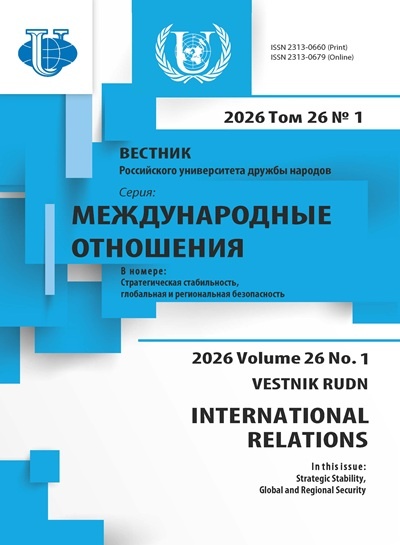
- Issue: Vol 26, No 1 (2026): Strategic Stability, Global and Regional Security
- Pages: 185-189
- Section: REVIEWS
- URL: https://journals.rudn.ru/international-relations/article/view/49516
- DOI: https://doi.org/10.22363/2313-0660-2026-26-1-185-189
- EDN: https://elibrary.ru/TFHQKN
- ID: 49516
Cite item
Full Text

Abstract
-
Full Text
The book A US Pivot Away from the Middle East: Fact or Fiction? is a collection of essays exploring various perspectives on the possibility of the US shifting the focus of its foreign policy from the Middle East towards addressing the strategic challenges posed by China, particularly Beijing’s growing influence in international relations.
The book contains two main parts: The Origin and Facets of a Pivot Away from the Middle East and Current US Engagements and Entanglements. The first part examines the reasons and the aspects behind a shift away from the region, while the second explores the current commitments and challenges that the United States faces in the Middle East.
The book as a whole consists of 15 essays which were generally presented at a conference organized the by the Arab Center in Washington, DC (ACW) on May 18, 2023. The conference aimed at discussing the issue of US disengagement and its pivot away from the Middle East and the realities and dimensions of this perceived retreat (Hard & Kanbergs, 2023, p. 5).
The May conference was held as a result of discussions between Arab Center Washington DC scientists and Arab officials and opinion leaders, many of whom argue that the US has started to pivot away from the region. However, this point of view is countered by American officials and scientists who are convinced that the shift is actually a mere misperception, pointing out that the US is indeed increasing its engagement.
The Arab Center Washington DC is a nonprofit and independent research organization that aims to promote a better understanding of the political, economic, and social aspects of the Arab world within the United States, as well as provide insight into American policy and interests in the Middle East. The mission of the ACW is to address fundamental aspects of US-Arab relations through objective academic research, policy analysis, and educational exchanges. The center maintains tight connections with the Arab Center for Research and Policy Studies (ACRPS) located in Doha, Qatar.
The 15 essays which form the reviewed book were written by a number of a widely recognized researchers and scientists who specialize in the Arab world, US foreign policy and relations between Washington and Middle East countries. Among these scholars are: Sahar Aziz, Charles W. Dunne, Imad K. Harb, Waleed Hazbun, Khalil E. Jahshan, Patricia Karam and Tamara Kharroub (Hard & Kanbergs, 2023, pp. 3–4). Sahar Aziz is a Distinguished Professor of Law, Middle East Legal Studies Scholar, and a Chancellor’s Social Justice Scholar at Rutgers University Law School. Imad K. Harb is the co-editor of the reviewed book and the Director of Research and Analysis at ACW. He previously worked as a Senior Analyst at the Emirates Center for Strategic Studies and Research and taught political science and international relations at the University of Utah and San Francisco State University. The research works of Tamara Kharroub focus on the intersection of technology and human rights and democracy in the Middle East and North Africa (MENA) region. She also publishes research papers, policy analyses and editorials exploring the role of media and communication technology in the political process. All of the named authors’ contributions explore the historical roots of the American shift in the Middle East, as well as its political, military, economic implications and future outlook.
The aim of the book is not to argue for or against a shift in the US Middle East foreign policy, but to examine its nature, intent and potential implications, and whether it should become an element of US national security strategy (Hard & Kanbergs, 2023, p. 5). The political impression that Washington is indeed pivoting away from the Middle East and abandoning its closest allies and alliances in the region gained popularity among the Arab countries. This has influenced national narratives and official policies among US’ allies, such as Saudi Arabia, the United Arab Emirates and Egypt. It has also influenced the views of Washington’s critics, such as Iran, Syria, China and Russia (Hard & Kanbergs, 2023, p. 6).
As for the main conclusions and scientific results of the reviewed book, one of the authors concludes that Washington seems to be de-facto admitting that today it sees no way out the situation in the Middle East. He writes that the “heavy weight” of US political and military infrastructure in the region and the current situation on the international arena will not provide for disentanglement in the near future. Washington frequently shifts military resources and political emphasis back and forth between MENA and the Indo-Pacific, but this move is unlikely to cause a significant reduction in US Middle East presence, according to the author. He states that “The United States seems to be more firmly tied to the region than ever before, and content to make the best of it while leveraging old ties to confront evolving threats”. He adds that “Any serious US retrenchment from the Middle East will have to wait” (Hard & Kanbergs, 2023, p. 21).
Another author of the book argues that it is very complicated to significantly reduce the US military presence in the Middle East, as American participation has tight links to the military structures of the region. Any sudden US withdrawal from the region could weaken the Washington’s regional influence. The author comes to a conclusion that in order to reduce American military presence in the region, Washington has to fundamentally review its policy and give up militarized approaches (Hard & Kanbergs, 2023, p. 32).
As for the economic dimension of the US shift from the Middle East, the authors of the book argue that the US will certainly remain vulnerable to global oil price volatility. Due to its vast oil resources, the Middle East is and will remain a key determinant of global oil prices, thus the Gulf monarchies will secure their significant importance to the United States. The authors state: “Without a greater policy focus on accelerating the move away from oil within the US economy, a pivot away from the Middle East will remain challenging, at least economically” (Hard & Kanbergs, 2023, p. 41).
Some authors of the book express the opinion that the US’s shift to Asia, especially East Asia and China, has led to the prioritization of the Indo-Pacific region recognition of China as the US main rival in the long term. Washington’s reorientation is due to the economic and political rise of Beijing. However, the same authors argue that MENA has become a new zone of the American-Chinese rivalry, meaning that the region’s future depends on the outcome of the contest between them (Hard & Kanbergs, 2023, p. 51). As long as China maintains strong positions in the Middle East, the US will continue to play a significant role there, even if it have the intention to withdraw, the authors say. They stress that the White House clearly acknowledges the unsuccessfulness of a possible shift from the region, but it has failed to offer a reliable alternative. The reviewed book calls on the United States to challenge China’s and Russia’s growing influence in region in order to maintain its power (Hard & Kanbergs, 2023, p. 63).
The book emphasizes that the US reduction of military activity in the region has led to the fact that an increasing number of Arab states started to Washington as an unreliable security partner. The authors write that some Arab governments are ignoring the US demands to cut energy supplies, increase or lower oil prices and limit relations with China, Russia, Israel and Iran. They are sure that this trend will continue in the coming years as the United States focus on military, counterterrorism, and energy issues in the region. The authors state: “From the perspective of Middle East countries, which are long accustomed to seeing their government officials bought and sold by external actors, there is nothing new here, and the shoe is now merely on the American foot” (Hard & Kanbergs, 2023, p. 89). As for the American point of view, the book argues that the Persian Gulf monarchies’ influence on Washington causes serious challenges in directing American foreign policy in the interests of the US people, and this is seen as a brutal attack on democracy. The authors of the book claim that the United States under President Biden does not respect human rights in the Middle East as it supports “abusive regimes” there (Hard & Kanbergs, 2023, p. 90).
One of the authors concludes that the Gulf countries, as the UAE, Saudi Arabia and Qatar have achieved brilliant success in the cyberspace. They became regional authoritarian digital powers which can contest with the world’s most serious cyber powers — the US, China and Russia. The book emphasizes that the last three powers will undoubtedly continue their struggle for dominance in the information and technological infrastructures of the Middle East and the world as a whole (Hard & Kanbergs, 2023, p. 101).
When it comes to the strategic American-Israeli alliance, the authors state that Israel’s path of apartheid is leading to turbulence in relations with the US. Absolute bipartisan support for Israel inside the United States can no longer be guaranteed, as younger and more diverse Americans lean today towards to the Palestinians, the authors write. Moreover, the dissatisfaction with the Israeli government among the Jewish community in the US is mounting. As for Washington’s relations with Israel’s deadliest enemies — the Gulf monarchies, the authors of the book point out that a complete American pivot away from the Persian Gulf region is hardly impossible because the Gulf Cooperation Council (GCC) countries are intensively involved in shaping a new global and regional landscape in which China enjoys positions of dominance (Hard & Kanbergs, 2023, p. 125). This, indeed, does not suit the US.
The authors conclude that the US’ nation-building and post-conflict efforts in Afghanistan, Iraq and Libya, as well as its brutal push for democracy in those states have clearly failed. The reason for that is the US guidance only by its own national interests and alignment with local corrupt and authoritarian players. Moreover, the US had no or Marshall Plan-like projects. The authors write: “The United States could have used the three cases … Afghanistan, Iraq, and Libya — to showcase that it can achieve more during peace than it can during war. Thus far, this has not been the case” (Hard & Kanbergs, 2023, p. 138). As for the Syrian conflict, the authors of the book are convinced that after president Bashar al-Assad took back control over most of the country with Russia’s military and logistic help, Moscow, Beijing, Tehran and Arab countries began to believe that the US role in Syria has diminished. One of the contradictions in US policy in Syria is that “Washington’s concerns about Russia did not seem to extend to the country’s actions in Syria, where it continued to act with impunity” (Hard & Kanbergs, 2023, p. 149), the authors write. We strongly disagree with this statement, because in fact Russia did not act in Syria with impunity, but at the invitation of the official and legitimate Syrian government, helping it fight international terrorism and extremism. Moscow’s military support for Damascus should by no means be considered as an “act of impunity.”
The reviewed book explores the engagement of the United States into Egypt and emphasizes the fact that President Biden shifted from Cairo and focused on his contest with Russia and China. Meanwhile, the Egyptian authorities made the US unprioritized in their domestic and foreign policy. In response, Washington is seeking to optimize its ties with Cairo, ensuring the security of the Israeli border, maintaining Egypt’s dependence on US military equipment and providing foreign aid in order not to step too far away from the most populated Arab state (Hard & Kanbergs, 2023, p. 162).
The book points out that the US wants to reassure its Middle East partners of its security and military commitments to the region, but the American-Gulf relations should be reviewed because they are very strained. Moreover, some Gulf monarchies do not believe that Washington is able to compromise its own interests for the sake of its partners. The authors state: “The wars in Yemen and Syria, the attack on Saudi oil facilities, and a long list of other issues over the past decade indicate that there is a growing view among GCC states that the US must reassess the balance between its commitments and its expectations” (Hard & Kanbergs, 2023, p. 172).
At the end of the book, the authors draw four final conclusions.
Firstly, Washington has chosen a strategy to maintain its engagement in the Middle East, with a reorientation focus on East Asia. However, military presence, the deployment of troops, commitments to Israel and the Gulf states are still important factors for the White House.
Secondly, the US in incapable of properly spreading democracy and human rights in the region because it in fact encourages authoritarian regimes there.
Thirdly, despite the strategic importance of the MENA region, the US has taken steps to prioritize the Indo-Pacific in its foreign policy in the face of challenges posed by China.
And fourthly, the American strategy of “ending all wars” during Barack Obama administration gave Washington the opportunity to act independently while making decisions about expanding strategic relations with China, Russia and other countries (Hard & Kanbergs, 2023, p. 176).
The reviewed is undoubtedly of significant practical and theoretical importance. It will be of interest to Orientalists studying the Middle East and may also be useful for students, masters and postgraduate students.
About the authors
Filipp A. Kirichko
RUDN University
Author for correspondence.
Email: 1142230184@rudn.ru
ORCID iD: 0009-0005-2443-5556
SPIN-code: 9253-5120
PhD Student, Department of Oriental and African Studies
10, bldg 2, Miklukho-Maklaya St, Moscow, 117198, Russian FederationReferences
- Hard, I. K., & Kanbergs, D. J. (Eds.). (2023). A US pivot away from the Middle East: Fact or fiction? Washington, DC: Arab Center Washington DC, Inc. Retrieved from https://arabcenterdc.org/wp-content/uploads/2023/09/A-US-Pivot-Away-from-the-Middle-East_Fact-or-Fiction.pdf
Supplementary files

