






 Email this article
BRICS and the Transformation of the Global Order: Academic Approaches and Interpretations
- Authors: Aleshin A.A.1
-
Affiliations:
- Primakov National Research Institute of World Economy and International Relations, Russian Academy of Sciences (IMEMO)
- Issue: Vol 26, No 1 (2026): Strategic Stability, Global and Regional Security
- Pages: 138-149
- Section: REGIONAL ASPECTS OF INTERNATIONAL RELATIONS
- URL: https://journals.rudn.ru/international-relations/article/view/49511
- DOI: https://doi.org/10.22363/2313-0660-2026-26-1-138-149
- EDN: https://elibrary.ru/STQDPF
- ID: 49511
Cite item

Abstract
In recent years, the BRICS group has undergone profound transformations, including the expansion of its membership, the establishment of alternative global financial institutions, and the diminishing role of the dollar in intrabloc settlements. However, this rapid evolution has also revealed pre-existing challenges and generated new constraints on multilateral cooperation among member states. Despite these obstacles, it is evident that BRICS has undoubtedly become a major driver in the ongoing transformation of the global order. As a result, forecasts regarding the association’s future, ranging from strongly optimistic to alarmist, have proliferated, while its nature and long-term objectives continue to be interpreted in diverse ways. The present study aims to identify the key themes and trends in academic literature on BRICS, and analyze how scholars conceptualize its development within the broader context of global order transformation. Using both qualitative and quantitative content analysis, the research examines peer-reviewed journal articles and monographs published between 2023 and April 2025. The findings reveal the absence of a unified scholarly perspective on BRICS’ evolution. Publications authored by researchers from non-Western countries outnumber those from Western academia. Differences in analytical approaches depend largely on the focus of research-whether it addresses individual member states or BRICS as a whole-and on the disciplinary lens, encompassing economic, political, or cultural-humanitarian dimensions. The topics attracting the greatest scholarly attention include BRICS financial and trade integration, the establishment of non-Western financial mechanisms, de-dollarization, the development of instruments for mutual settlements, and the use of new technologies to enhance economic governance. The persistent challenges experienced by the region are multifaceted, encompassing disparities in economic and political capacities, divergent national interests, bilateral tensions, and the growing difficulty of achieving consensus amid continued expansion. The most promising areas of potential lie in expanding intra-BRICS trade, strengthening non-dollar payment frameworks, and increasing the group’s influence in key sectors of the global economy such as energy, agriculture, and the extraction of strategic resources, including rare earth elements.
Keywords
Full Text
Introduction
In recent years, the BRICS association has received increasing attention in the academic and analytical literature, especially after the start of Russia’s special military operation (SMO) in Ukraine and the subsequent expansion of discourse on the development of non-Western financial, trade, economic, and political institutions. From 2023 to 2025, the number of BRICS members doubled, reaching 10 states. New issues are being added to its agenda, including de-dollarization, the development of alternative payment instruments, security, etc. (Antony, 2023). New areas of cooperation among BRICS countries are being highlighted (Strelnikova, Maiorov & Popov, 2024). Economic integration among member countries is developing, and the possibility of creating a common currency is being discussed (Nach & Ncwadi, 2024). BRICS’ discursive power is growing, and the association is developing its own norms and rules (Prokhorenko, 2024).
At the same time, a number of obstacles persist that hinder the advancement of BRICS. Tensions persist between member countries, particularly between India and China (Khoros & Potapova, 2024). A divergence in anti-Western rhetoric is evident among the member-states: in particular, India and Brazil oppose anti-Western stances, Iran views BRICS as a platform for bypassing the SWIFT interbank payment system and strengthening economic resilience, and the United Arab Emirates (UAE) seeks to increase its presence in BRICS markets without taking an anti-Western stance.[1] The establishment of a single currency is hampered by the heterogeneity of the BRICS economies, political differences, and the influence of third parties (Nach & Ncwadi, 2024). Experts also highlight the economic stagnation of member countries, the lack of unity of goals, and China’s dominance in bilateral trade within BRICS (Smirnov & Pasko, 2023). Furthermore, the ongoing expansion of BRICS (according to various sources, several dozen countries are interested in joining) complicates the development of a consensus within the group (Carmody, 2024). Furthermore, it is important to acknowledge the distrust of BRICS on the part of Western countries.
There are a variety of studies devoted to the official positions of BRICS member states on the development of the association.[2] This study focuses on examining the approaches of academics to BRICS issues. This perspective facilitates a broader view of the group’s development, its problems, and its prospects, as well as an objective analysis of issues that may be obscured by ideology, subjectivity, or political agendas.
The author examines the concept of discourse in M. Foucault’s classic interpretation as “the totality of speech acts produced in accordance with certain rules … the totality of acts of formulation, the totality of phrases that could be uttered … the totality of practices that systematically shape the objects of speech” (Foucault, 1996, p. 63). Scientific discourse in this study refers to communication within a scientific discourse community (Swales, 1990, pp. 24–27), defined by shared goals, genres (e.g., articles, monographs), scientific vocabulary, and mechanisms of interaction.
The study of scientific discourse is important because scientists influence foreign policy in three ways.
First, one of the functions of academic political science discourse is to narrate the past and future, creating theories and narratives that shape foreign policy identity. Theoretical constructs form the basis for the formation of political convictions, programs, and ideologies (Aleshin, 2022).
Second, the academic community directly influences specific foreign policy decisions by providing analysis to government bodies and participating in the development of national strategies (Aleshin, 2021).
Third, scholars are directly involved in “track-two diplomacy,” or science diplomacy. Research on scientific discourse is widely represented in the academic literature.[3]
The purpose of this study is to identify current trends in BRICS development as reflected in scholarly discourse. The objectives of this study are to identify the key themes and issues of BRICS interest to researchers and to analyze approaches to BRICS development by various researchers and schools of thought in the context of the transformation of the global order. It is assumed that there is no single scholarly approach to explaining and assessing BRICS development. Their perspectives vary significantly among scholars from different member countries.
The study relies on quantitative and qualitative content analysis to examine monographs and articles published in peer-reviewed journals. Quantitative content analysis was used to identify thematic correlations in publications using keywords and abstracts, while qualitative analysis was used to examine the substantive content of scholarly texts and extract authors’ key ideas in the context of BRICS development trends.
Thematic Correlations of Scientific Publications
To identify the main BRICS themes and issues of interest to researchers, all articles on international relations on the ResearchGate[4] scientific information social network website containing the word “BRICS” in the title, published between January 1, 2023, and April 1, 2025, and cited at least three times were selected. The final sample consisted of 57 publications.
The lower limit of the study’s chronological scope is determined by the fact that scientific publications on the new stage of global order transformation (since 2022) appeared en masse in 2023 (taking into account the timing and number of iterations of manuscripts’ review in peer-reviewed scientific journals). It is important to note that ResearchGate, a scientific information social network, is not a bibliographic database; its users (including journal editors) post their articles independently, and therefore it does not include all articles and monographs published worldwide during the specified period. Nevertheless, it provides a significant selection of publications, which allows for the identification of the most general thematic trends (Figure 1). Importantly, a single publication may contain multiple topics.
Publications in the largest group, “BRICS Expansion and World Order,” examine the dynamics of BRICS expansion, the transformation of the global balance of power in the context of BRICS development, the role of BRICS+ in the international legal framework, the BRICS relationship with Western institutions, and the corresponding transformation of the global financial architecture. This group is the largest in terms of number of publications, reflecting the high interest in the transformation of the international relations system, the dynamics of global centers of power, de-dollarization issues, and the development of new multilateral mechanisms for international cooperation.
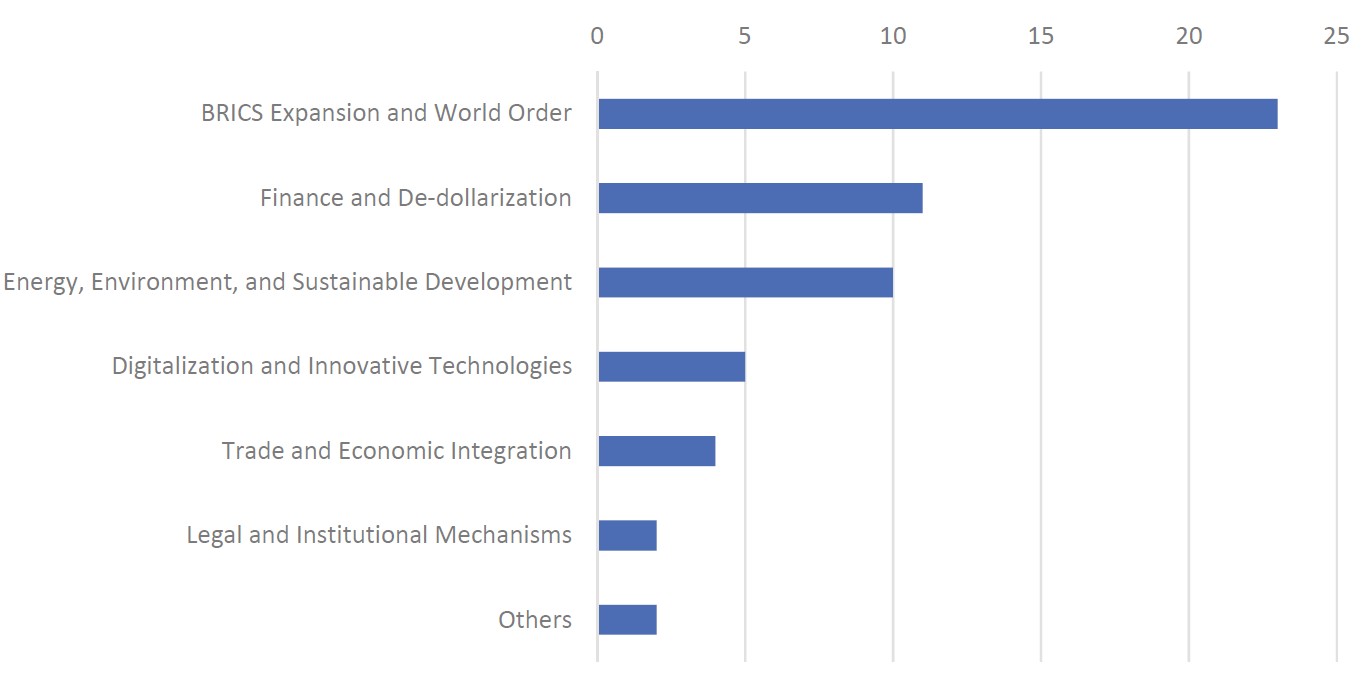
Figure 1. Most Popular Scientific Publication Topics on BRICS on ResearchGate from January 1, 2023, to April 1, 2025, by number of articles
Source: compiled by A. A. Aleshin.
Publications in the “Finance and De-dollarization” group address issues of stock market volatility, the impact of macroeconomic and corporate factors on financial indicators, de-dollarization, and the development of alternative payment systems. The authors focus on financial indicators and instruments, applying both classical econometrics and machine learning algorithms to analyze exchange rate dynamics, assess risks, and optimize the trading strategies of BRICS countries.
Articles in the “Energy, Environment, and Sustainable Development” group analyze energy efficiency, the transition to renewable energy sources, emissions reduction, carbon footprint analysis, and environmental sustainability measurement, as well as assessing the environmental impact of economic processes. Both macroeconomic and technological aspects of sustainable development in BRICS countries are examined. Many papers use econometric methods to analyze the impact of the energy transition, national environmental policies, and the role of education in promoting green growth.
The “Digitalization and Innovative Technologies” group analyzes the concepts of “Industry 4.0,” digital sovereignty, digital currencies, and the application of artificial intelligence and data analysis to optimize macroeconomic processes for practical application in various areas of BRICS economic policy and innovation management.
Articles in the “Trade and Economic Integration” group examine trade relations among BRICS countries, their competitive advantages, export and import dynamics, as well as the BRICS’s influence on global supply chains and the integration processes between its member countries.
The “Legal and Institutional Mechanisms” group includes works on the establishment and reform of investment arbitration, transnational legal processes and their role in ensuring sustainable development, and the development of new legal approaches to economic integration and dispute resolution.
The “Others” group comprises publications on education and human capital accumulation in BRICS countries, as well as the interrelationships within BRICS countries between military spending and structural economic problems, particularly income inequality.
Country Correlations of Scientific Publication Topics
About a quarter of the articles in the sample are devoted to individual countries (Figure 2). These studies focus on specific countries and their role in BRICS, their trade relations, economic characteristics, or unique country challenges. These include Brazil, India, China, Russia, South Africa, Egypt, the Middle Eastern countries, and Pakistan, a non-BRICS member. Let’s take a closer look.
Portuguese researchers I. M. Gebert and F. de Mello-Sampayo concluded in their article that during periods of crisis, the markets of Brazil and South Africa proved the most vulnerable in the BRICS, while China experienced rapid stabilization (Gebert & de Mello-Sampayo, 2025). They emphasized the importance of coordinating macroeconomic policies among BRICS countries to protect against global financial shocks.
Publications on India examined both political and economic issues. China-based scholar R. Verma concluded that India’s neutrality in the Russia — Ukraine conflict is not related to its desire to strengthen its status within BRICS, as bilateral relations with Russia do not affect the functioning of the group: BRICS is structured to avoid discussing contentious issues (Verma, 2024).
Mominur Rahman et al. (Bangladesh) examined the environmental sustainability impact of foreign direct investment in India from BRICS countries and ranked investments based on their correlation with CO2 emissions reductions (Mominur Rahman, Golam Faruque & Emran Hossain, 2024).

Figure 2. Percentage of Researchers’ Interest in General and Country-specific BRICS issues, %
Source: calculated by A. A. Aleshin.
China’s influence on BRICS development in the context of its conflict with the United States was studied by S. R. Bukhari et al. (Pakistan): through an examination of market mechanisms in China, the authors substantiate the view that Beijing is using BRICS to promote an alternative economic development model (Bukhari, Malik & Mahmood, 2024). The reverse impact of BRICS on the Chinese economy, specifically on the agricultural sector, is analyzed in an article by Turkish scholar R. Baki (2024): the author concludes that the level of trade integration with other BRICS countries remains low due to differences in their economic systems.
P. Mozias (National Research University Higher School of Economics) raised the issue of Russia’s identity as a developing economy and proposed that BRICS countries combine market reforms and state regulation (Mozias, 2023). Meanwhile, a group of Chinese researchers demonstrated that Russia and China have the greatest potential for intra-BRICS agricultural trade, but trade integration in this area faces logistical and regulatory barriers (Xin, Khan & Ling, 2024).
A. A. Ufimtsev (Institute for African Studies, Russian Academy of Sciences) identified Egypt’s motives for joining BRICS: access to financing through the New Development Bank, expanded trade with the group’s members, and reduced dependence on the US dollar (Ufimtsev, 2024).
The consequences of the accession of three Middle Eastern oil-exporting states—Iran, the UAE, and Saudi Arabia (the latter later declined to confirm its membership. — A. A.) — to BRICS were examined in articles by an international group of scholars (Ahmad, Haider & Afzal, 2024) and Brazilian researchers Kazelko & Semeghini (2024). It is noted that this expansion of the group has strengthened its influence in the energy sector, which could accelerate de-dollarization processes in energy trade. However, to achieve this, as emphasized in the articles, it is necessary to develop mechanisms for coordinating the interests and policies of the new members for effective economic cooperation. A study by S. Ahmad (China) and co-authors (Malaysia, Bangladesh) found that BRICS candidate Pakistan focuses primarily on China in its foreign trade, while its ties with the other BRICS countries are weaker. Trade with India has declined significantly in recent years due to political factors (Ahmad, Raihan & Ridwan, 2024).
Thus, country studies reveal differences in the motivations for participating in the association, economic structure, and foreign policy interests of BRICS member states. Some countries see BRICS as a tool for accelerating their own economic growth (Egypt, Pakistan), while others see it as a way to strengthen their global role (China, Russia). Furthermore, many researchers point out that BRICS needs greater institutional development to overcome internal contradictions and strengthen economic coordination.
Topics of the Most Cited Publications
Some publications with 10 or more citations will be considered separately.
In the article by B. T. F. Lee (China) and H. P. Sims (Chile), The BRICS+ Expansion, Global Trade Dynamics, and the Dedollarization Phenomenon (Lee & Sims, 2024), the following issues are highlighted in the context of the bloc’s expansion: the existence of differences in economic models, foreign policy interests, and levels of development among member countries, their dependence on the dollar, and the lack of a unified BRICS institutional structure. The authors conclude that “BRICS enlargement is not a quantitative increase, but a qualitative step toward restructuring the global economy. The bloc has the potential to act as a catalyst for de-dollarization, leveraging alternative currencies, digital technologies, and regional alliances to create a more balanced and sustainable global economic system” (Lee & Sims, 2024, p. 27).
Palestinian scholar M. Saaida’s article, BRICS Plus: De-Dollarization and Global Power Shifts in New Economic Landscape (Saaida, 2024), analyzes the implications of de-dollarization for the international financial system and the global balance of power. The author concludes that de-dollarization simultaneously contributes to the strengthening of the BRICS countries’ financial independence and to a redefinition of the global balance of power, while also creating serious challenges that require coordinated diplomatic and strategic efforts from both BRICS+ and the United States.
In the article by a group of US researchers, Accelerating BRICS Economic Growth: AI-Driven Data Analytics for Informed Policy and Decision Making (Abir et al., 2024), the authors highlight the ineffectiveness of decision-making methods in the BRICS countries in addressing issues such as income inequality, the need for industrial transformation, and infrastructure shortages. The article focuses on the BRICS countries’ efforts to integrate AI-based data analytics, noting that this has helped them to optimize resource allocation, eliminate inefficient trade flows, and mitigate labor market inequality.
In his article, BRICS New Payment System: A Challenge to the US Dollar’s Dominance (Valamontes, 2024), US scholar A. Valamontes analyzed the vulnerability of the BRICS countries in the Western-centric global financial architecture and proposed using blockchain and distributed ledger technologies to increase trust among participants, optimize trade flows, and circumvent Western sanctions.
The aforementioned article by Brazilian scholars Kazelko & Semeghini (2024) notes that the existing global financial architecture forces BRICS countries to operate under dollar-dominance, which limits their investment opportunities in energy and mineral resource extraction. Following its expansion, BRICS has united countries with large mineral resource reserves and leading oil producers with countries that are rapidly growing energy consumers. Consequently, BRICS could significantly alter global energy markets, with the bloc concentrating up to 72 % of the world’s rare earth metal reserves (Kazelko & Semeghini, 2024, p. 65). Furthermore, the entry of Egypt and Ethiopia has increased the role of countries in the Global South in regulating global energy trade.
In his article, The Economic and Geopolitical Significance of the BRICS Nations: A Comparative Analysis of Their Global Influence in the 21st Century (Moch, 2024), German researcher E. Moch examined the potential for further BRICS integration in the context of the existing imbalances in the global financial system and identified opportunities for deepening this integration. However, obstacles remain, including the BRICS countries’ insufficient influence in global institutions, which limits their role in shaping global political discourse, as well as differences in political regimes, economic models, and strategic priorities among the BRICS countries. This impacts their ability to develop directions for collective action in the international arena.
In 2024, the Russian National Committee on BRICS Research, jointly with MGIMO University and the University of World Civilizations, published a joint monograph titled BRICS in the World Finance and Economics. It features 35 chapters on a variety of topics authored by scholars from Russia and the BRICS member countries. Most experts observed a shift from the traditional dominance of Western-centric institutions to a more balanced and inclusive global architecture, where BRICS countries seek to play a leading role in the formation of alternative centers of influence. Many also observed the link between progress in innovation and technology and sustainable development. The monograph devotes significant attention to the problem of reforming global governance institutions in the context of the transformation of the BRICS agenda. It highlights the specific economic trajectories of each of the bloc’s countries and the challenges of aligning the positions of states with different political systems, cultures, traditions, and governance models. It is noted that the most pressing issue is the need to maintain a balance between the collective actions of BRICS participants and the preservation of their independent foreign policy (Gerasimov & Yarygina, 2024).
Another noteworthy publication is the monograph by German researchers Petry and Nölke, BRICS and the Global Financial Order: Liberalism Contested? (Petry & Nölke, 2024). In it, the authors examine the impact of BRICS developments on the dynamics of the global financial architecture. They primarily focus on de-dollarization policies, which are being implemented in four ways:
- the establishment of sovereign financial institutions, national rating agencies, and development banks by member countries,
- financial protectionist practices, restrictions on capital mobility, and controls over cross-border investments,
- the intensification of the use of national currencies in international settlements,
- attempts to form alternative international financial structures, such as the New Development Bank or contingent reserve arrangements.
The authors believe that the BRICS countries are not rejecting the global financial order, but rather, by combining elements of liberalism and state capitalism in their economic policies, are forming parallel financial mechanisms. China is leading the transformation of international financial structures. At the same time, India and Russia are playing a significant role in energy and stimulating trade settlements in national currencies. The 2024 expansion of BRICS marks a significant milestone in strengthening the bloc’s global role.
Conclusion
Thus, since 2023, the academic literature on BRICS has featured a variety of publications, primarily by scholars from non-Western countries. No unified approach has emerged among researchers to explaining and assessing BRICS development. Their perspectives differ significantly based on the authors’ geographic origins (scholars from BRICS member states, third-party countries, or Western countries). The research perspective is also influenced by the choice of subject matter—specific features of the target country’s national policy, its model of political and economic development, and the material, institutional, and reputational potential of its foreign policy. At the same time, most scholars agree on the key parameters of the most general trends in BRICS development in the context of the transformation of the global order and on the identification of the main challenges facing the association as a whole.
Of the three areas of cooperation within BRICS—politics and security, economics and finance, and cultural and humanitarian ties[5]—the second is the most sought-after by researchers: the impact of BRICS expansion on the transformation of the global economic order and the global financial system. This is likely due to the fact that this is precisely the area in which the group has demonstrated its greatest success. For the same reason, publications by Western scholars tend to emphasize the contradictions between BRICS members and the limitations of BRICS’s potential to influence global economic change.
Many scholars are interested not in the political issues of consensus-building and institutionalization of the association, but in practical mechanisms for accelerating de-dollarization and economic growth, including through new technologies. Of particular note is a series of publications on the strengthening role of BRICS in global energy markets following the association’s expansion. However, the overwhelming majority of scholars identify political issues as the key challenges facing BRICS, including conflicts between member countries, diverging national interests, differences in national political and economic models, and the differing foreign policy potentials of member countries due to economic and technological disparities.
Based on the conducted research, positive and negative trends in the development of BRICS can be identified.
The positive trends include:
- expansion of the association’s membership,
- strengthening its status, authority, and global role,
- increasing its influence by including countries with different economic characteristics and advantages,
- expanding the association’s thematic agenda, primarily through technological development issues.
The main trend in this group is rising expectations for BRICS activities and their impact on the transformation of the global economy, the global financial system, and international law.
Negative trends include:
- the erosion of the association’s common goals due to the inclusion of countries with different national interests,
- the growing conflicts between some BRICS members and between them and third countries caused by the transformation of the global order,
- the widening gap in the levels of economic development between the most and least influential member states,
- increasingly pronounced differences between the national political and socioeconomic models of BRICS countries,
- the growing negative impact of the policies of leading countries outside BRICS on its members, primarily in the area of sanctions and protectionism,
- the persistent ineffectiveness of BRICS financial and investment policies.
As can be seen, many trends are facets of the same processes and are presented as positive or negative, which often depends on the context. In other words, the same processes are exerting a dual influence on BRICS development, and the depth and extent of their future impact will depend on a multitude of factors—both those related to the success of BRICS integration and general trends in the global economy and international relations.
It appears that the key question regarding BRICS’s future development can be formulated as follows: “What is the consensus-achievable depth of integration among BRICS countries?” Based on an analysis of the scientific literature, it appears that the parameters of this integration will determine the degree of transformation of the international relations system, particularly in the financial sector, in the long term.
1 Muratbekova A. Assessment of the Results of the 2024 BRICS Summit // Eurasian Research Institute. (In Russian). URL: https://www.eurasian-research.org/publication/evaluating-the-2024-brics-summit-outcomes/?lang=ru (accessed: 04.05.2025).
2 See, e.g.: Lissovolik Y. BRICS Plus after the 2023 “Expansion Summit” // Russian International Affairs Council. January 17, 2024. URL: https://russiancouncil.ru/en/analytics-and-comments/analytics/brics-plus-after-the-2023-expansion-summit/ (accessed: 13.05.2025).
3 See, e.g.: (Istomin, 2016; Prokhorenko, 2019; Degterev, 2021).
4 ResearchGate. URL: https://www.researchgate.net/ (accessed: 03.05.2025).
5 See: XVI BRICS Summit. Kazan Declaration “Strengthening Multilateralism for Equitable Global Development and Security”. Kazan, Russian Federation. October 23, 2024 // President of Russia. URL: http://static.kremlin.ru/media/events/files/ru/MUCfWDg0QRs3xfMUiCAmF3LEh02OL3Hk.pdf (accessed: 07.05.2025).
About the authors
Alexander A. Aleshin
Primakov National Research Institute of World Economy and International Relations, Russian Academy of Sciences (IMEMO)
Author for correspondence.
Email: aleshin.a@imemo.ru
ORCID iD: 0000-0002-7872-3298
SPIN-code: 5114-9932
PhD (Political Sciences), Senior Research Fellow
23 Profsoyuznaya St, Moscow, 117997, Russian FederationReferences
- Abir, S. I., Sarwer, M. H., Hasan, M., Sultana, N., Dolon, Md Sh. A., & et al. (2024). Accelerating BRICS economic growth: AI-driven data analytics for informed policy and decision making. Journal of Economics, Finance and Accounting Studies, 6(6), 102–115. https://doi.org/10.32996/jefas.2024.6.6.8; EDN: IEVCWF
- Ahmad, I., Haider, A., & Afzal, J. (2024). The geopolitical and economic impact of BRICS on the Middle East. FWU Journal of Social Sciences, 18(4), 80–95. EDN: PKHLCP
- Ahmad, S., Raihan, A., & Ridwan, M. (2024). Pakistan’s trade relations with BRICS countries: Trends, export-import intensity, and comparative advantage. Frontiers of Finance, 2(2), 1–23. https://doi.org/10.59429/ff.v2i2.6551
- Aleshin, A. A. (2021). Scientific discourse role in the UK national security strategy transformation. Analysis and Forecasting. IMEMO Journal, (4), 72–84. (In Russian). https://doi.org/10.20542/afij-2021-4-72-84; EDN: HWZRDD
- Aleshin, A. A. (2022). Scientific discourse on NATO’s strategic evolution. Mezhdunarodnye Processy, 20(4), 136–156. (In Russian). https://doi.org/10.17994/IT.2022.20.4.71.1; EDN: XOXVIJ
- Antony, S. (2023). Diversification of BRICS: Emerging economic and geopolitical shift. Strategic Analysis, 47(6), 565–570. https://doi.org/10.1080/09700161.2024.2311475; EDN: QRWKWP
- Baki, R. (2024). Comparison of innovation performances of BRICS countries through CRITIC and GRA methods. Gaziantep Üniversitesi Sosyal Bilimler Dergisi, 23(4), 1561–1570. https://doi.org/10.21547/jss.1368192; EDN: THWKCC
- Bukhari, S. R. H., Malik, S. M., & Mahmood, M. A. (2024). Chinese BRICS: Contamination of US-led neoliberalism. Pakistan Social Sciences Review, 8(2), 320–331. Retrieved from https://ojs.pssr.org.pk/journal/article/view/642/485
- Carmody, P. (2024). BRICS’ enlargement: Power expansion or contraction in a changing world order? EconPol Forum, 25(1), 14–17. Retrieved from https://www.econstor.eu/bitstream/10419/284111/1/1882221397.pdf
- Degterev, D. A. (2021). Non-Western theories of development in the global capitalism era. World Economy and International Relations, 65(4), 113–122. (In Russian). https://doi.org/10.20542/0131-2227-2021-65-4-113-122; EDN: IQFDQE
- Foucault, M. (1996). Archeology of knowledge. Kiev: Nika-Tsentr publ. (In Russian).
- Gebert, I. M., & de Mello-Sampayo, F. (2025). Efficiency of BRICS countries in sustainable development: A comparative data envelopment analysis. International Journal of Development Issues, 24(1), 38–54. https://doi.org/10.1108/IJDI-12-2023-0287; EDN: BZPKFP
- Gerasimov, V. I., & Yarygina, I. Z. (Eds.). (2024). BRICS in the world finance and economy. Moscow: MGIMO-Universitet publ. (In Russian). EDN: APFULR
- Istomin, I. A. (2016). Evaluation of the international system in Russian official discourse and academic analysis. MGIMO Review of International Relations, (5), 20–33. (In Russian). EDN: YGCOQH
- Kazelko, A., & Semeghini, U. S. (2024). Expansion of BRICS: Implications for global energy markets. BRICS Journal of Economics, 5(1), 53–67. https://doi.org/10.3897/brics-econ.5.e117048; EDN: ALSRCT
- Khoros, V. G., & Potapova, E. Yu. (2024). From BRICS to BRICS+: The road to a new world order. Polycentric World, 1(1–2), 64–76. (In Russian). https://doi.org/10.20542/pwj-2024-1(1–2)-64-76; EDN: IHDABV
- Lee, B. T. F., & Sims, J. P. (2024). The BRICS+ expansion, global trade dynamics, and the dedollarization phenomenon. Unnes Political Science Journal, 8(1), 19–29. https://doi.org/10.15294/upsj.v8i1.4432; EDN: LDRKJA
- Moch, E. (2024). The economic and geopolitical significance of the BRICS nations: A comparative analysis of their global influence in the 21st century. East African Journal of Business and Economics, 7(2), 86–100. https://doi.org/10.37284/eajbe.7.2.2310; EDN: SNDEMC
- Mominur Rahman, Md., Golam Faruque, Md., & Emran Hossain, Md. (2024). Does good governance intensify the impact of energy finance on globalization? Evidence from BRICS nations. Research in Globalization, 9, 1–12. https://doi.org/10.1016/j.resglo.2024.100264; EDN: AKTQDW
- Mozias, P. (2023). Russia as a country of BRICS: Issue of identification. BRICS Journal of Economics, 4(3), 321–333. https://doi.org/10.3897/brics-econ.4.e98255; EDN: XKQQSX
- Nach, M., & Ncwadi, R. (2024). BRICS economic integration: Prospects and challenges. South African Journal of International Affairs, 31(2), 151–166. https://doi.org/10.1080/10220461.2024.2380676
- Petry, J., & Nölke, A. (2024). BRICS and the global financial order: Liberalism contested? Cambridge: Cambridge University Press. https://doi.org/10.1017/9781009498739
- Prokhorenko, I. L. (2019). Foreign policy thinking in Latin America: Concepts, approaches and research directions. Vestnik RUDN. International Relations, 19(2), 177–186. (In Russian). https://doi.org/10.22363/2313-0660-2019-19-2-177-186; EDN: RLKMSY
- Prokhorenko, I. L. (2024). BRICS: Results of the South African presidency and the decision to expand the composition of the participants. In V. G. Baranovsky & E. G. Solovyev (Eds.), Year of the planet (pp. 107–114). Moscow: Idea-Press publ. (In Russian). EDN: JAWFEO
- Saaida, M. (2024). BRICS Plus: De-dollarization and global power shifts in new economic landscape. BRICS Journal of Economics, 5(1), 13–33. https://doi.org/10.3897/brics-econ.5.e117828; EDN: HOTKST
- Smirnov, E. N., & Pasko, A. V. (2023). A new model for the development of economic cooperation within BRICS. Vestnik Altaiskoi Akademii Ekonomiki i Prava, (12–1), 147–153. (In Russian). https://doi.org/10.17513/vaael.3148; EDN: MCENDB
- Strelnikova, I. A., Maiorov, M. G., & Popov, D. I. (2024). BRICS expansion: Implications for logistics cooperation in the Arctic. Analysis and Forecasting. IMEMO Journal, (3), 71–82. (In Russian). https://doi.org/10.20542/afij-2024-3-71-82; EDN: FGFWBI
- Swales, J. M. (1990). Genre analysis: English in academic and research settings. Cambridge: Cambridge University Press.
- Ufimtsev, A. A. (2024). Economic and political aspects of Egypt’s accession to BRICS. Asia and Africa Today, (11), 49–56. (In Russian). https://doi.org/10.31857/S0321507524110066; EDN: CTIJQJ
- Valamontes, A. (2024). BRICS new payment system: A challenge to the US dollar’s dominance. Geopolitics Report, 1(12), 1–4. https://doi.org/10.5281/zenodo.13927101
- Verma, R. (2024). India’s quest for status and neutrality in the Russia—Ukraine war: BRICS, a case study. International Journal: Canada’s Journal of Global Policy Analysis, 79(1), 61–78. https://doi.org/10.1177/00207020231221831; EDN: JZYMCH
- Xin, G., Khan, H., & Ling, X. (2024). The impact of BRICS trade facilitation on China’s import and export trade in agricultural products. Frontiers in Sustainable Food Systems, 8, 1–12. https://doi.org/10.3389/fsufs.2024.1397350; EDN: FNHBKD
Supplementary files
Source: compiled by A. A. Aleshin.
Source: calculated by A. A. Aleshin.

