





 Email this article


Reconstructed conceptual model ‘God’ as a dominant value of Russian culture

- Authors: Denisenko V.N.1, Safaralieva L.A.1
-
Affiliations:
- RUDN University
- Issue: Vol 24, No 1 (2026): ARTIFICIAL INTELLIGENCE IN SCIENTIFIC RESEARCH AND TEACHING THE RUSSIAN LANGUAGE
- Pages: 138-153
- Section: Cultural Linguistics: Theoretical and Applied Aspects
- URL: https://journals.rudn.ru/russian-language-studies/article/view/49282
- DOI: https://doi.org/10.22363/2618-8163-2026-24-1-138-153
- EDN: https://elibrary.ru/UWRENM
- ID: 49282
Cite item

Abstract
The relevance of the study is determined by the need to develop new methods and approaches in a relatively young field of axiological linguistics, and to understand the term ‘dominant cultural value’, which has been recently introduced into scientific use by Professor V.I. Karasik. The moral and ethical guidelines of Russian society, reflected in the value attributes of the concept “God,” shape the national-ethnic consciousness and self-determination of Russian language speakers. The aim of the study is to reconstruct the model of the concept “God,” reflecting the views of Russian speakers on faith in God as one of the most important social values and to analyze the attitudes and behavioral stereotypes of Russian people embedded in the value attributes of this concept. The material used includes explanatory and etymological dictionaries of the Russian language, Russian National Corpus, 54 proverbs and sayings with the component God selected with a comprehensive sampling method from paremiological dictionaries, and the lyrics of contemporary Russian-speaking singers. The aim was achieved with the help of descriptive, linguistic-cultural, and linguistic-axiological methods. The ambivalent features of the concept “God” are revealed; on the one hand, God represents the supreme supernatural power, and on the other, he is a person possessing authority. The etymon of the concept verbalizer, or the name of the concept is an Old Indian root meaning ‘lord, bestower of wealth’. This is reflected both in the conceptual and figurative features of the concept under study; God represents the source of light, the highest degree of goodness, and a force that governs human life and predetermines human destiny. The analysis of proverbs and sayings with the component God, and Russian-language lyrics identified the value content of the concept “God,” which determines the behavioral attitudes of Russian speakers. A promising direction for research is the reconstruction of the concept “God” in other linguistic cultures compared with the Russian linguistic culture.
Full Text
Introduction
According to the anthropocentric paradigm of modern linguistics, language signs have a cultural component and a nationally marked evaluative content inherent in a particular people; it reflects how a native speaker of a particular language views the surrounding reality. The reconstructed linguistic worldview of a particular nation and the linguistic consciousness of native speakers identify the most significant value fragments of national culture which are reflected in linguistic units. At the same time, the linguistic consciousness “is not only anthropocentric, but also ethnocentric since the image of the world changes from one culture to another” (Vezhbitskaya, 1996). A.A. Leont’ev also believes that linguistic consciousness is always ethnically conditioned since “each nation’s worldview is based on its own system of subject meanings, social stereotypes, and cognitive schemas” (Leont’ev, 1993: 20).
The linguistic picture of the world is a set of linguistic and cultural concepts or special mental formations which represent “an operational unit of cultural memory, a quantum of knowledge, a complex and at the same time rigidly unstructured semantic education” (Alefirenko, 2011: 35); “a set of conceptual, figurative, and value features” (Karasik, 2022b: 17, 18). It is the value component that classifies cultural value dominants[1] or “behavioral dominants peculiar to representatives of a particular society” (Karasik, 2022a: 62). Thus, one of the priorities of modern linguistics, its axiological direction in particular, is to identify and describe fragments of the linguistic worldview which verbalize relevant concepts whose value component influences the behavior of native speakers. “Modeling Russian linguistic and cultural concepts <…> allows to delve deeply into the semantic spaces of language and to reveal the cultural and moral dominants of society” (Denisenko, Safaralieva, Perfilyeva, 2024: 59).
Cultural values are widely studied. Yu.S. Stepanov has systematized the cultural values of the Russian people and compiled a list of cultural constants, “concepts of Russian culture such as ‘Eternity’, ‘Law’, ‘Lawlessness’, ‘Fear’, ‘Love’, ‘Faith’, etc. <...>> There are not many of them, from four to five dozen, and yet the very spiritual culture of any society consists largely in operating with these concepts” (Stepanov, 1997: 7). I.A. Golovanov and E.I. Golovanova define the term “constants”: “Traditional, stable ‘predispositions’ in the perception and assessment of the world in the national consciousness can be designated by the word constants, taking into account the content of the corresponding concept in Yu.S. Stepanov <...> They summarize ethical imperatives accepted and shared by representatives of a national community” (Golovanov, Golovanova, 2015: 13). O.V. Lomakina, V.M. Mokienko also writes about value constants, “mental constants characteristic of a particular nation <...> which represent their traditions, mentality, national character, and social experience” (Lomakina, Mokienko, 2019: 313).
V.L. Abushenko believes that values are “the semantic foundations of human existence which set the direction and motivation of human life” (Abushenko, 2002: 21). According to V.A. Maslova, “everything that has a certain significance, personal or social meaning is a value <...> we can consider a number of concepts as values” (Maslova, 2011: 383). I.S. Bolotnova believes that “the axiosphere and the means of its representation are one of the urgent subjects of modern Linguistics” (Bolotnova, 2025: 54).
We follow the concept of V.I. Karasik, who believes that “values are recognized, conditioned by emotions, and determine actions <...> The emotional conditioning of values is based on the experienced system of cultural priorities, and actions fit into stereotypical actions accepted in the society” (Karasik, 2022a: 60, 61). V.I. Karasik suggests dividing all cultural values into basic, utilitarian, moral, and terminal ones (Karasik, 2022b: 14–16).
One of the most important values of Russian culture is faith in God, which is a dominant terminal value of the Russian-speaking society. Many scientific works are devoted to the concept “God” in Russian linguistic culture: O.K. Kalkova (2009) investigated the cultural concept “God”; M.C. Kremshokalova attempted to analyze the attitude to God in the genre picture of the world (Kremshokalova, 2014); L.N. Gishkaeva, O.V. Lomakina and A.S. Makarova analyzed the reflection of faith in God in the proverbs of 11 languages (Gishkaeva, Lomakina, Makarova, 2021); E.V. Miletova studied English-language sermons to describe the concept of “God” as a dominant value (Miletova, 2024), etc.
The aim of research is to reconstruct the model of the concept “God” as the value constant or value dominant of Russian culture in three projections:
- comprehension of the conceptual content of the concept (analysis of explanatory and etymological dictionaries);
- description of the figurative content (based on the contextual use of the concept verbalizers);
- identification of the value content expressed in the paremiology and songs of Russian singers and reflection of the attitudes and prescriptions of the behavior of Russian native speakers.
Methods and materials
The research material included Russian language dictionaries: explanatory[2], etymological[3], 54 proverbs and sayings with the component “God”, selected by continuous sampling from paremiological dictionaries[4], examples from Russian National Corpus[5], and lyrics of songs of Russian singers Shaman, A. Barykin, V. Kalina, Smokey Mo, etc[6].
The main research methods are the component analysis, descriptive, linguistic-axological, and linguistic-cultural methods.
Results
The analysis of the concept “God”, the reconstruction of its conceptual, figurative, and value features reveal the perception of God by Russian language native speakers and identify certain value orientations embedded in proverbs, sayings, and song discourse, which regulate the behavior of Russian-speaking people. Thus, the idea that faith in God is the dominant value of Russian culture is substantiated.
On the one hand, Russian language native speakers perceive “God” as a special force which completely controls the fate of a person. On the other hand, it is postulated that a person can control his own life and approach the image of God the creator. Thus, there is a certain ambivalence in the perception of God by Russian language native speakers.
Despite the influence of extralinguistic factors, the dominance of atheistic views in the Soviet era and the ban on religious rituals and views, the value attitudes in paremia with the component “God” are not lost and acquire a new meaning: a Russian should lead a decent God-fearing life in order to avoid trouble and get what they want, to become happy and to protect their homeland, Russia. Russian song discourse is dominated by this idea: love for the Motherland is love for God, and this love is the highest value for a Russian.
Conceptual, figurative, and value features of the concept under study identify the following attitudes and prescriptions of Russian behavior:
- Man should accept the idea that God is a Higher Power that governs the world and determines human life.
- Despite everything in the world is governed by God, a person must not be idle; on the contrary, they should make efforts to get what they want, they should work and improve themselves in order to become happy.
- Faith in God determines relationship with other people: one should not complain about life, hold grudges, or judge others, because everybody is responsible for his own actions before God.
- A native representative of Russian linguistic culture faces a choice: to believe in God as the highest degree of goodness and mercy towards man, or to succumb to the temptation of evil. Russian proverbs present an unequivocal decision: a person should choose God, otherwise difficulties and troubles await him. Russian song discourse reinforces this idea: the Russian people were chosen by God by right of birth, and this must be taken into account.
- True love is the love for God, which is embodied in the love for the Homeland, and it is the force which unites the Russian people in the fight against enemies.
Discussion
The dominant value “God” is reconstructed with an integrated approach to conceptual, figurative, and value features, or components of the concept with the same name.
The meanings of the name of the concept, the lexeme “God”, determine the conceptual features of the concept under study.
The following interpretations of the mentioned lexeme are found in the explanatory dictionaries of the Russian language:
- “according to religious beliefs, the supreme being who created the world and controls it...”[7].
- “Masculine. 1. According to religious beliefs, the creator of heaven and earth, of all things; the omniscient supreme mind which governs the world; the universal principle; 2. According to polytheism, one of the supernatural beings who govern a part of universe, patronize someone or something. 3. A person who had power over other people. 4. Something or someone being worshipped or admired”[8].
- “Masculine. 1. One of the supernatural beings who controls a certain part of the world and influences a certain sphere of human life || Figurative. A person with power over other people. 2. Figurative. Someone who is worshipped or admired; an idol. 2. God I masculine. The Creator of the universe, of all things, possessing, according to religious beliefs, a higher mind and governing the world. II. The highest, ultimate authority based on the objective truth of justice, goodness, universal culture, and freedom”[9].
- “Masculine. 1. In religion, the supreme omnipotent being who rules the world or one of such beings in polytheism. 2. Begins with a capital letter. In Christianity, the triune deity, the creator, and the universal principle. 3. Figurative. The object of worship, adoration. Obsolete, bookish”[10].
The interpretations identify the following conceptual features of the concept “God”:
- the supreme omnipotent being;
- the Creator of the world, the universal principle;
- higher intelligence;
- the highest truth and justice, the good;
- a powerful person;
- an object of worship, an idol.
On the one hand, “God” in Russian linguistic culture is a supernatural being who created the world and justly governs all living things, the ultimate truth. On the other hand, any talented person can approach the status of a “God” and rise above other people. Thus, there is ambivalence in the representation of “God” (Figure 1).

Figure 1. Ambivalence of the conceptual content of the lexeme God
Source: compiled by V.N. Denisenko, L.A. Safaralieva.
Thus, the content of the concept “God” has two opposing ideas: about the superpower of “God”, his unlimited power over people and, at the same time, about the power of man himself, his ability to build his own life and manage it.
Dictionary entries reflect the influence of Soviet ideological dominants. For example, D.N. Ushakov in his Explanatory Dictionary of the Russian Language calls into question the unlimited power of “God”: “According to religious beliefs, God is the supreme being who is supposedly standing above or controlling the world. The idea of God is used by the ruling classes to oppress the working class”[11]. The dictionary entry supports the idea with V.I. Lenin’s quotation which illustrates the negative impact of religious ideas on the consciousness of Russian native speakers: “First of all, God is historically and worldly a complex of ideas generated by the stupid oppression of man, external nature, and class oppression; these ideas consolidate this oppression and lull the class struggle”[12]. This interpretation of the lexeme “God” reinforces the idea that only man himself can and must manage his life. This meaning is not included in subsequent editions of the dictionary[13].
The etymological basis of the word “God” is the ancient Indian root *bhaga-s with the meaning ‘bestower, lord, happiness, wealth’; “the older meaning of the common Slavic bogъ is ‘bestowing wealth’. Probably, the common Slavic bogъ has an ancient Arabic origin, where baha, baga means ‘fate’, ‘lord, God’, or goes back to the ancient Indian bhaga-h ‘welfare, happiness’ and ‘giving, bestowing’”[14]. Thus, there is one more conceptual feature of the concept of “God”:
The Lord who gives wealth and happiness.
The figurative features of the concept “God” are established through the analyzes of statements clarifying its main characteristics. In the main subcorpus of Russian National Corpus, the word “God” is found in 228,514 examples and in 21,702 texts. At the same time, its frequency is significantly higher in 1900–1920 and 1990–2020 (Figure 2). This is due to extralinguistic reasons; in these periods, the attitude of the Russian government towards religion in general and faith in God in particular was quite democratic, it was even supported by the government.

Figure 2. Frequency of the word “God” in 1900–2021 in Russian National Corpus
Source: Russian National corpus. URL: https://ruscorpora.ru (Access date: 30.08.2025).
The frequency of the word “God” was lower in 1920 to 1990, in the Soviet period, when all religions, Christianity, Islam, and faith in God, were banned: “30 years ago, on October 25, 1990, the law ‘On freedom of religion’ marked the end of more than 70 years of struggle against religion in the Soviet Union.”[15]
The most frequent expressions with the word “God” from the main subcorpus of Russian National Corpus are given in Figure 3.
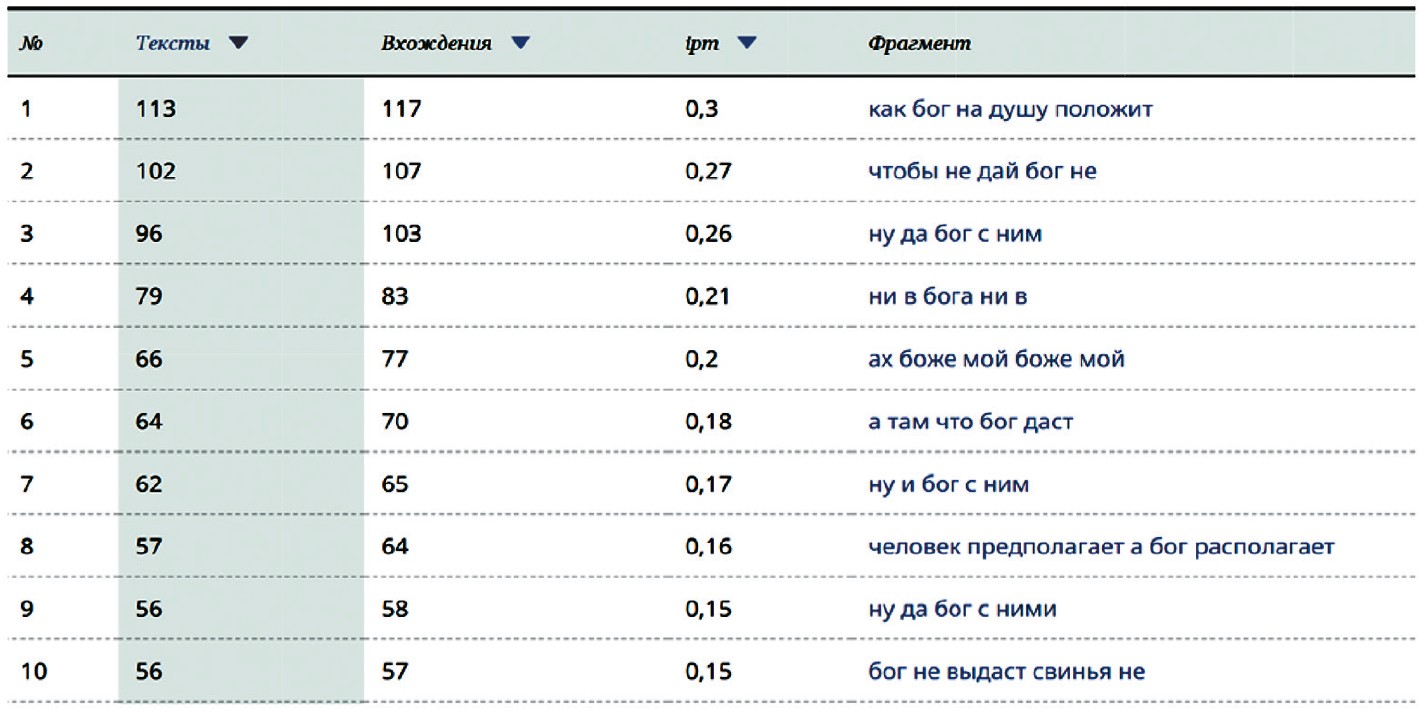
Figure 3. The most frequent expressions with the word “God” (5 components)[16]
Source: Russian National corpus. URL: https://ruscorpora.ru (Access date: 20.08.2025).
6 out of 10 above expressions reflect the ideas of Russian native speakers about God as an omnipotent and boundless force controlling man and his destiny. In the minds of Russian native speakers, it is God who directs events and everything that happens in the world:
“And those who stayed at school taught literature in higgledy-piggledy style” (literally ‘in the way God willed them to’); these examples[17] reflect the idea of God’s influence on the actions of a person who is only a passive observer of his life;
“He is a bad employee. Well, forget him” (literally ‘let God be with him!’); is often used in situations which require taking measures or any actions when native Russian speakers prefer to “let go”, leave the decision to higher powers or God;
“The task is to get to the Don Army area, and then as God will arrange. But man proposes, and God disposes; due to unfortunate circumstances, Lev Gurary had to unconditionally agree with this irrefutable fact”; these examples reflect the idea of Russian native speakers about divine predestination of life, about human impotence before the higher forces determining the future;
“From all sides, there will be a curse and people holding hands behind their back not to defile themselves with a handshake, God forbid”; an expression “God forbid” symbolizes a person’s faith that God can protect from unworthy or incorrect actions or deeds;
“You see, he was uncomfortable admitting that he, an old party member, a partisan commander, does not believe in God or the devil, but believes in the mysterious disappearance of my mother;” here God embodies true justice and the highest degree of goodness, which is opposed to the dark evil forces;
“Well, come on, let’s see… God will not betray, the pig will not eat! Moreover, I don’t see any suspicious car, it seems that there are no Federal Security Service or Internal Investigations Division officers here;” this example reflects the idea that everything can happen; if you believe in God, He will protect you from any troubles;
“Oh, my God, my God, what did he miss at home? Is this from Galaktion Pavlovich?”; this interjection originating from the vocative case of the word “God” (Боже) is used when a person wants to share his strong feelings and emotions with God.
The above-mentioned meanings reconstruct the following figurative features of the concept of “God”:
- The Almighty power;
- The embodiment of kindness, love;
- Carrying the light;
- Determining the fate of a person and his actions;
- Opposed to the forces of evil, to the devil.
The value features of the concept “God”, which underlie the stereotypical norms of behavior of Russian native speakers and characterize the “God – man” relationship, are reconstructed through the analysis of proverbs and sayings since “their basic aim is to directly convey the norms of behavior accepted in society”[18]. The paremiological fund of language contains the value dominants or value constants. According to O.V. Lomakina, they are reflected in semantic dominants, “in the general semantics which unites paremias of two or more languages and expresses the basic meanings and moral attitudes” (Lomakina, 2021: 173). Since the concept is expressed in language and various textual form (Popova, Sternin, 2001: 29), we analyze the texts of modern Russian songs where the relationship “God-man” is represented.
Thus, Russian paremiology formulates the following attitudes and prescriptions of behavior:
One should lead a decent God-fearing life to avoid trouble and get what he wants: Fear God! ‘behave conscientiously and wisely’; God spared me ‘about a solved problem without unpleasant consequences’; God gave someone / something ‘about someone or something a man has got’; God did not offend ‘about a person’s wealth’; God is merciful ‘about the hope that any situation will be resolved safely’; Live not as you want, but as God commands[19];
A man should choose good (God), not evil (the devil): God gave a priest, and the devil gave a buffoon; God gave a way, and the devil threw a hook; God gave relatives, and the devil gave enemies; God gives money, and the devil gives a hole, so God’s money go into the hole; God gave a way, so do not stray and do not trust an evil guide; God owns the brave, but the devil wobbles the drunken;
God governs human life: To give the soul to God ‘to die’; We all walk under God ‘trouble, misfortune can happen to anyone; God gave, and God took away ‘an expression of humility at the loss of someone, something’; Without God you cannot reach even the threshold ‘God helps in everything’; God closed his eyes ‘his eyesight has deteriorated; someone has died’, God changes the road ‘about unexpected events’, God has broken off his wings ‘someone became softer’, God has removed somebody ‘about someone’s death’; to look at God with one eye ‘to be near death’; to walk under God ‘to live, to exist’; As God wishes ‘about resignation to fate’; God gave us life, and He will give us health; God gives you a day, and He will give you food; If God does not want it, man will not be able to do it; I would not like it so much, but God ordered to do it; offended by God ‘about a poor or stupid person’; God has not given him mind ‘about a stupid person’; God blessed someone ‘someone is doing well’;
Only God knows about everything that happens in the world, and man cannot know this: God knows; only God knows ‘about something unknown’; God knows where ‘very far away‘; God knows what ’something unimaginable’; Where God sends ‘anywhere’; God sees, but will not tell us; God sees who is going where; God builds and preserves everything, gives limits to everything; God does not slumber, He hears everything;
One should not complain about life; one should not judge other people and hold grudges: Do not anger God! ‘you must not be dissatisfied’; God will forgive you ‘response to an excuse’; God is your judge ‘unwillingness to condemn someone’; God is with you ‘expression of reconciliation, forgiveness’;
One should not rely only on God, one must make efforts to achieve something: Rely on God and do not flatter yourself; God protects the protected, and the saber protects the Cossack; Let God bless us to get up, and we will lie down ourselves; God gave you health, and you should get the money yourself; God gave the ability as a gift, but you should get knowledge yourself; God is God, but you do not be bad yourself; Whoever gets up early, God gives him something; Whoever takes care of himself, God protects him; Pray to God, and work yourself.
The proverbs given above reflect the ideas of Russian native speakers about God as an active creative higher power controlling the destinies of people: “This active attitude to life and destiny is not the dominant feature of Russian linguistic consciousness <...> This is a repeatedly noted feature of the Russian national character and mentality that not a person, not his active actions change something, but a force outside, an element beyond his control which controls his decisions and actions” (Sanchez Puig, Karaulov, Cherkasova, 2001: 15). At the same time, some proverbs and sayings reflect the idea that despite omnipotence of a higher power, a person must also work, although the result of his labor depends on the will of God.
Now let us turn to the analysis of song discourse. In Russian-language songs, we find the same value orientations as in Russian paremias.
The song “Amen” by A. Barykin says:
“The soul has no happiness without God,
It longs for him, cries, tosses, and hurts…
A sick soul needs to pray to God.
God is waiting for his lost sons.
A soul without God has no happiness...”[20]
The lines contain a prescription that one should believe in God in order to be happy.
A similar idea is expressed in the song “May” by Macan:
“But thank God,
The pain pushes, but not for long,
in the end, to take us to heaven.”[21]
A few Russian songs postulate the idea that a Russian man should not complain about life, but gratefully accept everything that happens since everything is given by God:
✔ “Thank God for everything, Thank God for everything,
We must always come to terms with this.…
And there is no need to grumble and be afraid.…
We must all love and humble ourselves.…
Everything from God is given to us, sinners…
Do not grumble, but be patient and humble...”[22]
✔ “Thank you, God, thank you, beloved!
For the sight and hearing of our hearts.
And that we still have the desire
To love everything around.
There is on more idea in the Russian song discourse: God loves people, and his love is unconditional:
✔ “God loves all people:
Me and you,
Both big and small,
He will accept everyone lovingly.”[24]
✔ “This is love, God’s love,
It will flood everything, fill everything,
Only love, God’s love,
Everything in the world will pass, except for this love.”[25]
Many modern songs reflect the idea that Russian people were chosen by God and while they believe in God, Russia will always win:
✔ “We are Russians, which means God is with us.
We are chosen; we have our own way.
To the west, north, south, and east
Mother Russia is the abode of God.”[26]
“Our God is great, He is an omnipotent God
You are above all that breathes.
Our God is a healer; everything is in His power,
Our God, our God
And if God is with us,
who will revolt against us?
And if God is with us
✔ “As long as the Lord is with us and the truth is with us
We will say thank you for giving us the victory.
For those who have found their heaven and are no longer with us.
Conclusion
Our comprehensive study of the concept “God” allows us to conclude that the spiritual sphere of human life is culturally significant and underlies the stereotypical actions and decisions of Russian native speakers. Therefore, it represents the dominant value of Russian-speaking society. Despite the attempts of the Soviet government to eradicate the religious component of Russian culture, the concept “God” has kept its value for modern Russian people and acquired new features. It reflects the peculiarity of the Russian mentality, faith in the active principle of Higher Forces governing the world in general and man in particular.
The prospect of further research is to identify and describe the value dominants of other cultures in comparison with Russian culture.
1 Value dominants is the term of the Russian linguist V.I. Karasik (1996) denoting the most important and essential meanings of this culture with ethnic specificity. Cit.: Zhukova, I. N. (2013). Dictionary of terms of intercultural communication. Moscow: Flinta: Nauka Publ. (In Russ.). EDN: SDQYUD
2 Efremova, T. F. New Dictionary of the Russian language. Explanatory and word-forming. Moscow: Russky Yazyk publ., 2000.; Kuznetsov, S. A. Big Explanatory Dictionary of the Russian language. Saint Petersburg: Norint, 2000.; Ozhegov, S. I. Explanatory Dictionary of the Russian language: online version. 2008–2017; Evgenieva, A. P. (ed.). Dictionary of the Russian language: in 4 volumes. 3rd ed. Moscow: Russky yazyk publ., 1985.; Ushakov, D. N. (ed.). Explanatory dictionary of the Russian language: in 4 volumes. Moscow: Sovetskaya Encyclopedia : OGIZ publ., 1935–1940. Volume 1: And — Kyurin; Ushakov, D. N. Explanatory dictionary of modern Russian language. Moscow: Adelant publ., 2013.
3 Semenov, A. V. Etymological dictionary of the Russian language. The series “The Russian language from A to Z”. Moscow: YUNVES Publishing House, 2003; Fasmer, M. Etymological dictionary of the Russian language, Moscow: Progress, 1986. Vol. 1.; Shansky, N. M., & Bobrova, T. A. School etymological dictionary. Moscow: Drofa publ., 2004.
4 Mokienko, V. M., Nikitina, T. G., & Nikolaeva, E. K. The Big Dictionary of Russian proverbs. Moscow: OLMA Media Group CJSC, 2010.; Mokienko, V. M., & Nikitina, T. M. The Big Dictionary of Russian proverbs. Moscow: OLMA Media Group CJSC, 2007.
5 Russian National corpus. URL: https://ruscorpora.ru (Access date: 30.08.2025).
6 “Let’s stand straight” (performed by Shaman). Vse-pesni.com. URL: https://vse-pesni.com/song/shaman-vstanem / (Access date: 29.10.2025); “Our God is Great, He is Almighty” (performed by the band “The Word of Life”). Teksti-pesen.ru. URL: https://teksti-pesen.ru/17/Slovo-Jizni/tekst-pesni-Nash-Bog-velikiy-On-Vsemogushchiy (Access date: 29.10.2025); “We are Russian” (performed by V. Kalina). Musa.vip.ru. URL: https://muza .vip/print/169299 (Access date: 29.10.2025); “Tell me what brings you here”. URL: https://mytabs.ru/akkordy/h-r/hristianskie-pesni/skazhi-nu-chto-tebya-syuda-vedet_28938.html (Access date: 29.10.2025); “God Loves all people” (performed by Smokey Mo). Genius.com. URL: https://genius.com/Smoky-mo-god-loves-all-people-lyrics (Access date: 29.10.2025); “May” (performed by Macan). Textpesen.com. URL: https://tekstpesen.com/2376-macan-maj.html (Access date: 29.10.2025); Libertus B. “I am God’s Favorite song” (performed by Bratislava Libertus). Proza.ru. URL: https://proza.ru/2014/08/27/153 (Access date: 29.10.2025).
7 Evgenieva, A. P., (ed.). Dictionary of the Russian language: in 4 volumes. 3rd ed. Moscow: Russky yazyk publ., 1985.
8 Kuznetsov, S. A. Big Explanatory Dictionary of the Russian language. Saint Petersburg: Norint, 2000.
9 Efremova, T. F. New Dictionary of the Russian language. Explanatory and word-forming. Moscow: Russky Yazyk publ., 2000.
10 Ozhegov, S. I. Explanatory Dictionary of the Russian language: online version. 2008–2017. URL: https://gufo.me/dict/ozhegov/%D0%B1%D0%BE%D0%B3 (Access date: 16.08.2025).
11 Ushakov, D. N. (ed.). Explanatory dictionary of the Russian language: in 4 volumes. Moscow: Sovetskaya Encyclopedia : OGIZ publ., 1935–1940. Volume 1: And – Kyurin.
12 Ibid.
13 Ushakov, D. N. Explanatory dictionary of modern Russian language. Moscow: Adelant publ., 2013.
14 Fasmer, M. Etymological dictionary of the Russian language, Moscow: Progress, 1986. Vol. 1.; Semenov, A. V. Etymological dictionary of the Russian language. The series “The Russian language from A to Z”. Moscow: YUNVES Publishing House, 2003; Shansky, N. M., & Bobrova, T. A. School etymological dictionary. Moscow: Drofa publ., 2004.
15 Karpov, M. “Christianity, which was turned inside out”. The Soviet Union struggled with religion for 70 years but created a new one. They still believe in it. URL: https://lenta.ru/articles/2020/10/25/antigod /?ysclid=mdsjyazk5x790979845 (Access date: 20.08.2025).
16 Russian National corpus. URL: https://ruscorpora.ru (Access date: 20.08.2025).
17 Hereinafter examples are taken from Russian National Corpus, https://ruscorpora.ru (Access date: 20.08.2025).
18 Vorkachev, S. G., Karasik, V. I., Maslova, V. I., & Pimenova, M. V. (2025). Linguocultural Conceptology. Saint Petersburg: Publishing House of St. Petersburg State University of Economics. (In Russ.).
19 Hereinafter examples are taken from The Big Dictionary of Russian Proverbs and The Big Dictionary of Russian Sayings edited by V.M. Mokienko.
20 “Amen” sung by A. Barykin. Lyricsonline.ru URL: https://lyricsonline.ru/16893-barykin-aleksandr-amin.html (Access date: 29.10.2025).
21 “May” sung by Macan. Textpesen.com URL: https://tekstpesen.com/2376-macan-maj.html (Access date: 29.10.2025).
22 “Thank God for everything”. URL: https://webkind.ru/text/912424791_938400933p676532469_text_pesni_slava-bogu-za-vse.html (Access date: 29.10.2025).
23 Libertus B. “I am God’s Favorite Song” sung by Bratislava Libertus. Proza.ru. URL: https://proza.ru/2014/08/27/153 (Access date: 29.10.2025).
24 “God Loves all people” sung by Smokey Mo. Genius.com URL: https://genius.com/Smoky-mo-god-loves-all-people-lyrics (Access date: 29.10.2025).
25 “Tell me what brings you here”. URL: https://mytabs.ru/akkordy/h-r/hristianskie-pesni/skazhi-nu-chto-tebya-syuda-vedet_28938.html (Access date: 29.10.2025).
26 “We are Russians” sung by V. Kalina. Musa.vip.ru. URL: https://muza .vip/print/169299 (Access date: 29.10.2025).
27 “Our God is great, He is Omnipotent” (performed by the band “Word of Life”). Teksti-pesen.ru. URL: https://teksti-pesen.ru/17/Slovo-Jizni/tekst-pesni-Nash-Bog-velikiy-On-Vsemogushchiy (Access date: 29.10.2025).
28 “Let us stand straight” (performed by Shaman). Vse-pesni.com. URL: https://vse-pesni.com/song/shaman-vstanem / (Access date: 29.10.2025).
About the authors
Vladimir N. Denisenko
RUDN University
Email: denisenko-vn@rudn.ru
ORCID iD: 0000-0001-6021-4068
SPIN-code: 4635-8342
Scopus Author ID: 57193133860
Candidate of Philology, Assistant Professor at the Department of General and Russian Linguistics, Faculty of Philology
6 Miklukho-Maklaya St., Moscow, 117198, Russian FederationLyubov A. Safaralieva
RUDN University
Author for correspondence.
Email: kuznetsova-la@rudn.ru
ORCID iD: 0000-0002-6960-9426
SPIN-code: 1089-5456
Scopus Author ID: 57458779000
Doctor of Philology, Head of the Department of General and Russian Linguistics, Faculty of Philology
6 Miklukho-Maklaya St., Moscow, 117198, Russian FederationReferences
- Abushenko, V. L. (2002). Axiology. In A. A. Gritsanov (Ed.), The World Encyclopedia: Philosophy of the XX century (21–23). Moscow: AST Publ. ; Minsk : Harvest Publ.; Sovremennyi literator Publ. (In Russ.).
- Alefirenko, N. F. (2011). Linguistic-cultural nature of mentality. Language. Literature. Culture, (1), 23–43. (In Russ.). EDN: NWGYKJ
- Bolotnova, N. S. (2025). Value dominants and means of their representation in the media discourse of the program “Very personal” on the channel ‘Open television of Russia”. Bulletin of Tomsk State Pedagogical University, (1), 54–62. (In Russ.). http://doi.org/10.23951/1609-624X-2025-1-54-62 EDN: CRLFCD
- Denisenko, V. N., Safaralieva, L. A., & Perfilyeva, N. V. (2024). Semantic dynamics of the lexeme ‘pensioner’ in Russian linguistic culture. Russian Language Studies, 22(1), 58–72. (In Russ.). http://doi.org/10.22363/2618-8163-2024-22-1-58-72 EDN: PAKCJZ
- Gishkaeva, L. N., Lomakina, O. V., & Makarova, A. S. (2021). Refection of Faith in God as a value constant in the state fund (on the example of Christian and Muslim linguistic cultures). Cuadernos de Rusística Española, 17, 135–147. (In Russ.). https://doi.org/10.30827/cre.v17.21112 EDN: OSOTVV
- Golovanov, I. A., & Golovanova, E. I. (2015). Axiological constants of Russian mentality (on the material of folklore texts). Issues of Cognitive Linguistics, (1), 13–24. (In Russ.). EDN: THISWZ
- Kal’kova, O. K. (2009). The concept God in Russian language (the main components). Vestnik Tsentra mezhdunarodnogo obrazovaniya Moskovskogo gosudarstvennogo universiteta, (1), 89–92. (In Russ.). EDN: KTMWZL
- Karasik, V. I. (2022a). Axiogenic situation as a category of language and culture studies. In Universal and national in the linguistic picture of the world: collection of scientific articles based on the results of the IV International Scientific Conference, Minsk, October 24–26, 2019: in 2 vols. Vol. 1 (pp. 59–67). Minsk: MGLU Publ. (In Russ.).
- Karasik, V. I. (2022b). Generosity as a value of Russian linguocultures. General and Russian Linguoaxiology (pp. 14–39). Yaroslavl: Kantsler Publ. (In Russ.). EDN: CPIPWE
- Kremshokalova, M. Ch. (2014). Value concept “God” in genre world view of blessings and damnations. Philology. Theory & Practice, (4-3), 110–112. (In Russ.). EDN: RYIAEL
- Leont’ev, A. A. (1993). Linguistic consciousness and the image of the world. Language and consciousness: paradoxical rationality (pp. 16–21). Moscow: Institut yazykoznaniya RAN Publ. (In Russ.).
- Lomakina, O. V., & Mokienko, V. M. (2019). The conceptual dichotomy “God” – “Devil” in Russian phraseology and paroemiology (against the Slavic background). Bulletin of Tomsk State University, (447), 55–62. (In Russ.). https://doi.org/10.17223/15617793/447/7 EDN: PUZBYN
- Lomakina, O. V. (2021). Conceptualization of universal human values in proverbs (based on Russian, Uzbek, and Tajik languages). Cognitive Studies of Language, (3), 172–175. (In Russ.). EDN: TVYFFA
- Maslova, V. A. (2011). Concepts and values: The contents of meanings and their interpretation. Scientific Notes of the V.I. Vernadsky Crimean Federal University. Philological sciences, 24(2-1), 383–387. (In Russ.). EDN: UJIKNT
- Miletova, E. V. (2024). The concept ‘god’ as a value dominant of religious communication: the case of English sermons. Izvestia: Herzen University Journal of Humanities & Sciences, (213), 289–300. (In Russ.). https://doi.org/10.33910/1992-6464-2024-213-289-300 EDN: LHQRMN
- Popova, Z. D., & Sternin, I. A. (2001). Essays on cognitive linguistics. Voronezh: Istoki Publ. (In Russ.). EDN: UDBLDL
- Sanchez Puig, M., Karaulov, Yu. N., & Cherkasova, G. A. (2001). Associative norms of Spanish and Russian languages. Moscow-Madrid: Azbukovnik Publ. (In Russ.). EDN: SDCMNB
- Stepanov, Yu. S. (1997). Constants. Dictionary of Russian Culture. Research experience. Moscow: Shkola “Yazyki russkoi kul’tury” Publ. (In Russ.).
- Vezhbitskaya, A. (1996). Language. Culture. Cognition. Moscow: Russkie slovari Publ. (In Russ.).
Supplementary files
Source: compiled by V.N. Denisenko, L.A. Safaralieva.
Source: Russian National corpus. URL: https://ruscorpora.ru (Access date: 30.08.2025).
Source: Russian National corpus. URL: https://ruscorpora.ru (Access date: 20.08.2025).

