





 Email this article


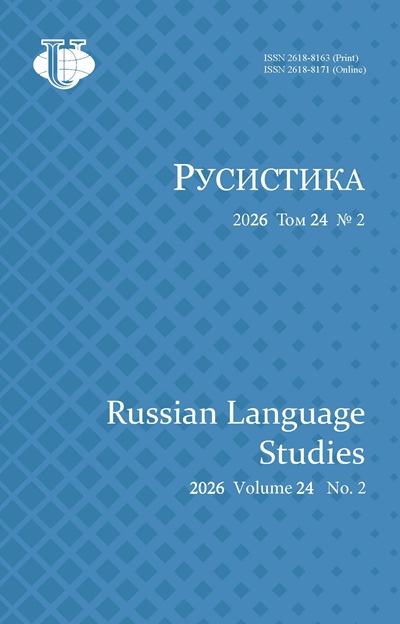
Evolution of political media rhetoric in Russia: a comprehensive linguistic analysis
- Authors: Akhrenova N.A.1
-
Affiliations:
- RUDN University
- Issue: Vol 24, No 2 (2026)
- Pages: 226-243
- Section: Key Issues of Russian Language Research
- URL: https://journals.rudn.ru/russian-language-studies/article/view/50576
- DOI: https://doi.org/10.22363/2618-8163-2026-24-2-226-243
- EDN: https://elibrary.ru/QFDTAH
- ID: 50576
Cite item

Abstract
The relevance of the study is determined by the need to comprehend the transformation of Russia’s public political language against the backdrop of radical socio-political shifts in the 20th-21st centuries and the digitalization of the media environment. The aim of the study is to identify and linguistically describe the systemic shifts in the political media rhetoric of the USSR and Russia and to determine the specifics of their impact on the structure of the Russian language. The methodological basis integrates critical discourse analysis and linguistic methods. The empirical material includes a sample of texts of political media communication from 1920s to the 2020s (press, leaders’ speeches, TV and digital content). Lexical-semantic, syntactic, metaphorical, intertextual and diachronic corpus analysis (Russian National Corpus) were applied. Diachronic analysis has distinguished three evolutionary phases with systemic impact on the Russian language. The era of the monologue was characterized by a ritualized, clichéd idiolect with complex syntax, nominalization, and semantic inversion of basic concepts. The era of communicative chaos radically transformed the language structure: semantic instability of terms, legitimization of criminal jargon, syntactic reduction, and fragmentation of the collective subject (“we”). The modern era of managed polylogue has established a strategy of “selective complexity”, i.e. the technological variation of linguistic codes from bookish syntax to digital agrammatism and the hybridization of official discourse with Internet slang. The author proves that the evolution of political media rhetoric in Russia is a process of permanent structuring of the grammatical, syntactic and lexical foundations of public speech in the Russian Language. Its specificity lies in the technological modernization of archaic ritual models of communication, where the Russian language acts simultaneously as the object and the key instrument of this transformation.
Full Text
Introduction
In the era of digital transformation, political rhetoric is evolving from a means of conveying ideology into a tool for constructing reality and managing meanings (Wodak, 2011). The Russian context because of fundamental socio– political shifts in the 20th and 21st centuries (the formation, transformation and collapse of the USSR, the formation of a new statehood), is a unique environment for a diachronic study of the relationship between media technology, language, and power. The evolution of political media rhetoric here is nonlinear and complex and requires an interdisciplinary synthesis of linguistics, discourse analysis, and media studies.
The relevance of the study is determined by three key factors: 1) the need to understand the transformation of public political speech under the changing media formats and digitalization; 2) the lack of holistic scientific works tracing the evolution of political media rhetoric in Russia as a single process, with an emphasis on the relationship between the changes in media channels (McLuhan, 1964) and language; 3) the lack of systematic comparative studies identifying the specifics of the Russian way against the background of western trends in political communication development.
The study of political media rhetoric in Russia is shaped by six interrelated scientific areas: 1) discourse semiotics: Yu.M. Lotman (Lotman, 1996), B.A. Uspensky (Uspensky, 1994); 2) methodology of critical discourse analysis and political linguistics: N. Fairclough (Fairclough, 1989), R. Wodak (Wodak, 2009, 2011), A.P. Chudinov (Chudinov, 2006); 3) media linguistics and philosophy of communication: F. Zappettini (Zappettini et al., 2021), V.I. Konkov (Konkov, 2018), M. McLuhan (McLuhan, 1964); 4) studies on the modern Russian media system: M. Ascott (Ascott, 2020), L.V. Balashova (Balashova, 2022), M. Gorham (Gorham, 2003), M. Laruelle (Laruelle, 2019); 5) changes in the Russian language of the Soviet and post-Soviet periods:
- Gorham (Gorham, 2015); 6) study of foreign political media rhetoric:
N.A. Akhrenova, S.G. Ter-Minasova (Akhrenova, Ter-Minasova, 2025), N.L. Kolesnikova (Kolesnikova, 2020), P.G. Loginova (Loginova, 2025). The Russian context because of fundamental shifts in the 20th and 21st centuries is a unique environment for the diachronic study of the relationship between media technology, language, and power.
However, the synthesis of microlevel linguistic analysis and media studies through a holistic diachronic and comparative perspective remains unexplored. The problem is the fragmentation of existing approaches and the need to create an integrative analytical model to explain the dialectic of ritual and technological features in the evolution of Russian political media rhetoric in the 20th – early 21st centuries.
To eliminate this gap, the author sets the following tasks:
- To develop an integrative analytical model of political media rhetoric evolution based on integrated critical discourse analysis and media studies.
- To identify the stages of political media rhetoric evolution in the XX–XXI centuries and to give them a comprehensive description.
Thus, the aim of the study is to identify and linguistically describe the systemic shifts in the political media rhetoric of the USSR and Russia in the XX–XXI centuries, reflecting the dialectic of media technological and sociopolitical transformations, and to determine the specifics of its evolution in Russia.
Methods and materials
The research uses an integrative methodology combining the principles of critical discourse analysis (CDA) and media studies for conducting diachronic linguistic analysis. The main methodological tool is the three-dimensional model of N. Fairclough’s CDA (Fairclough, 1989), where discourse is considered as a unity of text, discursive (production, distribution, and consumption) and social practice. This model is enriched by the approach of M. McLuhan’s media theory (1964) based on his idea “the medium is the message”. This makes it possible to analyze the transformation of rhetorical strategies as a result of the change in dominant media channels, from centralized “hot” media to segmented digital platforms.
At the textual level, we used linguistic analysis to identify and describe:
- Lexical and semantic features of political media rhetoric: the evolution of ideologies, key concepts, the nature of borrowings, and jargonization.
- Changes in the degree of syntactic complexity (nominalization, sentence typology), the use of stylistic features, official, journalistic, or colloquial.
- Metaphorical modeling to identify dominant conceptual metaphors (Lakoff, Johnson, 1980) and their transformation in different periods.
- Sources and types of precedent texts, citation mechanisms, and formation of discursive canons.
At the level of discursive practice, we studied the conditions of production and dissemination of political discourse: the specific media channels of each period, the role of institutions (party, state media, independent media holdings, digital platforms), and content production technologies. At the level of social practice, linguistic data was interpreted in a broad historical, political, and socio-cultural context.
Qualitative methods of discursive analysis and elements of quantitative linguistics were used to process the material. A diachronic corpus analysis was carried out using the subcorpora of Russian National Corpus (RNC)[1], including the newspaper corpus and the corpus of modern media, to track the frequency dynamics of the key lexemes and their collocations. The comparative aspect was realized through a comparison of the identified Russian trends with the main vectors of political communication evolution in the United States and Western Europe based on a secondary analysis of scientific literature.
The research material is a representative sample of political media communication texts of 1920–2020s: editorials of central Soviet newspapers (Pravda[2], Izvestia[3][4]) available online; transcripts and audio recordings of state leaders’ key speeches; TV programs, talk shows and debates (1990s–2020s); official accounts and propaganda publications on social networks (VK, Telegram) and messengers; articles of state news agencies (TASS[5], RIA Novosti[6]).
Results
The results of the conducted research are as follows:
- The phases of evolution and their dominant metaphorical models have been established. Three or four key phases in political media rhetoric development have been identified and described, each reflecting the dominance of a specific metaphorical system related to media technologies and social structure.
- The dialectic between media technologies and rhetoric is revealed, indicating that rhetorical shifts are not linear in nature but follow a pattern whereby every new phase emerges as a reaction-negation of its predecessor, the latter being mediated by novel media technologies.
- The specifics of the “Russian path” in evolution has been determined, and the features of the Russian model have been formulated, distinguishing it from Western transitological narratives: the mobilization framework permanence where the idea of the centralized mobilization function of media rhetoric does not change, but its goal–setting does: from building a bright future through survival in market and criminal chaos to protection from an external enemy; cyclical nature and restored archetypes, where evolution is not a straightforward transition from totalitarian to democratic rhetoric, but a complex cycle returning to archetypical models (“fortress”, “organism”) on a new turn, supported by digital technologies; hybridised media model with coexistence and interpenetration of rhetoric and practices of different eras: messianic notes (“spiritual bonds”) are juxtaposed with the market language of efficiency, and the Soviet metaphor of the “battle for wits” is reinterpreted in terms of “hybrid warfare” and “cyber sovereignty.”
- A typology of metaphorical mappings is proposed, wherein an analytical classification of the principal metaphorical sources for the description of the state and media has been elaborated and applied.
The systemic effect of successive political and rhetorical regimes on the grammatical structure and norms of the Russian language has been revealed. Each epoch not only formed a specific vocabulary and metaphor models, but also influenced syntactic patterns, morphological features, and word formation. The monologue era established a hypertrophied complex syntactic model dominated by verbal nouns, passive and impersonal constructions, which contributed to the nominalization and deagentivization of public speeches. The era of communicative chaos provoked a sharp syntactic reduction, utterance fragmentation and elliptical constructions legitimization; it led to the incorporation of morphological and word-formation models from marginal subcultures into public speech. The era of the guided polylogue institutionalized the principle of “selective complexity” when the grammatical structure became a technologically variable parameter: from complex periods in doctrinal texts to telegraphic syntax and incomplete sentences in the digital environment. Thus, the evolution of media rhetoric did not only change the content, but also permanently reformed the grammatical and syntactic foundations of Russian public speech.
Discussion
The Monologue Era
In the era of the one-party system, media rhetoric functioned as a complete ritual system where the media served as a technical amplifier of the unified and sacralized voice of power. The main channels of communication were centralized state media, which in the terminology of M. McLuhan (McLuhan, 1964) possessed the properties of “hot” means of communication: mass press, AllUnion radio, and later centralized television. Those channels provided a synchronous perception of the message throughout the country in the institutional absence of meaningful feedback mechanisms from the audience.
Linguistic analysis of the texts of this period identifies interrelated features transforming rhetoric into an instrument for total ideological control.
The dominant stylistic feature was the total ritualization and clichedness of the language, for example, the use of set formulas without factual information, but mandatory for any public statement: Under the leadership of the Communist Party ..., Faithful to the precepts of the great Lenin..., the unanimous support of the working people ..., the Indestructible unity of the party and the people.... Such expressions function as discursive markers; their main function is not to describe reality, but to signal belonging to “one’s own” and to reproduce the ritual. Their syntax does not change, and their vocabulary is standardized. This excludes the individuality of the utterance.
The pragmatic aim of the statement was not to convey new information, but to performatively confirm loyalty and reproduce the discursive system itself: “...... The workers talked about how a broad social program was being implemented simultaneously with the production renewal. For example, the operator V.D. Trishkina said: We always feel care of ourselves. I can confirm this both as an employee and as a mother. We have everything: a job we love, and opportunities for recreation.”[7]
The inverted word order imitates emotional conversational speech, but there are also clichés uncharacteristic of conversational style. The pragmatic goal of the text is dramatic staging: the speaker plays the role of “the people’ confirming their loyalty. The veridicality of the statement is of no consequence; rather, significance attaches to the deployment of the “patriot-toiler” image in the official discourse of a duly authorised high-ranking official, accompanied by appropriate prosodic marking.
This caused the semantic depletion of basic political concepts expressed by such words as
- Democracy (socialist democracy or genuine democracy opposed to bourgeois or formal democracy), which loses its common meaning (people’s power, political pluralism, electability) and gets a new, strictly defined meaning: the leading role of the Communist Party as the highest expression of the people’s will; thus the concept is narrowed and turns into a tool for discrediting alternative models.
- Freedom is conceptualized in set expressions freedom from exploitation, conscious necessity opposed to bourgeois freedom, which often gets the epithets illusory and anarchic. The concept of freedom is relativized and ideologically recoded. It is defined not through individual rights and opportunities, but through collective liberation from class enemies and submission to the objective laws of history dictated by the Communist Party.
- The concept of peace was used in aggressive foreign policy contexts: the struggle for peace in the world requires the decisive suppression of imperialist aggression. The concept of “peace” is semantically inverted. It does not mean the absence of war and means a state which can only be achieved through active, sometimes forceful, “struggle” against enemies.
The structural basis of this system was absolute monologue without any public discussion. There were no television debates as in Western political media communication. Rhetoric was constructed as an unquestionable authorities’ appeal to society, which was supposed to listen without any questions and follow the proposed course. Formats with imitated feedback, such as party conventions, were predetermined, and this was often expressed non-verbally, through synchronized applause at party congresses or unanimous approval in the press. Even elements of pseudo-dialogue, such as rhetorical questions or direct appeals, only reinforced the monological impact, as clearly demonstrated in the examples below:
“Of course, there are problems that need to be solved at the level of ministries, departments, and industry unions. For example, the question raised here seems reasonable: ‘Why is the shift foreman, who organizes the work of a brigade, is not the member of the brigade? And why is his salary calculated differently from that of a brigade member?’”[8] .
To simplify and mythologize socio-political realities, the system of conceptual metaphors was used. Complex abstract notions were replaced by a set of archetypal models: THE STATE/SOCIETY IS A MECHANISM OR AN ORGANISM (the cogs of the system, the healthy forces of society, the healing of society), HISTORICAL PROCESS IS MOVEMENT ALONG A PATH (the main path of development, to stray from the path, the path of correction), POLITICS IS WAR (the ideological front, striking criticism). These metaphors formed a vivid and emotionally charged picture of the world, resistant to rational criticism.
This picture of the world was reinforced by a strictly organized intertextuality of a ritual-canonical type. A vertical chain of citations was constructed from the sacred source texts of the classics of Marxism-Leninism through sacred texts at the institutional level, such as the Program of the Communist Party and the decisions of congresses, to the statements of the current general secretary. Intertextual references were only internal and created a hermetic semiotic universe completely isolated from external, “alien” discourses. These positions are expressed in speeches by state leaders: “How right Lenin was when he called our party a party of revolutionary transformers, a party of innovators! ... ‘The whole point,’ wrote Vladimir Ilyich Lenin, ‘is not to be satisfied with the skills which our previous experience has developed in us...’ (Works, vol. 28, p. 172)...” [9].
At the grammar level, this system was implemented through specific syntactic strategies. The texts were exaggeratedly bookish and syntactically complex: a predominance of complex sentences, frequent passive and impersonal constructions (it is emphasized, a decision is made), and a high degree of nominalization, the replacement of verbs with verbal nouns. These techniques created impersonal, supra-personal objectivity emanating from the words of the authorities.
Morphological and lexical levels show a gradual dissolution of the individual into the collective. The inclusive pronoun “we” (our people, our achievements) dominated, sharply contrasting with the image of the enemy (they, their intrigues). At the lexical level, a set of sacralized formulas was established; the formulas contained emotionally charged adjectives: great, unbreakable friendship, bright future. Key vocabulary was clearly distributed across thematic fields: war and mobilization (the labor front, the battle for the harvest), building (the building sites of communism), and family (brotherly republics, the paternal care of the party).
Thus, the grammatical level implemented this system through specific syntactic strategies with a long-term impact on the bookish writing norm of the Russian language. These techniques formed cliches of official syntax in the official business substyle of the Russian language.
Word-formation saw the frequency of suffixes which created abstract concepts and collective names (-stvo, -nie, -izm, -tsiya). They reinforced the priority of generalized categories over specific actions and persons.
The era of “communicative chaos”
The 1990s marked a radical restructuring of the entire system of public political communication in Russia, which was directly reflected in structural changes at the lexical-semantic, grammatical, and syntactic levels of the Russian language. The collapse of the ideologically monolithic Soviet discourse formed competing discursive systems, and each system developed its own linguistic code. This created the phenomenon of acute linguistic pluralism.
The Russian language of the 1990s is a unique example of a profound and rapid transformation of the language structure under the influence of a sociopolitical crisis. Discourse fragmentation at the content level directly corresponded with the disintegration of the unified lexical and grammatical norms of public speech. This period can be interpreted as a stage of “discursive and linguistic interregnum,” which combined the burst of semiotic freedom and linguistic experimentation with the loss of consolidating symbolic foundations. The preconditions for subsequent processes of re-ideologization and re-centralization of political language were formed. These macro-processes were expressed at the micro-level of the language system, in changes in vocabulary, grammar, and speech genres, as well as in the transformation of metaphorical models and intertextual practices.
A key process was the rapid devaluation and marginalization of the Soviet conceptual apparatus against the mass import of new concepts “democracy,” “market,” “freedom,” and “privatization.” However, being detached from their original socio- historical context, these concepts often functioned as “floating signifiers” (Laclau, Mouffe, 2001), without clear semantic and value fixation. At the same time, languages which had previously been on the periphery or in a marginal position entered the legitimate public sphere; criminal jargon (kry`sha ‘criminal protection’, avtoritet ‘criminal boss’, zachistka ‘purging’, Beat!, vy`zhivat` ‘to struggle to survive’, bespredel ‘lawlessness’, naezd ‘raid’, razborka ‘gang fight’, bratva ‘criminal brotherhood’, po ponyatiyam ‘according to criminal rules’, zakon tajgi ‘law of the taiga’), nationalist rhetoric (world Zionism, world backstage, Atlanticists, new world order, Dulles plan, Masonic conspiracy, Russian revival, Russian idea, national dictatorship, the third Rome, Russian order, Russian rebellion, etc.). This caused fierce competition for the right to define the content of basic social and political categories.
The collapse of the unified metaphorical system of the Soviet era led to the dominance of new conceptual models reflecting the crisis of society.
The conceptual metaphor “THE STATE IS THE MARKET,” which dominated Russian public discourse in the 1990s and early 2000s, semiotically substituted previous models and legitimized radical socio-economic transformations. Its lexical field was used in different spheres, from official economic discourse with terms such as voucher, privatization, and tender, to business and criminal-business jargon, such as kickback, protection, raiding, collision, carve-up, and cash-out, reflecting the illegal aspects of the new relationships. Set expressions and neologisms became established in journalistic and everyday discourse, such as privatization, new Russians, crimson jacket, and sell the factory. This metaphorical complex had a performative function, constituted a reality where market relations were perceived as a universal principle.
At the same time, the conceptual metaphorical model “POLITICS/ BUSINESS IS CRIME/ WAR OF ALL AGAINST ALL” was established. It inherited the formal structure of Soviet rhetoric but radically changed its content to criminal and violent. This was a direct linguistic reflection of economy criminalization. Violence legitimization was expressed in the lexicon: redistribution of property, corporate war, raider takeover, pressure, squeeze. Criminal jargon was legalized in the public sphere through concepts of criminal protection, contract killing, criminal showdown, and criminal brotherhood. Metaphors of violence also penetrated the communication (shooting — about criticism), and the established names “gangster St. Petersburg” and “the wild 90s” became cultural codes of the epoch. This model actively constructed social reality and shaped the perception of the political and economic space as an illegal struggle for power.
The chaos generated by this “war of all against all” and perceived as a crisis of statehood created a third powerful metaphor, that naturally entered political discourse: “THE COUNTRY IS A SHIP/A HOUSE IN A STORM/A FIRE.” This archetypical model used by various political forces described the total systemic crisis through images of catastrophe and imminent threat of destruction. It was most vividly realized in the rhetoric of General Alexander Lebed, who in his 1996 election discourse actively exploited the images of “saving a sinking ship” and “putting out a fire in a house”; he positioned himself as the only professional saviour capable of decisive action in an emergency. The key meanings of this metaphor were: the idea of an emergency requiring stopping normal procedures and discussions; the need for sole command (“steering wheel,” “strong hand”) instead of collegiality and democracy; a mobilizing call for consolidation in the face of external danger (raging elements) and the dichotomy of “order – chaos.” This model directly opposed the metaphor of market chaos and performed an important ideological function; it translated socio-economic and political issues into a question of physical survival and showed that a solution was not in legal or economic reforms but in authoritarian mobilization and power concentration. Thus, the metaphor of a ship in a storm became a linguistic bridge that legitimized the demand for a “firm hand” as the antithesis of the criminal lawlessness and market anarchy of the previous period.
Thus, the three intersecting metaphorical systems, “state as a market”, “politics as war/crime,” and “country as a ship in a storm”, formed a coherent linguistic landscape which recorded and ideologically justified the key social practices and demands of radical transition: total commodification and privatization, criminalization and violent rivalry, and, as a reaction to their negative consequences, a growing desire for authoritarian stabilization and order.
The 1990s intertextual field is characterized by the dynamic coexistence and conflict between heterogeneous precedent texts, occurring against the backdrop of Soviet canon deconstruction and the intensive development of new semantic resources. At the same time, along with relatively rare, often ironic references to Marxist-Leninist discourse, various reference systems are actively incorporated into socio-political communication, depending on ideological orientation: conservative-patriotic discourse appeals to the heritage of Russian religious philosophy and classical literature of the 19th–20th centuries (N. Berdyaev, I. Ilyin, F. Dostoevsky); liberal discourse appeals to Western political and economic thought (F. Fukuyama, M. Thatcher, M. Friedman). At the same time, there was an active, often ironic or nostalgic reinterpretation of Soviet cinema and literature, as exemplified by frequent quotations form popular comedy films such as The Diamond Arm and Operation Y.
The collapse of the total collective subject of the Soviet era (the people, the party) was reflected in the morphology of pronouns. Thus, the first-person plural pronoun “we,” which was a verbal reflection of the union between the state and its citizens, split into exclusive and often hostile “we-groups”: “we are democrats,” “we are patriots,” “we are reformers,” and “we are ordinary people.” At the same time, the first-person singular pronoun “I” entered public communication, where individuality was previously suppressed. This marked the growth of individualism and the publicity of private interests in politics and the media.
At the syntactic level, the complex constructions of the official Soviet style changed into short, often elliptical statements. The intonation shifted from didactic and confident to aggressive, confrontational, confessional, or emotional. Direct confrontation on live broadcast, non-standard vocabulary or euphemisms, and emotional outbursts ceased to be taboo and became ways of demonstrating “sincerity” and “closeness to the people.” This shift has legitimized open conflict as the basic mode of public interaction, for example: “The normal choice is the LDPR. Not because we are special. Ordinary people think simply. We’ve already had the communists. The democrats are thieves. The ruling party is powerless. That’s it. The fourth option. It’s elementary.”[10]
There has been a radical change in the dominant speech genres. The canonical genre of party reports or resolutions, which served as a ritual reproduction of power, has lost its central significance. There appeared new, confrontational, and spectacular formats: public television debates, confessional interviews, talk shows with scandal elements, and crime reports as a significant component of the news agenda. These genres constituted the public sphere as a space not for consensusbuilding, but for struggle and performative self-presentation.
Under media system commercialization and oligarchic media holdings formation, the communication pragmatics began to dominate over its semantic or ideological component. Communicative effectiveness was assessed not by its conformity to the “general line” or objective truth, but by its ability to generate ratings and sensation, capture attention, and discredit opponents. This caused a noticeable gap between speech acts and social action, and words became primarily a tool for momentary PR or manipulation, rather than the basis for a social contract or the development of common decisions.
Thus, the Russian language in the 1990s reflects not only the absence of rules, but a new system of rules centered on conflict, fragmentation, and performativity. This period is a stage of “discursive interregnum”, an explosion of semiotic freedom, which, however, was accompanied by a symbolic vacuum and anomie. This public language prepared the social demand for a new unification and symbolic order, one of the prerequisites for communication recentralization and re-ideologization in the subsequent period.
The era of controlled dialogue
The current period of political media rhetoric is not the Soviet monological model replication, but a complex hybrid system. This system uses digital communication media with low degree of determining and high interactivity, in M. McLuhan’s terminology to actualize and disseminate updated ideological attitudes. The key factor determining the specificity of this stage is the dual structure of the media space, combining centralized federal television for a mass audience with a segmented Internet environment for targeted influence and controlled forms of feedback. A fundamentally new component of this era is the technological production of speech as a complex media product. This model is based on selective complexity, which involves conscious varying of the discourse linguistic characteristics depending on the addressee and communication channel.
The lexical level clearly distributes vocabulary according to target audience and genre.
The doctrinal level (programme speeches and analytical articles) uses the terminology of geopolitical, historiosophical, and legal discourse. The active vocabulary includes such concepts as sovereign democracy, multipolar world, civilizational sovereignty, traditional values, and historical justice. This vocabulary conceptualizes foreign and domestic policy, intellectually legitimizes it, and integrates it into global conservative trends.
At the level of mass communication (talk shows, news programs, and “direct Lines”), journalistic and socio-political vocabulary dominates, often emotional and evaluative. Frequent concepts form binary oppositions: supporters of strong authority versus national traitors, patriots versus the collective West, sovereignty verses external control. The lexical field of defence and security (hybrid warfare, deterrence, threat) is actively used and supports permanent mobilization state.
The level of the digital youth environment combines official discourse with the language of Internet communication. Elements of youth and gaming slang (Zа nashih, to mobilize hype, the red pill), memes, and emojis are incorporated into the patriotic narrative. This adaptation glocalizes the global language of digital culture and ensures the recognition of official messages in youth communities.
The morphological and syntactic levels implement the principle of selective complexity, for example:
“...But what, in this regard, is being proposed? Essentially, it is being proposed to move forward, step over everything and everyone, not to think about anyone or anything, essentially disregard the risks associated with the epidemic, and simply lift all restrictions as quickly as possible. And if someone gets sick, let it be; if they become disabled or even die, it is their fate. In short, what is being proposed is the law of natural selection, where it is every man for himself...”[11].
The doctrinal level is characterized by syntactic complexity. Syntactic periods, systems of subordinate clauses, and a high degree of nominalization are represented. The present tense forms of non-perfective verbs predominate; this creates the effect of eternal truths and enduring processes. Such syntax reproduces the formal features of teacherly discourse which appeals to unquestionable authority.
The level of mass communication has deliberately simplified syntax. Simple and complex sentences prevail, aphoristic expressions, easy to quote and remember, are frequent (The Crimea is ours; We can repeat). Frequent rhetorical questions and appeals imitate dialogue with the audience. Verb forms are more diverse; past and future tenses to tell achievements and prospects.
The digital level shows radical syntactic reduction. Messages are often reduced to headlines, slogans, or fragments; their syntactic structure may be deliberately disrupted to fit the genre of a meme or short video clip. Nominative and incomplete sentences predominate.
The political and ideological narrative which had taken shape by the 2010s semiotically revised the 1990s discourse, partly rejected and partly transformed its central metaphors. The image of the “market as a state” and “politics as war of all against all” was replaced by a set of models aimed at consolidating and legitimizing sovereign, centralized power in the context of a systemic crisis and external confrontation.
First, the archetypal metaphor “RUSSIA IS A FORTRESS/CAMP UNDER SIEGE” became dominant; it inherited the Soviet militarized discourse with a new intensity. Its key function is to shape a worldview based on the idea of a permanent and total external threat. This justifies the logic of siege, which requires internal mobilization and consolidation around the supreme authority. At the lexical level, the model realizes in direct military terms (front, rear, mobilization of efforts, battle for history, information war, threat, hybrid war) and political concepts derived from them: besieged fortress, fifth column, sanctions pressure, Russophobia, civilizational confrontation. The metaphor creates an image of the collective defender-state in a defensive and therefore morally justified struggle against a hostile environment.
Second, the conceptual metaphor “THE STATE IS AN ORGANISM/BODY, AND THE GOVERNMENT IS A DOCTOR” returned and actualized. This model with deep paternalistic roots legitimized active, pervasive state intervention in all spheres of society, which is presented as therapeutic or surgical intervention necessary for the health. The vocabulary includes biomedical terms transferred to the socio-political reality: the health of the nation, the society immunity (to external influence), the social body, the surgical removal (of corruption, extremism, “abscesses”), hotbed of tension, recovery (of the economy, society), digital hygiene, demographic potential protection. Within this metaphor, the authorities position themselves as the only expert healers, diagnosing diseases, often caused by external “infections” or “poisonings” of the 1990s, and prescribing mandatory treatment which requires discipline and obedience from the patient.
Thirdly, in contrast to the Soviet linear metaphor of “the path to a bright future” (communism), the model of “HISTORY IS AN ETERNAL RETURN/ CYCLE” is established. This concept constructs a continuous national history, where current political situation is presented as the restoration of a natural order interrupted from outside and the correction of historical injustices. The lexical markers of this model are such formulas as the return of historical lands, the correction of historical mistakes, reunification, generational continuity, traditional values, spiritual bonds, a thousand-year history, and a centuries-old tradition of statehood. Periods of catastrophe (the Time of Troubles, the collapse of the USSR, the 1990s) are interpreted not as natural stages, but as painful but temporary breaks in the cycle caused by external forces or internal betrayal. After this the country inevitably returns to its “true” essence and geopolitical role.
These three metaphorical models together form a complementary and selfsustaining semiotic system. The metaphor of a fortress under siege sets the external political context and justifies the mobilization regime. The metaphor of the state as an organism and the government as a doctor defines the nature of domestic policies. The metaphor of cyclical history makes this system symbolically deep. This triptych is a stable picture of the world, where centralized power acts as the sole guarantor of survival, integrity, and historical truth in the face of constant external challenges.
The intertextual strategy of this period is systematic, canonizing, and segmented; it performs the functions of ideological legitimization and targeted influence on various audiences. As part of a new patriotic canon, the former Marxist-Leninist paradigm is being replaced by a hierarchically structured complex of precedent texts, which includes Russian conservative and religious philosophy (N. Berdyaev, I. Ilyin, K. Leontiev, I. Solonevich) for the philosophical and historical justification of the concept of the “special path”, key historical narratives emphasizing the theme of the Great Patriotic War and imperial land acquisition, and classical Russian literature (A.S. Pushkin, F.M. Dostoevsky, L.N. Tolstoy) to authenticate enduring spiritual and moral foundations. Doctrinal texts are dominated by legitimizing references to philosophical and historical discourses, such as the rhetorical use of the concept of the “Russian world,” which goes back to the ideas of I. Ilyin, or analogies with 19th-century diplomacy. In the sphere of mass communication, intertextuality has an emotional and mythological character, actively exploits quotations and images from Soviet films, military songs, and proverbs to appeal to the archetypes of collective memory and create an effect of national character. In the digital environment, the intertextual strategy is transformed and takes on a playful and memetic character, where political narratives are translated into the logic of computer games, cyberpunk, and viral content, and geopolitical confrontations are metaphorically described through chess terms or the gameplay of strategic simulators.
The speech of officials is not a spontaneous oral statement, but a result of complex media production. This process includes the following stages:
- Modular content structuring, where a speech is designed as a “core”, a coherent doctrinal text, with a set of autonomous “satellites”, vivid, easily extractable quotes and slogans for viral distribution.
- Multimodal synchronization, when the verbal text is closely connected with accompanying visual material (key frames for social networks, infographics, and subtitled videos).
- Platform optimization, where the source material is adapted to the formats and algorithms of specific digital platforms (long videos for RuTube, VKvideo, tweets for X, short vertical videos for TikTok).
Content is published simultaneously on federal TV, official social networks, and blogger networks, creating an effect of informational dominance.
Thus, the Russian language at the present stage is characterized by purposeful and technological control of the grammatical structure of speech depending on the communicative task. The doctrinal level is characterized by deliberate syntactic complexity; it preserves and develops the traditions of the “high”, bookish syntax of the Soviet era, but with updated vocabulary. Syntactic periods, systems of subordinate clauses, and a high degree of nominalization are used. This creates an effect of indisputability, relying on the “eternal” grammatical structures of power.
At the level of mass communication, syntax is deliberately simplified. A “popular,” accessible syntax is artificially cultivated: simple and complex sentences, short aphoristic expressions prevail. Grammatical means of dialogization are actively exploited: rhetorical questions, appeals, imperative forms to imitate interactivity.
The digital level demonstrates radical syntactic reduction, very close to norm deconstruction. Messages are often reduced to headlines, slogans, or fragments, where syntactic structure may be deliberately disrupted (agrammatism) to fit the genre of a meme or short video clip. Nominative and incomplete sentences predominate. Word formation undergoes hybridization: neologisms are created at the intersection of official vocabulary and Internet slang, where traditional morphological models of the Russian language are combined with new graphic and phonetic elements.
Morphology continues playing with pronouns, but now within a controlled scheme: the inclusive “we” dominates again, but its reference flexibly changes from ‘we as a state-civilization” to “we as a people opposing the collective West.”
Conclusion
The diachronic study demonstrates that political media rhetoric in Russia in the 20th and 21st centuries demonstrates not only a change in ideological paradigms, but also an active factor in the structural transformation of the Russian language: specific grammatical and syntactic models consistently established at each historical stage, from the nominalized syntax of the Soviet monologue and the syntactic reduction of the 1990s to the technologically varied principle of “selective complexity” in the modern controlled polyphony. The Russian model is characterized by the cyclical restoration and digital adaptation of archaic rhetorical structures, which allows us to consider political discourse as an instrument of norm-setting and semiotic hegemony. The prospects for further study are linked to micro-level linguistic analysis and comparative studies in foreign language contexts.
1 Russian National Corpus. Retrieved 23 December 2025, from https://ruscorpora.ru/
2 The main newspaper of the Soviet Union, all issues from 1918 to 1991. Retrieved 23 December 2025, from https://marxism-leninism.info/paper/pravda-1
3 Izvestia 100 is a special project dedicated to the anniversary of Izvestia. Retrieved 23 December
4 , from https://100.iz.ru/rubric/122
5 TASS. Retrieved 23 December 2025, from https://tass.ru/
6 RIA Novosti. Retrieved 23 December 2025, from https://ria.ru/
7 Chernenko, К. U. Speech at the meeting with workers of the Moscow metallurgical plant “Serp I Molot”. Retrieved 13 Junuary 2026, from https://www.gensek.ru/publications/books/vstrecha-srabochimi-zavoda-serp-i-molot.html ?ysclid=ml4340kxq1637606911
8 April, 29, 1984. Speech by the General Secretary of the Central Committee of the Communist Party of the Soviet Union, the Chairman of the Presidium of the Supreme Soviet of the USSR, Comrade K. U. Chernenko. Retrieved 10 January 2026, from https://www.gensek.ru/publications/books/vstrechas-rabochimi-zavoda-serp-i-molot.html ?ysclid=ml4340kxq1637606911
9 Brezhnev, L. I. Leninism is the great banner of the struggle for the triumph of communism.
Retrieved 10 January 2026, from document.wikireading.ru›hmta4dIcAs
10 Zhirinovsky, V. V. Quotations. Retrieved 5 January 2026, from URL: https://ru.wikiquote.org/wiki/ Владимир_Вольфович_Жириновский#cite_note-S-1
11 Vladimir Putin’s Address to the Citizens of Russia on April 28, 2020. Retrieved 3 January 2026, from URL: https://tass.ru/obschestvo/8357523
About the authors
Natalia A. Akhrenova
RUDN University
Author for correspondence.
Email: akhrenova-na@rudn.ru
ORCID iD: 0000-0002-1265-5595
SPIN-code: 9818-1046
Scopus Author ID: 58666248600
Doctor of Philology, Associate Professor, Head of the Postgraduate Education Department at the Institute of Foreign Languages, Professor at the Department of Theory and Practice of Foreign Languages
6 Miklukho-Maklaya St., Moscow, 117198, Russian FederationReferences
- Akhrenova, N. A., & Ter-Minasova, S. G. (2025). Evolution of political media rhetoric in Great Britain. RUDN Journal of Language Studies, Semiotics and Semantics, 16(4), 000–000. (In Russ.). https://doi.org/10.22363/2313-2299-2025-16-4-000-00 EDN: MXKGIU
- Ascott, T. (2020). This is not propaganda: Adventures in the war against reality. International Affairs, 97(1), 235–237. https://doi.org/10.1093/ia/iiaa208
- Balashova, L. V. (2022). The genre of the appeal of the President of Russia to its citizens during the first wave of the COVID-19 pandemic in the mirror of conceptual metaphor. Speech Genres, 17(2), 115–132. (In Russ.). https://doi.org/10.18500/2311-0740-2022-17-2-34115-132 EDN: JXTSZB
- Chudinov, A. P. (2006). Political linguistics. Moscow: Flinta; Nauka Publ. (In Russ.). EDN: SDQKXT
- Fairclough, N. (1989). Language and power. London: Longman.
- Gorham, M. S. (2003). Speaking in Soviet tongues: Language culture and the politics of voice in revolutionary Russia. DeKalb: Northern Illinois University Press. EDN: QRKMSB
- Gorham, M. S. (2015). After newspeak: Language culture and politics in Russia from Gorbachev to Putin. Canadian Slavonic Papers, 57(3), 1–2.
- Kolesnikova, N. L. (2020). Communicative strategies in the discursive practice of Theresa May (on the example of the campaign for the UK’s exit from the EU). Media Linguistics, 7(1), 69–82. (In Russ.). https://doi.org/10.21638/spbu22.2020.106 EDN: BJJFMT
- Kon’kov, V. I. (2018). Linguistic studies of political media discourse. Media Linguistics, 5(2), 138–161. (In Russ.). https://doi.org/10.21638/spbu22.2018.201 EDN: YTPHYL
- Laclau, E., & Mouffe, C. Hegemony and Socialist Strategy. Towards a Radical Democratic Politics. London, New York: Verso, 2001 [1985].
- Lakoff, G., & Johnson, M. (1980). Metaphors we live by. Chicago, IL: University of Chicago Press.
- Laruelle, M. (2019). Russian nationalism: Imaginaries, doctrines, and political battlefields. Routledge.
- Loginova, P. G. (2025). Political media rhetoric: A new approach to the analysis of the language of political media communication (on the example of France). Direkt-Media Publ. (In Russ.). EDN: EUBCJC
- Lotman, Yu. M. (1996). Inside the thinking worlds. Man — text — semiosphere — history. Moscow: LRC Publ. (In Russ.).
- McLuhan, M. (1964). Understanding media: The extensions of man. New York : New American Library.
- Uspensky, B. A. (1994). Selected works. Vol. 1: Semiotics of history. Semiotics of culture. Gnozis Publ. (In Russ.).
- Wodak, R. (2009). The discourse of politics in action: Politics as usual. Palgrave Macmillan.
- Wodak, R. (2011). Language, discourse, politics. Discourse & Society, 22(5), 625–632. https:// doi.org/10.1177/0957926511405700
- Zappettini, F., Ponton, D. M., & Larina, T. V. (2021). Emotionalisation of modern media discourse: A research agenda. Russian Journal of Linguistics, 25(3), 586–610. (In Russ.). https://doi.org/10.22363/2687-0088-2021-25-3-586-610 EDN: NYDDJB
Supplementary files

