





 Email this article


The Biblical cult ural background of Russian lexis and phraseological units in educational lexicography
- Authors: Nikitina T.G.1, Panova I.A.2, Rogaleva E.I.2
-
Affiliations:
- Saint Petersburg State University
- Pskov State University
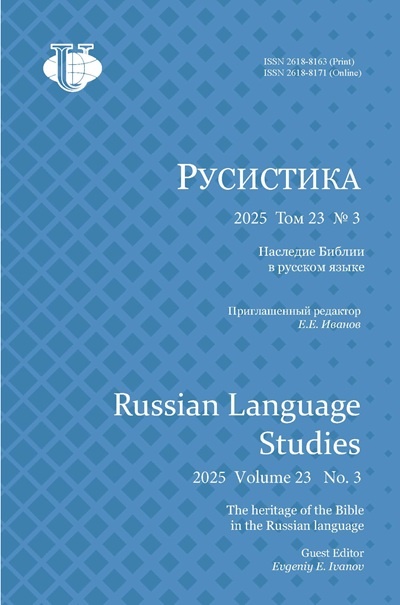
- Issue: Vol 23, No 3 (2025): THE HERITAGE OF THE BIBLE IN THE RUSSIAN LANGUAGE
- Pages: 482-498
- Section: Cultural Linguistics: Theoretical and Applied Aspects
- URL: https://journals.rudn.ru/russian-language-studies/article/view/46473
- DOI: https://doi.org/10.22363/2618-8163-2025-23-3-482-498
- EDN: https://elibrary.ru/XWRETL
- ID: 46473
Cite item

Abstract
The relevance of the study is conditioned by the cultural and historical value of linguistic units with a biblical cultural component and the need to improve the methods of their dictionary description. The aim of the research is to develop methods of accessible and scientifically reliable representation of the biblical cultural background of Russian lexis and phraseology in educational dictionaries for foreign students and schoolchildren. In accordance with the principle of methodological expediency, the material for the study was selected from Russian language textbooks for different categories of foreign students. The semantics of biblical units was clarified by the method of contextual analysis. The methods of lexicographic modeling, etymological paraphrasing and linguistic-cultural interpretation were used for structuring dictionary entries and developing the content of their parametric zones. As a result of the research, the authors developed the samples of linguistic-cultural commentary for biblical phraseological units in family reading dictionary for our foreign compatriots. The study identifies the possibilities of linguistic-cultural representation of biblical proverbs in the travelogue dictionary connected to video material. The parameters of ethnocentric dictionary description of georthonyms (names of national festivals) of biblical origin are defined; the techniques for interpreting biblical cultural background of toponyms and ubranonyms, including unofficial ones, are developed with various mechanisms of transonymic nomination. Samples of relevant dictionary entries are given. The dictionary materials can be useful for foreign students and for Russian schoolchildren and students because their spiritual and moral education does not always include the biblical material, despite the fact that the cultural background of biblical terms remains hidden for them in many respects.
Full Text
Introduction
Modern dictionaries of biblical units are lexicographic sources of the linguistic-cultural type; they combine linguistic and cultural aspects of lexicographic description (Zinovieva, Yurkov, 2009: 220) and belong to the broader category of “dictionaries of cultural heritage” (Khomutova, Denisenko, 2020; Grigorieva, 2021) as guardians of the biblical heritage in the contemporary Christian cultural space. Such large-scale Russian lexicographic projects are the dictionaries of biblical expressions by K.N. Dubrovina[1], V.M. Mokienko, G.A. Lilich, O.I. Trofimkina[2], G.N. Sklyarevskaya[3]. The international team of lexicographers under the leadership of V.M. Mokienko and E.E. Ivanov is developing a multilingual dictionary “Lepta of Biblical Wisdom”[4]; each edition expands the number of interlingual phraseological and paremiological parallels of biblical terms.
Dictionary compilers, phraseologists, paremiologists, and cultural linguists discuss the issues of lexicographic representation of biblical units: the representation of biblical heritage in the dictionaries of the XIX and XX centuries (Shvidchenko, 2016; Mokienko, 2023), lexicographic representation of biblical units in the modern sociocultural context, the dynamics of their form and content (Baláková, Kováčová, Mokienko, 2020; Kutieva, 2021; Fedosova, Kutieva, 2021). The content of certain parametric zones of dictionary entries is considered: expressive and stylistic notes (Nazarova, Ryadchikova, 2015), historical-etymological and linguistic-cultural commentaries (Ivanov, 2019; Walter, Ivanov, Mokienko, 2020), types of interlingual correspondences and their representation (Mokienko, 2018; Ivanov, Maslova, Mokienko, 2022; Mokienko, 2024; Ignatieva, Mokienko, Nikitina, 2024; Mokienko, Nikitina, 2024). The authors present their original lexicographic concepts embodied in dictionaries of biblical units: encyclopaedic dictionaries (Dubrovina, 2010), translation dictionaries (Balakova et al., 2015), dictionaries that are only being designed, thematic dictionary (Orlova, 2017) and dictionary of writers’ language (Petergova, Zhiltsova, Goncharova, 2023). However, despite the high level of theoretical elaboration of those issues, the sphere of educational lexicography has not been researched, with rare exceptions (Bakina, 2022); there is the only school dictionary of biblical units (published in 50 copies), the mini dictionary “Not by bread alone...” prepared by students of Magnitogorsk Technical University under the guidance of Professor S.G. Shulezhkova[5]. The dictionary shows the cultural background of 60 winged expressions originated from the Bible in an accessible and fascinating form, their meaning is interpreted, their use in artistic and publicistic text is contextually illustrated.
Well-known educational dictionaries of proverbs and phraseological expressions which include biblical units give middle and high school students a historical and etymological reference to a biblical source. For example, the dictionary of V.P. Zhukov and A.V. Zhukov says: “Scapegoat <...> From the ritual of the ancient Jews described in the Bible. The sins of the whole community were laid on a goat, which was then cast out into the desert[6]). The dictionary of V.M. Mokienko and co-authors says: Do not sweep pearls before swine, [lest they trample them with their feet] <...> An expression from the Gospel: “Do not give holy things to the dogs; and do not throw your pearls before the swine, for they might tread them with their feet” (Matthew 7: 6)[7].
The dictionaries of proverbs and phraseological expressions addressed to younger schoolchildren[8] do not include units of biblical origin or do not comment on their cultural and historical aspect, although methodologists note the pedagogical contradiction between the large number of biblical expressions in Russian language textbooks for elementary school and the lack of lexicographic support for teaching children these culturologically valuable linguistic units (Borisenko, 2014: 48–49). Foreign students studying Russian are also deprived of lexicographic support when mastering biblical units. Thus, the dictionary guidebook “Phraseological units in Russian Speech” by N.V. Basko [9] describe more than 600 phraseological units for foreigners and teachers of Russian as a Foreign Language (RFL), but does not reveal the connection with the biblical text for such expressions as бросать слова на ветер ‘to throw words into the wind’, в мгновение ока ‘in the blink of an eye’, в поте лица ‘in the sweat of one’s brow’, камень преткновения ‘stumbling block’, козел отпущения ‘scapegoat’, метать бисер перед свиньями ‘sweep pearls before swine’, умывать руки ‘washing one’s hands’.
Thus, the issues of representing cultural and historical background of biblical units in educational lexicographic editions remain open. The urgency of the issues and objective evaluation of the existing dictionaries for schoolchildren and students[10], including foreign students[11] show that they require additional explanations of the cultural and historical background of biblical units. The concept of these additional materials for the dictionaries implies the use of traditional etymological references and discursive techniques of “co-authorship”, already used in the above dictionaries, when the reader is invited to join the authors in their “historical-etymological research”, decipher, unravel the origin of a word or phraseological phrase at a level accessible to students. Now such studies also touch upon biblical units. The reader can also be assisted by a “respective narrator, a character or a group of characters who know the text of the Bible and can reliably and lucidly present a linguistic unit originationg from a biblical source (Nikitina, Rogaleva, 2024: 72–76). The new teaching dictionaries for different categories of addressees will include phraseological units and proverbs of biblical origin that we have not described before, as well as onomastics with a biblical cultural component. These vocabulary materials created with innovative lexicographic techniques can be helpful not only in the process of language education of students and schoolchildren, but also in the practice of educational lexicography, solving the problems of culturologically oriented description of biblical units, motivating young readers to master the spiritual and linguistic heritage of the Bible.
The aim of the study is to develop methods of accessible, engaging and scientifically accurate representation of the biblical cultural background of Russian phraseological units, proverbs, georthonyms and toponyms in educational dictionaries of different types and genres for readers learning Russian as a foreign language.
Methods and materials
The material of the study was the linguistic units of the above-mentioned categories selected from the textbooks on Russian as a foreign language[12]. At present 75 phraseological units and proverbs and 60 onomastic units are being developed. Thus, we are providing “lexicographic support” for the students learning biblical units at different stages of learning Russian. The semantics of biblical units was clarified by the contextual analysis. Lexicographic modeling was used for developing dictionary entries. The content of the parametric zones of the entry, first of all, the discursively organized zone of the complex commentary, was developed using the methods of etymological paraphrasing and linguistic-cultural interpretation. The prepared dictionary materials were tested in groups of foreign students of Pskov State University, polyethnic classes of schools and groups of preschool educational institutions of Pskov.
Results
The main results of the research are the creation and realization of effective models of representing biblical cultural background of Russian words and phraseological units in educational dictionaries of different types and genres:
- techniques of discursive story-oriented linguistic-cultural commentary focused on foreign preschoolers have been developed; these techniques are expedient in a family reading phraseological dictionary for our foreign compatriots;
- the possibilities of linguistic-cultural commentary of biblical units in the paremiological dictionary-travelogue, presenting the printed material of virtual excursion on cult buildings with the possibility of connection to video material, were revealed and realized;
- parameters of linguistic-cultural representation of georthonyms of biblical origin in a bilingual linguistic-cultural dictionary were determined; this category of onyms was not described earlier in educational dictionaries;
- methods of lexicographic interpretation of the biblical cultural background of toponyms and urbanonyms in a linguistic-cultural onomastic dictionary have been developed through various mechanisms of transonymic nomination.
Discussion
The main provisions of the author’s concept of representing biblical cultural-historical background of Russian words and phraseological units in educational lexicography are illustrated by the dictionary materials developed in accordance with the purpose of the study.
The youngest and the oldest audience, preschool children and their parents, our foreign compatriots, are addressed to the dictionary “New Phraseological Stories of Pudding and Barsik”, which is about to be published. The stories for family reading about Russian phraseological expressions are written in the genre of “lexicographic detective”. The origin of the expressions is “investigated” by the operational team, poodle-detective Pudding, cat-analyst Barsik and daw-trainee Khoma; the reader knows from the first part of the dictionary[13]. The new dictionary contains biblical phraseological units, for example:
ЗАРЫВАТЬ/ЗАРЫТЬ ТАЛАНТ В ЗЕМЛЮ ‘to bury talent in the ground’.
Not to use one’s abilities, natural gift.
Used in colloquial speech, with disapproval.
The discursive organization of the main part of the dictionary entry following the header and reference zone allows the authors not to drift away from the main goal, to present culturologically oriented etymologization of the phraseological unit, to show its use in modern speech and to include text information that broaden the child’s knowledge about the world. At the stage of “familiarization with the case materials”, detectives discuss the components of the phraseological unit, and readers learn interesting facts about the animals’ habits: which animals bury what and why, establish the meaning of the verb to bury and bury, remember the fairy tale of Alexei Tolstoy “The Golden Key, or The Adventures of Pinocchio”, which is based on the Italian fairy tale of Collodi “The Adventures of Pinocchio. The Story of the Wooden Doll”. Step by step, readers come to the origin of the phraseological unit, think about the unwise actions of Pinocchio, who buried his 5 soldos, Italian gold coins, in the Field of Miracles. The cat Barsik has such coins in his collection, so the word нумизмат ‘numismatist’ is introduced. Then the story moves on to the key component of the phraseological unit, талант ‘talent’. Barsik does not have this ancient coin in his collection, but he knows everything about it and shares information. Originally talent was a measure of weight of precious metals. In the Roman Empire, 1 talent weighed 26 kg of gold and silver corresponding to modern measures, later it was a coin of high value; when it went out of circulation, the word talent got a new meaning ‘special giftedness, outstanding abilities in some field’. If a person does not use these abilities, they say that he buries his talent in the ground. In our case, it is not just a person:
Detective Pudding: You, little pebble Homa, could be a great artist. After all, when Barsik and me are not there, you impersonate us answering the calls of customers, and no one can tell the difference. You’re burying your talent in the ground!
Daw Homa: No, colleagues, I do not bury my talent in the ground. I’m just modest. Watch the show “Best Impersonator” tonight on Channel 77. I hope I’m the best.
Analyst cat Barsik: Ah, really? And will you recommend the audience not to bury their talent in the ground and tell about the origin of this phraseology? Now we have just to find out its history.
Detective Pudding: I think that this story goes back to the very ancient times, when talent was still a coin. I met the word in biblical parables.
Daw Homa: Boss, you want to tell me that burying talent in the ground is a biblical phraseological unit. I’m subscribed to the Bible Phraseologies on Kids podcast. We’re about to learn everything about it. Here it is! “Parable about the Talents”. Playing. / In an accessible for the addressee form, video presents a biblical parable, and the child understands the mechanism of developing the phraseological meaning /.
The next dictionary in the series of phraseological and paremiological dictionaries-travelogues[14] for foreign students is the dictionary “Along the routes of Russian proverbs and sayings”. The previous dictionaries-travelogues were designed for readers who speak Russian at level B1. It showed the functioning of various phraseological units and proverbs against the background of realities of Russian regions; the origin of the described linguistic units is not connected with the regions, but their semantics and composition assume such linguistic-culturological connection. For example, the proverb Делу время, потехе час ‘Business before pleasure’ is interpreted by the students at the Baltic Federal University who are preparing for their next exam on Kant’s Island. Pskov blacksmiths tell about the origin of the phraseological unit доводить до белого каления ‘to drive crazy’ and at the same time about the Pskov blacksmith yard[15].
In the new dictionary for students with language proficiency B2, travel routes are set by the toponymic component of proverbs and phraseologisms: Москва не сразу строилась ‘Moscow was not built at once’; У нас в Рязани грибы с глазами ‘We have mushrooms with eyes in Ryazan’; ехать в Тулу со своим самоваром ‘to go to Tula with your samovar’, etc. Dictionary entries are written in a new genre, which can be called a virtual tour in paper format. The proverb with a biblical cultural component Где Святая Троица, тут и Псков, а где София — там Новгород ‘Where the Holy Trinity is, there is Pskov, and where Sofia is, there is Novgorod’ (Где святая София, тут и Новгород, а где Троица — там и Псков ‘Where the Holy Sophia is, there is Novgorod, and where the Trinity is, there is Pskov’)[16] is presented in the entry with the same name in the new paremiological dictionary-travelogue.
The complex commentary accompanying the proverb in the dictionary entry is preceded by a QR code, and users will be able to take part in a virtual excursion to the Pskov Trinity Cathedral and St. Sophia Cathedral in Veliky Novgorod. Readers of paper dictionary will learn about these monuments and the biblical cultural background of the corresponding ecclesiastical names from a dialog between Alina B. and Lisa P., students of Pskov and Novgorod State Universities, who lead a tour for their foreign classmates:
Alina B.: Novgorod, get connected, please. Can you see us? Can you hear us? Hello, I’m Alina. And this is my group, students from Turkmenistan and Tajikistan.
Lisa P.: Hello, Pskov! We are ready. I am Lisa, next to me are our medical students from India and guests from Belarus. They have come to the conference.
Alina B.: Our excursion is called “Where the Holy Trinity is, there is Pskov, and where Sofia is, there is Novgorod”. This is an ancient Russian proverb. It has two variants. Pskovites and Novgorodians usually put their city first. So we start with Pskov and the Holy Trinity. Now we are in the Pskov Kremlin, on the bell tower of the Holy Trinity Cathedral (shows the photos of the bell tower and the cathedral).
Answering questions from students from India, Alina talks about the Trinity, reveals the inner form of biblical unit, its cultural background, and clarifies the origin of the word духовность ‘spirituality’: Christians believe that God is one in three persons, Father, Son and Holy Spirit. This is the Holy Trinity. But it is not three Gods, but one God who has three essences. God the Father has been known long ago, many centuries and millennia. People learned about the second person of the Holy Trinity, God the Son, when Jesus Christ was born 2000 years ago. The Holy Spirit is the third person of the Trinity, through which the triune God works in man and the church; the Spirit is manifested in man through wisdom, faith, and moral values. Now all this is presented in the word “spirituality”.
The further story about the history of the cathedral and its interior decoration is accompanied by photos and icons referring to the comments, video format contains text inserts. Leaving the Kremlin, the students get to the Troitsky Bridge, easily explain its name and are transferred to Veliky Novgorod, where they participate in the second part of the virtual excursion. At the walls of the Cathedral of St. Sophia (Sophia Cathedral) the students learn about the history of its erection and the dedication of St. Sophia to the Divine Wisdom, because the name Sophia means “wisdom” in ancient Greek: The founders of the cathedral, Prince Yaroslav the Wise and his eldest son Vladimir, continued the ancient tradition of erecting temples in honor of Sophia, the Wisdom of God. Such temples had already been built in Jerusalem, Constantinople, and Kiev. The photos present external and internal views of the temple. The guide shows students the icon of the XV century “Sophia the Wisdom of God” (photo) in Novgorod Sophia Cathedral and explains its symbolism.
The excursion is over. Students are invited to recall the second part of the proverb from the “pre-excursion” stage of work with the dictionary entry, and to finish the journey: St. Sophia is there Novgorod: ... But before returning to Pskov (... and where the Trinity is, there is Pskov), the students notice another curious detail in the photo (or in the video format), a lead dove on the cross of the central dome of the Cathedral of St. Sophia, a symbol of the Holy Spirit.
The question about the meaning of this biblical unit is the first in the post-textual tasks. The exercises check whether the students understand other units of biblical origin in the text, new linguistic-cultural knowledge is activated, skills of using culturologically marked vocabulary in speech exercises are formed: to tell about the excursion using the title proverb in an interview with a journalist, in a telephone conversation with a friend from another university, in a letter to parents, etc. Thus, the new travelogue dictionary, as well as the previous editions of the series, will be used as a vocabulary guide for country studies reading and a means of forming students’ linguistic-cultural competence.
In line with the ethno-oriented approach to teaching Russian as a foreign language when special attention is paid to teaching tools, including dictionaries, which take into account the nationality of the addressee (Strelchuk, Ilihamu, 2022; Mamontov, Boguslavskaya, Ratnikova, 2024), we with our Chinese graduate students are developing a linguistic-cultural dictionary “Russian holidays”. In accordance with the pedagogical traditions of China, we use a commentary from the author to reveal the cultural and historical content of georthonyms of biblical origin. For example, here is the dictionary entry “Christmas”:
CHRISTMAS — 圣诞节. The holiday celebrating the birth of Jesus Christ. In Russia, Orthodox Christians celebrate it on January 7.
You already know about the holy book of Christians, the Bible. Today it tells us about Christmas, the holiday in honor of the birth of Jesus Christ, the Son of God.
Here is what we learn from the Bible about the birth of Jesus. His parents, Mary and Joseph, are a family from Nazareth, a town in Galilee, now northern Israel.
The text then details the miraculous birth of Jesus Christ, his earthly journey, death, and resurrection. In the conclusion, another aspect of the cultural background of the biblical unit is revealed, and readers learn about the traditions of celebrating Christmas:
Christ’s birthday, Christmas Day, is celebrated in Russia on January 7. For 40 days before Christmas, believers observe a fast; they do not eat meat and dairy products, eggs, refuse from entertainment. On Christmas Eve, the day before Christmas (January 6), everyone prepares for the holiday. In the evening families gather around the table and eat fasting food. The name of the traditional dish сочиво made of wheat seeds created the name Сочельник ‘Christmas Eve’. On Christmas night, solemn services take place in churches. The main Christmas Eve service takes place in Moscow in the Cathedral of Christ the Savior; it is led by Patriarch Kirill of Moscow and All Russia.
The text is accompanied by a list of unfamiliar words and expressions with their translation. This helps students to prepare a summary in their native language:
Christmas Fast, believers don’t eat meat, eggs, dairy products, do not entertain 圣诞斋戒,圣诞斋期 - 教徒不吃肉, 鸡蛋, 牛奶以及不娱乐.
Christmas Eve, January, 6, the day when people prepare for the holiday 圣诞前夜,平安夜- 1月6日. < ... >
In the following sections of the dictionary entry, Chinese students find formulas of congratulations and the features of gifts; they compare Russian holiday traditions with the realities of their native culture. Thus, answering the questions proposed by the authors and analyzing their own socio-cultural experience, the readers state the increasing popularity of celebrating Catholic Christmas among the young people in China. The religious meaning of the holiday is not important here; Christmas is perceived romantically; lovers give each other “apples” (平安果) — a symbol of prosperity and grace.
All the above-mentioned make it especially important to convey to foreign students and schoolchildren the biblical content of the georthonym, to prepare them for successful communication with native Russian speakers in a holiday situation. This is the aim of the dictionary entries. That is why the subtitle of the dictionary indicates that this is a manual on intercultural communication.
No less significant for the formation of foreign-language learners’ country studies knowledge is the dictionary commentary on the biblical cultural and historical background of toponyms, e.g. the names of large Russian cities, in Russian language textbooks. This material will be included in the onomastic linguistic-cultural dictionary for foreign students (A2–B1) being developed at the Experimental Laboratory of Educational Lexicography in Pskov State University. Relying on the concept of the dictionary entry of L.S. Golovina (2016) to describe Russian onomastics in the aspect of Russian as a foreign language, we expand the cultural-historical component of the linguistic-cultural commentary for toponyms derived from biblical units (Arkhangelsk, Blagoveshchensk, Petropavlovsk-Kamchatsky, etc.), show transonymization, bring the reader to the original biblical onyms. For example, the dictionary entry “Blagoveshchensk” contains an encyclopaedic interpretation: Far Eastern city of the Russian Federation, administrative center of the Amur region, located on the border with China on the left bank of the Amur River at the confluence of the Zeya River; it was founded as the Zeya village in 1653; in 2024, there were 240,000 inhabitants. The commentary introduces the date when the city was renamed and gives the base of nomination: Blagoveshchensk received its modern name in 1858 in honor of the erected church in the honour of the Blessed Virgin Mary Annunciation. The biblical cultural component of the ecclesionym is revealed: the Annunciation of the Blessed Virgin Mary is one of the most important holidays in Christianity. The word “Annunciation” is related to благая весть “good news”. It was the news of the future birth of Jesus Christ. The Archangel Gabriel, one of the seven highest angels, brought the news to the Virgin Mary, the future Mother of God. It happened on April 7, exactly 9 months before the Nativity of Christ. Therefore, every year on April 7 Orthodox Christians celebrate the Annunciation. There is a tradition to release birds, mostly white doves, symbols of peace and good news. The commentary also includes an emotive and evaluative component reflecting the attitude of residents to their city and its name: The residents of Blagoveshchensk are proud of the name of their city, which it received from the temple. One can find such unofficial names for Blagoveshchensk as “Blessed City”, “City of Good News under the cover of the Mother of God”.
The dictionary is aimed at broadening the linguistic-cultural outlook of foreigners on the material of Russian toponymy; information about the history, culture, natural objects of the country, which make up the cultural and historical background of toponyms, culturally labeled motivations of toponyms, including, religious nominations.
Another category of learners for whom the dictionaries of the Experimental Laboratory of Educational Lexicography of Pskov State University are intended is foreign-speaking children from migrant families; they learn Russian at elementary schools together with their Russian-speaking classmates. Their sociocultural adaptation in the region of study and orientation in the urban toponymic space is facilitated by classroom or independent work with regional dictionaries-guides. “Walks around Pskov with guide Barsik”[17] is such a dictionary, and the guide Barsik (sounds as a diminutive from барс — leopard, ‘a small leopard’), its main popular character, is the “younger brother” of the leopard depicted on the coat of arms of Pskov. It acquaints readers with Pskov streets, squares, temples, monuments and their names, including those with religious semantics: Petropavlovskaya, Uspenskaya, Georgievskaya streets, the Church of the Women of Myrrh Bearers, St. Basil on the Hill, St. Peter and St. Paul from Bui, Pokrovskaya, etc. The new edition of the dictionary includes the new excursion routes and new characters, also Barsiks, “friends” of our guide. These are real city objects, bronze statues of little leopards, installed on popular excursion routes: a student Barsik waering glasses in the university square, a sailor Barsik in a visor on the bank of the Velikaya River, a Barsik Venya named after Veniamin Kaverin near the library, a Barsik Savva near the monument to Savva Yamshchikov. These are “authoritative storytellers” who talk about their objects, their names, bring readers to interpreting the biblical cultural background of the word and phraseology. Thus, on the way from the square of Fallen Soldiers to the Velikaya River, travellers meet a cute little Barsik Misha (figure): I like my name. It is ancient and is found in the Bible. In Hebrew it means “no one is equal to God”. And it’s no coincidence they named me Misha. I show St. Michael’s Tower to tourists. It is an architectural monument of the XVI century, together with the fortress walls it protected the city from enemies. And it was called Mikhailovskaya because there was a monastery of St. Michael the Archangel nearby. St. Michael the Archangel is the most revered of the heavenly angels, who played an important role in the fate of mankind. The word “angel” in Greek means as “messenger”. Angels communicate the will of God to a Christian in a difficult situation, protect him from evil, and strengthen his faith. Accordingly, the archangel is the senior angel, in the Bible he is called “prince”, “leader of the Lord’s host”.
Archangel Michael performed his first feat in heaven during a rebellion against God. He gathered all the angels who did not succumb to the pernicious example, acted as the main fighter and defended God. Therefore, Archangel Michael is depicted with a spear and a sword in his hands. He is the crusher of evil, the leader of the angels, he now continues his war, defending the glory of God and protecting his favorite creation, people.

Барсик Миша у Михайловской башни в Пскове
Источник: фото из открытого ресурса https://yandex.ru/images/
Thus, even unofficial urbanonyms can be useful for developing a child’s interest in the Bible and familiarizing him or her with Christian values. This applies not only to foreign-speaking children, but also to their Russian-speaking peers, whose spiritual and moral education does not always use biblical material, and the cultural background of biblical vocabulary and phraseology often remains hidden for them.
Conclusion
Thus, the projects of the Experimental Laboratory of Pskov State University prove that the biblical cultural background of Russian lexicon and phraseology can be interpreted in dictionaries for different categories of learners, taking into account the addressee’s factor: his age, level of education, or nationality.
The object of linguistic-cultural interpretation, as our experience has shown, can be the biblical cultural and historical background of georthonyms, toponyms, ubranonyms, not previously described in dictionaries for foreign students.
New genres of dictionaries, dictionary-travelogue with an interactive tour in paper format connected to video materials; story-organized detective dictionary, bilingual linguistic-cultural dictionary, give new possibilities of commenting on the biblical cultural background of Russian lexicon and phraseology.
The dictionary materials in the article were tested in multi-ethnic classes of Pskov schools, the expediency of their use was established not only in foreign audience, but also among bilingual children from migrant families and Russian-speaking students, primarily in elementary school, when the foundations of children’s spiritual and moral consciousness are laid.
1 Dubrovina, K.N. (2010). Encyclopedic Dictionary of Biblical Phraseological Units. Мoscow: Flinta: Nauka Publ. (In Russ.). EDN: UXHMNT
2 Mokienko, V.M., Lilich, G.A., & Trofimkina, O.I. (2010). Explanatory dictionary of biblical expressions and words. Мoscow: AST : ASTREL Publ. (In Russ.).
3 Sklyarevskaya, G.N. (2016). Lexicon of modern Russian Orthodoxy. Explanatory-encyclopaedic dictionary. Saint Petersburg: Kontrast Publ. (In Russ.). EDN: ZNULYV
4 Lepta of biblical wisdom : biblical winged expressions and aphorisms in Russian, English, Belarusian, German, Slovak and Ukrainian languages (D. Balakova et al., author-composers). (2014). Mogilev: A.A. Kuleshov MSU Publ. (In Russ.). EDN: XYMTTV. Lepta of biblical wisdom: Russian-Slavonic dictionary of biblical expressions and aphorisms with correspondences in Germanic, Romance, Armenian and Georgian languages: in 2 Volumes. (E.E. Ivanov, V.M. Mokienko et al., Eds). (2019). Mogilev: A.A. Kuleshov MSU Publ. (In Russ.). EDN: XVKYFD EDN: VNYSOA
5 “Not by bread alone...”: a mini-dictionary of biblical expressions for schoolchildren (S.G. Shulezhkova, Ed.) (2017). Magnitogorsk: G.I. Nosov MSTU Publ. (In Russ.). EDN: YTEYWV
6 Zhukov, V.P., & Zhukov, A.V. (1989). School phraseological dictionary of the Russian language. Мoscow: Prosveshchenie Publ. P. 160. (In Russ.).
7 Mokienko, V.M. et al. (2002). School dictionary of living Russian proverbs. Saint Petersburg: Neva Publ.; Moscow: OLMA-PRESS Publ. P. 23. (In Russ.).
8 Zigunenko, S.N. (2010). Unique illustrated explanatory dictionary of proverbs and sayings for children. Мoscow: AST: Astrel Publ. (In Russ.). Roze, T.V. (2011). Big explanatory dictionary of Russian proverbs and sayings for children. Мoscow: Olma Media Group Publ. (In Russ.). Ushakova, O.D. (2004). Why do they say so: phraseological dictionary of a schoolchild. Saint Petersburg: Litera Publ. (In Russ.).
9 Phraseological units in Russian speech: a dictionary guide (N.V. Basko, comp). (2009). Мoscow: Flinta Publ. (In Russ.)
10 Rogaleva, E.I., & Nikitina, T.G. (2020). As smart as a whip. Children’s phraseological dictionary. Moscow: Meshcheryakov Publ. (In Russ.). Rogaleva, E.I., & Nikitina, T.G. (2021). Phraseological dictionary. Entertaining etymological stories for children. Мoscow: VAKO Publ. (In Russ.) Rogaleva, E.I., & Nikitina, T.G. (2021). We weren’t born yesterday. Merry phraseological dictionary Moscow: Meshcheryakov Publ. (In Russ.).
11 Aja, U., Nikitina, T.G., & Rogaleva, E.I. (2012). Proverbs in our speech : an educational dictionary with commentaries in Estonian. Pskov: Logos Publ. (In Russ.). Rogaleva, E.I., & Nikitina, T.G. (2016). Regions of Russia in proverbs and sayings: linguoculturological dictionary. Pskov: Logos Publ. (In Russ.). Rogaleva, E.I., & Nikitina, T.G. (2019). Traveling around Russia with Russian proverbs and sayings. Мoscow: Russky yazyk: Kursy Publ. (In Russ.).
12 Antonova, V.E., Nakhabina, M.M., Safronova, M.V., & Tolstykh, A.A. (2024). The Road to Russia: Russian language textbook (elementary level). Saint Petersburg: Zlatoust Publ. (In Russ.). Antonova, V.E., Nakhabina, M.M., & Tolstykh, A.A. (2024). The Road to Russia : a textbook of the Russian language (elementary level). Saint Petersburg: Zlatoust Publ. (In Russ.). Antonova, V.E., Nakhabina, M.M., & Tolstykh, A.A. (2020). The Road to Russia: a textbook of the Russian language (Basic level-I). Saint Petersburg: Zlatoust Publ. (In Russ.). Antonova, V.E., Nakhabina, M.M., & Tolstykh, A.A. (2024). The Road to Russia : a textbook of the Russian language (Basic level – II). Saint Petersburg: Zlatoust Publ. (In Russ.). Golovatina, V., Menzlova, E., Rykovska, M., & Sedlachkova, O. (2015). Conversation and exam. 25 topics for consolidation and preparation for the state exam. Plzeň : Fraus Publ. (In Russ.). Ding Shu (2014). Russian language: textbook for grades 7-9: in 3 parts. Beijing: People’s Education Publishing House. (丁曙. 俄语. 七八九年级. 全套三册. 北京. 人民教育出版社, 2014). (In Russ.). Zamkovaya, N., & Moiseenko, I. (2009). Is it difficult to be young! Russian language textbook for 12th grade. Tallinn: Koolibri Publ. (In Russ.). Maltseva-Zamkovaya, N. (2012). What are the meetings, what are the speeches. Perception and creation of oral text : a Russian language textbook for gymnasium. Tallinn: Argo Publ. (In Russ.). Mangus, I. (2008). Russian language: quickly and successfully! Textbook for 12th grade. Tallinn : TEA Kirjastus Publ. (In Russ.). Miller, L.V., & Politova, L.V. (2019). Once upon a time. 12 lessons of Russian language : a basic textbook. Saint Petersburg: Zlatoust Publ. (In Russ.). Muradov, B., & Dinakova, O. (2013). Russian language : textbook for the 6th grade of secondary schools. Ashgabat: Turkmen State Publishing Service. (In Russ.). Muradov, B.A., & Hojamedova, T.E. (2012). Russian language: textbook for 7th grade of secondary schools. Ashgabat: Turkmen State Publishing Service. (In Russ.). Skorokhodov, L.Yu., & Khorokhordina, O.V. (2021). Window to Russia : textbook on Russian as a foreign language for advanced stage: in 2 parts. Saint Petersburg: Zlatoust Publ. (In Russ.). Zhao Wei, Ding Shu (2020). Russian language. Compulsory: textbook for grades 10-12 : in 3 parts. Beijing : People’s Education Publishing House. (赵为,丁曙. 俄语. 十到十二年级. 全套三册. 北京. 人民教育出版社). (In Russ.). Shamonina, G.N., & Marinova, T.N. (2008). Hello, Russia! Parts 1-2. Varna: Varna University Press. (In Russ.). Shi Tetsyan (2009). Russian language 3. Beijing : Foreign Language Teaching and Research Publishing House. (史铁强,俄语3. 北京: 外语教学与研究出版社). (In Russ.).
13 Rogaleva, E.I., & Nikitina, T.G. (2022). Phraseological units in cheerful stories: a dictionary for children and their parents. Мoscow: Russky yazyk. Kursy. (In Russ.).
14 Rogaleva, E.I., & Nikitina, T.G. (2016). Regions of Russia in proverbs and sayings. Linguo-country dictionary. Pskov: Logos Publ. (In Russ.). Rogaleva, E.I., & Nikitina, T.G. (2019). Traveling around Russia with Russian proverbs and sayings. Мoscow: Russky yazyk. Kursy Publ. (In Russ.).
15 Rogaleva, E.I., & Nikitina, T.G. (2019). Traveling around Russia with Russian proverbs and sayings. Мoscow: Russky yazyk. Kursy Publ. P. 42–44, 46–50. (In Russ.).
16 Dictionary of Pskov proverbs and sayings (V.M. Mokienko, & T.G. Nikitina, comp.). (2001). Saint Petersburg: NORINT Publ. (In Russ.).
17 Walks around Pskov with guide Barsik (E.I. Rogaleva, & I.Yu. Stigina, comp.). (2017). Pskov: Logos Publ. (In Russ.).
About the authors
Tatiana G. Nikitina
Saint Petersburg State University
Author for correspondence.
Email: nikitina-tg2008@yandex.ru
ORCID iD: 0000-0001-9006-9738
SPIN-code: 6074-6500
Scopus Author ID: 57202860629
Doctor of Philology, Professor, Senior Researcher at the Faculty of Philology
7 Universitetskaya Embankment, bldg. 9, Saint Petersburg, 199034, Russian FederationIrina A. Panova
Pskov State University
Email: panova.pskov@mail.ru
ORCID iD: 0009-0001-4971-0412
SPIN-code: 3178-4000
Assistant Professor at the Department of Secondary General Education and Social Design
2 Lenin Square, 180000, Pskov, Russian FederationElena I. Rogaleva
Pskov State University
Email: cambala2010@list.ru
ORCID iD: 0000-0001-9963-4203
SPIN-code: 9925-2010
Scopus Author ID: 57298564500
ResearcherId: AAA-4084-2020
Doctor of Philology, Professor, Professor at the Department of Educational Technologies
2 Lenin Square, 180000, Pskov, Russian FederationReferences
- Bakina, A. D. (2022). On the creation of learner’s English-Russian dictionary of Biblical phraseology. In L. A. Nefedova (Ed.), Word, utterance, text in cognitive, pragmatic and cultural aspects. In 2 vols. Vol. 2 (pp. 222–227). Chelyabinsk: Chelyabinsk State University Publ. (In Russ.). https://doi.org/10.47475/9785727118054_222 EDN: BVHVRQ
- Baláková, D., Kováčová, V., & Mokienko, V. M. (2020). Biblical phraseology from the point of view of Russian language users (from the results of sociolinguistic research). Slavistic Magazine, 68(2), 299–310. (In Slovenian). EDN: VJPUBR
- Balakova, D., Walter, H., Ivanov, E. E., & Mokienko, V. M. (2015). About the translated dictionary of the most commonly used Biblical expressions (in English, Belarusian, German, Russian, Slovak, Ukrainian). Acta Germano-Slavica, 6, 154–163. (In Russ.). EDN: UJEJNT
- Borisenko, I. V. (2014). Biblical words in Russian language lessons in elementary schools: a lexical and spelling aspect. In S. G. Makeev (Ed.), Philological and methodological component of the educational Master’s program “Teaching the basics of religious cultures and secular ethics” (pp. 43–53). Yaroslavl: Yaroslavl State Pedagogical University Publ. (In Russ.). EDN: YNOLIT
- Dubrovina, K. N. (2010). The first Russian “Encyclopedic Dictionary of Biblical Phrases”: its objectives and ways of their achievement. Russian Journal of Linguistics, (4), 112–118. (In Russ.). EDN: NBJXPD
- Fedosova, O. V., & Kutieva, M. V. (2021). National and cultural specificity of biblical anthroponyms in composition of Spanish and Russian phraseological units: dynamic aspect. Science Journal of Volgograd State University. Linguistics. 20(1), 89–100. (In Russ.). http://doi.org/10.15688/jvolsu2.2021.1.7 EDN: LTZRTD
- Golovina, L. S. (2016). Ethnocultural semantics of the peripheral onomastic categories of the textbooks for teaching Russian language as foreign and its representation. Vestnik of Astrakhan State Technical University, (2), 78–82. (In Russ.). EDN: WZZILN
- Grigorieva, E. M. (2021). Cultural heritage dictionaries in modern lexicography. Theory and practice of a foreign language at school, (17), 54–59. (In Russ.). EDN: OXRNDP
- Ivanov, E. E. (2019). The dictionary of winged biblical expressions of the modern Belarusian literary language (with historical and etymological comments and phraseological correspondence in the modern Russian language). Slavic Historical Lexicology and Lexicography, (2), 185–199. (In Russ.). EDN: XGVGZS
- Ivanov, E. E., Maslova, V. А., & Mokienko, V. M. (2022). The heritage of the Bible in the language and culture of Russia and Belarus. Moscow: RUDN University Publ. (In Russ.). EDN: NGYGGO
- Ignatieva, N. D., Mokienko, V. M., & Nikitina, T. G. (2024). East Slavic paremiological parallels: Biblical wisdom in figurative variations. Studia Slavica Academiae Scientiarum Hungaricae, 69(1), 1–13. (In Russ.). https://doi.org/10.1556/060.2024.00148 EDN: URVPZJ
- Khomutova, T. N., & Denisenko, M. G. (2020). “Genius Loci” dictionaries of cultural heritage: an integral model. Bulletin of the South Ural State University. Ser. Linguistics, 17(3), 43–52. (In Russ.). https://doi.org/10.14529/ling200308 EDN: DDZDUX
- Kutieva, M. V. (2021). Salomon’s wisdom: Semantic productivity of a Biblical anthroponym in Spanish and Russian phraseological worldview. Cuadernos de Rusística Española, 17, 177–193. (In Russ.). http://doi.org/10.30827/cre.v17.18114 EDN: UBJLVU
- Mamontov, A. S., Boguslavskaya, V. V., & Ratnikova, A. G. (2024). The concept of creating a nationally oriented linguistic and country studies educational dictionary for Vietnamese citizens. Russian Language Studies, 22(2), 157–170. http://doi.org/10.22363/2618-8163-2024-22-2-157-170 EDN: HXCHET
- Mokienko, V. M. (2018). Russian Biblical units in the European context. Językoznawstwo, (12), 33–45. (In Russ.). https://doi.org/10.25312/2391-5137.12/2018_33-45 EDN: ALDQCT
- Mokienko, V. M. (2023). The Biblical heritage in the “Explanatory dictionary of the Russian language” edited by D. N. Ushakov. Philological Class, 28(4), 103–116. (In Russ.). https://doi.org/10.26170/2071-2405-2023-28-4-103-116 EDN: YAVBXX
- Mokienko, V. M. (2024). Wingedwords and Biblical units in text and in the mirror of comparison (Abomination of desolation). Proceedings of Voronezh State University. Series: Philology. Journalism, (3), 65–69. (In Russ.). EDN: GBPMEQ
- Mokienko, V. M., & Nikitina, T. G. (2024). Man and God: forms of interaction in the images of phraseological units. Studia Slavica Academiae Scientiarum Hungaricae, 67(1-2), 101–113. (In Russ.). http://doi.org/ 10.1556/060.2023.00098 EDN: XTHDQZ
- Nazarova, I. P., & Ryadchikova, E. N. (2015). Expressional and stylistic labels of Biblical expressions in various dictionaries. Cultural Studies of Russian South, (2), 74–78. (In Russ.). EDN: TZWUFX
- Nikitina, T. G., & Rogaleva, E. I. (2024). Expressions of Biblical origin in learners’ dictionaries of proverbs and phraseological units. Russian Language at School, 85(5), 68–78. (In Russ.). http://doi.org/10.30515/0131-6141-2024-85-5-68-78 EDN: SBUZPQ
- Orlova, N. M. (2017). Thematic dictionary of Biblical vocabulary: principles of development. In A. V. Rudakovа (Ed.), Psycholinguistics and lexicography (pp. 165–170). Voronezh: Ritm Publ. (In Russ.). EDN: YQJVAW
- Petergova, E. A., Zhiltsova, O. S., & Goncharova K. R. (2023). On the principles of compiling the educational dictionary “Biblical studies in the works of writers of the Kostroma region”. In L. A. Isakov (Ed.). Stages of Growth – 2023 (pp. 201–202). Kostroma: Kostroma State University Publ. (In Russ.). EDN: UPRLLR
- Strelchuk, E. N., & Ilikham, Sh. (2022). Teaching Russian to Uyghurs in PRC universities: pedagogical toolkit of nationally oriented methods. Russian Language Studies, 20(4), 515–530. (In Russ.). http://doi.org/10.22363/2618-8163-2022-20-4-515-530 EDN: HPHZCW
- Shvidchenko, A. Y. (2016). Biblical expressions as verbalizers of key concepts of Russian national consciousness (based on the dictionaries of M.I. Mikhelson and V.I. Dahl). Philology and Man, (4), 128–133. (In Russ.). EDN: XELVRX
- Walter, H., Ivanov, E. E., & Mokienko, V. M. (2020). National and cultural labeling of biblical expressions and aphorisms of the Russian language (linguistic and foreign studies area of the Russian-Belarusian dictionary of Biblical expressions with correspondences in German). In But we will save you, Russian language! Coll. monograph, dedicated to the 90th anniversary of academician V.G. Kostomarov (pp. 134–160). Moscow: Flinta Publ. (In Russ.). EDN: IOFMQF
- Zinovieva, E. I., & Yurkov, E. E. (2009). Linguoculturology. Theory and practice. St. Petersburg: MIRS Publ. (In Russ.). EDN: TGWAJN
Supplementary files
Source: photo from an open resource https://yandex.ru/images /

