





 Email this article


Feminitives in linguistic-cultural consciousness of Russian native and non-native speakers
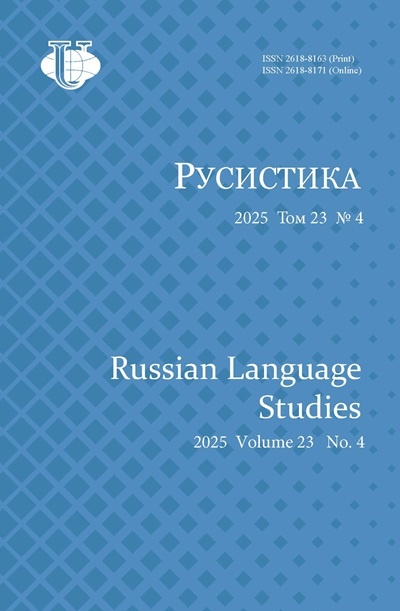
- Authors: Bozhenkova N.A.1,2, Sadivova N.3
-
Affiliations:
- Pushkin State Russian Language Institute
- Bauman Moscow State Technical University
- University of Presov
- Issue: Vol 23, No 4 (2025)
- Pages: 590-612
- Section: Key Issues of Russian Language Research
- URL: https://journals.rudn.ru/russian-language-studies/article/view/47705
- DOI: https://doi.org/10.22363/2618-8163-2025-23-4-590-612
- EDN: https://elibrary.ru/NQFPDI
- ID: 47705
Cite item

Abstract
The relevance of the study is determined by the object of research. Description and explanation of grammatically ambiguous positions of the use of linguistic units, including feminitives, are important tasks in teaching future Russian philologists. The Russian language in most cases does not have feminine forms referring to people by their profession or such forms have specific stylistic coloring. Consequently, the principles of grammatical and /or semantic coordination of such units with other parts of the sentence are not fully formalized. This causes difficulties in communication both for non-native and native Russian language speakers. The aim of this study is to identify and systemically characterize the ways how gender semantics of a person is expressed in the speech of Russian language native and non-native speakers when they use nouns which denote profession, title, or position. The main research method was an ascertaining pedagogical experiment. Its results were assessed with the help of methods of analytical description, component analysis, qualification analysis, and statistical data processing. The material of the study was the text-narrative in Russian which was compiled by N. Sadivova. The characters of the text are men, and they are represented by masculine lexemes. The respondents were asked to transform the text according to assignment where the characters belong to the female gender. The study proved that gender asymmetry in naming professions in Russian causes inconsistencies between the usual and normative variants both in the formation of feminine forms and in their use in context. The study identified productive word-formation models which are common to both native and non-native speakers of Russian and are used to create feminitives as usual innovations. 14 types of agreement between sentence members and nouns referring to female individuals have been identified. They indicate a new understanding of female subjectivity and grammatical means for its expression in Russian. It was determined that the linguistic-cultural consciousness of native Russian speakers and non-Russian speakers demonstrates an obvious tendency to use feminine forms as a marker of gender identity even in cases where the derivative is not normatively justified; linguistic-cognitive strategies for matching sentence members with such nouns are compensatory mechanisms for preserving the gender semantics of a person. The derivatives discursively and pragmatically substitute the lexical and morphological gaps of the Russian language. This indicates not only a new linguistic and cultural motivation for language choice, but the axiological determinants of modern society.
Full Text
Introduction
The transformed geopolitical structure of Russia in the 20th century has caused large-scale social changes. According to R. Guzaerova and V. Kosova (Guzaerova, Kosova, 2017: 11), the mass involvement of women in all spheres of public life contributed to the “active reproduction of existing correlates of the feminine gender and the emergence of a number of new nominations of female persons by professional and social affiliation”[1]. In other words, certain “theoretical prerequisites” were created for the emergence and consolidation of linguistic units that actualize female subjectivity in a certain professional sphere. The Russian language has great word-formation possibilities for creating feminine forms; “Russian Grammar” (Russian Grammar, 1980) lists 15 suffixes to form the feminine gender based on masculine. Nevertheless, these “derivational mechanisms” are not often used in real communication.
The necessity of feminine forms is discussed not only in linguistics (Gritsenko, Alikina, 2023; Guzaerova, Kosova, 2017; Lappo, Malinovskaya, 2020; Soltys, 2020; Mineeva, 2020; Khomitsevich, 2018), but also in social sphere (Gritsenko, Alikina, 2023; Piperski, 2018; Fufaeva, 2018). However, a unified approach to solving this practical problem has not yet been deve-loped. Thus, M.A. Krongauz and A.A. Somin (Krongauz, Somin, 2025) argue that Russian names of most professions are historically designed as masculine words and should be used in this form regardless of the gender of the person. I.V. Fufaeva (Fufayeva, 2020), on the contrary, presents a study of feminitive variants in historical, structural and sociolinguistic aspects though she doesn’t focus on establishing the “normativity” of their use[2].
Using the material of not only media resources, network communication, but also, which is especially interesting, children’s speech, M.A. Lappo and N.I. Malinovskaya (Lappo, Malinovskaya, 2020) note a high degree of linguistic variability in reflecting the “femininity” of a person; one name can create series of five to six forms, and this complicates the choice of the most functionally relevant unit[3]. At the same time, all authors are mostly aimed at identifying productive ways of forming feminitives, and grammatically correct agreement of the masculine noun with the feminine semantic gender is outside their research interests. This causes the greatest difficulties, which is evidenced in the practice of teaching Russian philologists.
These ideas of the Russian school are developing in the work of the author of the article, N.S. Sadivová (Sadivová, 2024a, 2024b). She proposes a taxonomy with three groups of nouns denoting profession, title, or position: (1) nouns that are a priori used in the feminine gender in relation to women (актриса ‘actress’; певица ‘singer’, etc.) or denote typically female professions which do not have full equivalents in the masculine gender (горничная ‘maid’; швея ‘seamstress’; няня ‘nanny’, etc.); (2) nouns which are used in feminine depending solely on the “preferences” of the actor (преподаватель / преподавательница ‘teacher’; начальник / начальница ‘boss’, etc.) or mark a broad social group (студент / студентка ‘student’, etc.); (3) nouns that are always used in the masculine gender to refer to women (юрист ‘lawyer’; пилот ‘pilot’; водитель ‘driver’, etc.).
The need for this taxonomy based on linguodidactic expediency is substantiated by two fundamental factors: (1) agreement of sentence members depends on “belonging” to a particular group[4]; (2) this lack of dis-tinction is the cause of speech errors of not only foreign students, but also native speakers (Gerasimova, 2018). Thus, on the one hand, the linguistic-cultural competence of native Russian speakers as a set of knowledge/skills and personal qualities acquired in mastering the system of cultural values expressed in language and regulating verbal behavior must be considered an indicator of a certain “mental understanding” of all the subtleties of coordinating sentence members with nouns of each group. On the other hand, linguistic-cultural consciousness of Russian speakers gives value-semantic components to any linguistic sign, including affixes. This complicates the formation of fe-minitives despite the derivational potential of the Russian language.
The aim of the study is to identify, describe, and characterize the linguistic-cognitive strategies to feminitive formation and their use in speech practice by both native and non-native Russian speakers, as well as quantitative, based on statistical data, confirmation of the hypothesis that the models of agreement with nouns naming persons by profession should be considered as the author’s reflection of the lexeme gender semantics and its linguistic explication.
Methods and materials
The main research method was an ascertaining pedagogical experiment; to evaluate its results, methods of analytical description, component analysis, qualification analysis, and statistical data processing were used.
The experiment was conducted in three groups of philology students — future teachers of Russian as a native and as a foreign language: Russian-, Slovak-, and Chinese-speaking[5]. The most interesting was the Chinese group; firstly, the Chinese language belongs to a different group of languages, isolating (root) languages, and students of the Russian language learn other word-formation phenomena; secondly, most Chinese students study Russian because of the expansion of economic contacts with Russia, and the naming of persons by profession is “lexical” core. The second target group included native Russian speakers since this group is most susceptible to the influence of various usual discursive practices, including media, where feminitives not recorded in dictionaries are being used more often. The third, Slovak, group was included in the experiment to confirm/refute hypothesis about the interference of the “laws” of the native language on the studied language. The total number of respondents was 67 people: 25 Russian native speakers, 22 Chinese speakers, 20 Slovak speakers.
The material for this experiment and the study as a whole was a narrative text in Russian composed by N. Sadivova, where all the characters are male and are represented by masculine lexemes (see below). Students, representatives of three language systems, were asked to rewrite this text based on the teacher’s assignment with female characters. The assignment implicitly assumed the possible/necessary replacement text components, the masculine form for the feminine form.
Results
The study revealed a wide range of linguistics strategies for making feminitives in Russian and their use in speech practice. Analysis of the empirical material shows that the formation of the female gender, especially in cases without normative version, is a complex process of reflection of the gender identity of the person named by activity in the linguistic-cultural consciousness of the actor. The process activates both grammatical and pragmatic-discursive resources of the Russian language.
Despite the existing grammatical rules, the gender of the referee is difficult or impossible to define without morphological markings, affixes or auxiliary words, in certain contexts. This is particularly complex in the third substantive group without normalized feminitive forms. As a result, there are a lot of innovations both in the formation of feminitives and in the agreement with other sentence parts.
The results of the experiment prove that the third group of nouns “generates” most grammatical and semantic errors. This group demonstrates 14 different types of agreement, which is significantly higher than in the first (3 types) and second (6 types) groups. The responses showed the dominance of complete grammatical agreement in the female gender, which indicates the need for gender marking in the language; the linguistic-cultural consciousness of both Russian native speakers and foreign philologists obviously records a tendency to use female forms, even when the feminitive is not normative. Established full agreement models are compensatory mechanisms for morphological and lexical gaps; when there is no “normative” femininitive respondents use variable strategies of agreement, that preserve gender semantics and minimize communicative misunder-standings.
Word-formation models for creating feminitives are also discussed. In the third group, the most productive formant was -к(а) (24% of cases), which is probably due to its relative neutrality in comparison with other suffixes; the second and third wide-spread were the affixes -ш(а) (14%) and -есc(а) (8%), which usually have stylistic coloring and a limited sphere of use. At the same time, the feminitive forms created by the respondents are not recorded in academic dictionaries and other official sources, but the growing frequency of their use in oral speech and often business writing indicates the usual dominance of such variants.
The empirical data and theoretical conclusions of the study demonstrate the importance of a comprehensive approach to studying agreement mechanisms, word formation, and linguistic-cultural motivation of language choice. The results of the study can become the basis for both modern lexicographic practice and updating grammatical aspects of the methodology of teaching Russian as a native and foreign language, as well as for Russian language studies.
Discussion
In the ascertaining experiment, students were offered the author’s narrative text including all three groups of nouns denoting the type of human activity (Table 1):
“My day started early. I woke up around seven in the morning and, as usual, checked my email first. Among the letters was a reminder from my boss about an upcoming meeting. I quickly got dressed and left the house. My personal driver was already waiting for me. On the way to work, I called an experienced lawyer, and we discussed the details of the new contract. The day promised to be eventful; in the office, there was a meeting with a charismatic CEO and a reasonable analyst who had prepared a report on current projects. The strict editor-in-chief of the corporate magazine and the energetic president of a partner organization also took part in the discussion.
After the meeting, I stopped at a cafe where my cousin, a creative pastry chef, worked. He treated me to fresh pastries and told me that a famous actor and a famous singer had recently visited them. Both were surprisingly easy to talk to and willingly took pictures with the staff. Next, I had a meeting with a doctor who consulted me on health issues. He works in a clinic under the guidance of a reputable Doctor of medical sciences, a specialist with extensive experience. They recommended me to undergo an examination and spend less time at the computer.
On the way back, I ran into an old acquaintance, a professor at the university where I was studying. We talked about science, and he spoke about the success of his graduate student who was then actively involved in research projects; the student was working as a young teacher and planning to continue his career in education.
In front of the shop, I was stopped by a security guard, a new employee, who I had never met before. We talked a bit, and he said that he had wanted to be a pilot but had chosen a more relaxed profession. After the conversation, I went to the store for groceries. A polite salesman helped me with the choice, and a smiling cashier was working at the cash desk. Despite feeling tired, he was in a good mood, and we exchanged a few words. When I returned home, I looked at old photos. Among them were pictures from competitions. Back then I was an active athlete, but I devote more time to reading and sometimes writing poems; this helps my inner poet.
This was another normal but busy day. Sometimes it seems that each of us lives several lives at once, sometimes as a director, as a lawyer, as a poet, or a pilot in spirit. And maybe this is the meaning of the future, to find yourself a little bit in every person you meet”.
Table 1
Nouns denoting professions
The first group of nouns | The second group of nouns | The third group of nouns | ||
Актер ‘actor’ Певец ‘singer’ | Начальник ‘boss’ Директор ‘director’ Специалист ‘specialist’ Преподаватель ‘professor’ Аспирант ‘graduate student’ Студент ‘student’ | Учитель ‘teacher’ Охранник ‘security guard’ Сотрудник ‘employee’ Продавец ‘salesman’ Спортсмен ‘athlete’ Поэт ‘poet’ | Водитель ‘driver’ Юрист ‘lawyer’ Аналитик ‘analyst’ Редактор ‘editor’ Президент ‘president’ | Кондитер ‘pastry chef’ Врач ‘doctor’ Доктор ‘Doctor of Sciences’ Пилот ‘pilot’ Кассир ‘cashier’ |
Source: compiled by N.A. Bozhenkova, N. Sadivova.
The discrepancy in number of the first group nouns is justified by the task itself (cf. classification of N. Sadivova). For the second group, 12 nouns were selected which have variable usage and feminitives are not marked colloquial in interpretation dictionary (Ozhegov, 2024). The third group is represented by 10 nouns, which do not have a feminitive fixed by the norms of the Russian language, but their feminitives are often used in publicistic genres, in internet discourses or function as conversational/ stylistically marked language units. Sentences with nouns from the third group in indirect cases were of the greatest research interest since there is a mixed agreement with the other sentence parts. Thus, it is necessary to distinguish two agreement types in the Russian language, complete and incomplete. In the first case, the subordinate word is consistent with the subordinating on in gender, number, and case; the predicative connection also requires the concordance of the predicate and the subject. In the second case, these rules do not work; here is grammatical, in form, and semantic, or referential, agreement (Khomitsevich, 2018)[6]. Sentences with nouns in indirect cases marking syntactic positions of the object, locus, instrument, etc., semantic concordance is forbidden, but it is often used in colloquial speech.
The most common model of agreement is the model where the adjectival components are of the masculine gender and the predicate (verb) is feminine. However, feminine gender agreement is sometimes possible for adjectives. In this regard, A.A. Gerasimova (Gerasimova, 2018) suggests distinguishing four types of adjectives, low, high, pronominal, and quantifying; they have different “potential” for agreement with nouns naming persons by profession, etc.
Low adjectives have limited combinability with a noun; feminine gender agreement is impossible for such adjectives. This is due to the fact that they are attached to a noun at an earlier stage of noun group formation (зубной врач ‘dentist’; финансовый аналитик ‘financial analyst’, etc.) and their meaning is idiomatic.
High adjectives, on the contrary, are characterized by free compatibility with a noun since they are added to it after the addition of low adjectives, i.e. they stand before low adjectives. Here we mention ameliorative adjectives, or adjectives with the meaning of “social approval” (талант-ливый / талантливая (главный) редактор ‘talented (chief) editor’; современный / современная (исполнительный) директор ‘modern (execu-tive) director’).
Pronominal adjectives (твой / твоя врач ‘your doctor’) and quantifiers (всякий / всякая врач ‘every doctor’) are added after high adjectives and can have agreement by the feminine gender (моя (внимательная зубной) врач ‘my (attentive dental) doctor)[7].
Many lexicographic sources give the only acceptable option, the grammatical agreement of all components in the masculine gender, and the agreement of feminine nouns with masculine attributes[8], which is widespread in the media, is non-normative. At the same time, journalistic discursive practices and modern artistic texts demonstrate deviations from the norm and a tendency for gender marking. It is no coincidence that academic grammar states that “it is precisely the requirement for designation, i.e. the need to communicate the gender of the person named, that ensures the usability of such combinations in modern speech” (Russian Grammar, 1980: 466). This generally confirms A.A. Gerasimova’s theory of four adjective types. It seems that the distinguishing feature in this case is the form of the nominative or indirect case; if semantic agreement in the feminine gender in the nominative case is acceptable, then expressions with attributed nouns in indirect cases violate Russian grammar system (с нашей любимой врачом ‘with our beloved doctor’; вчера встретил твою любимую косметолога ‘yesterday I met your favourite cosmetologist’).
This thesis was tested empirically; fragments of sentences transformed according to the task (noun + components of the word-combination / sentence subject to agreement[9]) are presented below. Each text fragment is followed by the students’ answers (their version of the noun, feminitive / original masculine form, and the form of the agreed adjective / verb) in their percentage ratio rounded off. The groups of respondents are designated by corresponding abbreviations: RS (Russian students — native speakers), CS (Chinese students), SS (Slovak students). An asterisk marks feminitive variants which can be interpreted as an error (insufficient Russian language proficiency) or special forms which are not recorded in dictionaries, despite the frequency of everyday use[10].
Table 2
Second group of nouns: nominative case
«остановил охранник — новый сотрудник» (predicate; noun from the second group as a subject; high adjective from the second group as an attribute; noun from the second group as an attribute) | ||
RS: | остановила охранница — новая сотрудница (80%) | Grammatical agreement in the feminine gender
|
остановил охранник — новая сотрудница (8%) | Grammatical agreement in the masculine gender + grammatical agreement in the feminine gender (mixed agreement) | |
остановил охранник — новый сотрудник (4%) | Grammatical agreement in the masculine gender | |
остановила женщина-охранник — новая сотрудница (4%) | Semantic verbal agreement with the auxiliary noun Женщина ‘woman’ + grammatical agreement in the feminine gender (mixed agreement) | |
остановила охранник — новая сотрудница (4%) | Semantic verbal agreement in the feminine gender + grammatical agreement in the feminine gender (mixed agreement) | |
CS: | остановила охранница — новая сотрудница (68%) | grammatical agreement in the feminine gender |
остановил охранник — новый сотрудник (18%) | grammatical agreement in the masculine gender | |
остановил охранник — новая сотрудница (9%) | grammatical agreement in the masculine gender + grammatical agreement in the feminine gender (mixed agreement) | |
остановил охранник — новая сотрудник (5%) | grammatical agreement in the masculine gender + semantic adjectival agreement in the feminine gender (mixed agreement) | |
SC: | остановила охранница — новая сотрудница (90%) | grammatical agreement in the feminine gender |
остановила охранник — новая сотрудница (10%) | semantic verbal agreement in the feminine gender + grammatical agreement in the feminine gender (mixed agreement) | |
«помог вежливый продавец» (predicate; high adjective as an attribute; noun from the second group as a subject) | ||
RS: | помогла вежливая продавщица (72%) | grammatical agreement in the feminine gender |
помог вежливый продавец (24%) | grammatical agreement in the masculine gender | |
помогла вежливая продавчиха* (4%) | grammatical agreement in the feminine gender | |
CS: | помогла вежливая продавщица (73%) помогла вежливая продавица* (22%) | grammatical agreement in the feminine gender |
помог вежливый продавец (5%) | grammatical agreement in the masculine gender | |
SS: | помогла вежливая продавщица (100%) | grammatical agreement in the feminine gender |
Note. RS (Russian students — native speakers), CS (Chinese students), SS (Slovak students); an asterisk — feminitive variants which can be interpreted as an error (insufficient Russian language proficiency) or special forms which are not recorded in dictionaries, despite the frequency of everyday use.
Source: compiled by N.A. Bozhenkova, N. Sadivova.
Table 3
Second group of nouns: indirect cases
«с харизматичным генеральным директором» (high adjective as an attribute; low adjective as an attribute; noun from the second group as an object) | ||
RS: | с харизматичной генеральной директрисой (52%) | grammatical agreement in the feminine gender |
с харизматичным генеральным директором (28%) | grammatical agreement in the masculine gender | |
с харизматичной генеральным директором (16%) | partial semantic adjectival agreement in the feminine gender | |
с харизматичной генеральной директоршей* (4%) | grammatical agreement in the feminine gender | |
CS: | с харизматичным генеральным директором (50%) | grammatical agreement in the masculine gender |
с харизматичной генеральной директoркой* (18%) с харизматичной генеральной директрисой (18%) | grammatical agreement in the feminine gender | |
с харизматичной генеральной директором (14%) | semantic adjectival agreement in the feminine gender | |
SS: | с харизматичной генеральной директоршей (40%) с харизматичной генеральной директрисой (35%) с харизматичной генеральной директоркой* (15%) | grammatical agreement in the feminine gender |
с харизматичной генеральным директором (10%) | partial semantic adjectival agreement in the feminine gender | |
«со старым знакомым — преподавателем университета» (noun from the second group as an attribute) | ||
RS: | со старой знакомой — преподавательницей (96%) | grammatical agreement in the feminine gender |
со старым знакомым — преподавателем (4%) | grammatical agreement in the masculine gender | |
CS: | со старой знакомой — преподавательницей (100%) | grammatical agreement in the feminine gender |
SS: | со старой знакомой — преподавательницей (100%) | grammatical agreement in the feminine gender |
«рассказал об успехах своего аспиранта, который» (pronominal adjective as an attribute, noun from the second group as an object, conjunctive word as a subject) | ||
RS: | своей аспирантки, которая (88%) | grammatical agreement in the feminine gender |
своего аспиранта, который (12%) | grammatical agreement in the masculine gender | |
CS: | своей аспирантки, которая (91%) | grammatical agreement in the feminine gender |
своего аспиранта, который (9%) | grammatical agreement in the masculine gender | |
SS: | своей аспирантки, которая (100%) | grammatical agreement in the feminine gender |
«работает молодым учителем» (high adjective as an attribute; noun from the second group as a nominative part of the predicate) | ||
RS: | молодой учительницей (96%) | grammatical agreement in the feminine gender |
молодым учителем (4%) | grammatical agreement in the masculine gender | |
CS: | молодой учительницей (100%) | grammatical agreement in the feminine gender |
SS: | молодой учительницей (100%) | grammatical agreement in the feminine gender |
«был активным спортсменом» (predicate; high adjective as an attribute; noun from the second group as a nominative part of a predicate) | ||
RS: | была активной спортсменкой (100%) | grammatical agreement in the feminine gender |
CS: | была активной спортсменкой (72,8%) | grammatical agreement in the feminine gender |
был активным спортсменом (13,6%) | grammatical agreement in the masculine gender | |
была активной спортсменом (13,6%) | semantic adjective-verbal agreement in the feminine gender | |
SS: | была активной спортсменкой (100%) | grammatical agreement in the feminine gender |
Note. RS (Russian students — native speakers), CS (Chinese students), SS (Slovak students); an asterisk — feminitive variants which can be interpreted as an error (insufficient Russian language proficiency) or special forms which are not recorded in dictionaries, despite the frequency of everyday use.
Source: compiled by N.A. Bozhenkova, N. Sadivova.
Table 4
Third group of nouns: nominative case
«ждал личный водитель» (predicate; low adjective as an attribute; noun from the third group as a subject) | ||
RS: | ждала личная водительница* (36%) | grammatical agreement in the feminine gender |
ждала личный водитель (36%) | partial semantic verbal agreement in the feminine gender | |
ждал личный водитель (24%) | grammatical agreement in the masculine gender | |
ждала личная водитель (4%) | semantic adjective-verbal agreement in the feminine gender | |
CS: | ждала личная водительница* (95%) | grammatical agreement in the feminine gender |
ждал личный водитель (5%) | grammatical agreement in the masculine gender | |
SS: | ждала личная водительница* (80%) | grammatical agreement in the feminine gender |
ждала личный водитель (20%) | partial semantic verbal agreement in the feminine gender | |
«строгий главный редактор» (high adjective as an attribute; low adjective as an attribute; noun from the third group as a subject) | ||
RS: | строгий главный редактор (32%) | grammatical agreement in the masculine gender |
строгая главная редакторша (24%) | grammatical agreement in the feminine gender | |
строгая главный редактор (20%) | partial semantic adjectival agreement in the feminine gender | |
строгая главная редактор (16%) | semantic adjectival agreement in the feminine gender | |
строгая главная редакторка* (8%) | grammatical agreement in the feminine gender | |
| строгий главный редактор (32%) | grammatical agreement in the masculine gender |
CS: | строгая главная редакторка* (27,2%) строгая главная редакторша (22,7%) | grammatical agreement in the feminine gender |
строгая главная редактор (13,6%) | semantic adjectival agreement in the feminine gender | |
| строгая главная женщина-редактор (4,5%) | semantic adjectival agreement in the feminine gender with the auxiliary noun женщина ‘woman’ |
SS: | строгая главная редакторка* (50%) строгая главная редакторша (30%) строгая главная редактриса (10%) | grammatical agreement in the feminine gender |
строгая главный редактор (10%) | partial semantic adjectival agreement in the feminine gender | |
«энергичный президент» (high adjective as an attribute; noun from the third group as a subject) | ||
RS: | энергичная президент (40%) | semantic adjectival agreement in the feminine gender |
энергичный президент (32%) | grammatical agreement in the masculine gender | |
энергичная президентка* (16%) энергичная президентша (12%) | grammatical agreement in the feminine gender | |
CS: | энергичный президент (50%) | grammatical agreement in the masculine gender |
энергичная президентка* (22,8%) | grammatical agreement in the feminine gender | |
энергичная президент (13,6%) | semantic adjectival agreement in the feminine gender | |
энергичная президентша (9,1%) | grammatical agreement in the feminine gender | |
энергичная женщина-президент (4,5%) | semantic adjectival agreement in the feminine gender with the auxiliary noun женщина ‘woman’ | |
SS: | энергичная президентка* (70%) энергичная президентша (20%) | grammatical agreement in the feminine gender |
энергичная президент (10%) | semantic adjectival agreement in the feminine gender | |
«креативный кондитер» (high adjective as an attribute; noun from the third group as an attribute) | ||
RS: | креативный кондитер (32%) | grammatical agreement in the masculine gender |
креативная кондитер (28%) | semantic adjectival agreement in the feminine gender | |
креативная кондитерша (28%) креативная кондитерка* (12%) | grammatical agreement in the feminine gender | |
CS: | креативный кондитер (36%) | grammatical agreement in the masculine gender |
креативная кондитерша (32%) креативная кондитерка* (23%) | grammatical agreement in the feminine gender | |
креативная кондитер (9%) | semantic adjectival agreement in the feminine gender | |
SS: | креативная кондитерка* (75%) креативная кондитерша (15%) | grammatical agreement in the feminine gender |
креативная кондитер (10%) | semantic adjectival agreement in the feminine gender | |
«работал улыбчивый кассир» (predicate; high qualitative adjective as an attribute; noun from the third group as a subject) | ||
RS: | работала улыбчивая кассирша (80%) | grammatical agreement in the feminine gender |
работал улыбчивый кассир (16%) | grammatical agreement in the masculine gender | |
работала улыбчивая кассир (4%) | semantic adjectival-verbal agreement in the feminine gender | |
CS: | работала улыбчивая кассирша (59%) | grammatical agreement in the feminine gender |
работал улыбчивый кассир (27%) | grammatical agreement in the masculine gender | |
работала улыбчивая кассир (9%) | semantic adjectival-verbal agreement in the feminine gender | |
работала улыбчивая кассирка* (5%) | grammatical agreement in the feminine gender | |
SS: | работала улыбчивая кассирша (85%) | grammatical agreement in the feminine gender |
работала улыбчивая кассир (15%) | semantic adjectival-verbal agreement in the feminine gender | |
«юрист» (noun from the third group as a subject) | ||
RS: | юристка* (64%) | — |
юрист (36%) | — | |
CS: | юристка* (64%) | — |
юрист (36%) | — | |
SS: | юристка* (90%) | — |
юрист (10%) | — | |
«пилот» (noun from the third group as a subject) | ||
RS: | пилот (72%) | — |
пилотесса* (20%) |
| |
пилотеса* (4%) |
| |
пилотица* (4%) |
| |
авиатрисса (4%) | — | |
CS: | пилотесса* (50%) | — |
пилот (45%) | — | |
пилотка* (5%) | — | |
SS: | пилотесса* (75%) | — |
пилот (25%) | — | |
Note. RS (Russian students — native speakers), CS (Chinese students), SS (Slovak students); an asterisk — feminitive variants which can be interpreted as an error (insufficient Russian language proficiency) or special forms which are not recorded in dictionaries, despite the frequency of everyday use.
Source: compiled by N.A. Bozhenkova, N. Sadivova.
Table 5
Third group of nouns: indirect cases
«с опытным юристом» (high adjective as an attribute; noun from the third group as an object) | ||
RS: | с опытной юристкой* (68%) | grammatical agreement in the feminine gender |
с опытным юристом (28%) | grammatical agreement in the masculine gender | |
с опытной юристом (4%) | semantic adjectival agreement in the feminine gender | |
CS: | с опытной юристкой* (77%) | grammatical agreement in the feminine gender |
с опытной юристом (14%) | semantic adjectival agreement in the feminine gender | |
с опытным юристом (9%) | grammatical agreement in the masculine gender | |
SS: | с опытной юристкой* (75%) | grammatical agreement in the feminine gender |
с опытной женщиной-юристом (15%) | semantic adjectival agreement in the feminine gender with the auxiliary noun женщина ‘woman’ | |
с опытной юристом (10%) | semantic adjectival agreement in the feminine gender | |
«с рассудительным аналитиком, подготовившим» (high adjective as an attribute; noun from the third group as an object; Past Participle as an attribute) | ||
RS: | с рассудительной аналитиком, подготовившим (44%) | semantic adjectival agreement in the feminine gender |
с рассудительным аналитиком, подготовившим (36%) | grammatical agreement in the masculine gender | |
с рассудительным аналитиком, подготовившей (12%) | partial semantic verbal agreement in the feminine gender | |
с рассудительной аналитикессой*, подготовившей (4%) | grammatical agreement in the feminine gender | |
с рассудительной аналитиком, подготовившей (4%) | semantic adjectival-verbal agreement in the feminine gender | |
CS: | с рассудительным аналитиком, подготовившим (36%) | grammatical agreement in the masculine gender |
с рассудительной аналитикой*, подготовившим (23%) с рассудительной аналитичкой*, подготовившим (14%) | partial grammatic agreement in the feminine gender | |
с рассудительной аналитиком, подготовившим (14%) | semantic adjectival agreement in the feminine gender | |
с рассудительной аналитикей*, подготовившим (9%) с рассудительной аналитицой*, подготовившим (9%) | partial grammatic agreement in the feminine gender | |
с рассудительной женщиной-аналитиком, подготовившей (9%) | semantic adjectival agreement in the feminine gender with the auxiliary noun женщина ‘woman’ | |
SS: | с рассудительной аналитичкой*, подготовившей (75%) | grammatic agreement in the feminine gender |
с рассудительной женщиной-аналитиком, подготовившим (15%) | semantic adjectival agreement in the feminine gender with the auxiliary noun женщина ‘woman’ | |
с рассудительной аналитиком, подготовившей (10%) | semantic adjectival-verbal agreement in the feminine gender | |
«с врачом, который» (noun from the third group as an object; conjunctive word as a subject) | ||
RS: | с врачом, которая (36%) | semantic agreement in the feminine gender |
с врачом, который (36%) | grammatical agreement in the masculine gender | |
с женщиной-врачом, который (8%) | grammatical agreement in the masculine gender with the auxiliary noun женщина ‘woman’ | |
| с врачихой, которая (8%) с докторшей, которая (8%) с врачиней*, которая (4%) | grammatical agreement in the feminine gender |
CS: | с врачом, который (77%) | grammatical agreement in the masculine gender |
с врачихой, которая (18%) с врачицей*, которая (5%) | grammatical agreement in the feminine gender | |
SS: | с врачихой, которая (60%) | grammatical agreement in the feminine gender |
с женщиной-врачом, который (25%) | grammatical agreement in the masculine gender with the auxiliary noun женщина ‘woman’ | |
с врачом, которая (15%) | semantic agreement in the feminine gender | |
«под руководством авторитетного доктора медицинских наук» (high adjective as an attribute; noun from the third group as an object) | ||
RS: | авторитетного доктора м.н.(40%) | grammatical agreement in the masculine gender |
авторитетной доктора м.н. (24%) | semantic adjectival agreement in the feminine gender | |
авторитетной докторши м.н. (24%) авторитетной докторки* м.н. (12%) | grammatical agreement in the feminine gender | |
CS: | авторитетного доктора м.н. (41%) | grammatical agreement in the masculine gender |
авторитетной докторши м.н. (22,7%) авторитетной докторки* м.н. (18,2%) | grammatical agreement in the feminine gender | |
авторитетной доктора м.н. (13,6%) | semantic adjectival agreement in the feminine gender | |
авторитетной женщины-доктора м.н. (4,5%) | semantic adjectival agreement in the feminine gender with the auxiliary noun женщина ‘woman’ | |
SS: | авторитетной докторши м.н. (50%) авторитетной докторки* м.н. (35%) | grammatical agreement in the feminine gender |
авторитетной женщины-доктора м.н. (15%) | semantic adjectival agreement in the feminine gender with the auxiliary noun женщина ‘woman’ | |
«хотел стать пилотом» (predicate; noun from the third group as an object) | ||
RS: | хотел стать пилотом (44%) | grammatical agreement in the masculine gender |
| хотела стать пилотом (28%) | semantic verbal agreement in the feminine gender |
хотела стать пилотессой* (20%) хотела стать авиатриссой* (4%) хотела стать пилотицей* (4%) | grammatical agreement in the feminine gender | |
CS: | хотел стать пилотом (45%) | grammatical agreement in the masculine gender |
хотела стать пилотессой* (41%) хотела стать пилоткой* (14%) | grammatical agreement in the feminine gender | |
SS: | хотела стать пилотессой* (75%) | grammatical agreement in the feminine gender |
хотела стать пилотом (25%) | semantic verbal agreement in the feminine gender | |
Note. RS (Russian students — native speakers), CS (Chinese students), SS (Slovak students); an asterisk — feminitive variants which can be interpreted as an error (insufficient Russian language proficiency) or special forms which are not recorded in dictionaries, despite the frequency of everyday use.
Source: compiled by N.A. Bozhenkova, N. Sadivova.
The qualitative analysis of the answers identified 14 types of agreement, which the respondents used in their answers: (1) grammatical agreement in the feminine gender (79%); (2) grammatical agreement in the masculine gender (11%); (3) semantic adjectival agreement in the feminine gender (feminine adjective + masculine noun + masculine verb (if there is a verb) (4%); (4) semantic verbal agreement in the feminine gender (feminine verb + masculine adjective (if there is an adjective) + masculine noun) (1.6%); (5) semantic adjectival-verbal agreement in the feminine gender (feminine verb + feminine adjective + masculine noun) (0.6%); (6) semantic agreement in the feminine gender (masculine noun + feminine agreeable words except verbs and adjectives) (0.5%); (7) partial semantic adjectival agreement in the feminine gender (high feminine adjective + low masculine adjective + masculine noun) (0.6%); (8) partial semantic verbal agreement in the feminine gender (masculine adjective + masculine noun + feminine verb) (0.6%); (9) partial grammatical agreement in the feminine gender (feminine adjective + feminine noun + masculine verb) (0.6%); (10) semantic adjectival agreement in the feminine gender with the auxiliary noun женщина ‘woman’ (feminine adjective + woman – masculine noun + masculine verb) (0.6%); (11) semantic verbal agreement with the auxiliary noun женщина ‘woman’ (feminine verb + woman- masculine noun) in mixed agreement only; (12) semantic adjectival-verbal agreement in the feminine gender with the auxiliary noun женщина ‘woman’ (feminine adjective + woman- masculine noun + feminine verb) (0.1%); (13) grammatical agreement in the masculine gender with the auxiliary noun женщина ‘woman’ (woman- masculine noun + agreeable masculine words except for verbs and adjectives) (0.3%); (14) mixed agreement, a combination of the listed options (0.5%).
The experimental study indicated a dominance of grammatical agreement in the feminine gender when using all three groups of nouns, including among native Russian speakers and even in the cases when there is no normative feminitive. Grammatical agreement in the masculine gender, preservation of the original form of the noun, is second in frequency. The third in frequency is semantic adjectival agreement in the feminine gender. The rest of the identified types of agreement are unique statements of respondents since their frequency is not higher than 2%.
The following affixes are the most productive in feminine gender formation[11]: -к(а) (24%), -ш(а) (14%) and -есc(а) (8%), which is predictable[12]. However, there were also derivatives with the suffixes -иц(а) (пилотица, водительница), -ин(я) (врачиня), -их(а) (продавчиха, врачиха) and a com-pound noun with the marker of feminine subjectivity (женщина-охранник, женщина-доктор, женщина-врач, женщина-юрист).
A comparative analysis of the responses of Russian/Chinese/Slovak students specializing in Russian language shows that the nouns of the first group were used in the feminine gender in accordance with the rules of Russian speech (Fig. 1); Slovak philologists consistently used the normative feminine form; native speakers chose the feminitive in 96% of cases, and the masculine form was used only in 4% of cases. Chinese philologists used the correct feminine form in 79.5% of responses, while the masculine form was preferred by 11.5% of respondents; in 9% of cases, incorrect or colloquial lexemes marking female subjectivity were used.

Figure 1. Nouns of the first group
Source: compiled by N.A. Bozhenkova, N. Sadivova.
The answers recording the “transformation” of nouns from the second group show (Fig. 2) that (1) native speakers preferred to use the standard feminine form in 77.85%, while the masculine gender was used in 17.54%; mixed use of forms was also observed, when one of the nouns was in the feminine gender, and the other, in the masculine gender (1.23%), which made it difficult to determine the dominant gender; incorrect or colloquial feminitives were recorded in 3.38% of cases; (2) Chinese students used the feminine form in 67.45% of cases, and the masculine form in 23.4%; the proportion of fragments with mixed gender forms coincided with the indicator of native speakers (1.23%); however, the frequency of non-standard / colloquial variants is significantly higher (7.92%); (3) Slovak philologists used the corresponding feminitive in 86.54% of cases, while the masculine form was found in 4.23% of responses; there was also a discrepancy in the use of feminine/masculine forms (0.77%), while new, non-standard, forms of feminitives accounted for 8.46%, which is the highest figure among all three groups of participants. The latter conclusion is of particular interest taking into account the inflectionality of the Russian and Slovak languages.

Figure 2. Nouns from the second group
Source: compiled by N.A. Bozhenkova, N. Sadivova.
When using nouns of the third group, native speakers preferred the standard masculine form in 61% of cases; in 39% of cases, colloquial/authorial variants of feminitives were suggested. In the responses of Chinese philologists, the proportion of deviations is higher; only 45.7% used the correct masculine form; in 54.3% of cases, incorrect or colloquial feminine forms were recorded. Slovak philologists used incorrect feminitives in 81%, and only 19% of responses contained the correct option, the masculine form (Fig. 3).
However, the very fact of using the corresponding form or creating a “new” version of a feminitive does not provide a complete answer to the question about the methods of explication a female person in a linguistic sign since female subjectivity can be represented by other lexemes. However, as for nouns from the third group, especially when they are used in indirect cases, the correct answer is full grammatical agreement in the masculine gender, which was demonstrated by a minority of respondents: RS — 35%, CS — 41%, SS — 0% (Fig. 4).

Figure 3. Nouns from the third group
Source: compiled by N.A. Bozhenkova, N. Sadivova.

Figure 4. Frequency of correct answers when using nouns from the third group
Source: compiled by N.A. Bozhenkova, N. Sadivova.
It is worth noting that the percentage of correct answers among Chinese philologists was higher than among native Russian speakers, and Slovak philologists used different types of grammatical/semantic, adjectival, verbal, or adjectival-verbal, agreement in the feminine gender. In other words, regardless of whether it is a native or non-native Russian speaker and regardless of their native language, most respondents make mistakes when using nouns from the third group, and the number of answers objectifying the normative version of using nouns from the first two groups exceeds 67%. This indicates not only significant difficulties in mastering agreement with these linguistic signs but also demonstrates new linguistic-cognitive processes in understanding the phenomenon of female subjectivity.
Conclusion
The conducted study indicated the stable need for an explicit expression of the feminine gender when naming female persons by profession. This reflects both current socio-cultural demands and the desire for linguistic designation of gender identity. At the same time, the perception of the axio-semantic components of feminitive forms has changed in the linguistic-cultural consciousness of Russian speakers. It is obvious that suffixes which previously had a completely different meaning and were considered inapplicable to de-signate women in the professional sphere, e.g. nouns with the formant -ш(а) used to designate the wives of men holding a specific position судейша ‘the judge’s wife’, генеральша ‘the general’s wife’, профессорша ‘the professor’s wife’, today are perceived as neutral markers (see the answers кондитерша, президентша, докторша, редакторша, директорша). At the same time, the colloquial nature of the suffixes -их (a) (продавчиха, врачиха, повариха, because there is ткачиха) or the “high” register of the suffix -ин(я) (врачиня, хирургиня, гинекологиня as in героиня) is “lost”; the derivational potential of the suffixes -иц(a) (пилотица, водительница) and -есс(a) (аналитикесса, пилотесса) is expanded. On the one hand, this does not solve the problem of the correct formation of feminitives for nouns from the third group; on the other, it shows that the “coordinative possibilities” of the Russian language provide the actor of communicative practice with a wide range of possible forms, and this choice reflects the axiological preferences of mo-dern society.
Further research with the increased number of respondents and/or representatives of other language systems may confirm our conclusions. At the same time, we consider it interesting to conduct a similar experiment in a group of Russian language teachers, native Russian speakers, belonging to the older age stratum. Its representatives might be less influenced by gender or teenager discourse in social networks. The materials of these studies can determine both the vector of scientific research in the field of Russian grammar and provide lexicographic description of new units which are being formed in the modern Russian language.
1 In this regard, we note two dictionaries: “Explanatory Dictionary of Women’s Names” (Kolesnikov, 2002), which systematizes the nominations of female persons by profession in the broad diachronic aspect, and “Women’s Names: Supplementary Dictionary” (Fiedoruszkow et al., 2006), which expands the previous dictionary and focuses exclusively on feminitives.
2 The official discourse does not often require using “non-standardized nominations” of the feminine gender since gender is expressed by an anthroponym.
3 This is the reason why the authors emphasize the need to create a relevant active dictionary and consider the parameters for describing such units: meaning, connotations, sphere of use, synonymy, and variability.
4 A study conducted at the Institute of Russian Studies at the University of Prešov in Slovakia (Sadivová, 2024a) showed that students tried to form the feminine form even for nouns of the third group. The author thinks that this demonstrates interference since the Slovak language mostly forms feminitives by adding the appropriate suffix to a masculine noun.
5 The study involved Russian and Chinese students from A.S. Pushkin Russian Language State Institute (Moscow, Russia) and students from the Institute of Russian Studies at the University of Prešov (Prešov, Slovakia).
6 Scientists also mention disagreement in gender.
7 The necessity of this distinction is also due to the fact that some adjectives tend to agree with the dictionary gender of the noun, and marking feminine subjectivity in the adjective is not always possible.
8 In some of cases, agreement with feminine nouns is pragmatically conditioned; this concerns attributes which can semantically be associated exclusively with female persons whereas the use of masculine forms in such contexts form illogical constructions (беременный водитель ‘pregnant driver’).
9 The syntactic position and characteristics of the adjective type are indicated in brackets.
10 The volume of the present article does not allow us to provide all the respondents’ answers. Therefore, the tables 2–5 present transformed constructions with nouns of the third group and partially the second group which clearly demonstrate the linguistic-cognitive strategies of the respondents. At the same time, we note some interesting positions in the use of nouns of the first (1) and second (2) groups, which were taken into account in the general conclusions. (1) in the RS group, preservation of the masculine form (известный актер ‘famous actor’ (4%), знаменитый певец ‘famous sin-ger’ (4%); in the CS group, cases of semantic adjectival agreement in the feminine gender (известная актер ‘famous actor’ (4.5%); знаменитая певец ‘famous singer’ (9%), grammatical agreement in the feminine gender with a colloquial/incorrect feminitive (известная актерка ‘famous actress’ (9%); известная актерша ‘famous actress’ (4.5%); известная актера* ‘famous actress’ (4.5%) and preservation of the masculine form (известный актер ‘famous actor’ (4.5%); знаменитый певец ‘famous singer’ (5%); (2) in the RS group, preservation of the masculine form (студент ‘student’ (4%); директор ‘director’ (44%); мой внутренний поэт ‘my inner poet’ (24%); моего начальника ‘my boss’ (4%); специалиста ‘specialist’ (24%), semantic adjectival agreement in the feminine gender (моя внутренняя поэт ‘my inner poet’ (4%) and the formation of colloquial/incorrect feminitives (директриса ‘headmistress’ (24%), директорша ‘director’ (4%); директрисса* ‘headmistress’ (28%); специалистки ‘specialists’ (68%); женщины-специалиста ‘female specialists’ (4%); специалисницы* ‘female specialists’ (4%); In the CS group, the preservation of the masculine form (директор ‘director’ (45%);
11 We mean feminitive formation outside the first and the second groups, which have normative feminitives.
12 However, given the neutral stylistic register of the text, forms докторша, редакторша, директорша used by Russian philology students surprised the authors. Here we also include authorial new words such as специалисница, авиатисса.
About the authors
Natalia A. Bozhenkova
Pushkin State Russian Language Institute; Bauman Moscow State Technical University
Email: natalyach@mail.ru
ORCID iD: 0000-0002-2381-5865
SPIN-code: 1041-8120
Scopus Author ID: 55987231400
ResearcherId: L-6652-2017
PhD, Doctor of Philology, Full Professor, Professor at the Department of General and Russian Linguistics, Pushkin State Russian Language Institute; Professor of the Russian Language Department, Bauman Moscow State Technical University
6 Akademika Volgina st., Moscow, 11748, Russian Federation; 5 2nd Baumanskaya st, bldg. 1, Moscow, 105005, Russian FederationNatalia Sadivova
University of Presov
Author for correspondence.
Email: natalia.sadivova@gmail.com
ORCID iD: 0000-0002-2946-0743
Doctor of Philosophy, Senior Lecturer, Institute of Russian Studies
15 17 Novembra st., Presov, 08001, Slovak RepublicReferences
- Fiedoruszkow, J., Ignasiak A., Kulpina, W., Rodak, A., Siemianowska, U., Tatarinow, W., & Wawrzyńczyk, J. (2006). Names of women. Additional dictionary. Warszawa: TAKT Publ.
- Fufaeva, I. V. (2020). What are women called? Feminitives: history, structure, competition. Moscow: AST Publ. (In Russ.).
- Fufaeva, I. V. (2018). Tkakha, blogger and new mayor. Why feminitives were, are and will be an organic part of the Russian language. https://knife.media/word-formation-difficulties/
- Gerasimova, A. A. (2018). Mixed agreement patterns in Russian (experimental study). Bulletin of the Russian Academy of Sciences: Studies in Literature and Languages, 77(1), 65–71. (In Russ.). EDN: YNWVQS
- Gritsenko, E. S., & Alikina, A. V. (2023). Gender issues as a positioning tool in Russian recruitment discourse. Tomsk State University Journal of Philology, (86), 18–33. (In Russ.). https://doi.org/10.17223/19986645/86/2 EDN: TOWZAL
- Guzaerova, R. R., & Kosova, V. A. (2017). Specificity of feminine nouns in modern Russian media space. Philology and Culture, (4), 11–15. (In Russ.). EDN: YLSHMI
- Khomitsevich, O. M. (2018). Nouns of common gender and names of persons by profession (using the Russian and Serbian languages as examples). In Innovative development and potential of modern science: Proceedings of the International (correspondence) scientific and practical conference (pp. 313–319). (In Russ.). EDN: YQGASW
- Kolesnikov, N. P. (2002). Explanatory dictionary of women’s names: more than 7000 units. Saint Petersburg: Astrel Publ. (In Russ.).
- Krongauz, M. A., & Somin, A. A. (2025). Research on language conflict: Conflict communication about language and language units in the sociolinguistic aspect. Journal of Siberian Federal University. Humanities and Social Sciences, 18(1), 158–177. (In Russ.). EDN: KROOJC
- Lappo, M. A., & Malinovskaya, N. I. (2020). Parameterization of the database of usual and non-usual feminitives. Russian journal of lexicography, (18), 52–72. (In Russ.). https://doi.org/10.17223/22274200/18/3 EDN: SVQGRG
- Mineeva, Z. I. (2020). Feminitives with Suffix ‘-shits(a ) /-chits(a)’. Nauchnyi dialog, (7), 142–157. (In Russ.). https://doi.org/10.24224/2227-1295-2020-7-142-157 EDN: WZISOS
- Ozhegov, S. I. (2024). Monolingual dictionary of the Russian language: about 100,000 words, terms and expressions. Moscow: AST Publ. (In Russ.).
- Piperski, A. Ch. (2018). Lawyer and Lawyer: A linguist on the future of feminitives and changes in language. https://philology.hse.ru/conflictology/news/217916506.html
- Sadivova, N. (2024a). Linguocultural analysis of Russian feminatives in comparison with Slovak and French languages (Candidate dissertation, Presov). (In Slovak.).
- Sadivova, N. (2024b). The degree of masculinization in the Russian linguistic environment. Student Scientific Art Conference of the Faculty of Arts of the University of Prešov – proceedings of papers, (1), 4–16. (In Slovak).
- Shvedova, N. Yu. (Ed.). (1980). Russian Grammatics. Vol. 1. Phonetics. Phonology. Stress. Intonation. Word formation. Morphology. Moscow: Nauka Publ. (In Russ.).
- Soltys, V. K. (2020). Gender issue in the Runet blogosphere language. Russian Language Studies, 18(4), 454–468. (In Russ.). https://doi.org/10.22363/2618-8163-2020-18-4-454-468 EDN: AAWKAH
Supplementary files
Source: compiled by N.A. Bozhenkova, N. Sadivova.
Source: compiled by N.A. Bozhenkova, N. Sadivova.
Source: compiled by N.A. Bozhenkova, N. Sadivova.
Source: compiled by N.A. Bozhenkova, N. Sadivova.

