





 Email this article


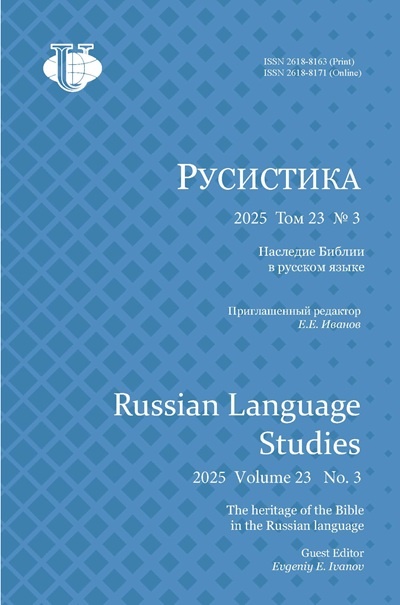
The heritage of the Bible in the Russian language: research areas and current issues
- Authors: Ivanov E.E.1
-
Affiliations:
- Mogilev State A. Kuleshov University
- Issue: Vol 23, No 3 (2025): THE HERITAGE OF THE BIBLE IN THE RUSSIAN LANGUAGE
- Pages: 359-384
- Section: Scientific Review
- URL: https://journals.rudn.ru/russian-language-studies/article/view/46466
- DOI: https://doi.org/10.22363/2618-8163-2025-23-3-359-384
- EDN: https://elibrary.ru/VWXMPE
- ID: 46466
Cite item

Abstract
The study presents an overview of the research of Russian and foreign Russianists devoted to the reflection of the biblical heritage in the Russian language, which is considered as a component of the spiritual code of culture and part of the language system. The relevance of the study is due to the lack of review and analytical works in this area of Russian studies. The aim of the study is to determine the historical background, main directions, and current issues of studying the heritage of the Bible in the Russian language. The material for the study includes more than 6800 scientific works of various genres devoted to the heritage of the Bible in the Russian language written since the first quarter of the 19th century. The research methods are heuristic, descriptive, generalization, comparison, analysis, and synthesis. The study showed that the study of the biblical heritage in the Russian language began in the late 19th century; after a long break, it intensified in the 1990s, became systematic in the first decade of the 21st century, and has currently differentiated into areas with different levels of theoretical and methodological validity, effectiveness and prospects. The most significant areas are translation, historical and etymological, phraseological, lexicographic, comparative, linguisticcultural, and theolinguistic studies. In all these areas, a set of theoretical provisions and methodological guidelines has already been formed; leading scientists and scientific centers has been determined. St. Petersburg Slavic (phraseological) school stands out because the works of its representatives and followers in Russia and abroad have significantly influenced the abovementioned areas of studying the heritage of the Bible in the Russian language. The most important tasks in studying the biblical heritage in the Russian language today are establishing the proportion of biblical meanings and values in the spiritual code of culture, developing a theolinguistic theory of reflecting biblical content in the semantic space of the Russian language, identifying typological and contrastive features of biblical expressions in the Russian language in relation to other Slavic and non-Slavic languages, and creating educational, translation and comparative dictionaries of biblical expressions. The prospects for the research are seen in analysis of the theory and methodology of each of the identified areas of studying the heritage of the Bible in the Russian language.
Full Text
Introduction
The Bible has been significantly influencing national languages as “the primary source of Christianity” and “one of the most significant texts of European linguistic culture” (Shaklein, 2012: 238). Many languages owe the Holy Scriptures their very existence (such as Church Slavonic), their alphabet created to translate it, and their writing reforms (such as the unwritten languages of the baptized indigenous peoples of Russia). The influence of the Bible is most obvious in new units in the language system (primarily at the lexical and phraseological level) and in new meanings, images, symbols, and metaphors in the semantic space, which directly or indirectly derived from the language and content of biblical texts. Not so obvious, but much deeper and more comprehensive impact of the Bible is manifested in the sociolinguistic aspect of functioning and development of literary forms of national languages. In this regard, the “confessional status of language” is considered as a full-fledged “sociolinguistic parameter” (Mechkovskaya, 1998: 259–261) and one of the criteria of “social typology of languages” (Mechkovskaya, 2001: 136).
The biblical texts have influenced languages in linguistic-cultural, linguistic-cognitive, linguistic-pragmatic, linguistic-discursive aspects. This influence is traced when comparing the peculiarities of background semantics in different languages, their conceptualization of reality, stylistic registers, speech genres, etc. in confessional style and in other functional styles, even in spoken language, including dialects and sociolects. The translation of the Bible launched internal and external changes in each language, which results in their selectivity (uniqueness) in the reception, preservation, and functional dynamics of the biblical linguistic and spiritual heritage.
The impact of the Bible on the Russian language and Russian culture has always attracted the attention of researchers. Diverse topics and methodology, a sufficiently large number of studies of the biblical heritage (there are about 570 works of different genres devoted to the analysis of biblical phraseological expressions[1]) requires generalization, systematization, and evaluation of the results obtained.
The urgent need for an analytical review is conditioned by the necessity to orient in the ever-increasing array of information, to realize what has already been done in this field, to identify general directions and understand the current issues of studying the heritage of the Bible in the Russian language.
Until now, there is only one review and analytical study by the Polish researcher of the Russian language E. Maksimowicz “Studying Biblical idioms in the Russian language — an overview of the most important research approaches” (Maksimowicz, 2021), which examines about 50 sources, 30 of them published between 1990 and 2000 and can hardly defined as “modern”. Many fundamental scientific works devoted to Russian biblical expressions, such as monographs (Grigoriev, 2006; Shulezhkova, 2013; Kuznetsova, 2017), collective monographs (Balakova, Kovacheva, Mokienko, 2013; Die slawisсhe Phraseologie und die Bibel, 2013; Khukhuni, Valuytseva, Osipova, 2014) are missing. The review does not show the history of the studying the biblical heritage in Russian; it analyzes theoretically and methodologically unimportant studies (e.g., on the use of biblical texts in school and university teaching) and pays much attention to irrelevant issues. As a result, the Polish linguist concludes that “modern Russian linguistic research has two approaches to studying phraseological expressions of biblical origin: Russian and Western” and that “the works devoted to phraseological expressions of biblical origin are mainly general studies that familiarize the reader with their use in modern language” (Maksimowicz, 2021: 176). It is obvious that these conclusions do not reflect the actual state even in the study of biblical idioms, not to mention other types and forms of biblical heritage in the Russian language. Therefore, it needs very substantial clarification and even more substantial supplementation.
Our study is aimed at determining the historical background, main directions and current issues of studying the heritage of the Bible in the modern Russian language. This heritage is understood as part of the language system and as a component of the spiritual cultural code represented in the language.
Materials and methods
The resources of the Russian State Library[2], the Scientific Electronic Library eLIBRARY.RU[3], available information resources abroad show that more than 6800 scientific works of various genres[4] are devoted to the Bible heritage in the Russian language over the last 200 years, from the first quarter of the 19th century. The analysis of the selected scientific works allowed us to differentiate them according to their aim into (1) studies which with different degree of completeness and depth touch upon certain aspects of the biblical heritage in the Russian language to solve broader problems, and (2) studies which are directly devoted to the identification, systematization and description of the diverse heritage of the Bible in its various manifestations in different social forms, at different levels, and in different historical periods. The analysis allowed us to narrow down the target group to a little more than 2400 scientific works. Then we chose the most significant studies in theoretical, methodological, and factual terms, about 350 in total. These works served as the main material for the present review.
The methodology of the analytical review involves focusing on the historical background of research in the field, main modern trends, scientific centers and leaders in the formation and development of each of the trends, current issues and prospects for further research.
Our research methods are heuristic and descriptive methods, generalization, comparison, analysis and synthesis.
Results
The study showed that the research of the Bible heritage in the Russian language began within the framework of biblical studies in the early 19th century; it was epistemologically formalized in the late 19th – early 20th centuries and practically ceased during the Soviet period (from the 1920s to the 1980s); it became active again only in the last decade of the 20th century and assumed a broad and systematic character in the early 20th century.
Various aspects of the study of the biblical heritage in the Russian language created seven directions which have emerged in the last decade: translation studies, historical-etymological, phraseological, lexicographical, comparative, linguistic-cultural, and theolinguistic ones. Each direction has received theoretical and methodological substantiation, has its actual issues, scientifically significant results and clearly outlined research prospects.
The St. Petersburg Slavistic (phraseological) School under the leadership of Prof. V.M. Mokienko (from the 1980s) has played a huge role in the development of most areas of studying the Bible heritage in the Russian language. Within the framework of this scientific school, the key provisions of the theory and methodology of historical-etymological, phraseological, lexicographical, comparative and linguistic-cultural directions developed. In the last 25 years, Russian and foreign representatives and followers of the St. Petersburg Slavic (phraseological) school have created explanatory, normative, translational and comparative dictionaries of biblical expressions including the world’s first polylingual dictionary of Russian biblical expressions and aphorisms with equivalents in all Slavic, major Romance and Germanic languages, Armenian and Georgian languages.
Discussion
On the History of Studying the Biblical Heritage in the Russian Language
The impact of the Bible on the Russian language and Russian culture over the last 1000 years cannot be overestimated, but a systematic scientific understanding of this impact has a relatively recent history. This was facilitated by the fact that biblical studies as a science began to develop in Russia only in the first third of the 19th century. By the beginning of the 20th century, it had achieved very notable results[5], primarily in such traditional fields as biblical history[6], archaeology[7], geography[8], geology, botany and zoology[9], hermeneutics[10], and textual criticism[11]. At the same time, by the end of the 19th century, the study of the Bible gradually began to go beyond the strict framework of biblical studies; the content of the Old Testament biblical texts began, on the one hand, to be projected onto ancient ideas of reality[12], and on the other hand, to be verified for its correspondence to the scientific picture of the world[13]. At the turn of the 19th and 20th centuries, the study of the Bible was no longer limited only to the biblical texts, recognized as the primary source of various elements of language and literature, art and spiritual culture, genetically related to the fragments of the Holy Scriptures, but independent in semiotic, semantic, functional terms. In this sense, the texts represent not the Bible itself, but its heritage[14].
The philological direction in Russian biblical studies developed in the 19th and early 20th centuries in accordance with its general tendencies but was not so versatile and profound. Traditionally, only the ancient languages of biblical texts[15], proper names in the Bible[16], and obscure fragments of the Holy Scriptures requiring special commentaries, usually in the form of a dictionary[17], were widely considered. Such commentaries date back to Old Russian manuscript alphabet books[18] where obscure words (glosses) in the texts of Holy Scripture were interpreted. The books can be considered the first dictionaries of biblical words in Russian biblical studies[19].
The first philological analysis of the heritage of the Bible in the Russian language is a small work by S.N. Glinka “On Biblical and Spiritual Eloquence in Relation to General Morality and Literature” (1829)[20], where the author seeks “to bring the beauties of Biblical and Spiritual Eloquence closer to the beauties of secular literature”[21] in order to show how “from a single thought, from a single utterance in the books of the Holy Scriptures to extract those excellent beauties that remain immortal monuments of human mind in national literature”[22].
The systematic study of the biblical heritage in the Russian language began in the middle of the twentieth century and was aimed at identification of biblical sources of Russian proverbs and sayings. The first consistent etymological commentary of this kind is found in I.M. Snegirev’s widely known collection “Russian Folk Proverbs and Proverbs” (1848). Russian proverbs and sayings are referenced to biblical texts where they are used in similar forms and meanings[23]. In the late twentieth century, the Bible as one of the most important sources of Russian phraseology is studied by E.I. Timoshenko in his work “Literary primary sources and prototypes of three hundred Russian proverbs and sayings” (1897)[24]. It is important that the Holy Scripture is placed here along with literary works. This emphasizes the importance of the Bible itself as a sacred text and of its heritage embodied in Russian set expressions.
However, the most interesting is I.M. Sirot’s study “Parallels. Biblical texts and their reflection in the sayings of Russian folk wisdom” (1897)[25]. It is the first work in Russian language studies which is devoted only to the biblical heritage in the subsystem of Russian set expressions. It is written on the material of 1475 Russian proverbs and their analogs in the books of the Old Testament. Like any first experience, I.M. Sirot’s work has certain inaccuracies and subjective evaluations, especially from the height of modern methodologies of studying the biblical heritage (Ivanov, Maslova, Mokienko, 2022: 105–106). For its time, it was undoubtedly a breakthrough study, the only one of a kind until recently[26] and relevant now for identifying and describing the rich heritage of the Bible in Russian phraseology and paremiology.
It is not accidental in this connection that after a century-long break caused by well-known political and socio-cultural factors, Russian linguists turned to the study of the biblical heritage in the Russian language primarily on the material of set expressions. These are the well-known works of E.M. Vereshchagin “The Biblical Element of the Russian Language” (Vereshchagin, 1993a), N.M. Shansky “The Gospel Text and the Phraseology of the Russian Language” (Shansky, 1995), V.G. Gak “Features of Biblical Phraseological Units in the Russian Language” (Gak, 1997), works by Russian and foreign representatives of the St. Petersburg Slavic (phraseological) school (Lilich, Mokienko, Stepanova, 1993; Birikh & Mateschich, 1994; Dmitriev, 1994; Lilich, 1995; Mokienko, 1995). These studies initiated the modern stage of studying the heritage of the Bible in the Russian language. The topic was reflected in a wide range of linguistic material, including comparisons with other languages, within individual linguistic disciplines and various interdisciplinary approaches.
Directions of research on the heritage of the Bible in the Russian language
Since the 1990s, a great number of scientific works have been devoted to various aspects of the biblical heritage in the Russian language; more than 100 doctoral and candidate dissertations have been written[27]. Their content is very diverse and testifies to the relevance of the main topic. At the same time, as the analysis has shown, not every aspect under study turns out to be epistemologically important enough to be developed into a separate area of research.
There are seven most theoretically and methodologically significant directions of studying the heritage of the Bible in the Russian language in modern Russian linguistics: translation studies, historical-etymological, comparative, phraseological, lexicographical, linguistic-cultural, and theolinguistic. They appeared at different times and on different bases, but they are equally active at present.
The field of translation studies emerged from the section of biblical studies devoted to the translation of the Bible into Russian[28] and remains closely related to it. In this connection, it is necessary to distinguish between the study of translation of biblical texts within the framework of biblical studies and translation theory as a scientific discipline. For biblical studies, the main thing is to transfer the meaning of the sacred text into Russian from the standpoint of religious dogmas and Bible interpretation in the Orthodox tradition (Efimets, 2024). Within the framework of translation theory, the most important are the issues of proper linguistic interpretation of the history and principles of translating biblical texts into Russian are considered (Alevich, 2019), adequacy and equivalence of translated biblical texts into Russian in the context of “traditions” and “understandability” of translation (Valuytseva, Khukhuni, 2012), linguistic boundaries of “violation of style and destruction of meaning” in translation (Kolesov, 1995), the relationship between the sociolinguistic situation and the linguistic and stylistic features of the first translations of the Bible into Russian (Kravetsky, 2015), the general features of the translation of the Bible into Russian against the background of its translations into other languages (Vereshchagin, 1993b; Murashkin, 2020), private issues of translating certain types of linguistic meanings in biblical texts into Russian and other languages (Kutieva, 2018) and some groups of linguistic units (Egorova, 2009).
The translation interpretation of the biblical heritage proper in the Russian language develops separately in terms of studying the influence of Russian Bible translations on the development of the Russian literary language (Alekseev, 2002), as well as translation strategies and tactics, peculiarities, methods and techniques of translating lexical and phraseological biblical units from Russian into other languages (Anand, 2019) and from other languages into Russian (Brezhneva, 2017).
A relevant issue of the translation studies is the ways of overcoming the tradition of Latin and Greek translations of the Bible and national traditions formed on their basis when translating biblical expressions into Russian, including from the languages of Slavia Latina and Slavia Orthodoxa.
The historical-etymological direction is based on research on the origin and history of words and set expressions in the Russian language. It dates back to the collections of I.M. Snegirev[29], I.E. Timoshenko[30], I.M. Sirot[31] in the middle of the 19th century aimed at establishing the biblical sources of Russian proverbs and sayings. In the Russian language, words of biblical origin (lexical biblical units) go back mainly to Church Slavonic translations of the Bible, excluding proper names. As a rule, it is easy to determine their prototypes; they are reflected in the dictionaries of the Church Slavonic language since the second half of the 18th century[32].
However, in many cases, especially in the Old Russian language background, differentiating the biblical and non-biblical origin of some words and set combinations is not so easy, so researchers consistently refer to the Greek and even Latin translations of the Bible and its original Hebrew. For example, the widely known expression стыд и срам ‘shame and disgrace’ can be interpreted as an Old Russian folk-poetic expression (V.V. Kolesov), as a biblical expression originating in Hebrew (D.V. Dmitriev), as a manifestation of ancient Slavic-Baltic syncretism in denoting feelings (B.A. Larin), and as belonging to all three sources at once (Ivanov, Maslova, Mokienko, 2022: 100–104).
The history and etymology of Russian biblical phraseological units based on the method of structural-semantic modeling developed by the representatives of the St. Petersburg Slavic (phraseological) school headed by V.M. Mokienko is fully described in the fundamental historical-etymological dictionary of Russian phraseology[33]. It involves a wide range of linguistic facts, both the results of interlingual comparison and dialectal data of the Russian language and other Slavic and non-Slavic languages. Research on the history and etymology of Russian biblical phraseological units continues; new data appear every year; historical-etymological materials are published (Mokienko, 2024b).
Along with the traditional historical and etymological analysis of Russian biblical phraseological expressions, a broad historical and cultural context is used in establishing their origin because the internal form and imagery of phraseological units are often based on the realities of history and everyday life, traditional and spiritual culture of different, including ancient, peoples, their folklore, mythology, and mentality. In this regard, many biblical phraseological units were found to have, firstly, their chronologically earlier sources than the Bible, and secondly, their later sources where biblical phraseology underwent significant changes in form and meaning (Grigor’ev, 2006, 2019). The main ways of penetration of biblical phraseological units into the Russian language have been established and described (Grigor’ev, 2007).
Lexical and phraseological biblical expressions in the history of the Russian language often acquire new shades of meaning or even completely new meanings, different from the biblical ones. These meanings require historical and etymological interpretation (for example, widely used in modern speech lexemes довлеет ‘dominates’ и злободневный ‘topical, burning’ go back to the Gospel expression довлеет дневи злоба его ‘sufficient unto the day is the evil thereof’ but do not semantically correlate with it and even contradict it[34]. The factors and conditions of such semantic changes are studied within the framework of the history of individual words and expressions (Lomakina, Mokienko, 2018).
In the framework of the historical and etymological study of the biblical heritage in the Russian language, it is important to find out the linguistic sources, time, factors and conditions of international words and expressions from biblical texts penetration into the Russian language and to distinguish between folklore influence and later borrowings.
The comparative direction was one of the first to develop after a long break in studying biblical expressions and was immediately focused on the elaboration of the basic principles of their interlingual comparison and determination of their interlingual similarities/differences (Lilich, Mokienko, Stepanova, 1993; Gak, 1997). Significant for the formation and development of the comparative study of biblical units were the works of the representatives of the St. Petersburg Slavic (phraseological) school. They laid the foundations for studying Russian biblical expressions in a broad European linguistic context (Mokienko, 2018). Over the next three decades, the main approaches to comparing biblical units in different languages were formed.
The most significant in biblical expression comparison is their full comprehensive comparative description mainly for a pair of languages – Russian and English (Mendelson, 2009), Russian and German (Shvidchenko, 2011), for three languages, Russian, German, Slovak (Balakova, Kovacheva, Mokienko, 2013) and for four languages, Russian, English, Spanish, and Italian (Reunova, 2011). This increase in the number of languages being compared may seem unnecessary, but in fact, it helps to identify significant commonalities in the types of biblical units, the ways of their connection to the source, their structure and semantics in different languages against the background of obvious interlingual differences in the composition of biblical units themselves due to different translation traditions and in their functioning determined by sociocultural and linguistic-cultural factors. Studies devoted to the equivalence of biblical units on the material of differently structured and genetically distant languages (Egorov, 2013; Reunova, 2014, 2015; Manyorova, 2024).
Another approach to the comparison of biblical units is the identification of interlingual similarities and differences in their individual properties and parameters: conditions of emergence and connection with their source (Velikoredchanina, 2017), peculiarities of meanings (Yakovleva, 2014; Eisner, 2018) and functioning (Velikoredchanina, 2012, 2013; Mishutinskaya, Zlobina, Shakirova, 2014), the use of the God component in biblical phraseological units (Lu, Shaklein, Mikova, 2019), figurative and symbolic components (Khostai, 2015, 2016; Adamia, Shelia, Marhania, 2020), proper names (Betekhtina, 1999; Buevich, 2013), etc. These detailed studies help to deeper understand and objectively explain what separates and what brings closer the linguistic heritage of the Bible in different languages and cultures.
The actual issue in the comparative direction is the comparison of biblical units in East Slavic languages, the identification of common and different features in the biblical lexicon and phraseology of Slavia Orthodoxa and Slavia Latina, identification of typological and contrastive peculiarities of biblical units in Russian in relation to non-Slavic languages, determination of the international pan-European stock in the composition of Russian biblical units, and the establishment of their unique properties against the background of typologically significant interlingual similarities.
The phraseological direction is the most productive in quantitative terms (more than half of all studies are devoted to set expressions) and the widest in terms of linguistic material (the object of description is all known types of set expressions, phraseological units, figurative expressions, winged words, proverbs, aphorisms, quotations, textual reminiscences, speech formulas, etc.). Among Russian biblical units, there are slightly more many-word units, than single-word ones[35]. At the same time, many-word units which derive from biblical texts or emerge after generalization of fragments of their content are the most numerous and active in use, many times surpass in this respect the lexical units originating from the language of the Bible. Therefore, it is not accidental, that the set expressions are not only the object of study of the phraseological direction, but also factual material, often the most preferable, for other directions, historical-etymological, comparative, lexicographical, linguistic-cultural. In this sense, the phraseological direction overlaps with these directions and is differentiated into relevant aspects, historical-etymological, comparative, lexicographic, linguistic-cultural.
The St. Petersburg Slavic (phraseological) school headed by V.M. Mokienko played a decisive role in the formation of theoretical provisions and methodological guidelines of the phraseological direction. The works of representatives and followers of the school in Russia and abroad have significantly influenced the development of Russian and Slavic phraseology and paremiology in the world science, including studies on the phraseological heritage of the Bible in Russian and other Slavic languages (Mokienko, 2024a).
In the strict understanding of the phraseological direction, set expressions are not only the object but also the subject of research in terms of describing their main properties (origin, type of connection with the biblical source, structural and semantic parameters, historical dynamics, functions and peculiarities of use in speech, stylistic features, etc.) and the general characteristics of phraseological biblical units as part of the phraseological subsystem of the language. These issues are touched upon and variously addressed, mostly separately in studies of historical-etymological (Lilich, Mokienko, Trofimkina, 2006; Grigor’ev, 2006, 2019; Shulezhkova, 2013), comparative (Lilich, Mokienko, Stepanova, 1993; Gak, 1997; Mendelson, 2009; Balakova, Kovacheva, Mokienko, 2013; Ignatyeva, Mokienko, Nikitina, 2024; Manyorova, 2024), lexicographic (Zhukovskaya, 2006; Kuznetsova, 2014; Balаkovа et al., 2015; Mokienko, Nikitina, 2023; Mokienko, Nikitina, 2024c), linguistic-cultural (Reunova, 2012; Walter, Ivanov, Mokienko, 2020; Mokienko. Rusyn God..., 2023b; Mokienko, Nikitina, 2024a, 2024b), or sociolinguistic nature (Baláková et al., 2020). Only few studies characterize Russian phraseological biblical units in general and describe their main features (Guri, 1993; Dubrovina, 2001, 2006, 2007a, 2007b, 2012a, 2012b; Orlova, 2020).
Quite a lot of attention is paid to the functioning of phraseological biblical units in the language of Russian fiction and journalism (Listrova-Pravda, 2001; Lomakina, 2012; Mokienko, 2017)[36].
The phraseological direction gives a full comprehensive description of phraseological biblical units as an independent subsystem within set expressions, identifies their structural and semantic dynamics, functional characteristics in different types and genres of modern discourse considering the specifics of electronic communication.
The lexicographic direction is represented in the theory, i.e. basic provisions, principles and techniques, of the dictionary description of biblical units and its practical realization in dictionaries of various types and in studying the representation of the Bible heritage in explanatory dictionaries of the Russian language (Mokienko, 2023a).
The unequivocal priority in the formation and development of the dictionary description of the biblical heritage in the Russian language belongs to the members and followers of the St. Petersburg Slavistic (phraseological) school headed by V.M. Mokienko, whose efforts have worked out the key provisions of lexicographic theory (Mokienko, 2011) and created the most representative in terms of coverage and quantity of linguistic material, completeness and depth of interpretation of biblical units linguistic dictionaries of all major types: explanatory[37], normative[38], translation[39] and comparative[40], including the world’s only polylingual dictionary[41].
Theoretical lexicography solves both traditional general problems of dictionary biblical lexicon and phraseology description in explanatory and educational dictionaries (Ivanov, Maslova, Mokienko, 2022: 221–249) and specific tasks of lexicographic representation of biblical units. Thus, the principles of dictionary description of biblical units in a special encyclopaedic dictionary (Dubrovina, 2010), stable comparisons based on biblical images (Kuznetsova, 2014; Nikitina, 2023), modern transformations of biblical phraseological units and proverbs (Mokienko, Nikitina, 2023), biblical units in educational dictionaries of lexical, phraseological and paremiological units (Nikitina, Rogaleva, 2024a, 2024b), translation equivalents of biblical units in a bilingual dictionary (Chlebda, 2002; Zhukovskaya, 2006; Ivanov, Mokienko, 2019), popular biblical expressions and aphorisms in a translation polylingual dictionary (Balakova et al, 2015), East Slavic biblical units in a comparative dictionary (Mokienko, Nikitina, 2024c), Russian equivalents and correspondences in an explanatory dictionary of biblical expressions and aphorisms of a closely related language (Ivanov, 2019a, 2019b, 2019c; Ivanov, Kravtsova, 2019), background semantics of Russian biblical units in a translation bilingual dictionary (Walter, Ivanov, Mokienko, 2020).
Russian lexical and phraseological biblical units are presented in monolingual, bilingual, and polylingual dictionaries. Among monolingual dictionaries of biblical expressions, two fundamental editions stand out, the explanatory dictionary of biblical expressions and words[42] and the encyclopaedic dictionary of biblical phraseological units[43]. These editions describe the corpus of Russian biblical expressions with illustrations of their use in speech since the XVIII century in the most complete and comprehensive way. The dictionaries of Russian biblical winged words by L.M. Granovskaya[44], G.A. Ioffe[45], N.G. Nikolayuk[46], V. Poznin[47], Y.A. Rakov[48] are less complete in composition, but quite representative in content. A separate group is explanatory and normative dictionaries by V.M. Mokienko[49], which present samples of correct understanding and use of biblical terms. And there is only one educational dictionary of biblical units for schoolchildren[50].
There are few bilingual translated dictionaries of biblical lexicon and phraseology: Russian-Armenian[51], Russian-German[52], German-Russian[53], Finnish-Russian-Finnish[54], French-Russian[55] and even Russian-Esperanto[56]. Polylingual dictionaries of biblical units are the translation Russian-English-German[57] and comparative nine-lingual Russian-Ukrainian-Belarusian-Bulgarian-Polish-Czech-English-German-French axiological dictionary of phraseological biblical units[58]. And the real lexicographic highlight is a series of three polylingual dictionaries under one title “Lepta of biblical wisdom” with 130 most frequent in Russian language biblical expressions and aphorisms and their equivalents and correspondences in Slovak and German languages (trilingual dictionary)[59], in English, Belarusian, German, Slovak and Ukrainian (six-language dictionary)[60], as well as in all Slavic, major Germanic (English, German, Swedish) and Romance languages (Spanish, Italian, French), Armenian and Georgian (the world’s only twenty-language dictionary of biblical expressions)[61]. Such a variety of dictionaries of biblical units exists only for the Russian language, so we can speak about the world leadership of Russian studies in this field of lexicography.
Actual issues of lexicographic description of the Bible heritage in the Russian language are the development of principles and creation of an educational dictionary of Russian biblical units for learners of Russian as a foreign language, development of principles and creation of a comparative dictionary of biblical units in East Slavic languages, creation of translation Russian-foreign language dictionaries of biblical units for all Slavic and major non-Slavic languages.
The linguistic-cultural direction is divided into two branches: (1) the identification and description of the national-cultural semantics (cultural background) of biblical units and (2) the study of the content and representation in the Russian language of that part of the spiritual code of culture, which is determined by the Holy Scriptures. The theory of syncretism of biblical and folklore heritage in the history of European culture developed by representatives of the St. Petersburg Slavic school under the leadership of V.M. Mokienko takes a significant place in the formation and development of theoretical and methodological provisions of linguistic-cultural description of biblical units (Mokienko, 2001). This theory explains the cases of “symbiosis of folk and biblical beginnings” in the spiritual code of culture and the biblical units that represent it (Ivanov, Maslova, Mokienko, 2022: 104).
The cultural background of biblical phraseological units is studied mainly on the material of phraseology and within the framework of one of the two approaches to its analysis, synchronic or diachronic. An example of implementing the synchronic approach is presented in K.N. Dubrovina’s study “Biblical phraseological uints in Russian and European culture” (Dubrovina, 2012b). It describes the processes of semantic transformation of phraseological biblical units (how they acquire cultural meanings) in the context of Russian and European culture (verbal, pictorial, and musical). The diachronic approach is successfully implemented in A.V. Grigor’ev’s study “Russian biblical phraseology in the context of culture” (Grigor’ev, 2019). It reveals the formation of the cultural background of biblical expressions and aphorisms in the context of ancient cultures, which motivate biblical imagery and condition not only the background but also the nominative semantics of biblical expressions.
The synchronic approach is also used to identify and describe the national-cultural semantics of biblical phraseology and aphorisms. The units acquire their semantics in the process of their functioning in the Russian language; they themselves become part of Russian culture merging with their biblical content and often displacing their original biblical meaning. For example, it happened with the biblical expression живая вода ‘living water’, which lost its original figurative meaning and began to be steadily associated only with Russian folk tales (Walter, 2012). The cultural background of biblical expressions is most effectively revealed and described through their cross-cultural analysis on the material of different languages (Reunova, 2012).
The biblical component of the spiritual cultural code is interpreted within the framework of religious and secular pictures of the world. In the first case, the content of the Bible is inherited by Orthodox spiritual culture and is viewed through the prism of confessional style. Mastering this style is one of the key linguistic competencies in learning Russian as a foreign language (Maschenko, 2004). In the second case, the content of the Holy Scripture is understood as part of the national spiritual code, “on which not only religious, but also moral postulates, values and standards are based” (Maslova, 2016: 83). In this regard, the Bible heritage is manifested in the spiritual cultural code in the form of “spiritual meanings” inherent, along with literal and figurative meanings, in those words and set expressions that represent the key concepts of the Russian national picture of the world.
For example, the lexeme love contains the biblical commandment “Love your enemies” (Matthew 5:44), which is one of the components of the spiritual meaning contained in this word (Maslova, 2019). The biblical heritage due to its manifestation in the spiritual meanings of lexical and phraseological units brings the sacral component to the spiritual code of culture and favorably influences its secular component. According to V.A. Maslova, these components determine the national values of the Russian people marked in the national language (Maslova, 2010).
Relevant within the framework of linguistic-cultural study of the Bible heritage in the Russian language is the identification of the share of biblical meanings and values in the spiritual cultural code and the spiritual component of the background semantics of linguistic units, the theoretical justification and linguistic verification of the biblical code as part of the spiritual code of culture and the description its representation in the Russian language and conceptualization in the Russian national picture of the world.
The theolinguistic direction is focused on identifying the part of the religious worldview reflected and expressed in the linguistic and background semantics of lexical and phraseological units, which goes back directly to the content of Holy Scripture, is determined by it and represents it in the mass consciousness of native speakers.
The founder of the theolinguistic direction is E.M. Vereshchagin, who formulated the general philological topics of studying the Russian language in the context of Russian Orthodoxy (Vereshchagin, 2007). Within the framework of this direction, T.E. Vladimirova, V.A. Maslova, V.I. Postovalova study Orthodox discourse (Vladimirova, 2008; Postovalova, 2021), describe language as a spiritual reality (Postovalova, 2019), reveal the sacred meaning and spiritual energy of the Russian word (Maslova, Danich, 2021; Maslova, 2023). E.E. Ivanov study the religious picture of the world in Russian aphoristics (Ivanov, 2019a, 2019b). At the same time, still undefined remain the epistemological boundaries of interaction between theology and linguistics in interpreting language units and fragments of the linguistic picture of the world reflecting the content of the Holy Scripture as a sacred text and as an outstanding literary monument of all times and peoples.
The actual issue of the theolinguistic direction is the development and verification of the theolinguistic theory of biblical content reflection in the semantic space of the Russian language and structural-semantic models of various speech genres.
Conclusion
The study shows that the systematic study of the biblical heritage in the Russian language began in the late twentieth century, after a long break it became active in the 1990s, became widespread in the early twentieth century, and in the last decade it has been differentiated into a number of separate directions with different levels of theoretical and methodological substantiation, results obtained and further prospects.
The most significant in terms of both the number of studies and their epistemological importance, as well as in terms of theoretical and methodological formalization are the seven directions of studying the heritage of the Bible in the Russian language: translation studies, historical-etymological, phraseological, lexicographical, comparative, linguistic-cultural, theolinguistic.
The most important for the formation and development of most areas of studying the heritage of the Holy Scriptures in the Russian language is the St. Petersburg Slavistic (phraseological) school under the leadership of V.M. Mokienko. Its members and followers in Russia and abroad have made a significant contribution to the development of the theory and methodology of historical-etymological, phraseological, lexicographic, comparative, and linguistic-cultural aspects of studying the Bible heritage and written fundamental studies of the Bible.
In the near future, actual issues for studying the Bible heritage in the Russian language are the establishment and description of typologically significant similarities and unique features in the composition, semantics, structure and functioning of biblical units in relation to other Slavic and non-Slavic languages; the creation of educational and translation dictionaries of Russian biblical units for learners of Russian as a foreign language, the development of principles and the creation of a comparative dictionary of biblical units of East Slavic languages; the identification of the share of Russian biblical units in the Russian language; the creation of a comparative dictionary of biblical units of East Slavic languages; the creation of a comparative dictionary of Russian biblical units for learners of Russian as a foreign language.
1 Kunygina, O. V. (2024). Study of biblical phraseological units: experience of bibliographic systematization. Chelyabinsk: ABRIS.
2 Russian State Library. Catalogs. Retrieved February 2, 2025 from https://www.rsl.ru/ru/4readers/catalogues/
3 Scientific Electronic Library eLIBRARY.RU. Search. Retrieved February 2, 2025 from https://elibrary.ru/
4 The search was performed automatically by simultaneous query of the words Bible (or Biblical) and Russian (or Old Russian) in titles, keywords, abstracts of scientific articles and conference proceedings, in tables of contents and/or abstracts of dissertations and books (monographs, dictionaries, etc.).
5 Soloveitchik, M. A. (1913). Basic Problems of Biblical Science. Saint Petersburg: Ezro.
6 See: Lopukhin, A. P. (1888). Guide to the Biblical History of the Old Testament. St. Petersburg: Publishing House of the bookseller I. L. Tuzov; Lopukhin, A. P. (1895). Biblical history in the light of the latest research and discoveries: The New Testament. Saint Petersburg: Publishing House of the bookseller I. L. Tuzov.
7 Troitsky, I. G. (1913). Biblical Archaeology. Saint Petersburg: Synodal Printing House.
8 Eleonsky, N. A. (1896–1897). Essays on Biblical Geography (Vol. 1–2). Saint Petersburg: Imperial Orthodox Palestine Society.
9 Sibirtsev, M. I. (1867). Experience of biblical-natural history, or Descriptive story of biblical geology, botany and zoology. Saint Petersburg: Journal “Wanderer”.
10 Savvaitov, P. I. (1844). Biblical Hermeneutics, or Interpretative Theology. Saint Petersburg: Publishing House of A. Ioganson.
11 Rybinsky, V. P. (1909). Biblical Old Testament Criticism. Kiev: Gorbunov’s Printing House.
12 Lovyagin, E. I. (1872). On the attitude of classical writers to biblical ones according to the view of Christian apologists: a historical and critical study. Saint Petersburg: Journal “Wanderer”.
13 See: Bankalsky, P. I. (1874). Forces of Nature, in Accordance with the Biblical Tale of the Six-Day Creation. Мoscow: Printing House of A. I. Mamontov & K°; Matveev, F. M. (1888). Experience of Applying Scientific Knowledge to the Biblical Tale of Peacemaking. Мoscow: Printing House of M. G. Volchaninov; Vvedensky, D. I. (1910). Biblical narrative about the Flood in its relation to the data of geology and traditions of peoples. Sergiev Posad: Printing House of Holy Trinity Sergius Lavra; Tutevich, S. N. (1914). Biblical Peacemaking and Natural Science (on the latest data of cosmogony, astronomy, geology, biology, zoology, paleontology, and anthropology): according to natural-scientific apologetics. Ananyev: Edition by I. Paskar & S. Tutevich.
14 See, for example: Solsky, S. M. (1878). On the biblical worldview in the life of the Old Russian people. Kiev: Davydenko’s Printing House; Barats, G. M. (1912). On the biblical element in the Tale of Igor’s Campaign. Kiev: Printing House of 1st Kiev Artel of Printing.
15 See: Lazarev, I. I. (1909). Notes on the Grammar of the Ancient Hebrew (Biblical) Language (Vol. 1–3). Vilna: Printing House of N. Matz & K°; Glubokovsky, N. N. (1914). Biblical Greek in the writings of the Old and New Testament. Kiev: Printing House of P. Barsky.
16 See: Solyarsky, P. F., Fr. (1879–1887). Experience of the Biblical Dictionary of Proper Names (Vol. 1–5). Saint Petersburg: Printing House of Tsederbaum & Goldenblum; Lebedev, V. F. (1916). Biblical proper names in their religious-historical meaning: historical-apologetic research. Petrograd: Synodal Printing House.
17 Chernyshev, V. F. (1889). Bible and Gospel readings with a dictionary. Vladimir on Klyazma: Printing House of the Gubernaya Zemstvo.
18 The oldest Russian alphabet book (Novgorod) is included in the list of the Synodal Kormchaya Book of 1282, see: Novgorod dictionary of the XIII century (1849). In I. Sakharov (Coll.) Tales of the Russian people (Vol. 2, pp. 215–216). Saint Petersburg: Sakharov’s Printing House.
19 A complete concordance of the Russian translation of the Bible was compiled and published by A.P. Lopukhin only in 1900, see: Symphony on the Old and New Testament (1900). Saint Petersburg: Printing House of A.P. Lopukhin.
20 Glinka, S. N. (1829). On biblical and spiritual eloquence in relation to the general morality and literature (Vol. 1–2). Мoscow: University Printing House.
21 Glinka, S. N. (1829). On biblical and spiritual eloquence in relation to the general morality and literature (Vol. 1, p. XV). Мoscow: University Printing House.
22 Glinka, S. N. (1829). On biblical and spiritual eloquence in relation to the general morality and literature (Vol. 1, p. 1). Мoscow: University Printing House.
23 Russian folk proverbs and parables published by I. Snegirev with a foreword and additions (1848). Мoscow: University Printing House.
24 Timoshenko, I. E. (1897). Literary sources and prototypes of three hundred Russian proverbs and sayings. Kiev: Printing House of P. Barsky.
25 Sirot, I. M. (1897). Parallels. Biblical texts and their reflection in the sayings of Russian folk wisdom (Vol. 1). Odessa: Printing house of M. Shpenzer.
26 In the V.P. Adrianova-Peretz’s materials published in the early 1970s, some of I.M. Sirot’s parallels are only repeated without references to his book or even mentioning it (Adrianova-Peretz, 1971).
27 See: Russian State Library. Catalog of Dissertation Abstracts. Catalog of Dissertations. Retrieved February 2, 2025 from https://www.rsl.ru/ru/4readers/catalogues/
28 See: Alekseev, A. A. (2002) The Bible. Translations into Russian. In Orthodox Encyclopedia. With the blessing of His Holiness Patriarch Alexy II of Moscow and All Russia (pp. 153–161). Мoscow: Church and Scientific Center of the Russian Orthodox Church “Orthodox Encyclopedia”.
29 Russian folk proverbs and parables published by I. Snegirev with a foreword and additions (1848). Мoscow: University Printing House.
30 Timoshenko, I. E. (1897). Literary sources and prototypes of three hundred Russian proverbs and sayings. Kiev: Printing House of P. Barsky.
31 Sirot, I. M. (1897). Parallels. Biblical texts and their reflection in the sayings of Russian folk wisdom (Vol. 1). Odessa: Printing house of M. Shpenzer.
32 See: Alexeev, P., Fr. (1773). Church Dictionary, or Interpretation of ancient Slavonic, as well as foreign language words without translation, found in the Holy Scriptures and other church books. Moscow: Imperial Moscow University; Dyachenko, G. (1899). Complete Church Slavonic Dictionary (with the addition of the most important Old Russian words and expressions). Мoscow: Vilde Printing House.
33 Birikh, A. K., Mokienko, V. M., & Stepanova, L. I. (2005). Russian phraseology. Historical and etymological dictionary. Мoscow: Astrel; AST; Lux.
34 Vinogradov, V. V. (1999). History of words: about 1500 words and expressions and more than 5000 words related to them. Мoscow: Institute of the Russian Language, Russian Academy of Sciences.
35 Among 2000 Russian biblical units, more than 1200 are many-word units, see: Lilich, G. A., Mokienko, V. M., & Trofimkina, O. I. (2010). Explanatory dictionary of biblical expressions and words: about 2000 units. Мoscow: AST; Astrel.
36 For the latest works see: Kunygina, O. V. (2024). Studying biblical phraseological units: the experience of bibliographic systematization (pp. 56–94). Chelyabinsk: ABRIS.
37 Lilich, G. A., Mokienko, V. M., & Trofimkina, O. I. (2010). Explanatory dictionary of biblical expressions and words: about 2000 units. Мoscow: AST; Astrel.
38 Mokienko, V. M. (2007). Let’s speak correctly. Dictionary of biblical winged expressions. Saint Petersburg: Faculty of Philology of St. Petersburg State University.
39 Mokienko, V. M., & Walter, H. (2009). Deutsche-russisches Wörterbuch biblischer Phraseologismen. Mit historisch-etymologischen Kommentaren. Greifswald: E.M.A.-Universität.
40 Balakova, D., Walter, H., & Mokienko, V. M. (2012). Lepta of biblical wisdom. Concise Russian-Slovak-German dictionary of winged words. Greifswald; Ružomberok; Saint Petersburg: E.M.A.-Universität Greifswald.
41 Ivanov, E. E. et al. (Eds.) (2019). Lepta of biblical wisdom: Russian-Slavonic dictionary of biblical expressions and aphorisms with their equivalents in Germanic, Romance, Armenian, and Georgian languages (Vol. 1–2). Mogilev: Mogilev State A. Kuleshov University.
42 Lilich, G. A., Mokienko, V. M., & Trofimkina, O. I. (2010). Explanatory dictionary of biblical expressions and words: about 2000 units. Мoscow: AST; Astrel.
43 Dubrovina, K. N. (2010). Encyclopedic Dictionary of Biblical Phraseological Units. Мoscow: Flinta; Nauka.
44 Granovskaya, L. M. (2009). Dictionary of names and winged expressions from the Bible: about 400 names, more than 300 expressions. Мoscow: AST; Astrel.
45 Ioffe, G. A. (2000). Dictionary of Biblical winged words and expressions. Saint Petersburg: Petersburg – XXI century.
46 Nikolayuk, N. G. (2012). The Bible Word in Our Speech: A Dictionary-Reference Book. 2nd edition, revised and supplemented. Saint Petersburg: Bibλioπoλiς.
47 Poznin, V. (2000). The cup of biblical wisdom: winged words from the Old and New Testament. Rostov-on-Don: Phoenix.
48 Rakov, Yu. A. (1999). Treasures of ancient and biblical wisdom: the origin of aphorisms and figurative expressions. Saint Petersburg: MiM; Respex.
49 See: Mokienko, V. M. (2007). Let’s speak correctly. Dictionary of biblical winged expressions. Saint Petersburg: Faculty of Philology of St. Petersburg State University; Mokienko, V. M. (2017). Biblical expressions in modern Russian speech: how to understand and use them correctly. Мoscow: Centerpoligraf.
50 Shulezhkova, S. G. et al. (Comp.). (2017). “Not by bread alone…”: a mini-dictionary of biblical terms for schoolchildren. Magnitogorsk: MSTU named after G. I. Nosov.
51 Sarkisyan, A. G. (2001). Russian-Armenian dictionary of biblical winged words. Tula: Grif & Co.
52 Yudina, E. V. (1999). Russian-German dictionary of church vocabulary. Saint Petersburg: Asta press.
53 Mokienko, V. M., & Walter, H. (2009). Deutsche-russisches Wörterbuch biblischer Phraseologismen. Mit historisch-etymologischen Kommentaren. Greifswald: E.M.A.-Universität.
54 Khramtsova, O. A. (2012). Finnish-Russian-Finnish dictionary of biblical phraseologisms. Petrozavodsk: National Library of the Republic of Karelia. Retrieved February 2, 2025 from https://avtor.karelia.ru/elbibl/hramtsova/fin_rus_fraz_new/20/index.html
55 Zhukovskaya, N. P. (2006). Biblical unints of the French language. Borrowings, phraseological units, quotations, characters, allusions. Experience of French-Russian commented dictionary of terms and expressions having a biblical source. Мoscow: Orthodox Svyato-Tikhnovsky Humanitarian University.
56 Shevchenko, A. B. (2009). Russian-Esperanto dictionary of biblical phraseological units. Мoscow: Impeto.
57 Adamia, N. L. (2005). Russian-English-German dictionary of proverbs, sayings, winged words and biblical sayings. Мoscow: Flinta; Nauka.
58 Bayramova, L. K., & Boychuk, V. A. (2020). Axiological dictionary of phraseological biblical units in Russian, Ukrainian, Belarusian, Bulgarian, Polish, Czech, English, German, French: dictionary of values and anti-values. Kazan: Center for Innovative Technologies.
59 Balakova, D., Walter, H., & Mokienko, V. M. (2012). Lepta of biblical wisdom. Concise Russian-Slovak-German dictionary of winged words. Greifswald; Ružomberok; Saint Petersburg: E.M.A.-Universität. There is also a version of this dictionary with illustrative quotations, see: Balakova, D., Walter, H., & Mokienko, V. M. (2015). Iz biblicheskoy wisdom = Z biblickej mudrostú = Biblische Weisheiten. Greifswald: E.M.A.-Universität.
60 Balakova, D. et al. (Comp.). (2014). Lepta of biblical wisdom: biblical winged expressions and aphorisms in Russian, English, Belarusian, German, Slovak and Ukrainian languages. Mogilev: Mogilev State A. Kuleshov University.
61 Ivanov, E. E. et al. (Eds.). (2019). Lepta of biblical wisdom: Russian-Slavonic dictionary of biblical expressions and aphorisms with their correspondences in Germanic, Romance, Armenian and Georgian languages (Vol. 1–2). Mogilev: Mogilev State A. Kuleshov University.
About the authors
Evgeniy E. Ivanov
Mogilev State A. Kuleshov University
Author for correspondence.
Email: ivanov-msu@mail.ru
ORCID iD: 0000-0002-6451-8111
SPIN-code: 8751-0620
Scopus Author ID: 57222386652
ResearcherId: E-4679-2019
Doctor of Philology, Professor, Head of the Department of Theoretical and Applied Linguistics
1 Kosmonavtov St., 212022, Mogilev, Republic of BelarusReferences
- Adamia, Z., Shelia, M., & Marhania, M. (2020). Comparative analysis of biblical phraseological units with blue and green colour components (on the example of English, Russian and Georgian). Scientific Bulletin of Uzhhorod University. Series Philology, (2), 17–27. EDN: ANVACQ
- Adrianova-Peretz, V. P. (1971). Biblical aphorisms and Russian proverbs. Proceedings of the Department of Old Russian Literature of the Institute of Russian Literature (Pushkin House), USSR Academy of Sciences, 26, 8–12. (In Russ.).
- Alekseev, A. A. (2002). The first Russian translation of the New Testament in the 1823 Edition. In The Role of Bible Translations in the Formation and Development of Slavic Literary Languages (pp. 7–38). Moscow: Institute of Slavic Studies, Russian Academy of Sciences Publ. (In Russ.). EDN: OIHLNI
- Alevich, А. V. (2019). History of Bible translations into Russian. Moscow University Translation Studies Bulletin, (4), 38–49. (In Russ.). EDN: LDQOIZ
- Anand, A. (2019). Biblical phraseological units in Russian and Hindi: Peculiarities of translation. Vestnik of Saint Petersburg University. Asian and African Studies, 11(3), 286–297. (In Russ.). https://doi.org/10.21638/spbu13.2019.303 EDN: PYZWDE
- Baláková, D., Kováčová, V., & Mokienko, V. M. (2020). Biblijska frazeologija z vidika jezikovnih uporabnikov ruščine (iz izsledkov sociolingvistične raziskave). Slavistična Revija, 68(2), 299–310. (In Slovak). EDN: VJPUBR
- Balakova, D., Kovacheva, V. & Mokienko, V. M. (2013). The Legacy of the Bible in Phraseology. Greifswald: E.M.A. Universität Publ. (In Russ.).
- Balakova, D., Walter, H., Ivanov, E. E., & Mokienko, V. M. (2015). About the translated dictionary of the most commonly used Biblical expressions (in English, Belarusian, German, Russian, Slovak, Ukrainian). Acta Germano-Slavica, 6, 154–163. (In Russ.). EDN: UJEJNT
- Betekhtina, E. H. (1999). Phraseological units with biblical names (in Russian and English). Saint Petersburg: St. Petersburg State University Publ. (In Russ.).
- Birikh, A., & Mateshich, I. (1994). From the history of Russian Biblical phraseological units. Russian Language Abroad, (5-6), 41–47. (In Russ.).
- Brezhneva, O. V. (2017). The peculiarities of translation of culture-specific Biblical expressions of the English language into the Russian language. Philology. Theory & Practice, (10-1), 88–90. (In Russ.).
- Buevich, A. A. (2013). Biblical proper names in phraseological units of Russian and Spanish languages. Philological Sciences. Scientific Essays of Higher Education, (2), 52–59. (In Russ.).
- Chlebda, W. (2002). To the description of biblical words in a bilingual dictionary. Przegląd Rusycystyczny, (4), 86–105. (In Russ.).
- Dmitriev, D. V. (1994). Synonymous doublets of biblical origin in Old Russian writing. In Dynamics of the Russian word: for the 60th anniversary of prof. V.V. Kolesov (pp. 43–50). Saint Petersburg: St. Petersburg State University Publ. (In Russ.).
- Dubrovina, K. N. (2012b). Biblical phraseological units in Russian and European culture. Moscow: Flinta: Nauka Publ. (In Russ.). EDN: SDQXKJ
- Dubrovina, K. N. (2001). Features of biblical phraseology in the Russian language. Philological Sciences. Scientific Essays of Higher Education, (1), 91–98. (In Russ.).
- Dubrovina, K. N. (2006). From the Bible to Russian biblical idioms. Russian Journal of Linguistics, (8), 98–104. (In Russ.). EDN: IKPWOZ
- Dubrovina, K. N. (2007a). From the Bible to Russian biblical idioms. Russian Journal of Linguistics, (1), 62–71. (In Russ.). EDN: IJEZQH
- Dubrovina, K. N. (2012a). Study of Biblical phraseology: general tasks and results. Scientific newsletter Voronezh state university of architecture and civil engineering. Series: “Modern linguistic and methodical-and-didactic researches”, (18), 154–163. (In Russ.). EDN: PHOWMJ
- Dubrovina, K. N. (2007b). The Bible and Russian phraseological units. Russian Speech, (2), 86–93. (In Russ.). EDN: HZPVLF
- Dubrovina, K. N. (2010). The first Russian “Encyclopedic Dictionary of Biblical phraseological units”: its Purpose, Objectives and their Implementation. Bulletin of the RUDN University. Series: Linguistics, (4), 112–118. (In Russ.). EDN: NBJXPD
- Efimets, I. A. (2024). Modern biblical translations into Russian. Bulletin of the Barnaul Theological Seminary, (4), 22–27. (In Russ.). EDN: ATAVYV
- Egorov, A. V. (2013). Comparative analysis of New Testament phraseology in Russian, Hungarian and Udmurt languages. Bulletin of Chelyabinsk State University. Series: Philology. Art criticism, 14(304), 16–21. (In Russ.). EDN: QIOYYX
- Egorova, N. V. (2009). The problem of translation of biblical proper names (based on the French and Russian languages). Bulletin of the Moscow State Linguistic University, (566), 89–98. (In Russ.). EDN: LJMJMB
- Eisner, S. N. (2018). The comparison of semantics of various phraseological units of Biblical origin in Russian and French. Vestnik of Moscow State Linguistic University. Humanities, (2), 202–209. (In Russ.). EDN: XRLYVF
- Gak, V. G. (1997). Features of biblical phraseological units in the Russian language (in comparison with French biblical units). Voprosy Jazykoznanija, (5), 55–65. (In Russ.).
- Grigor’ev, A. V. (2007). On the ways of penetration of biblical phraseological units into the Russian language. Russian Language at School, (6), 75–79. (In Russ.). EDN: JXUENP
- Grigor’ev, A. V. (2006). Russian biblical phraseology in the context of culture. Moscow: Indrik Publ. (In Russ.).
- Grigor’ev, A. V. (2019). Russian Biblical phraseology in the context of culture. Moscow: Moscow Pedagogical State University Publ. (In Russ.). EDN: OWHQCM
- Guri, I. (1993). Biblical phraseological units in the modern Russian language. In Jews and Slavs. Vol. I. Jerusalem. Saint Petersburg. (In Russ.).
- Ignatyeva, N., Mokienko, V., & Nikitina, T. (2024). East Slavic Paremiological Parallels: Biblical Wisdom in Figurative Variations. Studia Slavica Academiae Scientiarum Hungaricae, 69(1), 1–13. (In Russ.). https://doi.org/10.1556/060.2024.00148 EDN: URVPZJ
- Ivanov, E. E. (2019b). Aphorisms in religious discourse. Scientific notes of VSU named after P.M. Masherov, 29, 142–147. (In Russ.). EDN: NXPWCS
- Ivanov, E. E. (2019a). Aspects of empirical understanding of aphorism. RUDN Journal of Language Studies, Semiotics and Semantics, 10(2), 381–401. (In Russ.). http://doi.org/10.22363/2313-2299-2019-10-2-381-401 EDN: ZEELHM
- Ivanov, E. E. (2019c). On the dictionary of winged biblical expressions of the modern Belarusian literary language (with historical and etymological comments and correspondences in the modern Russian language). Slavic historical lexicology and lexicography, (2), 185–199. (In Russ.). EDN: XGVGZS
- Ivanov, E. E., & Kravtsova, D. S. (2019). Lexicographic description of winged aphorisms from Biblia in the modern Belarusian language (with equivalents of biblical aphorisms in Russian language). I. Yakovlev Chuvash State Pedagogical University Bulletin, (3), 54–63. (In Russ.). http://doi.org/10.26293/chgpu.2019.103.3.008 EDN: DMJGLC
- Ivanov, E. E., Maslova, V. А., & Mokienko, V. M. (2022). The heritage of the Bible in the language and culture of Russia and Belarus. Moscow: RUDN University Publ. (In Russ.). EDN: NGYGGO
- Ivanov, E. E., & Mokienko, V. M. (2019). Composition and structure of the Russian-Belarusian dictionary of winged biblical expressions and aphorisms. Proceedings of BSTU. Print- and media technologies, (2), 108–117. (In Belarusian). EDN: HGRBXT
- Khostai, I. S. (2016). The international character of Biblical symbols in the phraseological units of the English, Russian, Bulgarian and Croatian languages. Philology. Theory & Practice, (2-2), 157–160. (In Russ.). EDN: VJUJDH
- Khostai, I. S. (2015). Zoosemism symbols in biblical phraseological units of English, Russian and Croatian languages. Kazan Science, (12), 162–165. (In Russ.). EDN: VKIRXP
- Khukhuni, G. T., Valuytseva, I. I., & Osipova, A. A. (2014). Linguocultural aspects of interlingual transmission of the Biblical text. Moscow: Moscow State University of Education Publ. (In Russ.). EDN: YTEYYJ
- Kolesov, V. V. (1995). Violations of style and destruction of meaning in Modern translations of Biblical texts. In The Bible and the Revival of the Spiritual Culture of the Russian and Other Slavic Peoples (pp. 81–105). Saint Petersburg: Petropolis Publ. (In Russ.).
- Kravetsky, A. G. (2015). Sociolinguistic aspects of the first translations of the Bible into the Russian Language. Slověne, 4(1), 191–203. (In Russ.). EDN: UDBHRL
- Kutieva, M. V. (2018). Spiritual symbols in the translations of the Bible into Russian and Spanish: differences in figurative realizations. Vestnik of Moscow State Linguistic University. Humanities, (15), 229–240. (In Russ.). EDN: HLNLIP
- Kuznetsova, I. V. (2017). Characters of the Bible in Slavic stable comparisons. Cheboksary: I. Yakovlev Chuvash State Pedagogical University Publ. (In Russ.). EDN: SUTPWE
- Kuznetsova, I. V. (2014). Russian set comparisons of Biblical origin as an object of phraseography. Problems of history, philology, culture, (3), 86–88. (In Russ.). EDN: SPGXNJ
- Lilich, G. A. (1995). Biblicalisms as a reflection of the views of the era. In The Bible and the Revival of the Spiritual Culture of the Russian and Other Slavic Peoples (pp. 106–113). Saint Petersburg: Petropolis Publ. (In Russ.).
- Lilich, G. A., Mokienko, V. M., & Stepanova, L. I. (1993). Biblical studies in Russian, Czech and Slovak literary languages. Bulletin of St. Petersburg University. Series 2. History, linguistics, literary studies, 3(16), 51–59. (In Russ.).
- Lilich, G. A., Mokienko, V. M., & Trofimkina, O. I. (2006). On biblical expressions of non-Church Slavonic origin in the Russian language. In Word in dictionary and discourse: for the 50th anniversary of prof. H. Walter (pp. 545–556). Moscow: Elpis Publ. (In Russ.). EDN: ZQVMZF
- Listrova-Pravda, Yu. T. (2001). Foreign-language inclusions-biblicalisms in Russian literary speech of the 19th-20th centuries. Bulletin of Voronezh State University. Series 1, Humanities, (1), 119–139. (In Russ.).
- Lomakina, O. V. (2012). Features of the use of biblical phraseological units in the language of L.N. Tolstoy. Anuari de Filologia. Llengües i Literatures Modernes, (2), 45–54. (In Russ.).
- Lomakina, O. V. & Mokienko, V. M. (2018) Biblical intertexteme воздать сторицей ‘give a hundredfold return’: yesterday and today. In In Honorem: a collection of articles for the 90th anniversary of Prof. A. E. Suprun (pp. 169–178). Minsk: RIVSH Publ. (In Russ.). EDN: EWBSHL
- Lu, Yuxia, Shaklein, V. M., & Mikova, S. S. Russian Biblical Phraseological Units with the Component “God” in the Aspect of Chinese Linguistic Tradition. In Advances in Social Science, Education and Humanities Research, volume 315. Proceedings of the 2019 International Conference on Pedagogy, Communication and Sociology (ICPCS 2019) (pp. 255–258).
- Maksimowicz, E. (2021). Studying Biblical idioms in the Russian language – an overview of the most important research approaches. Studia wschodniosłowiańskie, 21, 169–181. (In Russ.). http://doi.org/10.15290/sw.2021.21.11 EDN: YGZOFB
- Manyorova, K. V. (2024). Russian and German biblical expressions: equivalence in the modern context. In Language and cultural communities in synchrony and diachrony (pp. 137–153). Moscow: Moscow University Press. (In Russ.).
- Maslova, V. A. (2019). “Love your enemies...”: the sacred and the secular in the concept of “Love”. In Anthology of theolinguistics (pp. 425–436). Ulyanovsk: Master Studio Publ. (In Russ.). EDN: YYLGIX
- Maslova, V. A. (2010). National values and language: spiritual code of culture. Linguistics, (2), 19–30. (In Russ.). EDN: ZCLPHJ
- Maslova, V. A. (2023). Sacral, spiritual and energy in the Russian word. Metaphysics, (3), 80–88. (In Russ.). https://doi.org/10.22363/2224-7580-2023-3-80-88 EDN: KBLZKE
- Maslova, V. A. (2016). Spiritual code from the standpoint of linguacultural studies: the unity of the sacred and the secular. Metaphysics, (4), 78–97. (In Russ.). EDN: YSLZBP
- Maslova, V. A., & Danich, O. V. (2021). Spiritual energy of the Russian word as a scientific challenge of humanitarian thought. Russian Language Studies, 19(2), 125–137. (In Russ.). http://doi.org/10.22363/2618-8163-2021-19-2-125-137 EDN: NEPXYY
- Maschenko, S. P. (2004). Orthodox Spiritual Culture: Linguocultural Aspect. Saint Petersburg: Sudarynya Publ. (In Russ.).
- Mechkovskaya, N. B. (2001). General Linguistics: Structural and Social Typology of Languages. Moscow: Flinta: Nauka Publ. (In Russ.).
- Mechkovskaya, N. B. (1998). Language and Religion Religion: Lectures on the Philosophy and History of Religions. Moscow: Fair Publ. (In Russ.).
- Mendelson, V. A. (2009). Phraseologisms of Biblical Origin in English and Russian. Kazan: Novoye Znanie Publ. (In Russ.). EDN: QVBMOF
- Mishutinskaya, E. A., Zlobina, I. S., & Shakirova, A. A. (2014). Comparative analysis of functioning of Biblicisms in the English and Russian languages. Philology. Theory & Practice, (12-1), 125–127. (In Russ.). EDN: SYECMT
- Mokienko, V. (2017). Biblical motifs in Modern Donbass poetry. Quaestio Rossica, 5(2), 552–566. (In Russ.). http://doi.org/10.15826/qr.2017.2.238 EDN: ZBEOEL
- Mokienko, V. M. (2024a). Biblical winged word in Slavia. The World of Russian Word Journal, (3), 5–13. (In Russ.). EDN: XBDBRS
- Mokienko, V. M. (2001). Biblicalisms and folklorisms: genetic relationship or typological parallelism? Studia Slavica Savariensia, (1–2), 65–77. (In Russ.).
- Mokienko, V. M. (2024b). From the history of Slavic phraseological biblical expressions. Slavistika, 28(1), 41–55. (In Russ.). https://doi.org/10.18485/slavistika.2024.28.1.3 EDN: VTPWLF
- Mokienko, V. M. (1995). Phraseological biblical expressions in a modern text. In The Bible and the Revival of the Spiritual Culture of the Russian and Other Slavic Peoples (pp. 143–158). St. Petersburg: Petropolis Publ. (In Russ.).
- Mokienko, V. M. (2011). Problems of dictionary description of Russian biblical expressions (general and educational lexicography). In Russian language and literature in time and space: XII Congress of MAPRYAL, Shanghai, China, May 10-15, 2011. (pp. 670–675). Shanghai: Shanghai Foreign Language Education Press. (In Russ.).
- Mokienko, V. M. (2018). Russian biblical terms in the European context. Językoznawstwo, (1), 33–45. (In Russ.). EDN: ALDQCT
- Mokienko, V. M. (2023a). The Biblical Heritage in the “Explanatory Dictionary of the Russian Language” Edited by D. N. Ushakov. Philological Class, 28(4), 103–116. (In Russ.). https://doi.org/10.26170/2071-2405-2023-28-4-103-116 EDN: YAVBXX
- Mokienko, V. M. (2023b). The Rusin Bog in proverbs and sayings. Rusin, (71), 163–182. (In Russ.). https://doi.org/10.17223/18572685/71/7 EDN: VRZALU
- Mokienko, V. M., & Nikitina, T. G. (2024c). The biblicisms of the East Slavic languages in comparative lexicographic representation. Russian Journal of Lexicography, (33), 71–88. (In Russ.). https://doi.org/10.17223/22274200/33/4 EDN: GXIFEM
- Mokienko, V. M., & Nikitina, T. G. (2024a). Biblical names and the Rusin “formula for the impossible”. Rusin, (75), 105–129. (In Russ.). https://doi.org/10.17223/18572685/75/6 EDN: ECGELH
- Mokienko, V. M., & Nikitina, T. G. (2023). Biblical phraseological units and paroemias in the modern socio-cultural context: towards the concept of dictionary representation. Scientific Dialogue, 12(8), 193–210. (In Russ.). https://doi.org/10.24224/2227-1295-2023-12-8-193-210 EDN: PBHELF
- Mokienko, V. M., & Nikitina, T. G. (2024b). Man and God: forms of interaction in the images of phraseological units. Studia Slavica Academiae Scientiarum Hungaricae, 67(1-2), 101–113. (In Russ.). https://doi.org/10.1556/060.2023.00098 EDN: XTHDQZ
- Murashkin, R. A. (2020). Features of bible translation into Russian and English. Bulletin of the Moscow International Academy, (1-2), 58–69. (In Russ.). EDN: AUNVFA
- Nikitina, T. G. (2023). Biblical images in Slavic stable comparisons: types of interlanguage correspondence and their dictionary representation. Rusin, (71), 113–130. (In Russ.). https://doi.org/10.17223/18572685/71/5 EDN: ARQBPA
- Nikitina, T. G., & Rogaleva, E. I. (2024b). Confessional Component of Urbanonymy in Lexicographic Interpretation. Nauchnyi dialog, 13(6), 78–94. (In Russ.). https://doi.org/10.24224/2227-1295-2024-13-6-78-94 EDN: PVIWJH
- Nikitina, T. G., & Rogaleva E. I. (2024a). Expressions of biblical origin in educational dictionaries of proverbs and phraseological units. Russian language at school, 85(5), 68–78. (In Russ.). http://doi.org/10.30515/0131-6141-2024-85-5-68-78 EDN: SBUZPQ
- Orlova, N. M. (2020). Bible and Small Literary Genres: Russian proverbs, sayings, and quotations. Speech Genres, (1), 29–35. (In Russ.). https://doi.org/10.18500/2311-0740-2020-1-25-29-35 EDN: UEGKOO
- Postovalova, V. I. (2019). Language as a spiritual reality. The doctrine of the name and prayer in the Orthodox tradition (sources, directions, conceptual development). Moscow: Cultural Revolution Publ. (In Russ.). EDN: JJZJUZ
- Postovalova, V. I. (2021). Prayer as creativity in the religious discourse of Orthodoxy (constants and innovations). Critique and Semiotics, (2), 71–87. (In Russ.). http://doi.org/10.25205/2307-1737-2021-2-71-87 EDN: UDPXWB
- Reunova, E. V. (2014). Characterictics of non-equivalent idioms of Biblical origin in Russian and English. RUDN Journal of Language Studies, Semiotics and Semantics, (4), 90–98. (In Russ.). EDN: SXHILH
- Reunova, E. V. (2011). Comparative analysis of phrases of Biblical origin in the Russian, Spanish, Italian, and English languages. RUDN Journal of Language Education and Translingual Practices, (3), 40–44. (In Russ.). EDN: OCVXAJ
- Reunova, E. V. (2012). Cross cultural analysis of Biblical expressions in Russian, Spanish, Italian, French and English. RUDN Journal of Language Studies, Semiotics and Semantics, (4), 45–49. (In Russ.). EDN: PXZSFN
- Reunova, E. V. (2015). Linguo-pragmatic features of non-equivalent Biblical idioms with anthroponyms in Russian, Spanish, Italian, French and English. Vestnik TvGU Series: Philology, (3), 334–337. (In Russ.). EDN: VAVNKJ
- Shaklein, V. M. (2012). Historical linguoculturology of the text. Moscow: RUDN University Publ. (In Russ.). EDN: TNGSET
- Shansky, N. M. (1995). Gospel text and phraseology of the Russian language. Russian language at school, (3), 49–53; (4), 55–57; (5), 53–57; (6), 54–59. (In Russ.).
- Shulezhkova, S. G. (2013). From the Promised Land to the Promised Heaven (Essays on the Fates of Biblical Catchphrases). Moscow: Flinta: Nauka Publ. (In Russ.). EDN: SBMMZV
- Shvidchenko, A. Yu. (2011). Comparative characteristics of the funds of biblical expressions of the Russian and German languages according to lexicographic sources. Problems of history, philology, culture, (3), 639–642. (In Russ.). EDN: MYGEUS
- Valuitseva, I. I., & Khukhuni, G. T. (2012). “Intelligibility” and tradition: the principles of Bible translations into Russian. RUDN Journal of Language Studies, Semiotics and Semantics, (2), 24–30. (In Russ.). EDN: PXZTNJ
- Velikoredchanina, L. A. (2012). Function peculiarities of Biblical expressions in the English and Russian language. Bulletin of the Moscow region state university. Series “Linguistics”, (1), 64–70. (In Russ.). EDN: PEHRQP
- Velikoredchanina, L. A. (2013). Modern text adaptation of Biblical phraseological units in the English and Russian languages. Bulletin of the Moscow region state university. Series “Linguistics”, (5), 53–59. (In Russ.). EDN: RMRMQF
- Velikoredchanina, L. A. (2017). Phraseological units formed in the process of the Bible paraphrasing in the Russian and English languages. Bulletin of the Moscow region state university. Series “Linguistics”, (3), 117–124. (In Russ.). EDN: ZAESNJ
- Vereshchagin, E. M. (1993a). Biblical element of the Russian language. Russian Speech, (1), 90–98. (In Russ.). EDN: PZQSOB
- Vereshchagin, E. M. (1993b). On the most ancient translations of the Bible, as well as on the translation into modern Russian. Asia and Africa today, (11), 45–50. (In Russ.). EDN: PRTLCX
- Vereshchagin, E. M. (2007). Russian language and Russian Orthodoxy: general philological issues: report at the XI Congress of MAPRYAL, Varna, Bulgaria, September 17–22, 2007. Moscow: V.V. Vinogradov Institute of the Russian Language, Russian Academy of Sciences Publ. (In Russ.).
- Vladimirova, T. E. (2008). Russian linguistic personality and Orthodox discourse. In Christianity and Science (pp. 286–315). Moscow: RUDN University Publ. (In Russ.).
- Walter, H., Ivanov, E. E., & Mokienko, V. M. (2020). National and cultural marking of biblical expressions and aphorisms of the Russian language (linguistic and cultural zone of the Russian-Belarusian dictionary of biblical expressions with correspondences in German). But we will save you, Russian language! Coll. monograph, dedicated to the 90th anniversary of academician V.G. Kostomarov (pp. 134–160). Moscow: Flinta Publ. (In Russ.). EDN: IOFMQF
- Walter, H., & Mokienko, V. M. (Eds.). (2013). Die slawisсhe Phraseologie und die Bibel = Slavic phraseology and the Bible = Slovanská frazeólogia a Biblia. Greifswald: E.M.A. Universität Publ. (In Russ., Polish, German). EDN: XRLJUZ
- Yakovleva, E. N. (2014). The evolution of Old Testament Biblical personal names in Modern French and Russian. Bulletin of the Moscow State Regional Humanitarian Institute. Series: Philology. Linguistics and Intercultural Communication, 2(2), 120–123. (In Russ.). EDN: TIXBEJ
- Zhukovskaya, N. P. (2006). To the question of creating the French-Russian dictionary of Bibleisms. St. Tikhon’s University Review. Series III: Philology, (2), 67–79. (In Russ.). EDN: KVAFOJ
Supplementary files

