






RUDN Journal of Political Science
Editor-in-Chief: Yuriy M. Pochta, PhD, Professor
ISSN: 2313-1438 (Print) ISSN: 2313-1446 (Online)
Founded in 1999. Publication frequency: quarterly.
Open Access: Open Access  APC: no article processing charge.
Peer-Review: double blind. Publication language: Russian, English
PUBLISHER: Peoples’ Friendship University of Russia named after Patrice Lumumba (RUDN University)
Journal History
Indexation: White List RCSI, Russian Index of Science Citation, RSCI, Google Scholar, Ulrich's Periodicals Directory, IPSA, DOAJ, Dimensions
The mission of the Journal is a broad exchange of scientific information and results of theoretical and empirical studies by researchers from different fields of Russia's Political science: Comparative Politics, Russian Political History, Political Sociology, as well as Political Philosophy and Political Psychology.
The purpose of the Journal is enhancement of research efficiency in the field of political science on the basis of the development of scientific, editorial and publishing activities as well as dissemination and approbation of modern techniques and the latest achievements of political science in order to realize the mission of a modern classical university. Principal objectives of the journal:
- conceptualization of political problems, goals, trends and tasks and further development of political self-consciousness and political culture;
- providing the researchers with an opportunity of free expression and exposition of their vision of political processes and institutions within the framework of scientific discourse while allowing critical review of political problems through the prism of certain concepts, aspects and approaches;
- cooperation with Russian academic and educational institutions in order to expand the information field and promote exchange of scientific knowledge;
- in publications, materials should be selected according to the specificity of RUDN University in general and topics of selected countries in particular;
- expanding the authors’ cooperation network;
- promoting the image and helping to further recognition of the journal by expanding its international activity and visibility;
- advancing the journal in the market of scientific periodical reviewed works;
- using the published materials in research and educational process at Political Science departments of Russian higher educational establishments as well as within the Human Sciences framework.
The journal is designed for publishing the results of independent and original research works by researchers, professors of RUDN University and scientific centers in the form of research articles, review materials, scientific reports, and bibliographical reviews on certain subjects and within selected scientific areas. The journal provides an overall coverage of political processes in Russia and the contemporary world. At the same time, following the scientific trends of the University, special attention is paid to Russia-related studies: Political history of Russia; Religion and state politics; Contemporary political process; Russia in the system of international relations; Foreign policy of Russia; political thought and methods of Political Science research. Particular attention is paid to the problems of political and state development of contemporary Russia. Research is based on the principles of methodological pluralism and the interdisciplinary approach, as well as studies of international relations and dialogue of civilizations in the context of ongoing changes in the global landscape. Concurrently, traditional methodological tools of Political Science are being reconsidered.
Announcements More Announcements...
Post Release of the Round table "Water politics"Posted: 20.09.2025
The round table of the authors of the issue 1 of 2025 |
|
|
Current Issue
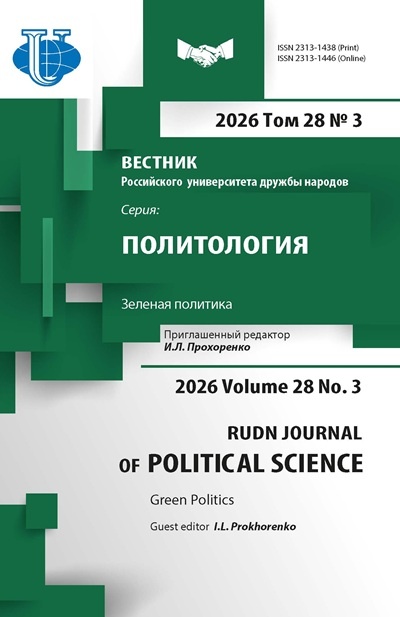
Vol 28, No 3 (2026): Green Politics
- Year: 2026
- Articles: 18
- URL: https://journals.rudn.ru/political-science/issue/view/2196
- DOI: https://doi.org/10.22363/2313-1438-2026-28-3
Full Issue

WORLD POLITICS OF THE ENERGY TRANSITION ERA
The Political Science Dimension of the “Energy Transition” Category: A Review of Theoretical Discourse
Abstract
The study examines the evolution of the political science interpretation of the energy transition in Russian academic discourse between 2021 and 2025. The study demonstrates that the concept of energy transition is increasingly moving beyond its traditional techno-economic framing and emerging as a multidimensional political phenomenon associated with geopolitics, geo-economics, public governance, institutional transformation, and social resilience. Particular attention is paid to the growing tendency, especially after 2022, to interpret the energy transition as an instrument of international competition and redistribution of global influence. The analysis reveals the predominance of the geopolitical perspective within the examined body of literature, supplemented by discussions on transition risks, technological sovereignty, green regulation, discursive practices, and the social implications of energy transformation. At the same time, the research identifies a gradual shift from descriptive and economically oriented approaches toward more complex political science interpretations of the energy transition. The methodological framework combines bibliometric analysis, discourse analysis, content analysis, and elements of quantitative analysis of publication dynamics. The bibliometric approach was used to form the corpus of publications; discourse analysis was applied to identify conceptual and semantic frameworks; content analysis enabled the structuring of the research field; and quantitative methods were employed to assess the dynamics and internal structure of the scientific discourse.
 499-518


China’s Energy Transition Policy: the Arctic and Central Asian Factors
Abstract
The article presents the results of the analysis of China’s international policy in the field of energy transition through the prism of the influence of Arctic and Central Asian factors. The authors therefore aim to analyze the role and place of Arctic and Central Asian factors in advancing China’s Energy Transition. The relevance of this study stems from the strategic significance of China’s energy transition as one of the long-term goals and the ultimate outcome of Xi Jinping’s “Beautiful China” environmental vision (the state development plan for the Communist Party of China until 2030, integrating environmental policy with socio-economic development strategies), energy security strategy, and the achievement of the “second centenary goal of building a prosperous, democratic, beautiful, and modernized socialist power”. The lack of research on this topic can be characterized as a gap in domestic scholarship. This study is based on a systems analysis and participant observation. The priorities of the new 15th Five-Year Plan (2026-2030) indicate that the significance of Arctic and Central Asian factors will continue to increase as China’s economic energy transition accelerates. In recent years, China has been actively promoting the energy transition, primarily through expanding renewable energy capacity domestically and internationally, as well as importing natural gas and LNG from the Russian Arctic and Central Asia. The US’s announced plans to increase LNG exports from Alaska pose risks related to lower prices for Russian gas, as well as to Russia’s overall energy policy. The research findings may be of particular interest to our country’s ministries and agencies responsible for developing and implementing energy policy.
519-535
Energy Transition in Brazil’s Ecological Transformation Strategy
Abstract
With the return to the presidency of Luiz Inácio Lula da Silva (2003-2011; 2023 - present), environmental issues have once again become one of the priorities of Brazil’s national policy. The country has developed the “Brazil’s Ecological Transition Plan”, the cornerstone element of which is the energy transition. Brazil already has one of the cleanest energy balances in the world. Nevertheless, the Latin American giant is taking additional measures to accelerate the transition to a low-carbon economy: it is shaping policies aimed at structural reforms in the energy sector to reduce dependence on fossil fuels, increase the share of renewable energy sources, and promote energy efficiency. Brazil’s abundant resources in the fields of hydropower, wind, solar and biomass allow it to be considered as a potential leader in green energy. While adhering to this strategic course, the government is nevertheless forced to maintain and even increase the volume of hydrocarbon production. The purpose of this article is to offer an analysis of the energy transition as an important area of environmental transformation promoted by the Government of Lula da Silva. Based on scientific research, development programs and government decisions, the author suggests considering the key changes taking place in the Brazilian energy sector, the main directions of government policy in the field of renewable energy, and analyzing the mixed reactions and non-obvious results of the decisions taken. The article presents the main arguments that make it possible to understand the logic of expanding oil production while simultaneously declaring a “green” agenda, and notes that an integrated approach combining the interests of economic development, ecosystem protection, social integration and technological opportunities will be crucial for success of the energy transition plan.
536-552
Indian Federalism in Terms of Energy Transition Policy: Cooperation or Competition Between the Union and the State of Jharkhand
Abstract
India’s energy transition is essential for fulfilling Paris Agreement commitments and achieving sustainable development, necessitating exceptional coordination between the central and state governments. This research paper analyzes Centre-State relations within India’s federal system as they pertain to energy transition policies, with a particular focus on the dynamics of cooperation and competition between the central government and the state of Jharkhand. The study highlights the often-overlooked political interactions inherent in federal energy governance. The inclusion of energy on the Concurrent List allows both levels to legislate, frequently resulting in conflicts, especially when political parties in power differ. Jharkhand, which derives approximately 70 % of its revenue from coal, exemplifies the challenges posed by national renewable energy initiatives, making it a critical case for assessing how federal institutions can either facilitate or hinder green transitions in developing countries. This study employs secondary data analysis, utilizing sources such as the Indian Constitution, the Paris Agreement, and reports from the National Institution for Transforming India (NITI Aayog), International Renewable Energy Agency (IRENA), Central Electricity Authority, and relevant state departments. The research adopts a longitudinal approach covering the period from 2016 to 2025, with occasional references to pre-2016 developments. Data analysis involves a comparative evaluation of policy documents, legislative acts, and institutional outputs to identify patterns of cooperation and competition. The study integrates systems theory to conceptualize intergovernmental relations as interdependent systems and applies institutionalism to examine organizational constraints on policymaking. The Marble Cake model of cooperative federalism is used to illustrate mechanisms for coordinating central and state actions. The research offers practical recommendations for addressing biases, promoting nonpartisan, citizen-oriented policies, and enhancing the effectiveness of energy transitions within governmental frameworks. These insights may also inform reforms in other resource-dependent governments and international federations facing similar climate challenges.
553-563
GREEN POLICIES
EU Climate Policy: New Dimension of Municipal Authorities and National Governments Conflict
Abstract
The article examines a new dimension of conflict between municipal authorities and national governments in the system of multi-level governance in the European Union within the framework of EU climate policy. The author uses the organizational theory and the multi-level concept to analyze local experience of climate initiatives, problems of organization and financing of such projects for megacities and small towns, interaction between national and municipal authorities regarding financing and control of implementation of these projects. The general trends and country characteristics of this multidimensional political conflict are revealed, based on the specifics of state-territorial organization, model of inter-budgetary relations, political culture and citizens’ activity in a particular country. The analysis of key requests from local authorities to national governments and EU institutions for adaptation of territorial communities to climate change is placed in the context of various EU cities associations and networks activities, taking into account the potential of the EU to co-finance municipal “green” plans and programs, as well as the evolution of narratives of the EU energy transition, discussion of the EU Multiannual Financial Plan for 2028-2034. The conclusion drawn is that territorial disparities within the EU are deepening between megacities and small towns, urban and rural cities on adaptation to climate change, about changes in the municipal party landscape due to the growing conflict between local and national governments over climate change and EU climate policy.
564-576
The Ecological Ontology of the Common Good: Unifying Society Through a Politics of Nature
Abstract
This article investigates the contested role of environmental values as a potential basis for social cohesion in contemporary Russia. While ecological crises are often presumed to generate new forms of solidarity by virtue of their universal threat, we argue that such a hypothesis obscures the increasingly politicized nature of environmental discourse. Drawing on the theoretical framework of political ecology, the study shows that environmental issues in the Russian public sphere operate less as a consensual ground than as a structuring axis of political division between ecological stewardship and economic growth imperatives. Surveying the national agenda, the authors find that environmental concerns remain peripheral relative to state security, infrastructural expansion, and human development - these are the priorities that dominate public discourse. However, this macro-level marginalization contrasts sharply with the micro-level dynamics observed among younger cohorts. Based on original focus group data, the article demonstrates how youth appropriate the environmental agenda as a resource for civic identity formation. By engaging in individual environmental practices that restore a sense of personal agency, young Russians increasingly articulate their belonging through what we term ecological patriotism - an identity strategy that, while locally and generationally cohesive, does not translate into national-level consolidation. The article thus advances a nuanced understanding of environmental solidarity as a phenomenon that is generationally bounded and locally situated rather than universally scalable.
577-591
Young Generation, the Green Agenda, and Rural Development Policy in Southern Russia
Abstract
The study of Russian rural young generation requires new approaches that take into account contemporary realities. Conflicting assessments of “rurality” in academic discourse are, to a certain extent, the projection of contrasting images of the countryside in the public consciousness. Retaining young people in rural areas is key to rural development, a barrier to depopulation, and a source of economic and social innovation. Based on the analysis of empirical data from the study of rural young people in two regions of southern Russia - Krasnodar Krai and Astrakhan Oblast - the main motivations for living in or moving to the countryside, their perceptions of the advantages and disadvantages of a rural lifestyle, and the future of their communities are defined. The role of environmental factors in determining life strategies of rural young people is demonstrated. The shift in rural development paradigm is possible through introduction of new forms of motivation for rural youth, focusing not only on using modern agricultural technologies but also on development of creative industries in rural areas. It is critically important to consider regional factors, the specific values and living conditions of young people in various regions of The Russian Federation.
592-611
The Geopolitical Challenges of the EU Green Deal
Abstract
The geopolitical challenges affecting the implementation of the European Union’s Green Deal constitute important dimensions of modern climate governance. The climate agenda affects the strategic autonomy of the EU, as well as the specifics of implementing environmental initiatives in the context of growing turbulence in international relations. Systemic barriers preventing the effective implementation of the Green Deal in the current geopolitical realities, with particular attention to institutional configurations and systemic interdependencies that structure policy outcomes. An integrated methodological framework based on institutionalism and systems analysis considers politics as an integrated, complexly organized system. The evolution of the EU’s energy strategy can be traced through institutional transformations and interconnections embedded in the regulatory framework. The system analysis considers the Green Deal as a large-scale project that simultaneously affects the economy, security and institutional architecture of the European Union. The comparative method is used to analyze the national strategies of member States and third countries along with official documents of the European Union, revealing differences in implementation opportunities and political commitment. The accelerated decarbonization of the European economy has created a paradoxical dependence through overcoming dependence on hydrocarbons, which has led to a critical asymmetric vulnerability of the EU to imports of rare earth metals and high-tech components necessary for renewable energy infrastructure, electric mobility and digitalization. The findings highlight the need to align climate policy with industrial, technological, and foreign policy strategies to mitigate emerging vulnerabilities and enhance coherence in the European Union’s systemic response.
612-621
European Green Party: Evolution and Prospects
Abstract
The “green” agenda in Europe is not losing its relevance, but, on the contrary, is becoming increasingly important both for intrinsic reasons and due to the activity of the Greens. The article analyzes the place and role of the European Green Party (EGP) in the pan-European political space from the moment of its emergence to the present day. The main stages of the Party’s development, its organizational features, basic ideological principles and key areas of its activities are considered. Particular attention is paid to the participation of the European Greens in the elections to the European Parliament (since 1984) and their work as part of the “Greens / European Free Alliance” (“Greens/EFA”) faction in the EP (from 1999 to present). Considering the results of the study, the author makes an attempt to outline the future prospects of the EGP, taking into account today’s complex geopolitical realities, and comes to the following conclusion: according to the results of the European elections of all years, despite moderate “wavy” fluctuations in the representation of the European Greens in the EP, the general trend is a gradual increase in the representation of the Greens in this body. However, the aggravation of the geopolitical and economic situation amid the military conflict in Ukraine (since February 2022) contributed to a sharp decline in the rating of environmental parties in the largest EU countries - Germany and France. This was evidenced in the results of the 2024 European elections, and may have a longterm effect: if the crisis deepens, the positions of the EGP may significantly weaken in the future.
622-641
The Price of Green Leadership: Environmental Priorities and Socio-Economic Challenges in New Zealand’s Agricultural Policy
Abstract
New Zealand’s environmental agenda has become an arena of political contestation in which development priorities, the distribution of transition costs, and access to public decision-making are negotiated and challenged. These tensions are particularly visible in agricultural policy, where the interests of the government, political parties, farmers’ associations, major agribusiness companies, environmental movements, trade unions, and Māori communities intersect. Each group advances its own understanding of the acceptable balance between climate commitments, economic benefits, support for rural areas, and rights to land and natural resources. Despite its “clean and green” reputation, New Zealand faces growing internal imbalances: environmental standards place greater pressure on small farms, contribute to capital concentration in large companies, and deepen social inequality in rural regions, while access to political decision-making remains uneven. Environmental policy therefore emerges as a fluid political compromise shaped by asymmetries of power, unequal resources, competing interests, and shifts in governing coalitions. Methodologically, the study combines the concept of political compromise, a case-study approach, and interest group analysis. This framework makes it possible to identify the principal stakeholders, their resources and strategies, and the institutional mechanisms through which interests are represented, negotiated, and balanced. The policy pursued combines compromise and adaptation, as environmental leadership and economic growth are often achieved at the cost of social concessions. The New Zealand case demonstrates that green transformation requires not only technological innovation and a rethinking of economic development, but also effective political coordination capable of ensuring a fair distribution of costs and benefits among different actors, regions, and cultural communities.
642-656
The Green Policy in the Context of a Transforming World Order: Strategic Partnership Between Russia and China
Abstract
In the context of the transformation of the global order and the emergence of a multipolar system of international relations, the analysis of strategic partnerships between leading non-Western centers of power has acquired particular relevance. The aim of this study is to analyze the goals, mechanisms, and fundamental contradictions of Russian-Chinese cooperation in environmental and climate policy. This paper utilizes a comparative political method, institutional analysis, and case studies to examine specific projects and initiatives. The author analyzes the conceptual foundations of the two countries’ green policies, their interaction within international structures (BRICS, SCO), and practical steps to implement joint energy transition projects. The author concludes that the policy of strategic partnership between Russia and China as a tool for coordination and creating a negotiating counterweight to the Western climate agenda is not truly strategic in the long term due to the objective divergence of national interests and will remain situational and pragmatic.
657-677
THE GREEN AGENDA AT THE SUPRANATIONAL LEVEL
Green Development in Southeast Asian Countries: Challenges and Solutions
Abstract
The green transition to the development model in the countries of Southeast Asia is motivated by economic, energy, technological, financial, social and climatic interests. The priority direction of green development within the framework of the decarbonization of the economy is determined, which is due to the need to reduce carbon dioxide emissions, considering the high economic and social costs of climate change and the climate commitments made by the Southeast Asian countries. Special attention is paid to the energy transition as the most important condition for the implementation of low-carbon development. The factors complicating the practical implementation of green development projects are identified, which requires the direct participation of the state to make changes to the regulatory framework, create new institutions and a favorable investment climate. The main dilemma facing Southeast Asian countries today is finding a balance between their economic and environmental interests, which requires political will, which is not always demonstrated by the governments of the region’s states, which prefer the interests of extensive economic growth. The Southeast Asian countries are only at the initial stage of green development, and their thirty-year time lag they have taken to implement the new model is dictated by the available opportunities.
678-695
BRICS in the System of the International Climate Regime
Abstract
The discuses about the real causes and possible consequences of climate change (global warming) continue. However, this process has a huge impact on all spheres of modern human life: economic, social, political, etc. It is the global scale of the problem that makes it a matter of concern for international organizations of different levels and formats. The BRICS was created to solve problems other than the climate. The author explores the reasons and circumstances that stimulated the group not only to address these issues, but to include them as particularly important on its agenda. The article is based on the methods of inventorying, reviewing the аssociation’s documents and research literature. It is concluded that the BRICS interest in the topic of climate is caused by the contradictions of the official international climate policy pursued by the United Nations and other formal and informal international organizations within the framework of sustainable development programs. The theoretical framework of the work is the World-systems theory. It allows us to explore the genesis of the debate on the climate issue and the principles of the distribution of parties in this matter. It explains, why such an “eclectic” BRICS (the members of the group differ significantly in economics, politics, traditions, geography) recognizes the need for unity of action on the climate track. The author shows that currently the association does not oppose the official international climate regulation regime. Its requirement is to take into account the characteristics and needs of the further development of its members. However, theoretically it becomes clear that deep-seated differences on this range of issues cannot be eliminated by simply agreeing positions. They are rooted in the established system of economic, political and international relations, which is based on hidden inequality. In this case, this is the inequality of States as subjects of international climate policy.
696-709
Drivers of Coalition Formation Аmong Developing Countries in the UNFCCC Process
Abstract
The international political process on climate change is institutionally enshrined primarily in the United Nations Framework Convention on Climate Change (UNFCCC) and its Conferences of the Parties (COPs), where the main directions of climate policy and the allocation of responsibilities are agreed upon. Negotiations are structured around intergovernmental coalitions. Historically, coalitions were formed based on status within the Convention itself - that is, membership in its Annexes. However, although under these conditions the common interests of developing countries are represented by a single, largest coalition - the “Group of 77 and China” - narrower groups have also emerged. It is proposed to categorize such coalitions according to the general mechanisms by which they are formed. For each coalition, the key characteristics of their negotiating positions are outlined, followed by a quantitative analysis of factors relevant to the climate context on which these groups may demonstrate homogeneity. It is concluded that many of the coalitions examined are characterized by homogeneity in terms of indicators relevant to the formation of their negotiating positions. The reasons for the low homogeneity of a number of coalitions have been identified; this is characteristic of groups formed primarily along political lines and of coalitions of countries with common geographical features. For different coalitions, the indicators along which their homogeneity is observed vary depending on the mechanisms of their formation and the principles underlying their negotiating positions.
710-730
Green Economy in the Countries of Central Asia: Results and Political Challenges
Abstract
The issues related to the development of a green economy in Central Asian countries are reflected in the documents adopted by the regional states. The research critically examines the complex challenges faced by Central Asian states on their way towards a green economy. It is explained by the need to restructure the entire economic system and implement a transition to new development principles. Along this path, the countries of the region encounter a number of challenges, including the role of climate change and increasing water scarcity, as well as the limited capacity of Central Asian states to finance the transition to a green economy. To address this academic objective, methodologies from historical and political sciences are employed: the historical-analytical method, the comparative method. Rational choice theory is also applied, identifying the factors that influenced the decisions of Central Asian states to pursue a green economy. Using a systems approach within the framework of neorealist theory, the author examines Central Asia as a structure in which new economic and political ties are being established between its individual parts - regional states. The creation of a green economy not only opens up new opportunities but also carries certain risks for Central Asian countries. The research concludes that the establishment of a green economy is a long-term trend that has emerged in Central Asian states and will have a significant impact on their further economic development. However, the achievement of these goals remains uncertain.
731-749
SECURITY AND DEVELOPMENT ISSUES
Information Risk Management in the System of Strategic Political Governance in the Context of Artificial Intelligence Development: Contemporary Models and Mechanisms
Abstract
Under conditions of digital transformation, information risk management assumes a system-forming role within the architecture of strategic political governance, determining the resilience of the institutional environment, the quality of managerial decision-making, and the level of the state’s information sovereignty. The article elaborates three core analytical models of information risk management - knowledge management, communication management, and information management - and traces their qualitative transformation under the influence of artificial intelligence technologies. Particular attention is devoted to the shift from reactive to proactive governance strategies, in which AI functions as an instrument of scenario-based forecasting, early risk identification, and anticipatory agenda construction. The research further examines how the contemporary system of information risk management is taking shape within the logic of a new data-based culture of political decision-making (data-driven, data-informed, and data-augmented), one that presupposes the integration of forecasting, monitoring, verification, and strategic information interpretation tools. Current practices involving large language models, knowledge graphs, retrieval-augmented generation (RAG), and multi-agent simulation of socio-political processes within public governance frameworks are analysed. It is substantiated that ensuring cybersecurity, digital sovereignty, and institutional trust, alongside the development of intelligent mechanisms for countering destructive information influence, acquire critical importance in the face of hybrid threats and escalating uncertainty. The article concludes that the formation of a sovereign AI infrastructure and a normative-ethical framework for algorithmic governance constitute essential preconditions for the long-term political resilience of the state.
750-764
Modern Russia’s Science and Technology Policy: The Institutional Legacy of Soviet Modernization and Long-Term Development Trajectories
Abstract
Drastic technological changes in the world require a change in approaches to the ways how research is organized, and technologies and innovations are managed, as they are to be transformed into the most important resource for the development of society thus ensuring the sovereignty of the country. The relevance of this research can be explained by the need to outline an effective strategy for Russia’s socio-economic development in the current conditions, the urge to overcome the slowdown in modernization and the desire for a technological breakthrough. The main purpose of the study is to analyze the evolution of Russian science and technology policy in the period from 1992 to 2024, as well as to identify its key stages, achievements and problems. Methodologically the article is based on the theory of neo-institutionalism, whereupon at the beginning of the article the author provides the historical context of the development of scientific policy in the USSR, noting the key points of how the Soviet scientific and technological complex was organized. An analysis of the further development of Russian science and technology policy makes it possible not only to study the measures that the state is taking to support research activities, but also to make a number of assumptions about possible ways to solve existing problems in this area. In a rapidly changing global context, understanding science development strategies and effective governance can become a competitive advantage and help bring the country to the forefront in terms of its economic and social welfare.
765-779
BOOK REVIEW
An Axiological Portrait of Russian Student Youth: Reflecting on Book Strelets, E.M. (Ed.) (2026). Creative Values of Modern Russian Students. Moscow: MGIMO Publishing House, 321 p.
Abstract
The reviewed monograph has become a significant event in the field of political sociology of youth, offering not a routine analysis, but a sharp, empirically rich work that captures the value shift among Russian students in the context of a geopolitical turning point. The authors not only identify latent contradictions but also formulate non-trivial responses to the challenges of the time, outlining the contours of an urgent agenda for the state and education.
780-787