






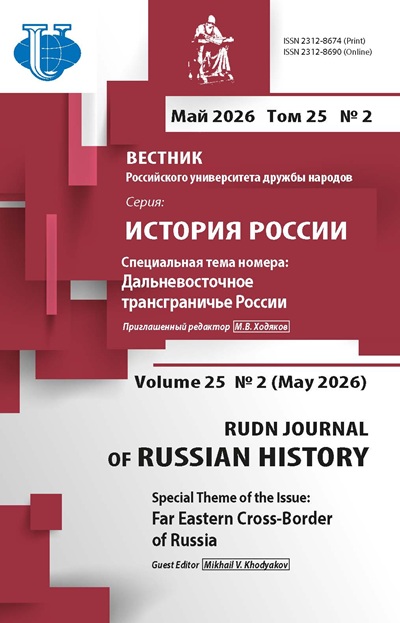
Vol 25, No 2 (2026): FAR EASTERN CROSS-BORDER OF RUSSIA
- Year: 2026
- Articles: 15
- URL: https://journals.rudn.ru/russian-history/issue/view/2125
- DOI: https://doi.org/10.22363/2312-8674-2026-25-2
Full Issue

FAR EASTERN CROSS-BORDER OF RUSSIA
Formation of Ussuri Region Civil Railway Infrastructure during the Early 20th Century
Abstract
The author in their article examines the process of railway construction in the Far East during the late 19th - early 20th century. The difficulties of this project demonstrated that the cross-border location of the Amur Governorate-General and its extreme remoteness from the imperial center, which created unique conditions that required significant adaptation of management and organizational practices which had been tested in other outlying regions. The complex system of interaction between the local authorities and the Railway Administration is analyzed in their article; conflict zones and strategies for adapting imperial management practices in cross-border conditions are identified. The author concludes that it was the settlements along the Ussuri Railway, which developed most intensively. They ensured the transfer of material and human resources from Vladivostok through Northern Manchuria to European Russia until 1916. This particularly affected the development of towns and settlements along the Nikolskaya railway line, which connected the Ussuri Railway with the Chinese Eastern Railway. The increase in their population led to the development of civil infrastructure (the construction of hospitals, churches, commercial establishments, residential areas, etc.), a development in which actors of various levels participated.
 218-234


Ussuri Railway in the Government Plans for the Far East Development
Abstract
The author in their article examines the question of departmental affiliation of the Ussuri Railway, which was posed to the government after the Russo-Japanese War under the unique circumstances of the Duma monarchy. It demonstrates that in Vladivostok, as the largest Russian port in Asia, there was a clash the interests between various imperial departments. In addition, the redistribution of “assets” also affected commercial and entrepreneurial circles. Formally the Chinese Eastern Railway, a private enterprise, which took over the Ussuri Railway, was subordinate to the Ministry of Finance. The position of the officials de facto managing the Chinese Eastern Railway was formed based on the assessments received from the field, personal impressions, and the established policies of the Ministry of Finance. The competition between the Railway Administration of the Ministry of Railways, the military represented by governors-general, the viceroy, and military governors of the regions, and the Ministry of Finance, which managed the activities of the Chinese Eastern Railway through its board, also influenced the economic development of the sections of the entire Trans-Siberian Railway. The question of the modernization of all railway lines, including the Ussuri Railway and the associated port infrastructure of Vladivostok remained at the core of this development. The author concludes that the government’s compromise on defense and administration of the Far East was achieved thanks to the railway’s correct operation in financial and administrative terms before World War I. By 1914, largely thanks to the Ussuri Railway and the Amur Mainline under construction, a unified economic space had already been formed and opportunities for the further colonization of the Amur region and the development of regional infrastructure increased.
235-253
“Railway Traffic Manager” of the Chinese Eastern Railway: Engineer A.K. Hinze’s Actions from 1906-1917
Abstract
The author in their article considers the operation of the Chinese Eastern Railway (CER) after the end of the Russo-Japanese War, a venture which required the involvement of a significant number of highly professional specialists in large-scale work. One of them was engineer Alexander Hinze. After he received a basic education in St. Petersburg and gained professional experience in managing the activities of various sections of Russian railways, in 1906, he was invited to help manage the CER, where he took on the position of head of the mainline operation. Hinze addressed crucial issues of evacuating troops from the theater of military operations and establishing the operation of the railway in peacetime and later aimed at achieving high commercial results. Based on available archival materials, it is shown that during World War I, the railway’s operation department ensured the movement of steam locomotives through 90 stations and 65 sidings through the railway. By the time of the revolutionary events of 1917, the CER had over 490 steam locomotives of various types and over 600 passenger cars. In that period the railway’s freight car fleet, which exceeded 9.5 thousand wagons of various types, began to play a key role in terms of military affairs but military actions being conducted by Russia did not affect the commercial efficiency of the CER. It remained the only railway supplying the country with military and private cargoes arriving from abroad via Vladivostok. Particular importance was attached to the supply of American steam locomotives to Russia. In addition, the CER was a supplier of food cargoes to the regions of Russia. Based on previously unknown documents, the author shows the role of A.K. Hinze in the efficiency of the railway’s operation department and specifies the time and place of his death.
254-267
Kazakh-Xinjiang Section of Soviet-Chinese Border in the Second Half of the 1920s - the First Half of the 1930s: Border and Passport Regimes, Illegal Migration, and Economic Practices of the Population
Abstract
The author in their article considers the USSR state policy in the field of protecting the border zone with China in the Kazakh-Xinjiang section of the border in the 1920-1930s. The purpose of the study is to show the migration processes and economic practices of the border territories population during the period of transition, from a period of frequent contact to the erection of a barrier on the border. The research is based on the legal acts regulating the border regime and the departmental records of the OGPU on border protection issues. The author shows the nature of the border during this period, firstly, it existed as a line of state demarcation and a military-political boundary, and secondly, it existed as a border contact territory, with established economic and migration practices. The author comes to the conclusion that even in the context of tightening the border regime, the population of the border territories maintained economic interaction, resorting to illegal practices in order to survive and circumvent government restrictions.
268-283
Russian Émigrés in Manchuria during the Period of the CER Joint Soviet-Chinese Administration in the 1920s
Abstract
The author in their work considers the history of Russian emigration in Manchuria in the period of the joint Soviet-Chinese administration of the CER in the 1920s. The study focuses on the division of the Russian population into “Soviet citizens” and “émigrés.” It provides a critical analysis of the approaches established in Russian historiography to studying this problem, as well as contemporary scholars’ views and assessments of Russian emigration in Manchuria. The author examines the size and composition of the Russian population on the CER, issues of citizenship, and the émigrés’ attitude toward the Soviet Union. The author uses documents from Russia’s regional archives, as well as published statistical and analytical materials to develop their study. They conclude that the entire Russian population of the CER, regardless of citizenship, constituted a relatively cohesive community of Russian émigrés. Diverse views and political preferences, as well as social and class divide in the ethnocultural and geopolitical conditions of the cross-border region, allowed the émigrés to remain within a unified Russian community.
284-302
Cross-Border Educational Cooperation of Russia, Mongolia and China: Historic Basis and Current Trends
Abstract
The author in their article analyzes the interstate cooperation of Russia, Mongolia, and China within Inner Asia in the area of higher education. Inner Asia is a unique geostrategic space, within the boundaries of which stable ties are formed that determine the nature of trilateral relations between the aforementioned states. The study focuses on the historical conditions that determined the substantive lines of interstate interaction in the 20th - first quarter of the 21st century. Of particular importance in trilateral relations was the educational cooperation between the USSR, the Mongolian People’s Republic and the People’s Republic of China during the middle of the last century. The development of the educational system and the socio-economic assistance of the Soviet Union gave impetus to the modernization processes in Mongolia and China. In the evolution of interstate interaction in the field of higher education between the countries, it is possible to identify separate stages that have their own substantive features and chronology, which depend on bilateral relations at the highest level. In the early 21st century, the content and nature of relations in the field of education between the countries changed. The main factors became the internationalization of education, as well as changes in the foreign policy of China, which began to actively promote its culture and language, including in Inner Asia. The main actors were the State Office for the Promotion of Chinese Abroad (汉办), as well as the universities and the Government of the Inner Mongolia Autonomous Region of China. Inner Mongolia universities implement a number of programs aimed at teaching Chinese to schoolchildren and students from Russia and Mongolia and hosted cultural events. In current interstate interaction, of great significance is the China-Mongolia-Russia Economic Corridor, initiated by the Chinese government. Thus, Inner Asia is regaining its geostrategic importance in interstate relations.
303-318
SOCIO-ECONOMIC AND POLITICAL HISTORY OF RUSSIA
Armenians’ Entrepreneurial Activities in the Context of the Economic Policy of the Russian Empire during the 18th - 19th Centuries
Abstract
The author in their article examines the entrepreneurial activities of Armenians in Russia in the 18th - 19th centuries, their contribution to the economic development of the country, and their interaction with the Russian authorities. The relevance of the study is due to the importance of analyzing the role of ethnic communities in forming the economic structure of the Russian Empire. The author in their article aims to analyze the key aspects of Armenians’ entrepreneurial activities, to identify the factors contributing to their success, and highlight the specifics of Armenian entrepreneurs’ interaction with government agencies. The scientific novelty of the research lies in the systematization of archival data and identification of little-studied aspects of the economic activities of the Armenian community. The methodological basis of the study includes historical-genetic and comparative-historical methods, which allows for a comprehensive examination of the formation and development of entrepreneurship among Armenians in Russia. The main results of the study show that Armenian entrepreneurs actively participated in trade, industry, and finance, making a significant contribution to Russia’s economic development. The specificity of Armenian entrepreneurship lay in the unique combination of traditional economic practices and adaptation to Russian realities. The study confirms that the Russian monarchs’ support contributed to the expansion of economic opportunities for the Armenian community, which, in turn, strengthened trade relations between Russia and Eastern countries.
319-328
Activities of the Main Administration for Producers’ and Consumers’ Cooperatives in the Bashkir ASSR in 1946-1950
Abstract
The author in their work considers the activities of the Main Administration for Producers’ and Consumers’ cooperatives on identifying shortcomings and dealing with them in cooperative organizations in the Bashkir ASSR in 1946-1950. Based on the documents of the Russian State Archive of Economics, they analyze the main areas of work of the Office of the Chief Inspector of the Main Administration for Producers’ and Consumers’ cooperatives in the Bashkir ASSR. Particular attention is paid to the measures for improving trade and production activities in cooperative organizations in the period of the post-war economic recovery. The author assesses the effectiveness of cooperative organizations in meeting the demands of the population and overcoming the deficit of manufactured goods and foodstuffs. The reports on audits and revisions by the Main Administration for Producers’ and Consumers’ cooperatives show that fulfilling the plans for goods turnover by consumer cooperative organizations was uneven both in planned periods and in different districts of the republic. Orders of rural consumer societies, based on the demands of the shareholders, were disregarded by state-owned industry. A significant part of the output of producers’ cooperative organizations did not meet the demand of the population, was of low quality, and had high production costs. The authors come to the conclusion that despite the inability to solve all the problems in the systems of producers’ and consumers’ cooperatives, the Office of the Chief Inspector of the Main Administration for Producers’ and Consumers’ cooperatives in the Bashkir ASSR achieved a certain amount of success. Besides differentiating the industrial programs and a significant growth in goods turnover, the number of unprofitable cooperative organizations decreased and disruptions in trade occurred more rarely.
329-341
HISTORY OF RUSSIAN CULTURE
Muslim Parishes in the Astrakhan Governorate during 18th - Early 19th Century
Abstract
The author devotes their work to one of the key moments in the history of Islam in the Lower Volga Region - the analysis of the state of the Muslim structure and the inclusion of the local Turkic-Muslim population in the Orenburg Muslim Spiritual Assembly during the 18th - early 19th century. The article provides an overview of the history of the ethnic groups of the Muslim population in the region, as well as the development of the Muslim religious infrastructure in the center of Orenberg and villages of the Astrakhan governorate. The author also highlights the role of the local administration and the first Russian Mufti, Mukhamedzhan Khusainov, in the process of including the Muslims of the region in the Orenburg Muslim Spiritual Assembly. For the first time, the author introduces into scientific use the information about the time of the construction of mosques in Astrakhan and the villages of the Yurt Tatars, the number of Muslims, the Astrakhan parishes, and the Muslim clergy in them in the mid-18th - early 19th centuries, as well as the time and circumstances that led to the inclusion of the Muslims of the Lower Volga Region in the structure of the Orenburg Muslim Spiritual Assembly. The author concludes that during the 18th century, in the Astrakhan Governorate, one of the regions of the Russian Empire with a considerable Muslim population, there was a process of institutionalization of the religious infrastructure and its gradual integration into the state system. As a result of the joint efforts of the executive authorities and Mufti Mukhamedzhan Khusainov, in the early 19th century, the Muslim population of the Astrakhan Governorate was included in the area of the Orenburg Muslim Spiritual Assembly.
342-355
Role of the Communist University of Workers of the East in Training Managers for the RSFSR Autonomous Regions during the 1920s
Abstract
The author examines the activities of the Communist University of Workers of the East (KUTV) at the initial stage of its establishment and development as a leading party university. The purpose of the article is to analyze the organization of the educational process, the content and features of the general education of the party nomenclature of the national regions of the largest Union republic - the RSFSR. Based on the newly identified documents and materials, the author highlights the problems of student admission, their national composition in the 1920s, and the approaches of the university staff to determining the content and methods of education, taking into account the level of training of representatives of different nationalities. Through their research, they found that the difficulties of the KUTV work were also associated with the need to take significant measures for improving students’ health and organization of everyday life. They also show the contribution of the university to the socialization of people from different ethnocultural regions, and their provision, nutrition, and education. Their conclusion is that the KUTV was a key link of party education in ensuring indigenization and provision of the management system with trained specialists, as well as the formation of ethnic elite is an important subject in to nation-building and Soviet transformations.
356-372
The Fate of the Palaces of the Royal Family in Soviet Times: The Palace of the Emir of Bukhara in Zheleznovodsk
Abstract
The attitude of the Soviet government towards the palaces of former reigning personages in the early years was ambiguous. In their article, the author focuses on the palaces of the Emir of Bukhara, which had not previously been considered as symbolic objects. In 1926, the Uzbek SSR attempted to take over the palace of the Emir of Bukhara in Zheleznovodsk. The source for their analysis was the correspondence of the Uzbek authorities with the allied and Russian authorities regarding the transfer of the palace to the Uzbek SSR. The specified correspondence is stored in the funds of the State Archive of the Russian Federation. The appeals and responses of the authorities reflected the vision of the potential future fate of the palace. By studying the stated issue, it is possible to identify the main arguments of the Uzbek SSR regarding the transfer of the palace in Zheleznovodsk. The Permanent Mission of the Republic to the Government of the USSR noted that the republic does not have enough facilities for the treatment of patients, and that the Uzbek SSR has legal rights to the palace, since it was built with funds from the exploitation of the Bukhara people. In addition, the palace was supposed to also be used for propaganda purposes. However, these arguments proved inconclusive at the time, and the palace remained in the ownership of the RSFSR. The attraction of information about the fate of the palaces of the Emir of Bukhara in Yalta, as well as about the Livadia Palace, allowed us to conclude that the actual and intended use of the palaces of the Emir of Bukhara generally coincided with the approach of the RSFSR to the palaces of the Romanovs. At the same time, the transfer of the palace in Zheleznovodsk would have had probably have symbolic significance for the Uzbek SSR, as it could declare itself as the successor of the Bukhara Emirate, the Bukhara Republic.
373-385
“Buridan’s Ass” of Soviet Language Policy: Attempt to Reform Korean Writing System during the 1930s
Abstract
The author considers the process of creating a new Korean writing system in the USSR in the 1930s and reveals the features of this activity carried out within the framework of Soviet language construction. They reveal the reasons, courses, and results of the reform of the Korean writing system, as well as the composition of the participants in its implementation. The study is based on the analysis of the documents identified in the Archive of the Russian Academy of Sciences, the State Archive of the Russian Federation, and the Russian State Archive of Socio-Political History. The author comes to the conclusion that the struggle for the modernization of the Korean language and writing system launched in the USSR resulted in the development of a new Korean alphabet based on Latin. The All-Union and Far Eastern ‘romanization’ institutions and party structures were involved in the activities on Korean Romanization. Several projects of the new Korean alphabet based on the ‘English’ and ‘all-Soviet’ basis were developed and discussed. However, among the ‘romanizers’ there was a clash on the issue of choosing a basis for the new Korean alphabet. In early 1932, there was support for convening a ‘Korean conference’, which was supposed to approve the new alphabet. However, this initiative was canceled by the decision of the Central Committee of the All-Union Communist Party (Bolsheviks). After that, Korean Romanization in the USSR slowed down. As a result, the approval for and implementation of the new Korean writing system failed.
386-399
SOURCES AND METHODOLOGY OF HISTORICAL RESEARCH
Project of General Commissariat of the Russian Empire in Manchuria during the Early 20th Century in the Collection of Manuscripts of Tsarskoye Selo Palace
Abstract
The author in their work considers the documents of the State Archive of the Russian Federation unknown to the scientific community from the “Collection of Manuscripts of the Tsarskoye Selo Palace” (fund 583) dating back to the early 20th century. These documents include letters and reports, which, in a varying degree, address various aspects related to the history of Manchuria and which are practically not reflected in the publications on the history of Northern and Northeastern China. The author’s chief concern is the creation of the institution of the “General Commissariat” of the Russian Empire in Manchuria which dates back to the beginning of the 20th century. An attempt to create a similar structure for managing civil affairs was made in 1898 on the territory of the Liaodong Peninsula, but it was not put into practice. The Russian government returned to the idea at the beginning of the 20th century, when a proposal was made to introduce unity of command in the management of the region in order to consolidate the three Military Commissariats (Jilin, Mukden and Heilongjiang provinces) that had been operating independently. The authors of the project of the “General Commissariat” in Manchuria at the beginning of the 20th century, as well as the related documents are not known. The project outlined the idea in detail and provided a financial assessment, but this project was never implemented either. The reason the project was not implemented is probably the change of the situation in the Far East as a result of the Russo-Japanese War of 1904-1905. Referring to this historical source is important for reconstructing a more complete history of Northern and Northeastern China during the early 20th century.
400-409
Outbreak of World War I According toemoirs of N.N. Shebeko, Russian Ambassador to Austria-Hungary
Abstract
The study is based on on Russian Ambassador to Austria-Hungary N.N. Shebeko’s unpublished memoirs and reports to the Ministry of Foreign Affairs. The author sets the task to reveal in Shebeko’s memoirs important and little-known details of the diplomatic conflicts that took place in JuneJuly 1914. These facts are considered in the context of the topical issues of historiography of the July crisis. Special attention is paid to Shebeko’s relationship with Minister of Foreign Affairs S.D. Sazonov. The author considers Shebeko’s proposals to resolve the conflict between Russia and Austria-Hungary due to the ultimatum issued by Vienna to Serbia. According to Shebeko, the Austrians did not want a war with Russia and were afraid of it. The author shows that the Russian ambassador tried to convey to the leadership of the Ministry of Foreign Affairs of Austria-Hungary the idea that Russia would stand up for Serbia. However, until the beginning of the Russian mobilization, the officials Vienna were confident that Russia would yield without any war. In general, the activities of the Russian ambassador to AustriaHungary during the July crisis can be divided into three stages. At first, he saw no danger of an armed conflict between Austria-Hungary and Russia in the ongoing events and made reassuring reports to the Ministry of Foreign Affairs in Saint Petersburg. This is important additional evidence that Russia was not preparing for war and did not seek to unleash it. During the second stage, Shebeko focused his efforts on warning the Ministry of Foreign Affairs of Russia about the ultimatum which Austria-Hungary was going to issue to Serbia. He was sure that in this situation Russia would stand up for Serbia and considered it necessary to warn official Vienna about this so that it would moderate its aggressiveness towards Belgrade. During the final stage of the July crisis, N.N. Shebeko continued to seek a compromise between Russia and Austria-Hungary.
410-425
SCHOLARLY LIFE
426-434