





 Email this article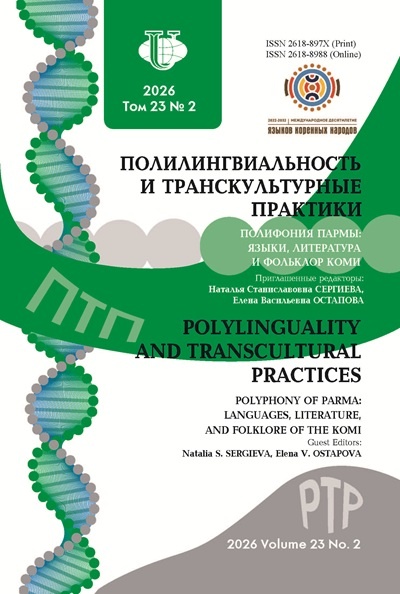


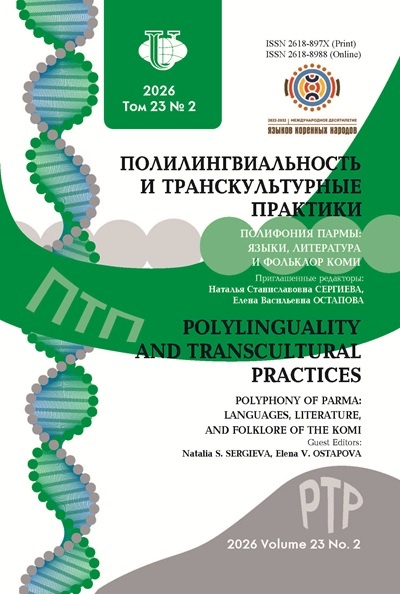
The Polyphony of Parma: Guest Editors’ Introduction
- Authors: Sergieva N.S.1, Ostapova E.V.1
-
Affiliations:
- Pitirim Sorokin Syktyvkar State University
- Issue: Vol 23, No 2 (2026): POLYPHONY OF PARMA: LANGUAGES, LITERATURE, AND FOLKLORE OF THE KOMI
- Pages: 237-246
- Section: POLYPHONY OF PARMA: LANGUAGES, LITERATURE, AND FOLKLORE OF THE KOMI
- URL: https://journals.rudn.ru/polylinguality/article/view/51872
- DOI: https://doi.org/10.22363/2618-897X-2026-23-2-237-246
- EDN: https://elibrary.ru/JCRKOF
- ID: 51872
Cite item
Full Text

Abstract
-
Full Text
By Decree of the President of the Russian Federation (No. 962 of December 25, 2025), the year 2026 has been proclaimed the Year of Unity of the Peoples of Russia. This year is meant to serve as a reminder of the value of all the peoples who live in our vast country. The foundation of Russia’s national policy lies in preserving the unique identity of every people residing on its territory. Care for the preservation of languages, traditions, and cultural distinctiveness helps foster harmonious interethnic relations and achieve peace and accord among Russian citizens. Since 2022, RUDN University has been using its journal Polylinguality and Transcultural Practices as a direct platform for specialists from Russia’s regions to address a broad range of issues related to the preservation and development of national languages and cultures. The significance of this initiative cannot be overstated. Ethnocultural diversity of Russia is a unique spiritual heritage that forms the multifaceted unity and distinct identity of Russian civilization. Historically, the Komi have had two permanent, compact areas of settlement: the Komi Republic and Perm Krai. Komi communities can also be found on the Kola Peninsula in Murmansk Oblast, as well as in Yamal, Yugra, and Siberia. On the one hand, this geographical dispersal creates a rich polyphony - a diversity of natural landscapes, dialects, and distinctive ways of life and culture. On the other hand, the Komi cultural code has helped maintain connections and mutual influence - a kind of enduring dialogue - across the centuries. One of the unifying concepts for the Komi is Parma. The word parma has several meanings. Some researchers believe it derives from the legendary Finno-Ugric land of Biarmia, which is mentioned repeatedly in Old Russian and Scandinavian chronicles and in the Viking sagas from the 9th to 13th centuries. In Russian, parma translates as “a spruce forest on high ground” or simply “forest, taiga.” In geological and geomorphological terms, it refers to a vast and varied territory in the far north and northeast of the European part of the Russian Federation - a landscape type characterized by predominantly flat terrain, uplands, and ridges of the Ural range, covered in dense spruce-fir taiga typical of the Komi Republic and Perm Krai. For the indigenous peoples of these areas - the Komi-Zyryans and Komi-Permyaks - Parma is a deeply conceptual notion. Since ancient times, it has represented their native land, their homeland, the place where they live and sustain themselves. Rich in natural resources, it has been poetically celebrated in folklore and literature, while at the same time remaining far from fully explored or fully understood. According to the 2020 All-Russian Census, the total number of Komi people in Russia is approximately 200,000, including about 144,000 Komi-Zyryans and some 56,000 Komi-Permyaks. The majority of Komi-Zyryans live in the Komi Republic, while Komi-Permyaks are primarily concentrated in the Komi-Permyak Okrug of Perm Krai. In the Komi Republic, the titular language has official status. A common adverse trend, driven mainly by urbanization, is the decline in the share of the indigenous population proficient in the Komi language. Administrative and civic efforts are underway in the Komi Republic to support the Komi language and expand its public functions. In 2023, May 19 was established as the Day of the Komi Language and Writing. In ancient times, the Komi people were united as they settled the territories of the Kama region, sharing a common ethnicity, culture, and folklore traditions. Beginning in the 1920s, two distinct ethnic groups were officially distinguished: the Komi-Zyryans (northern Komi) and the Komi-Permyaks (southern Komi, named after the toponym Perm, meaning “faraway land” or “land beyond the portage”). The name Zyryans first appears in the Life of Stephen of Perm, written by Epiphanius the Wise in the early 15th century, and by the 1570s, the exonym “Zyryan” had become firmly established for the modern Komi-Zyryans, gradually replacing the common name Perm, which first appears in the early 12th century. The traditional self-designation among all Komi has long been the compound terms Komi mort and Komi voityr for the Komi-Zyryans, Komi otir for the Komi-Permyaks, as well as simply Komi or Komiyas. Etymologically, this autonym derives from a Proto-Finno-Ugric root meaning “person” or “man.” The native language of the Komi-Zyryans and Komi-Permyaks is Komi, which, together with Udmurt, forms the Permic branch of the Finno-Ugric group of the Uralic language family. Komi-Zyryan and Komi-Permyak are linguistically very close, yet by long-standing tradition they are treated as separate languages. Together, the two languages encompass around twenty dialects. The Komi language has a long-standing written tradition. A unique phenomenon in world culture is the emergence of the first Komi alphabet, Anbur (in some sources, A-bur), created in the late 14th century by Stephen of Perm, an educator and Orthodox missionary, based on Cyrillic, the Greek alphabet, and local runic signs (pas). This was the first alphabetic writing system specifically devised for a Finno-Ugric people. It remained in use for about two centuries and served as the foundation for the rise and development of Komi written culture and literature. Stephen of Perm translated numerous liturgical texts, thereby spreading the use of the Old Komi language both in Perm the Lesser (on the Vychegda River) and in Perm the Great, throughout the territories inhabited by the ancestors of the Komi-Permyaks. From the Old Komi writing system, only fragments have survived to the present day, in the form of inscriptions on icons, copies of the alphabet, and marginal notes in Russian manuscripts from the 15th and 16th centuries. Subsequently, the Komi quickly adopted Russian writing. The active educational work of the Church, the early emergence of writing, and the development of book culture were factors that contributed to the Komi having the highest literacy rate among the Finno-Ugric peoples until the early 20th century. Currently, the main research and educational centers in the Komi Republic are the Institute of Language, Literature and History of Komi Science Centre of the Ural Branch of the Russian Academy of Sciences and Pitirim Sorokin Syktyvkar State University. In Perm Krai, they are Perm Federal Research Center of the Ural Branch of the Russian Academy of Sciences and Perm State Humanitarian Pedagogical University. Fundamental academic linguistics traditionally aims to study the internal structure of a language and its lexical composition, as well as their normalization and development. A prominent representative of the Komi people and the founder of Komi linguistic scholarship was Georgy Stepanovich Lytkin (1835-1907) - a historian, ethnographer, Finno-Ugrist, Mongolist, Komi poet, and educator. Significant contributions to the advancement of Komi linguistics were made by A.S. Sidorov, V.I. Lytkin, A.I. Turkin, A.N. Rakin, E.S. Gulyaev, L.M. Beznosikova, G.V. Fedyuneva, E.A. Igushev, G.G. Baraksanov, G.A. Nekrasova, E.A. Tsypanov, V.M. Ludykova, as well as the Komi-Permyak linguists R.M. Batalova and A.S. Krivoshchekova-Gantman. Among the new generation of linguists, notable scholars include M.S. Fedina, A.G. Musanov, G.V. Punegova, S.A. Sazhina, O.I. Nekrasova, and others, along with the Komi-Permyak linguists A.S. Lobanova and R.P. Popova. In recent decades, new trends have emerged in the development of Komi academic linguistics - namely, the pursuit of applied problems alongside fundamental ones. Komi linguists are engaged in extensive work on the preparation and publication of popular science literature on Komi linguistics, university textbooks, as well as textbooks and self-instruction manuals for the Komi language. Fiction in the Komi language emerged in the mid-19th century and is associated with the name of Ivan Alekseevich Kuratov (1839-1875), the founder of Komi literature, whose literary and scholarly legacy cannot be overstated and whose talent is of global significance. In his multifaceted work, he transformed the Komi language into a language of Komi poetry. At the beginning of the 20th century, Kallistrat Falaleevich Zhakov was called both the Zyryan Lomonosov and the Zyryan Faust, in recognition of his scientific and literary achievements in mathematics, astronomy, philosophy, ethnography, folklore studies, poetry, prose, and drama. The 1920s were a time that gave the world unique literary phenomena. In Komi literature, this was embodied in the work of the founders of 20th-century national literature: Tim Ven - Veniamin Timofeevich Chistalev, Nebdinsa Vittor - Viktor Alekseevich Savin, and Illya Vas’ - Vasily Ilyich Lytkin. The pioneers of Komi-Permyak literature include Pityu Önyö - Andrey Nikolaevich Zubov and Mikhail Pavlovich Likhachev. They were individuals of diverse interests, possessed extensive knowledge, had a gift for pedagogy, and carried out significant work in shaping the Komi-Permyak literary language and creating textbooks. The outstanding writers of the Komi people became for subsequent generations an example of selfless love and devotion to their people, their native language, and their culture. Komi literature of the 20th century proved its maturity and substance, creating unforgettable images and evoking a rich palette of feelings and emotions. A significant contribution to the study of the history of Komi literature and poetics has been made by literary scholars A.A. Vezhev, A.N. Fedorova, A.K. Mikushev, V.A. Latysheva, A.E. Vaneev, V.I. Martynov, V.N. Demin, and V.V. Pakhorukova. The traditions established in Komi literary studies are preserved and furthered by T.L. Kuznetsova, V.A. Limerova, E.V. Ostapova, N.V. Gorinova, E.V. Eltsova, L.E. Surnina, and others. For the written culture of a people, one of the important sources is its oral poetic tradition. Folklorists have uncovered layers of folk creativity rooted in the Middle Ages and sometimes dating back to an even more ancient period - the era of the Permic linguistic community. The collection of folklore material in the 19th and early 20th centuries was carried out primarily by linguists, while Komi folklore studies as an academic discipline developed in the 20th century through the efforts of I.A. Osipov, F.V. Plesovsky, A.K. Mikushev, and other scholars. Their work is being continued by a new generation of researchers: P.F. Limerov, A.V. Panyukov, N.S. Korovina, A.N. Rassykhaev, and L.S. Lobanova. The present issue contains articles by researchers from academic and higher education institutions in Syktyvkar and Perm. The articles presented cover a range of topics. Alongside leading scholars, the issue features work by emerging researchers. Thematically, the issue is diverse, addressing current questions in the fields of Finno-Ugric linguistics, literary studies, folklore studies, and ethnopedagogy. The articles explore issues of language contact and their consequences for the linguistic system, forms of ethnic and linguistic self-identity, contexts for the preservation and development of literary languages, problems of linguostylistics, the history of Komi literature and art, traditional and contemporary folklore genres, practices of traditional culture, and applied aspects of educational bilingualism and the dialogue of cultures. In celebration of the 100th anniversary of the literary and artistic journal Voyvyv kodzuv (Northern Star), the issue features an interview with the journal’s editor-in-chief, Nina Obrezkova, a renowned poet in the Komi Republic. Through out its history, the journal has opened its pages to literary works in the Komi language. It has played, and continues to play, an important role in the history of Komi literature, its formation and development, and in the creative careers of both established and emerging Komi authors. Since 2020, Pitirim Sorokin Syktyvkar State University (SSU) has been publishing the scholarly and educational journal Komi Philology, which offers authors the opportunity to publish their research findings specifically in the Komi language. This special issue includes an informational article providing an overview of the materials published in the journal and highlighting its important role in bringing together Komi scholars interested in publishing academic work in their native language. The administration of Pitirim Sorokin Syktyvkar State University, together with the authors and editors of this issue, express their gratitude to the editorial board of the journal Polylinguality and Transcultural Practices and personally to Professor U.M. Bakhtikireeva for supporting the concept of this issue and for their assistance in its preparation.×
About the authors
Natalia S. Sergieva
Pitirim Sorokin Syktyvkar State University
Author for correspondence.
Email: nsergieva@yandex.ru
ORCID iD: 0000-0003-0261-6901
SPIN-code: 8363-2257
ResearcherId: A-7306-2018
Doctor of Philology, Chief Researcher, International Center for Social Research
55 Oktyabrsky prospect, Syktyvkar, 167001, Russian FederationElena V. Ostapova
Pitirim Sorokin Syktyvkar State University
Email: Ost-1966@yandex.ru
ORCID iD: 0000-0001-9128-7980
SPIN-code: 8061-5703
ResearcherId: G-2517-2016
Candidate of Philological Sciences, Associate Professor, Head of the Department of Komi Philology, Finno-Ugric Studies and Regional Studies
55 Oktyabrsky prospect, Syktyvkar, 167001, Russian FederationReferences
Supplementary files

