







 Email this article


Metatextual discourse markers as pragmatic units: A corpus-based analysis of poetic discourse and colloquial speech
- Authors: Sokolova O.V.1
-
Affiliations:
- Institute of Linguistics, Russian Academy of Sciences
- Issue: Vol 29, No 4 (2025): Pragmalinguistics: Сorpora and Discourse Studies
- Pages: 769-794
- Section: RESEARCH ARTICLES
- URL: https://journals.rudn.ru/linguistics/article/view/47821
- DOI: https://doi.org/10.22363/2687-0088-45733
- EDN: https://elibrary.ru/KHCVAF
- ID: 47821
Cite item
Full Text

Abstract
Researchers typically examine metatextual discourse markers as linguistic tools that promote cohesion and logical coherence. Therefore, their functioning beyond these traditional roles remains insufficiently explored. This article analyses the use of inferential markers следовательно, quindi and therefore across different communicative practices, comparing poetic discourse with ordinary language to trace the expansion of their functional potential. A comparative analysis of these units demonstrates how different types of discourse reorganize logical, pragmatic and semantic relations. In order to address the various and overlapping definitions of discourse and pragmatic markers, this study adopts the concept of pragmatic units, which encompasses deictics, discourse markers, illocutionary verbs and modal verbs. Analyzing these linguistic elements in terms of pragmatic markers enables a thorough investigation into how they perform communicative and metalinguistic functions, express the speaker’s stance, indicate the coordinates of the communicative act, structure discourse and organize interaction. The goal of this study is to identify the functional and pragmatic modifications of metatextual discourse markers in poetic discourse compared to ordinary language. Drawing on a Poetic Corpus of three million words in three languages (Russian, Italian, and English), the research compares these markers with those found in Spoken Language Corpora, such as the Russian National Corpus (Spoken), KiParla (L’italiano parlato e chi parla italiano), and the Corpus of Contemporary American English (Spoken). The results provide deeper insight into the mechanisms of the pragmatic dimension of language, define the pragmatic specificity of contemporary poetry, and demonstrate how metatextual discourse markers expand their functional potential, display multifunctionality, and undergo context-driven resemantization.
Full Text
Introduction
Although some studies explore discourse markers in relation to cohesion and coherence, their role in shaping pragmatic meaning in poetic discourse, as compared with ordinary language, has not yet been systematically analyzed. This study examines this contrast in order to reveal the broader functional range of discourse markers in different communication practices.
The foundations of pragmatics as the study of linguistic means in relation to the speaker and the communicative situation were laid by C.S. Peirce, C. Morris, and A. Gardiner. In the 1960s, J. L. Austin, J. Searle, H. P. Grice, and others conceptualized utterances as actions capable of altering extralinguistic circumstances. This perspective has influenced linguistics, the humanities, and the arts. In the mid‑20th century, linguistic theory shifted from structuralism to an anthropocentric perspective, largely due to Benveniste’s notion of “subjectivity in language” (1971: 293–294), later extended by Stepanov’s “anthropocentric principle” (1974: 14).
Despite advances in big data methods, corpus‑based research on pragmatic phenomena remains one of the most challenging areas, given their contextual dependence and multifunctionality of such phenomena. Yet recent studies (Aijmer & Rühlemann 2014, Rühlemann 2019, Landert, Dayter et al. 2023, Heine et al. 2024) demonstrate considerable potential, particularly in cross-linguistic analyses of discourse markers (DMs) (Fedriani & Sansò 2017, Lansari 2020, Park 2024).
Today, linguistics increasingly adopts a data-centric rather than anthropocentric orientation, encouraging the integration of “big” and “small” data and of subject- and technology-oriented perspectives. In this context, corpus‑based studies of specific discourse practices, particularly artistic discourse, provide new insights into pragmatic phenomena.
This article examines metatextual discourse markers (MDMs) in both poetic discourse and colloquial speech. Poetry serves as the main object of analysis because it fosters linguistic experimentation, particularly in the pragmatic realm, and emphasizes the metalinguistic function. These features enable a wider range of pragmatic functions to emerge in poetry compared to colloquial speech. The choice also reflects current communicative conditions, including the erosion of the boundaries between everyday and poetic utterances, which frequently trigger linguistic experimentation in poetry and intensify its pragmatic dimension. The interplay between contemporary poetry and everyday speech reflects Fairclough’s concept of “conversationalization”, whereby public and private discourse merge (2003). However, while public discourse uses colloquial elements to appear approachable, poetry reworks them to enrich meaning and make the ordinary more complex.
The goal of this study is to identify the functional and pragmatic modifications of metatextual discourse markers in poetic discourse compared to ordinary language, and to determine how these transformations reveal the potential of pragmatic units across communicative practices.
The research seeks to answer the following questions: How do metatextual discourse markers in poetry differ from their usual argumentative and cohesive roles in everyday speech? What types of pragmatic shifts and resemantization processes occur in poetic discourse? In what ways do these shifts contribute to a better understanding of pragmatic phenomena in different discourses and languages?
Theoretical and terminological framework
This study draws on classical approaches to linguistic pragmatics (Leech 1983, Levinson 1983, Verschueren 1999). Reflecting on subjectivity in language, Benveniste distinguishes between lexical items like tree, and the unit of “individual discourse” like personal pronouns I: “The «I», then, does not denominate any lexical entity <…> The reality to which it refers is the reality of the discourse. It is in the instance of discourse in which I designates the speaker that the speaker proclaims himself as the «subject»” (1971: 226). He includes deictic markers and illocutionary verbs among the categories that refer to the speech act itself, accrue additional meanings, and function as forms of subjectivity in language (Ibid.). Levinson similarly defines “pragmatics” as the study of “context-dependent aspects of linguistic structure and the principles of language use and understanding” (1983: 9). Thus, DMs can also be seen as pragmatic units.
Given the variety of definitions for “DMs”, “pragmatic markers”, “pragmemes”, etc. (Fraser 1999, Capone 2005, Aijmer & Simon-Vandenbergen 2011, Ghezzi & Molinelli 2014, Bogdanova-Beglaryan 2014, Fedriani & Sansò 2017), the broader term “pragmatic units” (PUs) is proposed here, encompassing deictics, DMs, illocutionary and modal verbs.
In Sokolova and Feshchenko (2024), PUs were defined as linguistic elements that perform communicative and metalinguistic functions, express the speaker’s stance, indicate the coordinates of the communicative act, structure the discourse, and organize interaction1. From a pragmatic perspective, deictics, DMs, illocutionary verbs, modal verbs, modal predicative expressions, imperatives and appellatives are united by their relationship to the speaker and the communicative situation. They indicate the parameters of the situation and address the recipient (deictics and appellatives), referring not to the extralinguistic sphere, but to the communicative act itself; structure the utterance and realize intersubjective relations between its participants (DMs); express speaker’s attitude (DMs and modal verbs; and perform the utterance as an action directed toward the addressee (illocutionary verbs and imperatives).
While most DMs studies focus on everyday speech, some investigate discourse specific uses in political, media, medical, and other discourses (Simon-Vandenbergen 2000, Maschler, Dori-Hacohen 2012). Although some works examine DMs in classical poetic texts (Bonifazi 2009, Dardano 2012), the role of PUs in contemporary poetic utterances compared with colloquial use remains underexplored.
Within corpus-based discourse analysis (CBDA; e.g., Furkó 2020, Baker 2023), particular attention should be paid to the discourse-specific features of PUs. Literary texts often dominate DM corpora, unless specialized subcorpora (colloquial, newspaper or academic) are selected. This highlights the importance of considering poetic material in its own right.
According to Jakobson (1960), the poetic function dominates artistic discourse. Thus, consideration should be given to the specifics of how linguistic phenomena function in literary texts2. Everyday discourse primarily describes external realities, whereas poetic discourse integrates emotive and perceptual dimensions into the communicative act itself (Kraxenberger 2014: 14–15). Capone (2023: 3) describes a poem as a “pragmeme,” a context-bound speech act whose meaning emerges from the interplay between language and social setting, aiming to transform readers’ interpretative engagement.
Data and methods. Algorithm of corpus-based discourse analysis
In this article, we employ CBDA to study MDMs, which are words that express causal-consecutive relations, signal contrastive relations, elaboration or addition, temporal sequencing, etc. We focus on the words, which belong to the group of inferential DMs3: следовательно (sledovatel’no) ‘therefore’ in Russian, quindi ‘therefore’, ‘thus’ in Italian, and therefore in English. The algorithm incorporates both quantitative and qualitative methods to provide an overview of the use of these units in different types of discourse and to identify their functional features4.
(I) The first stage was to compile a Poetic Corpus (PC) of Russian, English, and Italian poetry (approx. 3 million words, 1 million per subcorpus), covering the 1960s–2020s. The focus on contemporary poetry is motivated by the aim to compare poetic discourse with spoken data available only from the second half of the 20th century onward. For this comparison, the study also uses spoken corpora: the Russian National Corpus (RNC, spoken subcorpus), KIParla (L’italiano parlato e chi parla italiano), and Corpus of Contemporary American English (COCA spoken subcorpus).
(II) The second stage involved selecting PUs, relevant for cross-linguistic analysis, including illocutionary verbs, deictics and DMs. Since this article focuses on the MDMs следовательно, quindi, and therefore, it is necessary to establish their place within the classification adapted for poetic discourse.
Drawing on Halliday & Hasan’s endophoric/exophoric distinction (1976), Bazzanella’s triadic model (2005), and Molinelli’s taxonomy (2018), three groups are proposed:
- Metatextual DMs organize coherence and logical relations5: inferential markers (e.g., следовательно, итак, таким образом, dunque, quindi, therefore, so, thus); contrastive markers (e.g., однако, с другой стороны, invece, d’altra parte, anyway, on the other hand); elaborative markers (другими (иными) словами, например, in altre parole, per esempio, in other words, for example), etc.
When used in poetic discourse, MDMs acquire a distinctive function due to the evolving role of the metalinguistic function. Traditionally responsible for regulating language use, they are increasingly acting as elements of “metalanguaging”, i.e. “using language in order to communicate about the process of using language” (Maschler 2009: 1). In this framework, DMs no longer refer to external reality, but rather to the text itself, the interaction among its speakers, or the cognitive processes underlying verbalization (Ibid).
In poetic discourse, elements of metalanguaging acquire self-referentiality. They operate as markers of intensified metalinguistic reflection, combining their primary role, reference to the utterance itself, with participation in a “pragmatic experiment.” They expose points of tension within structural and logical links, highlighting their instability and the potential for generating new connections. This dual function reinforces the interpretive complexity of poetic discourse, as the DMs simultaneously comment on and reshape the communicative framework in which they occur.
For example, DM следовательно ‘therefore’ occurs in the center of poetic reflection appearing at the end of the line and stanza without introducing a subsequent proposition in the fragment (1): Собака ест птицу следовательно ‘The dog eats the bird therefore’. In this fragment, следовательно is at the center of metalinguistic reflection, merging its basic function of providing commentary on discourse with the poetic function of drawing attention to the utterance itself (for further analysis see below):
(1) Он бросил собаку что неожиданно
Собака ест птицу следовательно
Она парит в воздухе kua kai he kuli emanu
Ты съешь собаку без перевода (A. Dragomoshchenko)
<He threw the dog, which was unexpected / The dog eats the bird therefore // She hovers in the air kua kai he kuli emanu / You will eat the dog without translation>
- Contextual DMs convey the speaker’s stance toward the communicative situation and often mark epistemic modality (e.g., возможно, конечно, maybe, of course, forse, magari, davvero). In poetic discourse, they acquire specific functions linked to self-referentiality, which can be interpreted through Bühler’s concept of deixis ad phantasma (1965 [1934])6. Instead of pointing to external reality, such markers typically refer to the intratextual situation, reinforcing poetry’s orientation toward its own communicative framework7.
- Interpersonal DMs reflect the bidirectionality of poetic auto‑communication (Lotman 2000), as they may address either an internal or an external addressee. These group includes reactive items (e.g., да, нет, хорошо, sì, no, va bene, ok, yes, no, yeah); phatic or etiquette DMs (e.g., спасибо, здравствуйте, grazie, buongiorno, ciao, thank you, hello); hesitation markers (e.g., ну, allora, beh, well); and attention‑getting markers (e.g., видишь, постой, guarda / guardi, un attimo, you see, you know). In poetic discourse, they emphasize the dialogic and relational aspects of the utterance while also shaping its self-addressed nature.
(III) At the third stage, the corpus was annotated using PUs tagging. Quantitative analysis (via AntConc) measured frequencies per million words, while qualitative analysis examined the specific uses of PUs in poetry compared to spoken language.
Results
4.1. Selection criteria for pragmatic units
The selection of comparable PUs in a cross-linguistic study poses a significant methodological challenge due to the inherent multifunctionality and context-dependence of such elements, as well as the lack of strict lexical equivalence across languages. For instance, the Italian marker quindi may correspond to a variety of Russian units, such as ‘следовательно’, ‘значит’, ‘итак’, ‘поэтому’, ‘потому’, or to English counterparts such as ‘therefore’, ‘so’, or ‘thus’, depending on the communicative context. Conversely, each of these Russian or English markers may have multiple translations into Italian, making a purely semantic or formal alignment unfeasible.
In this context, a functionally and pragmatically oriented selection criterion proves particularly relevant. Rather than relying on surface-level lexical equivalence, this approach focuses on the discourse role and pragmatic function of the markers in organizing textual cohesion and expressing causal or inferential relationships. All three selected markers (следовательно, quindi, and therefore) belong to the same functional class of inferential MDMs, whose primary role is to signal cause-and-effect relationships between propositions, structure discourse progression, and introduce conclusions or logical outcomes.
This criterion allows for meaningful comparisons despite differences in the degree of grammaticalization, syntactic distribution, or multifunctionality. By prioritizing pragmatic function in context over formal similarity, it becomes possible to investigate both cross-linguistic commonalities and language-specific patterns of discourse structuring in poetic discourse and colloquial speech. This focus aligns with the study’s broader aim of exploring how these markers operate in poetry compared to everyday speech and revealing their extended functional range in contexts of linguistic experimentation and metalinguistic reflection.
4.2. Results of quantitative analysis
The main quantitative results on the use of MDMs, based on PC data and spoken corpora of Russian, Italian and English, are summarized below (for more detail, see Table 1).
Table 1. Frequency of MDMs use in PC and national corpora
PU (Ru) | PC (Ru) | RNC | PU (It) | PC (It) | KIParla | PU (En) | PC (En) | COCA |
inferential DMs | ||||||||
следовательно | 17 | 24 | quindi | 120 | 521 | therefore | 63 | 48 |
итак | 51 | 91 | dunque | 302 | 74 | thus | 131 | 12 |
contrastive DMs | ||||||||
однако | 207 | 64 | tuttavia | 74 | 4 | however | 60 | 68 |
тем не менее | 36 | 141 | nondimeno | 6 | 0 | nevertheless | 21 | 10 |
с одной стороны | 4 | 65 | da una parte | 3 | 27 | on the one hand | 2 | 11 |
с другой стороны | 6 | 89 | dall’altra (d’altra) parte | 32 | 41 | on the other hand | 12 | 35 |
напротив | 18 | 15 | al contrario | 24 | 13 | on (to) the contrary | 10 | 4 |
elaborative DMs | ||||||||
другими (иными) словами | 6 | 7 | in altre parole | 8 | 1 | in other words | 8 | 43 |
например | 277 | 562 | per (ad) esempio | 101 | 569 | for example | 72 | 116 |
короче (говоря) | 43 | 56 | in breve | 6 | 1 | in short (brief) | 6 | 4 |
кроме того | 21 | 65 | inoltre | 42 | 16 | moreover | 6 | 3 |
The table shows the total number of MDMs occurrences in the PC (1795) and in national spoken corpora (2719). Figure 1 shows the overall distribution of MDMs across the analyzed corpora. While spoken language displays a higher number of occurrences, the data also reveal a widespread use of MDMs in poetic discourse. This indicates that metatextual structuring and inferential functions remain highly relevant beyond everyday communication.

Figure 1. Total number of MDMs occurrences (per million words, ipm)
Figure 2 draws parallels between the frequency of MDMs usage across Italian, Russian, and English corpora. According to the corpora, Italian uses MDMs more frequently than Russian and English, as evidenced by the KiParla corpus (1191) and the PC (718). The second most frequent use of these units is in Russian: RNC (1179) / PC (686), and the third is in English: COCA (349)/PC (391).

Figure 2. Frequency of MDMs usage in Italian, Russian, and English (ipm)
The revealed correlations result from the specific structures of the compared languages and historical processes. The variation in the data between Russian and Italian is minimal, whereas the difference between these two languages and English is significant. According to PC data, contemporary Italian poetry demonstrates a marked tendency to use MDMs. The difference from Russian-language poetry is more significant than from everyday language: 718 (Italian PC) and 686 (Russian PC).
In general, English-language poetry uses MDMs less often than Italian and Russian poetry. However, it uses these units more often than American everyday language: 391 (PC) and 349 (COCA, Spoken), which reflects the metalinguistic reflection of the pragmatic phenomena of language in American poetry. The marker thus is indicative in this regard. Poetry uses it ten times more often (131) than everyday language does (12). The large number of occurrences of thus in PC compared to COCA (Spoken) is due to its presence in academic discourse, with which contemporary poetry interacts8. In colloquial language, there is a tendency to use thus less frequently, replacing it with more “conversational” markers (so, therefore, then) 9.
Figure 3 presents the most frequent MDMs found in the Poetic Corpus. According to the PC, the most frequent PUs in Italian poetry are dunque (302), quindi (120), per (ad) esempio (101), and tuttavia (74), in Russian: например (277), однако (207), and итак (51), and in American: thus (131), therefore (63), and for example (72).

Figure 3. Most frequent MDMs in the Poetic Corpus (ipm)
Figure 4 shows the frequency of MDMs in the Poetic Corpus compared to Spoken Language Corpora. Poetry uses some words more often than everyday communication: dunque (poetic discourse) 302 / (colloquial speech) 74; tuttavia 74 / 4; nondimeno 5 / 0; однако 207 / 64; напротив 18 / 15; thus 131 / 12; therefore 63 / 48; nevertheless 21 / 10, and on (to) the contrary 10 / 4. Poetic and everyday language utilizes the following words with similar frequency: dall’altra (d’altra) parte 32 / 41; следовательно 17 / 24; короче (говоря) 43 / 56, and however 60 / 68.
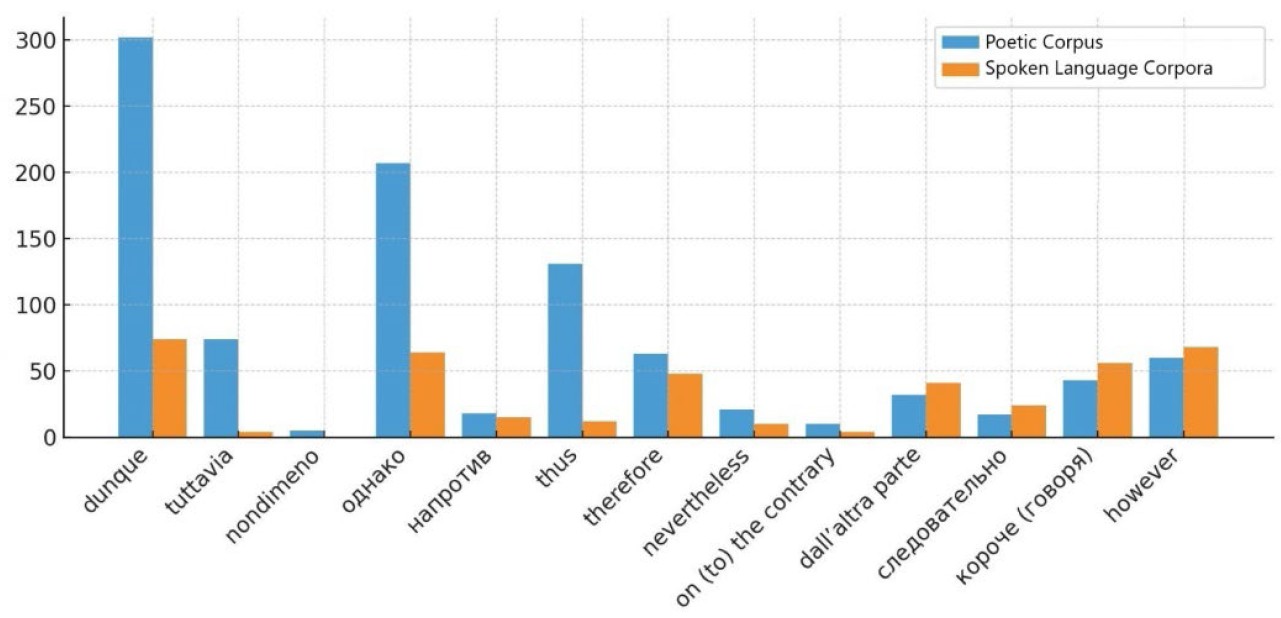
Figure 4. Comparison of MDMs usage: Poetic Corpus vs. Spoken Language Corpora (ipm)
4.3. Results of qualitative analysis
4.3.1. The lexical meanings and discourse functions of inferential markers
The inferential markers следовательно, quindi, and therefore establish a logical connection between the basis of a judgment and its conclusion in argumentative discourse. The selected units operate within the framework of narrow causality. Their use presupposes a discourse structure consisting of two components: P, representing the premise, argument, or condition, and Q, representing the inference or consequence. In constructions such as P (следовательно/quindi/therefore) Q, the inferential DM explicitly encodes the logical relationship between P and Q. This indicates that Q is not merely a subsequent event but rather the logical outcome or conclusion derived from P.
Unlike the abstract logical formula P → Q (“If P, then Q” or “Q follows from P”), these markers have additional pragmatic and semantic functions in discourse, including epistemic stance and the speaker’s subjective evaluation of the situation.
According to lexicographic sources, it is possible to define the following meanings10:
СЛЕДОВАТЕЛЬНО
Synonyms: значит; итак; получается; иначе говоря; отсюда следует, что
- Causal-inferential value: indicates a conclusion drawn from real-world circumstances or factual premises: Она почему-то не пришла — Следовательно, она не получила нашего письма <She didn’t come for some reason — Therefore, she didn’t receive our letter>
- Argumentative (deductive) value: marks a logically structured inference derived from a stated argument or condition: Свет у них в окнах не горит, на звонки никто не отвечает, следовательно, они действительно уехали в отпуск <The lights in their windows are off, and no one answers the phone, therefore, they really went on vacation>
QUINDI
- Locative value (archaic): indicates a spatial origin or reference point: E quindi giù nel fosso vidi gente attuffata (Dante) <And from there, in the ditch, I saw people submerged>
Synonyms: di qui, da questo luogo o punto. - Temporal-sequential value: expresses succession or progression in time, typically with future orientation: Percorri la strada fino in fondo, quindi gira a sinistra <Go all the way down the street, then turn left>
Synonyms: da ora, da quel momento, da ultimo. - Causal-inferential value: Il torto è tuo, quindista a te chiedergli scusa <It’s your fault, therefore it’s up to you to apologize>
Synonyms (for causal-inferential and argumentative values): perciò, dunque, per tal motivo, di conseguenza. - Argumentative value: Se non ha risposto al messaggio, quindi non è interessato <If he/she didn’t reply to the message, then he/she is not interested>
THEREFORE
Synonyms: thus; so; hence; consequently; accordingly; as a result; it follows that
- Causal-inferential value: Those people have their umbrellas up: therefore, it must be raining.
- Argumentative value: The government failed to act quickly. Therefore, it cannot be trusted.
4.3.2. The functioning of inferential markers in poetic utterances
One of the defining features of poetic discourse is its structural non-linearity, resulting from vertical (line-by-line) typographical segmentation, in contrast to linearity typical of prose, as well as its self-referentiality and autocommunicative nature11. In poetry, MDMs regularly play the uncharacteristic role of disorganizer of logical-semantic and syntactic connections. For this reason, they can be considered as “disconnectives” when they carry an additional pragmatic load to express inference procedures and attract the addressee’s attention to the utterance itself. It is important to emphasize that these units can act as both connectives12 and “disconnectives” in poetry, which allows us to identify a wider range of their functions than in ordinary language. Acting as “disconnectives,” they do not cease to function as linking markers, but rather trigger metalinguistic reflection on logical, syntactic, and discursive relations, while enhancing the degree of speaker’s subjectivity present in their use.
The tendency to violate the logic of a statement is similar to the logical error known as a «non sequitur»13, which is used as a literary device. However, contemporary poetry does not use it to create a comic effect; rather, it is used as part of a pragmatic experiment to identify the stability and unidirectionality of logical connections and the boundaries of objective and epistemic modality. At the heart of this experiment are metatextual inferential markers that index the presence of logical connections. According to PC, contemporary poetry creates various forms of such violations.
4.3.2.1. A violation of the structure of an argumentative statement
A violation of the structure of an argumentative statement can occur through the omission of one of the judgment’s components (argument or conclusion), as in examples (1 and 2), or through an absence of a correlation between the argument and conclusion, as in examples (3, 4, 5, 6, and 7).
The conclusion is either missing or lacks a direct logical connection to the argument, as in the example (1), where the logical structure of the utterance is disrupted: the causal link introduced by the discourse marker следовательно appears at the end of the line and stanza without introducing a subsequent proposition (Собака ест птицу следовательно ‘The dog eats the bird therefore’). Even assuming that the following stanza serves as the conclusion, the causal-consecutive relationship between the two propositions remains unclear. A more logical inference from the premise would be a statement such as: The dog is eating the bird; therefore, the dog is a predator. Additionally, the phrase contains referential ambiguity in Russian because the pronoun она (‘she/it’) in the following phrase Она парит в воздухе ‘She is floating in the air’ could refer to either the dog or the bird, both of which are feminine in Russian.
When the argument is absent or fails to establish a direct logical connection to the conclusion, the interaction of DMs may generate functionally divergent effects. In example (2), the combination of quindi and the interpersonal DMs ciao ciao (‘bye-bye’ or ‘goodbye’) forms “clusters”14 of DMs with different functions, producing the effect of overlapping discourses, contrast, and violation of logic in example (2):
(2) che dorme... i vermi a torme... nella cassa...
dentro le ossa... nel sangue...che passa...
quindi ciao ciao sugli ossi... tutto passa...
la vita passa... il sangue passa... passa... (P. Valduga)
<that sleeps… the worms in swarms… in the coffin… / inside the bones… in the blood… that flows… / therefore, bye-bye on the bones… everything passes… life passes… the blood passes… passes…>
Another case involves an absence of a direct correlation between the conclusion and the argument, as in example (3), where quindi expresses the logical operation of reformulation il passato e quindi il pensato, but it indicates an absence of strict dependence between the antecedent and consequent. Since there is no obvious logical connection between the past and the thought, their unification through quindi lacks a strict logical basis, violating the logical implication:
(3) il passato e quindi il pensato
il passato in quanto corrisponde alla parola
il pensato in quanto corrisponde alla parola
il pensato che va in direzione opposta (M. Zaffarano)
<the past and therefore the thought / the past insofar as it corresponds to the word / the thought insofar as it corresponds to the word / the thought that moves in the opposite direction>
Fragment (4) demonstrates the same principle of breaking logical connections:
(4) Sympathy requires terrific optimism, bravado, and therefore paranoia.
Already I regret having singled the woman out (L. Hejinian)
Inferential markers index logical coherence, which is actually violated in the following fragments (5, 6). The speaker expresses doubt about the reliability of the information he communicates in example (6), which leads to a violation of inferential relations in the sphere of epistemic modality:
(5) I do not know English, and therefore I can have nothing to
say about this latest war, flowering through a night-
scope in the evening sky (M. Palmer).
In this example, one of the meanings of the polysemous verb say is ‘to speak authoritatively; to declare; to have an opinion’. However, the indication of English in the argumentative part P allows the statement to be interpreted from the speaker’s point of view regarding their ignorance of the language: I do not know English. Thus, the unfamiliarity with the language leads to the conclusion about the refusal of self-expression: <I> have nothing to say. Moreover, the very expression of the impossibility of speaking brings this statement closer to illocutionary suicide (according to Z. Vendler), since the subject denies the act of speech itself.
The modal indicators (невозможно мочь ‘it is impossible to be able’) in the fragment (6) demonstrate the modal-ontological limit of the utterance, where the marking of the logical connection serves as a tool for poetic criticism of this kind of relationship:
(6) Расщепление письмом стирает ненасытную
субъективность <…>
Она есть причинение ничто,
неприемлемый дар такого беспамятства, которое
позволяет, не приближаясь, приблизиться к точке,
где больше уже невозможно мочь, невозможно
превозмочь и схватить и, следовательно, помыслить (A. Skidan)
<The splitting by writing erases insatiable / subjectivity <…> / It is the causing of nothing, an unacceptable gift of such oblivion that / allows, without approaching, to get close to the point / where it is no longer possible to be able, impossible / to overcome, to grasp, and, therefore, to conceive>
The denial of the ontological modality невозможно мочь ‘it is impossible to be able’ serves as an argument for the conclusion: и, следовательно, <невозможно> помыслить ‘and therefore <it is impossible> to think’. This marks a weakening of the epistemic position, as the subject acknowledges a loss of capacity for judgment, thought, and the formulation of knowledge.
4.3.2.2. Transforming lexical-semantic relations
The antithesis is expressed as a conclusion, as in the fragment (7), which compares two concepts that are usually perceived as opposites: Где лето, там зима / А где зима, там следовательно лето ‘Where there’s summer, there’s winter, / But where there’s winter, therefore, there’s summer’:
(7) Гипнотизирует сама
Идея что где лето там зима
А где зима там следовательно лето (D. Davydov)
<The idea itself hypnotizes / that where there’s summer, there’s winter, / But where there’s winter, therefore, there’s summer>
On the one hand, winter and summer are contextual or relational antonyms, contrasted within the system of seasons. On the other hand, they participate in forming a causal connection that enhances the contrast.
Categorical error: in example (8), the subject I assumes the plural property of we, reflecting a deictic shift between singular and plural that violates standard logic:
(8) Then the singing man, whose doom had yet to come, spoke. “Darkness, we are two and therefore I am two” (L. Hejinian)
Violating hyper-hyponymous relations results in the blurring of the logical and ontological hierarchy of time units, as seen in fragment (9):
(9) У часов есть циферблат, но отсутствуют стрелки:
даже при самом пристальном изучении циферблата
мы все не узнаем определенный час суток,
а следовательно, мало кто догадывается, какой сейчас век:
каменный или не каменный, что ли (V. Sosnora)
<A clock has a dial but no hands: / even when studying the dial very closely / we still cannot tell the exact hour of the day, / and therefore, few people know what century it is: / the Stone Age or not, or something like that>
Therefore links a particular observation (the absence of arrows: У часов есть циферблат, но отсутствуют стрелки ‘The watch has a dial but no hands’) with an inappropriate generalization (the uncertainty of the century: мало кто догадывается, какой сейчас век ‘few people know what century it is’), emphasizing the semantic uncertainty of both temporal and logical categories.
4.3.2.3. Using DMs in a non-standard distribution
Fragmentation intentionally violates linear logic due to incomplete constructions that are syntactically separated as independent fragments, as seen in examples (10, 11):
(10) And am not surprised, in the possessive case, that there’s no land
there. Not for me. Though I went at random and therefore. Could not
ever hope to stop (M. Waldrop)
(11) Here a Dying Song shells obdurate therefore. Consequently
a criminal lineup makes an arrangement cut on the bias of mass
incarceration (C. Harryman)
Another distributional deviation occurs when the DM is inserted within a modal construction, as in example (12; see also 16), where therefore occupies a marked position between the modal verb and the main verb:
(12) Would you note
the pretty poem
I might (therefore) of wrote? (R. B. DuPlessis)
The phrase I might (therefore) of wrote is a non-standard form of might have written. The construction of wrote (instead of have written) marks a morphological anomaly: while the standard form requires the perfect infinitive (have + past participle), here the auxiliary have is reduced to of and the participle is replaced by the simple past form wrote, reflecting a common colloquial reduction in everyday speech. Placing (therefore) inside the compound modal verbal predicate violates the statement’s syntactic coherence, blurring the logical argumentation.
Similarly, in example (13), square brackets indicate the optional nature of the word [therefore]. This leads to a shift between the objective nature of the utterance and the speaker’s subjective attitude toward reality:
(13) I am [therefore] studying the substance of illusion, that
which is allowed to the infant, and which in adult life is inherent in
art and religion <…> (S. Howe)
4.3.2.4. Expansion of multifunctionality
Unlike in everyday speech, where multifunctionality is contextually resolved as a prerequisite for efficient communication, poetry tends to activate and foreground multifunctionality. The expression of additional functions may occur through the repetition of DMs (as in examples 14, 15, 16) or their use in conversational-style contexts. These strategies lead to a convergence of metatextual and interpersonal functions (see examples 18, 19).
The repetition of DMs in one statement can be literal (in examples 15 and 16), or it can be expressed in different forms, like “chains” (or “catene” as designated in (Bazzanella 2006: 455)) (see example 16):
(14) Therefore the real, an irreducible pattern by which this real presents itself
in experience, is what anxiety signals. This is the guiding thread . . .
Therefore an absent cause is what remains of the irreducible in the com-
plete operation of the subject’s advent in the locus of the Other . . .
Therefore is a purpose to all things. The billboard telegraphs its message,
you have a stake in this outcome. It would be happy to think so (B. Watten)
(15) Nothing is hidden. Therefore cannot see. Therefore a view of the world
unimportant. Even though according to it. Every day. I brush my teeth (K. Waldrop)
(16) ora, se non sono nessuno,
resto però un modesto e appassionato collezionista di autografi: (e può
quindi
(capirmi,
dunque, spero, il perché adesso Le scrivo): (con molti ossequi ecc. dal Suo): (E. Sanguineti)
Unlike in ordinary language, the repetition of PUs in a poetic utterance is not a tautology. In this case, therefore begins to perform not only a logical-argumentative, but also a poetic function. DMs become an element of rhythmic and semantic progression, participating in the structuring of the unfolding meaning and redefining the subject’s position. Thus, therefore turns into an instrument of semantic increment rather than repetition.
The use of DMs in speech acts combines metatextual and interpersonal functions, and in isolated positions, therefore loses its copula function and becomes an indirect speech act that merges basic illocutionary functions with the inference function:
(17) <…> for one second you didn’t
watch where you were going
and look what you got.
Therefore:
Au vers!
Need someone?
a pronominal volunteer
who “translates” of
arcs stars “stones” wrecks acts strings notes dots <…> (R.B. DuPlessis)
In terms of speech act theory, therefore marks a multifunctional speech act that combines the metatextual function of inference with the other functions: representative function (asserting a logical connection), expressive function (expressing the speaker’s inner experience), and declarative function (meaning ‘I conclude that’).
In example (18), similar to the use of a speech act, quindi creates an effect of violating a pragmatic implicature:
(18) Troppa luce risulta accecante, superfluo ricordarlo
– quindi, occhio agli occhi, fratellini. Ché questo è un paese,
e lo è veramente e in verità, da vivere come immersi
in una grande foresta (M. Lunetta)
<Too much light proves blinding, superfluous to recall it / — therefore, keep an eye on your eyes, little brothers. For this is a country, / and it truly is, in truth, to be lived as if immersed / in a great forest>
After declaring the reminder to be redundant, superfluo ricordarlo ‘it is unnecessary to remind’, the author moves on to the speech act of reminding: quindi, occhio agli occhi, fratellini ‘therefore, keep an eye on your eyes, little brothers’.
4.3.2.5. Contextual resemantization
The semantic “bleaching”, or desemantization, typical of DMs formation, a process involving the reduction or loss of the original lexical content15, becomes an object of contemporary poetic metalinguistic reflection. As Traugott (2021: 10) notes, “nearly all pragmatic markers in English originate historically in discoverable lexical expressions,” a claim that holds true for many European languages. Although tracing such etymologies is not always straightforward, the historical source is often recoverable. Contemporary poetry often exploits this by engaging in a process that can be described as “contextual resemantization”, whereby the pragmatic phenomenon is re-actualized as a semantically loaded unit. This strategy restores components of the original lexical sense and foregrounds etymological and semantic links, thereby enriching the interpretive potential of the poetic text. Resemantization differs from lexicalization, which is a semantic transition of a linguistic unit into a separate meaningful word. Lexicalization has a diachronic character, as in the case of tout-à-fait (Bally 1944: 148)) and «offers new semantic contours that separate and distance themselves from those represented by the constituent parts of the unit», as F. Floricic shows using the example of altroché (2023: 60).
Resemantization involves restoring etymological connections through transposition, the use of cognate words or fragmentation, leading to the restoration of the lost lexical meaning of the DMs. Through processes like substantiation (see example 19: a time of therefore), the unit can shift from functioning as a logical connector to acquiring nominal status, referring to the semantic domain of temporality. In this case, it is not the single marker therefore that becomes substantivized, but the entire construction a time of therefore. Here, the DM is reinterpreted as a noun modifier within a nominal phrase, denoting the ideas of ‘time of conclusion’ and ‘time of logical consequence’:
(19) Constantly offered as a time of therefore but with a feeling of as (J. Clover)
In example (20), the reactivation of the etymological root sled (Old Russian sled, Proto-Slavic slědъ) foregrounds the polysemy of the Russian noun следователь “investigator” and the discourse marker следовательно:
(20) и следователь говорит
и следовательно <не> существуешь (A. Skidan)
< and the investigator says / and therefore you <do not> exist >
Poetic resemantization occurs through the graphic and morphemic fragmentation of the word there-fore in example (21), where the etymology of the word is revealed: “Middle English ther-fore, from Old English þærfore; from there + fore, an Old English and Middle English collateral form of for” (OED).
(21) The words, as I write them, are larger, cover
more surface on this two-dimensional picture plane. Shall I, there-
fore, tend toward shorter terms — impact of page on vocabulary? (R. Silliman)
Various methods of resemantization make it possible to restore the etymology of discourse markers, attaching them the status of semantically loaded units. Consequently, the marker functions as a key element of the utterance, expressing the process of meta-reflection about language, communication, and the boundary between everyday and poetic utterance.
Discussion
Examining PUs across different communicative practices, particularly in poetic discourse against the backdrop of their use in spoken language, reveals a broader range of functions, shaped by poetry’s orientation toward linguistic experimentation, polysemy, and multifunctionality. In poetry, MDMs may integrate functions of structuring discourse and guiding the interpretive process with additional roles that intensify their multifunctionality. Unlike in everyday utterances, this multifunctionality is not reduced but rather heightened, fostering the emergence of new meanings. Statistical analysis showed a high frequency of use of metatextual markers in poetry in all three languages. Notably, the Poetic Corpus uses the following units more often than the spoken corpus: dunque, tuttavia, однако, напротив, thus, therefore.
While the primary objective of this study was to identify general tendencies in the use of inferential DMs in Russian, Italian, and English based on poetic and spoken corpora, the analysis also revealed notable differences. According to data from both Spoken and Poetic Corpora, Italian and Russian display a particularly rich system of discourse markers, reflected in their higher frequency of use.
Corpus data shows that Russian and Italian have a richer system of DMs, which aligns with Coseriu (1980) and Heinrichs (1981) typology of particle density. English, by contrast, reduced its DMs inventory due to historical restructuring: the shift from inflectional Old English to more isolating Middle English increased the functional weight of all syntactic positions and salience of structural elements in clause. This also determined the communicative specificity when changes and transpositions of existing linguistic means contribute to achieving communicative goals (van Kemenade & Links 2020: 1).
Comparative studies of Russian and Italian connectives and MDMs offer different perspectives: Govorukho (1998: 44–45) interprets Russian sentences as more explicit in marking logical-syntactic links, while Pecorari and Pinelli (2024: 299) emphasize a stronger tendency toward such explicitness in Italian.
Corpus data show that, in both spoken language and poetic language, there is a greater tendency toward the explication of cause-and-effect relationships in Italian than in Russian. However, given the minor variation in the quantitative data, it would be beneficial to conduct a corpus analysis of additional discourses characterized by the use of inferential markers in order to draw more general conclusions about the pragmatic dimensions of Italian and Russian. These discourses could include academic, prose, drama, and so on.
Poets’ attention to this group of PUs can be attributed to their high frequency of use in Italian and their ability to organize not only exogenous connections in discourse, thereby structuring it, but also endogenous ones, thereby participating in the organization of interaction. For example, the unit quindi expands the sphere of functioning in dialogic speech and varies discourses. According to Govorukho (1998: 73), quindi is more prevalent in journalism, academic prose, and other genres of non-fiction literature, as well as in colloquial speech, compared to dunque, which is more prevalent in fiction. Camugli Gallardo (2017) compares quindi and dunque, arguing quindi specializes in strict, expected and external consecution (factual sequences and metadiscourse comments), whereas dunque reflects speaker-related inferences and functions as a parenthetical connector. Recent studies (Mascherpa 2016, Alfano & Schettino 2023) have observed an expansion of quindi’s functions in spoken language, where it combines its basic metatextual role with a range of interpersonal uses. These functions include demarcation changes in communicative roles, serving as a pause filler, or hedge, and maintaining and planning discourse.
Sweetser (1990: 31) distinguishes three types of causality: sociophysical (one event causes another), epistemic (evidence leads to a conclusion), and conversational (a causal link between speech acts). Generalizing this typology, Traugott (2021: 6–7) claims that these three domains could be ‘the basis of cognitive work on DMs’: socio-physical (real world); epistemic (world of reasoning and belief); and speech act (textual/discourse world). The researcher proposes the following general classification of DMs: social, epistemic, and discourse (Ibid.: 4). Kroon (1995) applies Sweetser’s classification to Latin particles, mapping quia/quod to sociophysical, quoniam to epistemic, and nam/enim to epistemic + conversational causality.
Grounded in this approach, we can conclude that in modern Italian, the strict division of markers into different groups becomes fuzzier. Initially, quindi was a logical-argumentative marker that expressed a conclusion or consequence, frequently performing an epistemic function. However, in modern colloquial speech, quindi increasingly performs the interpersonal functions of ‘well’, ‘so’, serving as a hedge when the logical connection is not the main focus (e.g., Quindi, che facciamo stasera?). Thus, quindi relates to both epistemic and conversational types of causality16.
The KiParla corpus data confirms this tendency (see Table 1). There are 5216 total occurrences of quindi, 4770 of which are used in the interpersonal function as a hesitation or demarcation marker (‘well’, ‘so’, etc.) and 445 of which are used in the metatextual function as a logical connection marker (‘therefore’, ‘so’, etc.). This demonstrates the high degree to which these units participate in the organization of spontaneous speech.
English corpora show a frequency of MDMs that is approximately three times lower. This pattern is attributable to historical developments of English as an analytic language. Although the English Poetic Corpus overall contains fewer MDMs than the comparable Russian and Italian corpora, it still shows higher frequency than COCA (Spoken), reflecting a contemporary American poetic inclination toward experimentation with metatextual units.
Due to its grammatical analytism, the English-language poetry shows a stronger tendency toward syntactic experimentation and shifts in normative distribution. This is particularly evident in the experimental insertion and placement of DMs within a verb group, a phenomenon also observed in the Italian PC. Contemporary Italian poetry, in turn, often uses inferential markers in speech-act contexts to increase multifunctionality. It also uses them in structures where the logical outcome contradicts the epistemic stance. Russian poetic discourse engages more frequently in lexico-semantic experimentation, such as presenting antithesis as a logical conclusion and disrupting hyperonym-hyponym relations. Across all three Poetic Corpora, diverse strategies of contextual “resemantization” aim to restore the original semantic motivation of DMs, moving them beyond the role of purely logical connectors. Placed at the center of pragmatic experimentation, metatextual markers thus foreground metalinguistic reflection on language itself, the communicative act, and the boundaries between poetic and everyday discourse.
Conclusions
This study highlights the significance of combining corpus-based and discourse approaches in examining pragmatic phenomena. As artistic discourses (including prose, poetry, drama, cinematic, etc.) differ fundamentally from everyday language, foregrounding the form of the utterance rather than communicative efficiency, its inclusion in corpus research requires close attention to its specific properties. The analysis of metatextual discourse markers in poetic discourse compared to spoken language demonstrates their expanded pragmatic potential and contributes to understanding the mechanisms of pragmatic meaning-making across communicative practices. Metalinguistic reflection on PUs in contemporary poetry seeks to reveal how they participate in the very process of using language, or metalanguaging, thus making it possible to speak of a poetic form of pragmatic experimentation. The growing “conversationalization” of contemporary poetry, evident in the frequent use of discourse markers, illustrates this experimentation by expanding their functions and altering their meanings within poetic discourse. These findings broaden the perspective on the interaction between linguistic form, function, and context, and point to the importance of integrating artistic discourse into cross-linguistic pragmatic studies.
1 It should be specified that the study by Sokolova and Feshchenko (2024) uses the term “pragmatic markers”. However, we adjusted the term to avoid homonymy, as in linguistics, “pragmatic markers” have a more specific meaning of “discourse markers” (Aijmer & Simon-Vandenbergen 2011, Beeching 2016, among others). Therefore, we propose using the term “pragmatic units”.
2 For a project focusing on a parametric study of linguistic creativity in various discourses, including artistic ones, see (Zykova 2021).
3 Although there are different terms used to describe this group, such as “causal markers” and “causal-consecutive”, we will use the term “inferential DMs” (Fraser 2005: 196).
4 See Sokolova & Feshchenko (2024) for a more detailed description of the CBDA stages.
5 See E. Traugott’s (2021: 20) claim that MDMs are essential to the negotiation of meaning in “communicative discourse”.
6 See Feshchenko and Sokolova (2023) for more information about the specifics of deixis in contemporary poetry.
7 Units marking parameters of the communicative act, such as time (e.g., еще, уже, still, already, then, ancora, già) and space (e.g., вот, вон, here, there, qui, lì, là), are multifunctional and often serve as temporal and spatial deixis.
8 See Feshchenko (2023) for more on the connections between linguistic theory and poetic experimentation.
9 Statistical data on the use of thus in different types of discourse show that academic discourse utilizes it most frequently (488 times) compared to ordinary discourse (13 times) (see Serpil & Ceyhun 2017: 66).
10 The definitions drawn from Morkovkin (2003: 319–320) s.v. следовательно; (Treccani online, Sabatini e Coletti online) s.v. quindi; (Merriam-Webster online, Collins online) s.v. therefore.
11 For the definition of poetic discourse and fundamentals of poetic pragmatics, see Sokolova & Zakharkiv (2025).
12 According to O. Inkova, connectives are units with a connecting function, consisting of several elements, whose composition can differ (2016: 38).
13 Non sequitur (Latin: does not follow) — in logic, this term refers to an irrelevant argument or logical fallacy in which the provided argument is not related to the conclusion.
14 Bazzanella (2006: 466) uses the term “cumuli”.
15For more details on the mechanisms of grammaticalization in different languages, see Heine (2003: 579) and Heine, Yang & Rhee (2024), the special issue of Russian Journal of Linguistics 28 (4).
16 See Traugott (2021: 15) for more information on the semantic and pragmatic changes in MDMs: from the emergence of metatextual discourse functions to the subsequent hedging function.
About the authors
Olga V. Sokolova
Institute of Linguistics, Russian Academy of Sciences
Author for correspondence.
Email: olga.sokolova@iling-ran.ru
ORCID iD: 0000-0003-4399-0094
PhD, Dr. Habil., is a Senior Researcher
Moscow, RussiaReferences
- Aijmer, Karin & Anne-Marie Simon-Vandenbergen. 2011. Pragmatic markers. In Jan Zienkowski, Jan-Ola Östman & Jef Verschueren (eds.), Discursive pragmatics, 223–247. Amsterdam: John Benjamins. https://doi.org/10.1075/hoph.8.13aij
- Alfano, Iolanda & Loredana Schettino. 2023. Segnali discorsivi in italiano: Funzioni e posizioni. Cuadernos de Filología Italiana 30. 207–227.
- Baker, Paul. 2023. Using Corpora in Discourse Analysis. London: Bloomsbury Publishing.
- Bally, Charles. 1944. Linguistique Générale et Linguistique Française. Berne: A. Francke.
- Bazzanella, Carla. 2005. Linguistica e Pragmatica del Linguaggio: Un’introduzione. Roma–Bari: Laterza.
- Bazzanella, Carla. 2006. Discourse markers in Italian: Towards a ‘compositional’ meaning. In Kerstin Fischer (ed.), Approaches to discourse particles, 449–464. Amsterdam, Elsevier.
- Beeching, Kate. 2016. Pragmatic Markers in British English: Meaning in Social Interaction. Cambridge: Cambridge University Press.
- Benveniste, Émile. 1971. Problems in General Linguistics. Miami: University of Miami Press.
- Bogdanova-Beglaryan, Natalya. 2014. Pragmatic items in everyday speech: Definition of the concept and general typology. Perm University Herald. Russian and Foreign Philology 3 (27). 7–19.
- Bonifazi, Anna. 2009. The pragmatic meanings of some discourse markers in Homer. In Elisabeth Rieken & Paul Widmer (eds.), Pragmatische kategorien: Form, funktion und diachronie. Akten der arbeitstagung der indogermanischen gesellschaft von 24. bis 26. September 2007 in Marburg, 29–36. Wiesbaden: Reichert.
- Bühler, Karl. 1965. Sprachtheorie. Die Darstellungsfunktion der Sprache. Stuttgart: Gustav Fischer Verlag.
- Camugli Gallardo, Catherine. 2017. Si dunque est donc, que faire donc de quindi? De conjonctions à marqueurs de discours apports d’un corpus. Pragmalinguistica 1. 52–88.
- Capone, Alessandro. 2005. Pragmemes (a study with reference to English and Italian). Journal of Pragmatics 37 (9). 1355–1371. https://doi.org/10.1016/j.pragma.2005.01.013
- Capone, Alessandro. 2023. A pragmatic view of the poetic function of language. Semiotica 250. 1–25.
- Coseriu, Eugenio. 1980. Partikeln und Sprachtypen. Zur strukturell–funktionellen Fragestellung in der Sprachtypologie. In Gunter Brettschneider & Christian Lehmann (eds.), Wege der Universalienforschung. Sprachwissenschaftliche Beiträge zum 60. Geburtstag von Hansjakob Seiler, 199–206. Tübingen: Narr.
- Dardano, Maurizio. 2012. Segnali discorsivi della prima poesia italiana. In Barbara Wehr & Frédéric Nicolosi (eds.), Historische Pragmatik und Syntax. Akten der gleichnamigen Sektion des XXXI. Romanistentags (Bonn, 27.9.–1.10.2009), 47–68. Frankfurt am Main: Peter Lang.
- Fairclough Norman. 2003. Conversationalization of public discourse and the authority of the consumer. In Fairclough Norman (ed.), The authority of the consumer, 235–249. London: Routledge.
- Fedriani, Chiara & Andrea Sansò (eds.). 2017. Pragmatic Markers, Discourse Markers and Modal Particles. New Perspectives. Amsterdam: John Benjamins,
- Feshchenko, Vladimir & Olga Sokolova. 2023. Visualising deixis in avant-garde and contemporary poetry ‘on and off the page’. In Magdalena Elisabeth Korecka & Wiebke Vorrath (eds.), Poetry and contemporary visual culture / Lyrik und zeitgenössische visuelle kultur, 49–72. Berlin / Boston: De Gruyter. https://doi.org/10.1515/9783111299334-003
- Feshchenko, Vladimir. 2023. Russian and American Poetry of Experiment. The Linguistic Avant-Garde. Leiden: Brill.
- Floricic, Franck. 2023. Altro che / altroché et l’expression du haut degré en italien. In Cristiana Papahagi, Sanda‐Valeria Moraru & Veronica Manole (eds.), Excès et Abus dans les Langues Romanes | Eccesso e Abuso nelle Lingue Romanze | Exceso y Abuso en las Lenguas Románicas |Excesso e Abuso nas Línguas Românicas, 35–65. Presa Universitară Clujeană.
- Fraser, Bruce. 2005. Towards a theory of discourse markers. In Kerstin Fisher (ed.), Approaches to Discourse Particles, 189–204. Amsterdam: Elsevier Press.
- Furkó, Bálint Péter. 2020. Discourse Markers and Beyond: Descriptive and Critical Perspectives on Discourse-Pragmatic Devices across Genres and Languages. Cham: Palgrave Macmillan.
- Ghezzi, Chiara & Piera Molinelli (eds.). 2014. Discourse and Pragmatic Markers from Latin to the Romance Languages. Oxford: Oxford University Press.
- Govorukho, Roman. 1998. Semantika i pragmatika ital'yanskikh konnektorov dunque i quindi (Semantics and pragmatics of the Italian connectives dunque and quindi). Aktual'nye Problemy Romanistiki. 65–74. Smolensk: SGPU. (In Russ.).
- Govorukho, Roman. 2008. Tipy klauzal'nogo sochineniya v ital'yanskom i russkom yazykakh (Types of clausal composition in Italian and Russian). Vestnik RUDN. Voprosy Obrazovaniya: Yazyki i Spetsial'nost' 3. 37–45. (In Russ.).
- Halliday, Michael A. K. & Ruqaiya Hasan. 1976. Cohesion in English. London: Longman.
- Heine, Bernd, Yang Wenjiang & Rhee Seongha. 2024. Discourse-pragmatic markers of (inter)subjective stance in Asian languages. Russian Journal of Linguistics 28 (4). 751–770. https://doi.org/10.22363/2687-0088-40718
- Heine, Bernd. 2003. Grammaticalization. In Brian Joseph & Richard Janda (eds.), The Handbook of Historical Linguistics, 575–601. Oxford: Blackwell.
- Heinrichs, Werner. 1981. Die Modalpartikeln im Deutschen und Schwedischen. Tübingen: Niemeyer.
- Inkova, Olga. 2016. Towards the description of multiword connectives in Russian: Ne tol’ko… no i ‘not only… but also’. Topics in the Study of Language 2. 37–60. https://doi.org/10.31857/S0373658X0000978-4
- Jakobson, Roman. 1960. Linguistics and poetics. In Thomas A. Sebeok (ed.), Style in language, 350–377. Cambridge, MA: M.I.T. Press.
- Kraxenberger, Maria. 2014. Jakobson revisited: Poetic distinctiveness, modes of operation and perception. Rivista Italiana di Filosofi a del Linguaggio 8 (1). 10–21.
- Kroon, Caroline. 1995. Discourse Particles in Latin a Study of Nam, Enim, Autem, Vero and At. Amsterdam: J.C. Gieben.
- Landert, Daniela, Daria Dayter, Thomas C. Messerli & Miriam A. Locher 2023. Corpus Pragmatics. Cambridge University Press, Cambridge; New York; Port Melbourne; New Delhi; Singapore.
- Lansari, Laure. 2020. A Contrastive View of Discourse Markers: Discourse Markers of Saying in English and French. Cham: Palgrave Macmillan.
- Leech, Geoffrey N. 1983. Principles of Pragmatics. London: Longman.
- Levinson, Stephen C. 1983. Pragmatics. Cambridge: Cambridge University Press.
- Lotman, Yuri. 2000. Avtokommunikatsiya: “Ya” i “Drugoy” kak adresaty (O dvukh modelyakh kommunikatsii v sisteme kul'tury) (Autocommunication: “I” and “Other” as addressees (on two models of communication in the cultural system)). In Yuri Lotman (ed.), Semiosfera, 159–165. Moscow / St. Petersburg: Iskusstvo.
- Mascherpa, Eugenia. 2016. I segnali discorsivi allora, quindi, però, ma in apprendenti di italiano L2. Cuadernos de Filología Italiana 23. 119–140. https://doi.org/10.5209/CFIT.54006
- Maschler, Yael & Gonen Dori-Hacohen. 2012. From sequential to affective discourse marker: Hebrew nu on Israeli political phone-in radio programs. Discourse Studies 14 (4). 419–455. https://doi.org/10.1177/1461445612450374
- Maschler, Yael. 2009. Metalanguage in Interaction: Hebrew Discourse Markers. Amsterdam: John Benjamins.
- Molinelli, Piera. 2018. Different sensitivity to variation and change: Italian pragmatic marker dai vs. discourse marker allora. In Pons Borderìa S. & Coureda Lamas Ó. (eds.), Beyond grammaticalization and discourse markers. New issues in the study of language change, 271–303. Leiden: Brill.
- Park, Jiyeon. 2024. The evolution of pragmatic marker zenzen in Japanese: From objectivity to intersubjectivity. Russian Journal of Linguistics 28 (4). 865–890. https://doi.org/10.22363/2687-0088-40516
- Pecorari, Filippo & Erica Pinelli. 2024. Architetture testuali in contrasto: Preferenze d’uso dei connettivi avverbiali italiani e russi nei corpora paralleli del NKRJa. In Marina di Filippo, Olga Inkova & Petra Macurová (eds.), Architetture Testuali. Simmetrie e Asimmetrie a Confronto, 297–323. Napoli: UniorPress.
- Rühlemann, Christoph. 2019. Corpus Linguistics for Pragmatics: A Guide for Research. Oxford: Routledge.
- Serpil, Uçar & Ceyhun Yükselir. 2017. A corpus-based study on the use of the logical connector thus in the academic writing of Turkish EFL learners. English Language Teaching 10 (2). 64–72. https://doi.org/10.5539/elt.v10n2p64
- Simon-Vandenbergen, Anne-Marie. 2000. The functions of I think in political discourse. International Journal of Applied Linguistics 10 (1). 41–63.
- Sokolova, Olga & Ekaterina Zakharkiv. 2025. Pragmatika i poetika: poeticheskiy diskurs v novykh media (Pragmatics and poetics: Poetic discourse in New Media). Moscow: Novoe literaturnoe obozrenie. (In Russ.).
- Sokolova, Olga & Vladimir Feshchenko. 2024. Pragmatic markers in contemporary poetry: Corpus- discourse analysis. Russian Journal of Linguistics 28 (3). 706–733. (In Russ.).
- Stepanov, Yury. 1974. Emile Benveniste and linguistics on the path of transformation. In Yury Stepanov (ed.), Benvenist Émile. Obshchaya lingvistika (Problems in General Linguistics), 5–16. Moscow: Progress.
- Sweetser, Eve. 1990. From Etymology to Pragmatics: Metaphorical and Cultural Aspects of Semantic Structure. Cambridge: Cambridge University Press.
- Traugott, Elizabeth C. 2021. A constructional perspective on the rise of metatextual discourse markers. Cadernos de Linguística 2 (1). 01–25.
- van Kemenade, Ans & Meta Links. 2020. Discourse particles in early English: Clause structure, pragmatics and discourse management. Glossa: A Journal of General Linguistics 5 (1). 1–23. https://doi.org/10.5334/gjgl.1020
- Verschueren, Jef. 1999. Understanding Pragmatics. London: Edward Arnold.
- Zykova, Irina (ed.) 2021. Lingvokreativnost' v diskursakh raznykh tipov: Predely i vozmozhnosti: kollektivnaya monografiya (Linguistic creativity in different types of discourse: Limits and possibilities: Collective Monograph). Moscow: R. Valent. (In Russ.).
Supplementary files

