







 Email this article


Pragmalinguistics: Сorpora and discourse studies
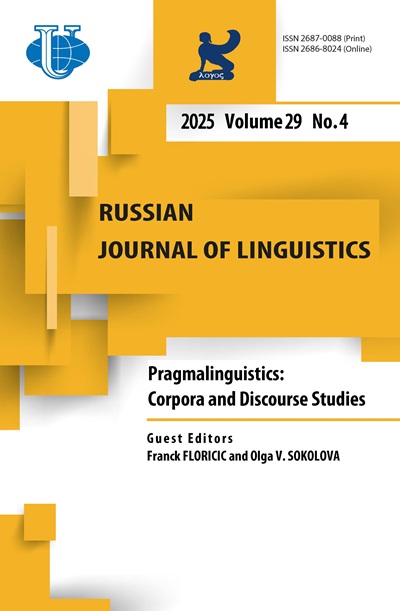
- Authors: Floricic F.1, Sokolova O.V.2
-
Affiliations:
- Université de Paris 3 -Sorbonne Nouvelle & LPP (CNRS)
- Institute of Linguistics, Russian Academy of Sciences
- Issue: Vol 29, No 4 (2025): Pragmalinguistics: Сorpora and Discourse Studies
- Pages: 731-744
- Section: INTRODUCTORY
- URL: https://journals.rudn.ru/linguistics/article/view/47819
- DOI: https://doi.org/10.22363/2687-0088-46503
- EDN: https://elibrary.ru/KFQLAE
- ID: 47819
Cite item
Full Text

Abstract
Pragmalinguistics is a dynamic field of study that combines insights from pragmatics, discourse analysis, and corpus linguistics to examine how speakers use language to achieve communicative goals and construct meaning in various social and cultural contexts. This field has seen significant growth over the past few decades, due to methodological innovations and a growing interest in analyzing real-world language data. The relevance of this issue is due to the increasing interest in using corpora and discourse analysis to study “language in use” and “language in action”. The volume aims to discuss the current state of pragmalinguistic research and its connections with other linguistic methods, contributing to the innovative and promising field of corpus pragmatics. This issue presents a range of theoretical and empirical studies that use corpus-based methods to investigate language as a means of communication, social interaction, and intercultural understanding. It emphasizes the significance of corpora in exploring various aspects of pragmatics, including discourse, intercultural, social, cognitive-inferential, and historical perspectives. It also highlights the potential of an interdisciplinary approach to enhance corpus pragmatics by providing fresh insights into the structure, function, and variation of pragmatic units across languages and discourses and discusses the prospects for future research in the field.
Full Text
Introduction
Pragmalinguistics, the study of language use in context, is a dynamic field that combines insights from pragmatics, discourse analysis, and corpus linguistics as well as philosophy, psychology, human ethology, sociology, among others (Senft 2014). It is no coincidence that the term “pragmatics” was used in various disciplines (Kotorova 2019). Linguistically oriented pragmatics or pragmalinguistics examines how speakers use linguistic resources to achieve communicative goals, construct meaning and manage interaction in various social and cultural settings. Over the past few decades, research in this area has grown significantly, reflecting broader methodological innovations in linguistic research and a growing interest in analyzing real-life language data. Charles S. Peirce, Charles W. Morris, Alan H. Gardiner and Karl Bühler laid the groundwork for pragmatics by analyzing linguistic means in relation to the speaker and the communication situation. A major breakthrough in linguistic theory of the second half of the twentieth century was the “performative turn” in the philosophy of language, which became a new stage of the broader “linguistic turn.” This shift was grounded in the reconceptualization of the utterance as an action capable of transforming the circumstances of the world and communication. Ludwig Wittgenstein’s emphasis on the use of language laid the foundation for a move away from a purely structural view of language toward one that highlights its pragmatic and social dimensions. The 1960s saw the emergence of an anthropocentric paradigm, influenced by John L. Austin’s theory of performatives, John Searle’s theory of illocution, Paul Grice’s theory of cooperation and Émile Benveniste’s concept of “subjectivity in language”.
Very soon pragmatics has broadened its boundaries and is no longer limited to a single utterance. Scholars have proposed a dialogical, “wide pragmatic” approach (Kecskes 2016), emphasizing that it can help better understand the complexities of communication. Thus, pragmatics is inextricably linked with discourse analysis and, according to researchers, is an “indispensable source for any discourse analytic study” (Alba-Juez 2016: 43).
The inclusion of a cultural context in pragmatic research has led to the development of Ethnopragmatics (Wierzbicka 2003/1991, Goddard 2006), Cross-Cultural Pragmatics (Gladkova 2023) and Intercultural Pragmatics (Kecskes 2014, Senft 2020), which aim to explain cultural differences in communication and bridge gaps in understanding caused by these differences. This volume aims to discuss the current state of research in pragmalinguistics, in connection with the most relevant linguistic methods, paving the way for such an innovative and promising field as corpus pragmatics.
This journal issue focuses on the theoretical and practical challenges of pragmatically oriented corpora and discourse studies, and presents their recent ramifications, which open up new opportunities for in-depth analysis of pragmatics as “Dark Matter” using S. C. Levinson’s metaphor (2024: 3).
Corpus pragmatics as an integrative linguistic area
By combining qualitative and quantitative methods, corpus pragmatics allows linguists to analyze discourses from the perspective of corpus-based discourse analysis, corpus-assisted discourse studies, etc. (Romero-Trillo 2008b, 2013, 2014). Within the framework of Ch. Morris’s triad, corpus linguistics has long been more concentrated on syntax and semantics, studying the formal relations of one sign to another and the relations of signs to objects, while pragmatics, as the relation of signs to those who interpret the signs, the users of language, long remained beyond the corpus analysis. From the point of view of corpus tools, corpus studies of syntax and semantics are more equipped with different types of linguistic annotation, including lemmatization, tokenization, stemming, parsing, etc. Weisser claimed that pragmatic annotation is more complex than other types of annotation due to the fact that it “almost always needs to take into account levels above the individual word and may even need to refer to contextual information beyond those textual units that are commonly referred to as a ‘sentence’ or ‘utterance’” (Weisser 2015: 84).
The methodological issue of pragmatic analysis goes back to the philosophical origins of pragmatics, which grew out of the semiotic and logico-philosophical studies. Pragmatics maintains a close relationship with philosophy: it “not only takes into account empirical investigations based on language use, but also takes advantage of a more philosophical approach to language” (Capone 2019: 1). Explaining the relationship between pragmatics and philosophy, Senft (2014) states that one of the central questions of philosophy is how we generate meaning and one of the most important tools we use to do this is language (Senft 2014: 11).
Corpus pragmatics offers new opportunities to complement “real data” with “big data” by developing a holistic approach that shifts from analysis to synthesis and views language as a natural biological and social phenomenon (as set out in the works of Sapir and Whorf; see also Pike 1967). Studying language “from the perspective of language users embedded in their situational, behavioral, cultural, societal and political contexts” (Senft 2014: 3) is based upon a broad variety of methodologies and interdisciplinary approaches.
The main task of corpus pragmatics was to bridge the gap between pragmatics and corpus linguistics, which “not only helped each other in a relationship of mutualism, but, they have also made common cause against the voices that have derided and underestimated the utility of working with real data to elucidate the patterns of language use” (Romero-Trillo 2008a: 1). Corpus pragmatics “integrates the horizontal (qualitative) methodology typical of pragmatics with the vertical (quantitative) methodology predominant in corpus linguistics” (Rühlemann & Aijmer 2014: 1).
The relevance of this special issue is due to the significant interest of linguistics in the use of corpora and discourse analysis to explore ‘language-in-use’ and ‘language-in-action’. Both theoretical and methodological questions have a strong place in modern linguistics. To date, corpus pragmatics has earned recognition as one of the fastest growing methodologies in contemporary linguistics, as evidenced by a large number of research, conferences and journals: Journal of Pragmatics, International Journal of Corpus Linguistics and Pragmatics, and Corpus Pragmatics.
Corpus pragmatics, as a technology-based linguistic field grounded in the use of “big data”, focuses not only on pragmatic phenomena as tools of discourse organization, but also on the research of the role of the subject in providing the language forms with pragmatic functions. On the one hand, the departure from the principle of “subjectivity in language” distinguishes the data-based approach from the anthropocentric one; on the other hand, it opens up perspectives for the interaction of “big” and “small” data, technological and human-oriented approaches.
Modern fields of pragmalinguistics research
In current pragmatic studies the social dimension of communication is actively explored in the areas of Intercultural Pragmatics, Sociopragmatics, and Discourse studies. Crossing disciplinary boundaries, Intercultural Pragmatics contributes to the study of intercultural interactions using established methods and innovative techniques (Kecskes 2014). Kecskes argued that intercultural pragmatics examines how the language is used in social encounters between people who have different first languages and represent different cultures (Kecskes 2014: 14). Exploring the issues of communication in the globalized world, intercultural pragmatics employs corpus tools that form “a perfect alliance to describe language use in real intercultural contexts” (Romero-Trillo 2022: 510).
Sociopragmatics addresses how everyday interactions and relationships with others help to construct our social worlds (Haugh et al.2021). Linguistics of emotion, which is a rapidly growing field within linguistics, is actively developing in conjunction with sociopragmatics and discourse analysis. The sociopragmatic and discourse-pragmatic approaches to the study of emotion (Alba-Juez & Larina 2018, Alba-Juez & Haugh 2025, Mackenzie & Alba-Juez 2019) contribute to a broader scholarly understanding of emotions and their role in social life. As Alba-Juez and Haugh (2025) argue, “a systematic understanding of emotions cannot be achieved without approaching them through a sociopragmatic lens that takes into consideration the evaluative, relational, and moral dimensions of emotions in discourse and social interaction” (Alba-Juez & Haugh 2025: 4).
The use of databases of national corpora, such as the International Corpus of English, the Australian National Corpus, etc. “offers theoretically motivated explanations for the pragmatic effects” (Jaszczolt et al. 2016: 253). The socio-cognitive approach to communication and pragmatics deals with intercultural communication and communication in a second language, attaching the same importance to the social and cognitive individual factors in pragmatics (Kecskes 2023). Pragmatically oriented corpora such as the Corpus of English Dialogues 1560–1760 (CED), the Corpora of Early English Correspondence (CEEC), the Corpus of Early English Medical Writing 1375–1800 (CEEM) etc. can benefit from both socially oriented and historical pragmatics. The latter explores changes in the field of pragmatics from a diachronic perspective, focuses not only on the pragmatic phenomena themselves, but also on the processes of grammaticalization and pragmaticalization (Suhr & Taavitsainen 2012, Landert 2024).
Covering topics from pragmatic phenomena in colloquial speech to the pragmatics of different types of discourse, corpus pragmatics interacts with discourse analysis (Baker 2023; Gillings et al. 2023). Corpus-based discourse analysis focuses on investigating discourse phenomena through the systematic examination of linguistic patterns and frequencies within large corpora (Flowerdew 2023), while Corpus-assisted discourse studies (Ancarno 2020) combine corpus techniques with qualitative discourse analysis to explore how language constructs social and ideological meanings. The study of the pragmatics of artistic discourses, which interact with colloquial language in contemporary contexts and often reveal a pragmatic experiment, plays a special role in corpus pragmatics research (Person et al. 2022, Sokolova & Feshchenko 2024).
Among the main trends in corpus pragmatics is the investigation of different types of pragmatic phenomena, such as illocutionary verbs, discourse (or pragmatic) markers, and deictics, using corpus data (Aijmer & Rühlemann 2014, Rühlemann 2019, Stoica 2021, Zolyan 2021).
Discourse markers are among the most extensively researched pragmatic units. Contemporary studies often draw on multilingual corpora, contributing to cross-linguistic and typological research (Andersen 2015, Inkova & Kruzhkov 2016, Fedriani & Sansò 2017, Bonola & Stoyanova 2020; Traugott 2022; Hansen & Visconti 2024; Floricic 2023). A wide range of corpora and subcorpora provide data for different research purposes, including pragmatic issues: Corpus of Early English Medical Writing 1375–1800 (CEEM), German Political Speeches Corpus, Corpus of British Parliament speeches, etc. These studies also make use of corpora of colloquial speech in different languages, such as COCA (Spoken), SEC, KiParla, Val.Es.Co, Stories about Dreams and Other Spoken Speech Corpora, ORD Corpus, and Pragmaticon (Davies 2010, Kibrik & Podlesskaja 2009, Mauri et al.2022, Dobrushina & Sokur 2022, Bychkova & Rakhilina 2023). The corpus pragmatics approach makes it possible to explain crucial issues of discourse markers studies and to trace the derivational links of contemporary discourse markers to the primary unit (Auer & Maschler 2016); to explore the development of discourse markers and to explain their similarities and differences across a typologically wide range of languages (Heine et al.2021); to distinguish between strategic vs. symptomatic uses of DM on the basis of their combination, function and distribution across different registers in English and French (Crible 2018); to compare discourse markers in different languages and examine how they function in discourse from a syntactic and semantic-pragmatic perspective (Lansari 2020), etc. The recent study of discourse connectors provides an up-to-date study of discourse relations, incorporating synchronic, diachronic, cross-linguistic, and corpus methodologies (Zufferey, Degand 2024). The special issue of the Russian Journal of Linguistics 28 (4) and Heine, Yang & Rhee (2024) examine the rise of discourse markers from earlier lexical units of Chinese origin in Japanese, Korean, Vietnamese and Thai.
Furthermore, theoretical and methodological aspects remain some of the most pressing issues in corpus pragmatics. State-of-the-art corpus pragmatics methods offer a combination of theoretical, qualitative, quantitative, statistical approaches, analysis of multimodal data, and respond to the demand for the development of new corpus methods (Cienki& Iriskhanova 2018, Põldvere et al. 2022, Landert et al. 2023).
The contributions to this special issue
This volume brings together a wide spectrum of studies on issues such as the status of the subject in pragmatics, negation as a shifter category situated between grammar and pragmatics, pragmatemes operating at the boundary between semantics and pragmatics, and the search for fundamental pragmatic elements. It also covers diverse topics such as interjections and formulaic expressions, as well as providing detailed investigations of individual pragmatic markers. The papers address terminological and methodological issues relating to minimal and universal units of pragmatic analysis, such as pragmatic units, pragmatic markers, discourse units, pragmatic particles, pragmatemes and speech formulas. These units are examined from various perspectives, including discourse and corpus studies, prosodic analysis, phraseology, constructional-pragmatic frameworks and semantic enquiry. Synchronic and diachronic approaches are also employed. The research spans different discourse types, ranging from political and poetic to cinematic and artistic, in both spoken and written forms. The volume concludes with case studies focusing on specific items, offering detailed analyses of markers such as bueno, uno, and one. The materials draw on a broad set of languages, including English, Spanish, Italian, Greek, French and Russian, as well as typological data from Australia, Africa and the Americas.
In his opening contribution, Suren T. Zolyan addresses a fundamental question in pragmatics: how to identify the subject of communication. Although pragmatics is often reduced to the relationship between the speaker and the sign system, this perspective is insufficient for cases of suprapersonal or impersonal communication, in which institutions or imagined communities act as interlocutors. Zolyan revisits the development of pragmatics and the distinction between micro- and macropragmatics, touching upon branches such as intercultural, cross-cultural and sociocultural pragmatics. Furthermore, the paper puts forward a significant refinement: the distinction between macropragmatics and megapragmatics.
Having considered shifter categories operating at the intersection of grammar and pragmatics, the next question addressed in the special issue is how to identify the fundamental elements of pragmatic analysis. The contribution by Olga V. Sokolova introduces the umbrella term “pragmatic units” to encompass deictics, discourse markers, illocutionary and modal verbs. By examining poetic discourse alongside everyday speech, the study highlights the importance of integrating discourse and corpus approaches in order to understand how pragmatic units vary in different contexts. Based on a three-million-word poetic corpus in Russian, Italian, and English, together with spoken corpora, the analysis focuses on the inferential markers sledovatel’no (следовательно), quindi, and therefore. While these markers primarily signal logical-semantic relations in conversation, in poetry they often appear in unconventional positions, undergo resemantization, and disrupt coherence. A cross-linguistic comparison shows that Russian and Italian use them more frequently to make logical and structural links in speech more explicit, and to treat them as the objects of metalanguage reflection in poetry, whereas English displays much lower frequencies overall. Yet American poetry shows a marked experimental tendency compared to everyday English.
Building on the exploration of pragmatic units in different types of discourse, the next issue turns to political communication, in which pragmatic markers play a crucial, albeit distinct, role. The topic of the fourth contribution, by Péter Bálint Furkó, is the strategic use of pragmatic markers in parliamentary discourse, focusing on how markers such as of course, well, but, and you know contribute to ideological positioning and manipulative intent. Drawing on the Europarl corpus of European Parliament debates and employing corpus-based critical discourse analysis, the study demonstrates that pragmatic markers extend beyond cohesion and interactional management to function as tools of populist and strategic discourse. The analysis highlights the interplay of evidential markers, modal adverbs, and general extenders, showing how their co-occurrence patterns reflect broader socio-political dynamics and strategies of legitimation. Continued examination of these subtle mechanisms contributes to a more nuanced understanding of how language, power, and ideology intertwine in discourse.
The study by Antonio Hidalgo Navarro and Noelia Ruano Piqueras argues that the traditional notion of the “sentence” is insufficient for analyzing spontaneous conversation, which is characterized by interruptions, ellipses, and non-canonical word orders. Given the limitations of laboratory-based approaches, it proposes a pragmaprosodic segmentation model designed to capture the authentic dynamics of colloquial discourse. The analysis draws on a conversational fragment examined acoustically with Praat and framed within the convergence of Hidalgo’s (2019) interactive-functional model and the structural framework developed by the Val.Es.Co. group. Findings reveal a systematic correspondence between discourse units (act and subact) and prosodic principles such as pitch declination, hierarchy/recursivity, and integration. On this basis, the study demonstrates that intonation serves as the most reliable criterion for segmenting colloquial speech. Moreover, it underscores the methodological rigor of an approach that not only accounts for melodic organization but also provides a more accurate representation of the functional structure of oral discourse.
Interjections occupy a special place at the intersection of grammar, discourse, and pragmatics, and the article by Dionysis Goutsos investigates their functions in Modern Greek. Rather than treating interjections as marginal or peripheral, the study highlights their fundamental role in structuring interactions, managing speaker-hearer relationships, and expressing emotional states. Drawing on both spoken and written data, the analysis identifies the range of forms and meanings conveyed by Greek interjections, from basic exclamations of emotion to markers of discourse organization. Particular attention is given to their multifunctionality, and to how they bridge the boundary between lexical items and pragmatic markers. By situating Greek interjections within broader typological and pragmatic frameworks, the article demonstrates their relevance for understanding formulaicity, discourse coherence, and the dynamics of interpersonal communication.
In her study, Irina V. Zykova investigates the role of formulas in cinematic discourse, paying particular attention to contact-terminating means such as farewells, apologies and requests. Drawing on cinematic and literary corpora, the analysis identifies such means in films and classifies them into twelve pragmatic types. A comparative study of three farewell formulas across corpora reveals that, unlike in films, they are often used for other communicative functions in literary discourse and display limited variability. This highlights the colloquial nature of cinematic language and its divergence from other artistic discourses. The data show that the contact-terminating means employed in cinematic and artistic discourse possess a certain pragmatic specificity. They modify or deviate from conventional conversational closure and use formulas creatively.
Moving from general categories of pragmatic units to the fine-grained study of individual markers, the article by Araceli López Serena and Santiago García-Jiménez offers a constructional-pragmatic analysis of the Spanish discourse marker bueno. Challenging item-based approaches that treat bueno as a lexical unit with inherent pragmatic functions, the study argues that its discursive values emerge from participation in broader discourse patterns. Drawing on the Val.Es.Co. corpus, the authors identify and formalize patterns such as topic resumption, topic shift, reformulation, and online planning support. The conclusion highlights the importance of avoiding both functional overmultiplication and excessive abstraction: many values traditionally attributed to bueno derive from underlying discourse patterns rather than the marker itself. By emphasizing a pattern-level approach, the study contributes to more precise definitions of macro- and microfunctions and demonstrates the methodological relevance of discourse patterns for crosslinguistic description, grammaticalization studies, language teaching, and translation.
Elena L. Vilinbakhova and Oksana Yu. Chuikova examine the generic uses of the impersonal pronouns one in English and uno in Spanish within parliamentary debates. The analysis employs a parallel corpus approach with Europarl data and contrastive pragmatics methodology to investigate how these pronouns express generalizations, applying the theoretical distinction between rules (established norms) and inductive generalizations (inferences from observed facts). While both pronouns show comparable frequency of generic use, their distribution differs markedly: English one strongly prefers encoding rules, whereas Spanish uno shows no significant bias, being used equally for both types of generalizations. The cross-linguistic comparison reveals that in functionally equivalent contexts, first-person forms are underrepresented for generic one in Spanish, while second-person you appears less frequently for non-generic uno in English.
In their final contribution Olga A. Solopova and Natalia N. Koshkarova aim to explore the metaphorical modelling of the BRICS in the mass-media discourse of one of its member states, the Republic of South Africa. Using the News on the Web Corpus they compiled the corpus of 521 metaphors based on thematic, chronological, and frequency principles with the help of computer-assisted and manual processing. Drawing on the theory of image schemas by M. Johnson and G. Lakoff they studied the metaphors through quantitative estimation, metaphorical modelling, cognitive, discursive, linguistic and cultural analysis. The findings suggest that despite a relatively low metaphor density in South African media discourse, the BRICS image is structured by more than 10 source domains. The frequency of similar image schemas underlying the metaphors is linked to their ability to reflect fundamental characteristics of groupings: multipolarity, national sovereignty, equality, and mutually beneficial cooperation. Family, game and sport, body, and animal metaphors, based on social and biological archetypes, were found more culturally marked than those based on universal physical laws. This study contributes to media linguistics, specifically the study international relations from a linguistic perspective.
Conclusion
This special issue presents a variety of theoretical and empirical studies that employed corpus-based methods to examine language as a tool for communication, social interaction, and intercultural understanding. The contributions explore the intersection of various linguistic methods, demonstrating how qualitative and quantitative approaches, manual and automatic analyses, and distant and close reading can complement each other when studying pragmatic phenomena.
The issue emphasizes the importance of corpora in addressing the various dimensions of pragmatics, such as discourse, intercultural, social, cognitive-inferential and historical perspectives. Ultimately, the collective studies showcased the capacity of an interdisciplinary approach to enrich corpus pragmatics, offering fresh insights into the structure, function, and variability of pragmatic units across languages and discourses.
About the authors
Franck Floricic
Université de Paris 3 -Sorbonne Nouvelle & LPP (CNRS)
Email: franck.floricic@sorbonne-nouvelle.fr
PhD, Dr. Habil., is a professor of Italian linguistics Paris, France
Olga V. Sokolova
Institute of Linguistics, Russian Academy of Sciences
Author for correspondence.
Email: olga.sokolova@iling-ran.ru
ORCID iD: 0000-0003-4399-0094
PhD, Dr. Habil., is a senior researcher at the Institute of Linguistics
Moscow, RussiaReferences
- Aijmer, Karen & Christoph Rühlemann (eds.). 2014. Corpus Pragmatics: A Handbook. Cambridge: Cambridge University Press.
- Alba-Juez, Laura. 2016. Discourse analysis and pragmatics: Their scope and relation. Russian Journal of Linguistics 20 (4). 43–55. https://doi.org/10.22363/2687-0088-15147
- Alba-Juez, Laura & Tatiana V. Larina. 2018. Language and emotion: Discourse-pragmatic perspectives. Russian Journal of Linguistics 22 (1). 9–37. https://doi.org/10.22363/2312-9182-2018-22-1-9-37
- Alba-Juez, Laura & Michael Haugh 2025. The sociopragmatics of emotion in discourse and social interaction. In Laura Alba-Juez & Michael Haugh (eds.), The Sociopragmatics of emotion, 3–40. Cambridge: Cambridge University Press.
- Ancarno, Clyde. 2020. Corpus-assisted discourse studies. In Anna De Fina & Alexandra Georgakopoulou (eds.), The Cambridge Handbook of Discourse Studies, 165–185. Cambridge: Cambridge University Press.
- Andersen, Gisle. 2015. Relevance. In Aijmer Karin & Rühlemann Christopher (eds.), Corpus Pragmatics: A Handbook, 143–168. Cambridge: Cambridge University Press.
- Auer, Peter & Yael Maschler (eds.). 2016. NU / NÅ: A Family of Discourse Markers Across the Languages of Europe and Beyond. Berlin, Boston: De Gruyter.
- Baker, Paul. 2023. Using Corpora in Discourse Analysis. London: Bloomsbury Publishing.
- Baker, Paul & Tony McEnery (eds.). 2015. Corpora and Discourse Studies: Integrating Discourse and Corpora. Basingstoke: Palgrave Macmillan.
- Barron, Anne, Yueguo Gu & Gerard Steen (eds.). 2017. The Routledge Handbook of Pragmatics. London: Routledge.
- Bonola, Anna & Nataliya Stoyanova. 2020. Izuchenie diskursivnykh i pragmaticheskikh markerov v ital'yanskoy lingvistike: napravleniya i metody (Discourse and pragmatic markers in Italian linguistics: Trends and methods). Voprosy Jazykoznanija 1. 124–147. https://doi.org/10.31857/S0373658X0008303-2
- Brisard, Frank, Mieke Vandenbroucke, Pedro Gras, Sigurd D'hondt. 2022. Handbook of Pragmatics. Amsterdam: John Benjamins.
- Bychkova, Polina & Ekaterina Rakhilina. 2023. Towards pragmatic construction typology. The case of discourse formulae. In Barotto Alessandra & Mattiola Simone (eds.), Discourse phenomena in typological perspective, 35–63. Amsterdam / Philadelphia: John Benjamins.
- Capone, Alessandro. 2019. Pragmatics and Philosophy: Connections and Ramifications. Cham: Springer.
- Capone, Alessandro, Roberto Graci, Pietro Perconti (eds.). 2024. New Frontiers in Pragmalinguistic Studies. Cham: Springer.
- Cienki, Alan & Olga K. Iriskhanova. 2018. Aspectuality across Languages: Event Construal in Speech and Gesture. Amsterdam: John Benjamins.
- Crible, Ludivine. 2018. Discourse Markers and (Dis)fluency. John Benjamins.
- Davies, Mark. 2010. The corpus of Contemporary American English as the first reliable monitor corpus of English. Literary and Linguistic Computing 25 (4). 447–464. https://doi.org/10.1093/llc/fqq018
- Dobrushina, Nina & Elena Sokur. 2022. Spoken corpora of Slavic languages. Russian Linguistics 46. 77–93 https://doi.org/10.1007/s11185-022-09254-9 doi: 10.1007/s11185-022-09254-9
- Fedriani, Chiara & Andrea Sansò. 2017. Pragmatic Markers, Discourse Markers and Modal Particles: New Perspectives. John Benjamins.
- Floricic, Franck. 2023. Altro che / altroché et l’expression du haut degré en italien. In Papahagi Cristiana, Moraru Sanda‐Valeria, & Veronica Manole (coord.), Romania contexta. Excès et abus dans les langues romanes, 35–64. Presa Universitară Clujeană.
- Flowerdew, Lynne. 2023. Corpus-based discourse analysis. In Lynne Flowerdew (ed.), The Routledge Handbook of Discourse Analysis, 126–138. London: Routledge.
- Gillings, Mathew, Gerlinde Mautner & Paul Baker. 2023. Corpus-Assisted Discourse Studies. Cambridge: Cambridge University Press.
- Gladkova, Anna. 2023. Cross-Cultural Pragmatics. Oxford Bibliographies in Linguistics. Oxford University Press. https://doi.org/10.1093/OBO/9780199772810-0313
- Goddard, Cliff (ed.). 2006. Ethnopragmatics: Understanding Discourse in Cultural Context. Berlin: Mouton de Gruyter.
- Hansen, Maj-Britt Mosegaard & Jacqueline Visconti. 2024. Manual of Discourse Markers in Romance. Berlin, Boston: De Gruyter.
- Haugh, Michael, Dániel Z. Kádár & Marina Terkourafi (eds.). 2021. The Cambridge Handbook of Sociopragmatics. Cambridge: Cambridge University Press.
- Heine, Bernd, Wenjiang Yang & Seongha Rhee 2024. Discourse-pragmatic markers of (inter)subjective stance in Asian languages. Russian Journal of Linguistics 28 (4). 751–770. https://doi.org/10.22363/2687-0088-40718
- Heine, Bernd, Gunther Kaltenböck, Tania Kuteva & Haiping Long. 2021. The Rise of Discourse Markers. Cambridge: Cambridge University Press.
- Huang, Yan. 2014. Pragmatics. Oxford University Press.
- Inkova, Olga & Mikhail Kruzhkov. 2016. Nadkorpusnye russko-frantsuzskie bazy dannykh glagol'nykh form i konnektorov (Supracorpora databases (SCDB) of Russian and French verbal forms and connectors). In Olga Inkova & Andrea Trovesi (eds.), Lingue slave a confronto, 365–392. Bergamo: Bergamo University Press.
- Jaszczolt, Kasia M., Eleni Savva & Michael Haugh. 2016. The individual and the social path of interpretation: The case of incomplete disjunctive questions. In Alessandro Capone & Jacob Mey (eds.), Interdisciplinary studies in Pragmatics, Culture and Society, 251–284. Heidelberg: Springer.
- Kecskes, Istvan (ed.). 2022. The Cambridge Handbook of Intercultural Pragmatics. Cambridge: Cambridge University Press.
- Kecskes, Istvan. 2014. Intercultural Pragmatics. Oxford: Oxford University Press.
- Kecskes, Istvan. 2016. A dialogic approach to pragmatics. Russian Journal of Linguistics 20 (4). 26–42. https://doi.org/10.22363/2687-0088-15146
- Kecskes, Istvan. 2023. The Socio-Cognitive Approach to Communication and Pragmatics. Cham: Springer.
- Kibrik, Andrej A. & Vera I. Podlesskaja (eds.). 2009. Rasskazy o snovideniyakh: korpusnoye issledovanie ustnogo russkogo diskursa (Night Dream Stories: A corpus study of spoken Russian discourse). Moscow: Yazyki Slavyanskikh Kul’tur.
- Kotorova, Elisaveta G. 2019. Pragmatics among linguistic disciplines: Problems of definition and classification. Russian Journal of Linguistics 23 (1). 98–115. https://doi.org/10.22363/2312-9182-2019-23-1-98-115
- Landert, Daniela. 2024. Methods in Historical Corpus Pragmatics: Epistemic Stance in Early Modern English. Cambridge: Cambridge University Press.
- Landert, Daniela, Daria Dayter, Thomas C. Messerli & Miriam A. Locher. 2023. Corpus Pragmatics. Cambridge: Cambridge University Press.
- Lansari, Laure. 2020. A Contrastive View of Discourse Markers. Discourse Markers of Saying in English and French. Cham: Palgrave MacMillan.
- Levinson, Stephen C. 2024. The Dark Matter of Pragmatics: Known Unknowns. Cambridge: Cambridge University Press.
- Mackenzie, J. Lachlan & Laura Alba-Juez (eds.). 2019. Emotion in Discourse. Amsterdam: John Benjamins.
- Mauri, Caterina, Silvia Ballarè, Eugenio Goria & Massimo Cerruti. 2022. Il corpus KIParla. In Cresti-Massimo Moneglia Emanuela (a cura di), Corpora e studi linguistici. Proceedings of the LIV International Congress of the Società di Linguistica Italiana (Online, 8-10 September, 2021), 109–118. Milano: Officina ventuno. https://dx.doi.org/10.17469/O2106SLI000006
- Person, Raymond F., Robin Wooffitt & John P. Rae (eds.). 2022. Bridging the Gap Between Conversation Analysis and Poetics. Studies in Talk-In-Interaction and Literature Twenty-Five Years after Jefferson. New York and London: Routledge.
- Pike, Kenneth L. 1967. Language in Relation to a Unified Theory of the Structure of Human Behavior. The Hague, Paris: Mouton & Co.
- Põldvere, Nele, Rachele De Felice & Carita Paradis. 2022. Advice in Conversation: Corpus Pragmatics Meets Mixed Methods. Cambridge: Cambridge University Press.
- Romero-Trillo, Jesús. 2008a. Introduction. In Jesús Romero-Trillo (ed.), Pragmatics and Corpus Linguistics: A mutualistic entente, 1–10. Berlin and New York: Mouton de Gruyter.
- Romero-Trillo, Jesús (ed.). 2008b. Pragmatics and Corpus Linguistics: A Mutualistic Entente. Berlin and New York: Mouton de Gruyter.
- Romero-Trillo, Jesús (ed.). 2013. The Yearbook of Corpus Linguistics and Pragmatics 2013: New Domains and Methodologies. Dordrecht: Springer.
- Romero-Trillo, Jesús (ed.). 2014. The Yearbook of Corpus Linguistics and Pragmatics 2014: New Empirical and Theoretical Paradigms. Dordrecht: Springer
- Romero-Trillo, Jesús. 2022. Corpus Pragmatics: Corpus-Based Intercultural Pragmatic Research. In Istvan Kecskes (ed.), The Cambridge Handbook of Intercultural Pragmatics, 510–524. Cambridge: Cambridge University Press.
- Rühlemann, Christoph. 2019. Corpus Linguistics for Pragmatics: A Guide for Research. Oxford: Routledge.
- Senft, Gunter. 2014. Understanding Pragmatics: An Interdisciplinary Approach to Language Use. Abingdon: Routledge.
- Senft, Gunter. 2020. “... to grasp the native's point of view...” — A Plea for a holistic documentation of the Trobriand Islanders' language, culture and cognition. Russian Journal of Linguistics 24 (1). 7–30. https://doi.org/10.22363/2687-0088-2020-24-1-7-30
- Sokolova, Olga V. & Vladimir V. Feshchenko. 2024. Pragmatic markers in contemporary poetry: A corpus-based discourse analysis. Russian Journal of Linguistics 28 (3). 706–733. https://doi.org/10.22363/2687-0088-40107.
- Stoica, Irina. 2021. The Syntax and the Semantics of Manner of Speaking Verbs. Bucharest: Bucharest University Press.
- Suhr, Carla & Irma Taavitsainen (eds.). 2012. Developing Corpus Methodology for Historical Pragmatics. Helsinki: Varieng.
- Weisser, Martin. 2015. Speech act annotation. In Karin Aijmer & Christopher Rühlemann (eds.), Corpus Pragmatics: A Handbook, 84–114. Cambridge: Cambridge University Press.
- Zolyan, Suren. 2021. On pragma-semantics of expressives: Between words and actions. In Alexander Haselow & Sylvie Hancil (eds.), Studies at the grammar-discourse interface: Discourse markers and discourse-related grammatical phenomena, 246–271. John Benjamins.
- Zufferey, Sandrine & Liesbeth Degand. 2024. Connectives and Discourse Relations. Cambridge: Cambridge University Press.
Supplementary files

