






RUDN Journal of World History
Editor-in-Chief: Sergey A. Voronin, PhD, Professor, Head of the World History Department in RUDN, Moscow, Russia
ISSN: 2312-8127 (Print)ISSN: 2312-833X (Online)
Founded in 2009. Publication frequency: quarterly.
Open Access: Open Access . APC: no article processing charge.
Peer-Review: double blind. Publication language: Russian, English
PUBLISHER: Peoples’ Friendship University of Russia named after Patrice Lumumba (RUDN University)
Indexation: White List RCSI, Russian Index of Science Citation, DOAJ, Google Scholar, Ulrich's Periodicals Directory, Dimensions
The aim of the journal is to increase the efficiency of research work in the field of human knowledge through the development of scientific and editorial and publishing activities, as well as dissemination and testing of advanced methodologies and the latest achievements of historical science in order to implement the humanitarian mission of modern classical university.
The journal is intended for publication of the results of independent and original research scholars, faculty, and staff of the University and other research centers in the form of articles, review materials, scientific reports, bibliographic reviews on specific topics and research areas. The magazine covers all areas of the study of history from antiquity to the present.
Based on actual problems of modern historical science, a priority for the journal is to publish research on the problems of Africa, Asia and Latin America. As part of the magazine is also crucial issues related to the socio-political and cultural development of world civilizations of East and West, from antiquity to the present time; and considerable attention is paid to comparative analysis and the role of Russia in the context of the existence of civilizations "East-West".
All materials submitted by the authors to the journal are reviewed.
Current Issue
Vol 18, No 2 (2026)
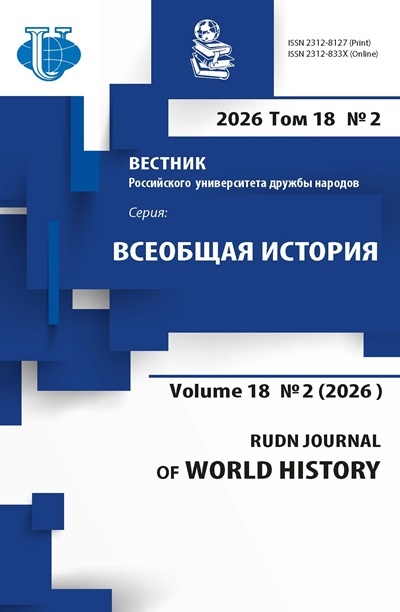
- Year: 2026
- Articles: 9
- URL: https://journals.rudn.ru/world-history/issue/view/2131
- DOI: https://doi.org/10.22363/2312-8127-2026-18-2
Full Issue

Ideas and politics in history
The heralds of the idea of a united ummah: the Muslim world in search of inter-regional cooperation at the turn of the 19th-20th centuries
Abstract
In the study the authors examine the evolution of ideas about Muslim unity among traditional intellectuals of the Middle East, North Africa and South Asia in the late 19th and early 20th centuries. The works and statements of Muhammad Abduh (1849-1905), Salih al-Sharif al-Tunisi (1869-1920) and Shibli Nomani (1857-1914) are used as examples. The weakening of the Ottoman State and the triumph of the colonial powers of Europe confronted Arab and Indian Muslim theologians with the need to rethink the call for unity inherent in the Islamic tradition. The new understanding of this problem by Muslim politicians has raised a wide range of discussions of both a political and cultural-civilizational nature. As a result, the gradual emergence of a trend towards country patriotism in the Islamic world exposed the risks of splitting Muslim societies and gave the colonial powers new opportunities to undermine the Ottoman statehood. Correlations have been revealed between the views of intellectuals of the Islamic world on the acceptability of modernizing everyday life, culture and the worldview of the population and their ideas about the possibility of preserving the Ottoman leadership system. The authors evaluate the effectiveness of the practical work of both reformers and traditionalists in supporting the achievements of the centuries-old Islamic political culture in the educational and propaganda spheres. The conducted research shows the diversity of reactions of country and regional elites to political challenges from European colonization, the Young Turk revolution of 1908-1909 and the subsequent collapse of the Ottoman Empire during the First World War.
 133-151


The exchange of prisoners of war as a site of ideological confrontation during the Korean war
Abstract
The Korean War (25.06.1950-27.07.1953) represents a multifaceted conflict of the Cold War era, in which the national interests of the two Korean states, the Democratic People's Republic of Korea (DPRK) and the Republic of Korea (ROK), became intricately intertwined with the interests of major powers - the USSR, the USA, and the People's Republic of China (PRC). From the very outbreak of the war on June 25, 1950, various proposals for achieving peace and restoring the status quo were put forward at the United Nations. However, for various reasons, the war became protracted. Truce talks commenced in July 1951 and concluded only two years later with the signing of the Korean Armistice Agreement. One of the reasons for the prolonged negotiations was the disagreement between the sides regarding the exchange of prisoners of war. The aim of this study is to examine how the ideological confrontation between the sides of the military conflict (the USA and the ROK versus the DPRK, the PRC, and the USSR) influenced the negotiations on the POWs exchange and the subsequent treatment of repatriated prisoners in their home countries (on the examples of American and British POWs). As a result of the research, the author concludes that tens of thousands of POWs became object of ideological propaganda and manipulation by both the United States, commanding the UN forces, and the DPRK and the PRC. The ideological confrontation between the sides emerged as one of the primary factors of tension within the prisoner-of-war camps, threatening the lives and safety of the captives.
152-174
The women’s question and the social hygiene movement in American society during the Progressive era
Abstract
The study analyzes the social hygiene movement in the United States during the Progressive Era in its relationship with the women's question. The study demonstrates how, in the context of large-scale social reforms and the transformation of Victorian ideals of femininity, a new approach to regulating public health and morality emerged. The movement, which united religious reformers, feminists, and medical experts, simultaneously challenged established moral norms in American society through a critique of double standards and became an instrument of repressive biopolitics aimed at controlling female sexuality. Based on an analysis of the movement's ideological tenets and actual practices, this article demonstrates how prostitution was redefined from a moral issue to a public health threat, justifying forced examinations and the isolation of women accused of spreading dangerous diseases. Thus, despite its progressive goals, the social hygiene movement reproduced patriarchal models of control over women.
175-185
Antique world
Political metamorphoses in Asia Minor during the time of Cicero and Augustus, or how pirates and philosophers became tyrants
Abstract
The authors devoted their study to a topic that has remained relevant over the past several decades: piracy and its role in the military and political confrontation in the Roman Mediterranean in the first century BC. Firstly, at this time the last state formations of the Hellenistic world, such as the Seleucid and Ptolemaic kingdoms, finally disappeared from the political map of the region, being absorbed by the world Roman Empire. Secondly, in Rome itself, the senatorial republic was replaced by autocracy in the form of the principate regime during the bloody civil wars, and what is commonly called the Roman Empire arose. And in these significant changes of a military-political nature, the "third force" - numerous pirate squadrons - played a significant role. The authors analyze the causes and consequences of the rise of Mediterranean piracy in the 1st century BC, as well as how the Roman authorities responded to this phenomenon: at first, they tried to ignore it, then they began to fight it - until 67 BC with varying success, and later they sometimes even attracted pirates to their side, using this "third force" in the political struggle. Here the authors turn to the historical realities of Roman Asia Minor, where during the specified period there were cases of seizure of power in individual cities and even regions by successful adventurers, among whom were found not only pirates, such as Zeniketus, Tarcondimotus, Antipater and Cleon, but also representatives of quite peaceful professions, such as, for example, the Epicurean philosopher Lysias. All these episodes were evidence of the political instability that accompanied the dramatic and painful transition from the Roman Republic to the Roman Empire.
186-200
The worship of the emperor in the image of Sobek-Souchos in Roman Egypt
Abstract
This study is devoted to the problem of the identification of the Roman emperor and god Sobek. The relevance of this issue lies in the fact that there is still no special scientific research devoted to this problem in academia. The main method was the comparison of papyrus and temple texts, as well as the visual representation of Roman rulers and the god Sobek which reflect the issue of identifying the emperor with the crocodile-headed deity. The material presented demonstrates that, according to the beliefs of the Egyptians, the Roman emperor, portrayed in the image of the solar god Sobek, was believed to facilitate the rebirth of the world, pacify the population, and act as the protector of Egypt. Furthermore, during the 1st and 2nd centuries, the cult of the emperor, venerated in the form of Sobek, underwent an evolution. It shifted from the image of a ruler affirming the eternity of his reign under Augustus to the notion that Egypt was governed by the god Sobek, who asserted his authority through the emperor's image.
201-210
East and West: contacts and contradictions
Features of the formation of the EU foreign policy strategy towards Sub-Saharan Africa
Abstract
The relevance of the topic is driven by the heightened attention that developed countries are paying to Sub-Saharan Africa. In conditions of geopolitical and economic uncertainty, global leaders seek to build relationships with Africa that are advantageous to themselves, actively incorporating this vector into their foreign-policy strategies. One of the major players in this new "scramble for Africa" is the European Union (EU), which, from the beginning of the formation of this economic and political association, has paid attention to the development problems of African regions. However, this issue has received insufficient attention in Russian historiography. Accordingly, the aim of the study is to determine the place and role of Africa in the EU's foreign-policy strategy. The study employs the principle of historicism, systems analysis, and analysis of the texts of foreign-policy doctrinal documents and official publications of the EU in order to identify the contradictory path of relationship formation between the parties and the key prerequisites for incorporating Africa into the EU's foreign policy. The article also proposes to analyze the role of the European Union in the development of the new "scramble for Africa" and attempts at neocolonialism. The study concludes by identifying the reasons that prompted the EU to join the "scramble for Africa" and the efforts the Union has made to address the stated problems.
211-223
Contemporary Germany’s policy towards African states
Abstract
The study investigates the influence of the colonial past on Germany’s contemporary foreign policy in Africa. The aim of the study is to test, using specific examples, whether historical ties determine current models of interaction or have given way to pragmatic interests. The analysis is based on the material of Berlin’s policy towards two groups of states: former colonies (Namibia, Tanzania, Togo) and partners without a shared colonial past (South Africa, Nigeria, Ghana). The source base consists of official documents of the Federal Republic of Germany (2017-2025). It has been established that the colonial past influences Germany’s policy selectively. It becomes a decisive factor only in relations with Namibia, where events of the early 20th century have formed a special agenda of historical responsibility. Interaction with other former colonies (Tanzania, Togo) is built on standard pragmatic foundations, while dialogue with countries of the second group is based exclusively on contemporary strategic and economic interests. Thus, Berlin’s African policy demonstrates a general priority of pragmatism over history, with the exception of isolated cases.
224-243
Studies on Chinese history
Approach of the Kuomintang government to army construction in 1927-1932
Abstract
The relevance of the topic lies in the fact that after the establishment of the Nanjing government in 1927, due to the turbulent situation, it has long faced the contradiction between the urgent need for national defense and the low capacity of industrial production. The purpose of this study is to examine a series of measures taken by the Chinese government to develop the defense industry and armed forces during this period by comparing and analyzing the available archival materials. Based on the method of literature analysis, the author summarizes the following measures taken by the Chinese government during this period: the determination of national armament and equipment standards, the new formation of divisions, and the relocation and construction of factories. But due to factors such as time constraints and lack of production capacity, the relevant work was not fully implemented until the outbreak of military conflict with Japan in 1931, these efforts yielded very limited results. However, these approaches did serve as a basis for further defense construction during the subsequent war with Japan.
244-256
Reviews
257-261