






 Email this article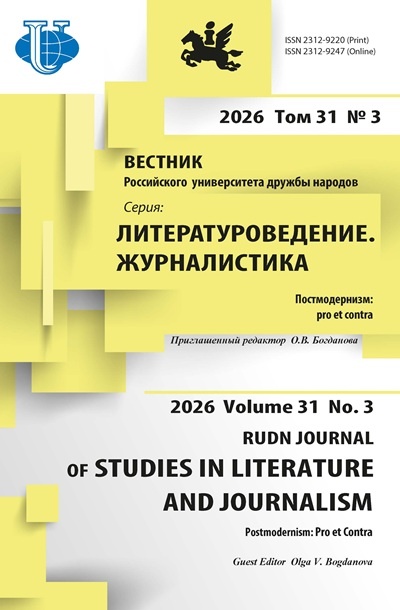


Postmodernism: Pro et Contra. Introductory Remarks

- Authors: Bogdanova O.V.1
-
Affiliations:
- Russian Christian Humanitarian Academy named after F.M. Dostoevsky
- Issue: Vol 31, No 3 (2026): POSTMODERNISM: PRO ET CONTRA
- Pages: 539-548
- Section: EDITORIA
- URL: https://journals.rudn.ru/literary-criticism/article/view/52716
- DOI: https://doi.org/10.22363/2312-9220-2026-31-3-539-548
- EDN: https://elibrary.ru/AVVYGD
- ID: 52716
Cite item

Abstract
-
Full Text
Postmodernism dominated Russian culture, art, literature, and society in the late 20th century, but now its era is over. Postmodernism peaked between the 1980s and the 2000s, but the new millennium has seen a gradual decline of postmodern tendencies. Meanwhile, the heyday of postmodernism remains a milestone in the history of Russian literature, forever inscribed on the tablets of philological history. A quarter of a century later, we are able to objectively assess the impact of postmodernism on the contemporary Russian literature.
The term comes from the Latin post (after) and modernus (modern), i.e., post-modernity. The phenomenon itself is as strange and paradoxical as its name, shocking and striking in its total alogism and intellectual over-sophistication. Homo sapiens invented postmodernism to derive a certain aesthetic satisfaction from the game of breakdowns and reversals.
In fact, postmodernism as a term has a long history. First mentioned by Rudolf Pannwitz as early as in 1917, it resurfaced in 1934 and 1954 in the works of Federico de Onís and Arnold Toynbee, respectively. In the 1960s, American researchers Leslie Fiedler and Ihab Hassan applied the term to the new style of literature that erased the boundaries between traditional and modern narrative, between elite and mass culture, boldly and creatively rethinking the history of the distant and recent past.
In its modern sense, the term established itself as the name of an entire era and philosophical movement in Jean-François Lyotard’s La Condition Postmoderne (1979), where he proclaimed his distrust of metanarratives and archetypal plots with their triumph of reason, progress, communism, religiosity, morality, etc. Later, Lyotard’s ideas gained full support from the classics of postmodern theory: Umberto Eco, Jorge Luis Borges, Alain Robbe-Grillet, John Ashbery in literature, John Cage in music, Jean-Luc Godard and Andy Warhol in cinema, Mario Merz and Mimmo Paladino in painting, etc. The term took hold, and the phenomenon gained widespread distribution.
However, its chronological content as postmodernity soon gave way to postmodernism as a timeless existence that overthrew the previous ideals of reason, progress, science, and truth, constituting an era of universal dehierarchization as it deconstructed not just human beliefs but the laws of the world as such. It reversed the basic ethical polarities of good and evil, truth and lies, light and darkness, God and devil, rational and sensual, and in doing so, it reversed the world itself: what was forbidden became permissible, what was once full of meaning became mere rhetoric. In culture (and literature in particular), purpose gave way to play, synthesis to deconstruction, basic code to idiolect, metaphysics to irony, the transcendent to the immanent, the signified to the signifier, etc. (Ihab Hassan).
In the West, the Postmodern era dawned in the late 1950s, following the traumas of World War II, the rise of consumer society, and the crisis of Modernism. As a result, its zenith occurred in the 1970s and the 1980s as an intellectual play in all areas of art while the decline started in the 1990s with the shift to pop culture. Russia, in this regard, lagged behind. The origins of Russian postmodernism go back to the late 1960s and 1970s. It is associated with the names of Abram Tertz, Venedikt Erofeev, Andrey Bitov, and Sasha Sokolov, underground movements and their fixation on Western ideas[1]. During Perestroika in the 1980s and 1990s, postmodernism became a popular mass phenomenon, driven by such cult writers as Vladimir Sorokin, Viktor Pelevin, Liudmila Petrushevskaya, Tatiana Tolstaya, Sergei Dovlatov, Viktor Erofeev, etc.
The twilight of postmodernism lasted through the 2000s and the 2010s. The crisis of method triggered a search for a new sincerity in literature and art, giving way to post-postmodernism and metamodernism. In general, Western postmodernism turned out to be more rational and theoretical, as represented by such writers and philosophers as Umberto Eco, Roland Barthes, Jacques Derrida, Jean Baudrillard, Jacques Lacan, etc. Their postmodernism was a play oriented primarily toward philosophy and culture. Russian postmodernism, on the other hand, crystallized in more socio-politicized forms. Its pretexts were not world culture or literary classics but the Soviet reality and the principles of Socialist Realism in art, a localized context of recent Soviet history. If the Western postmodernism grew out of material affluence and philosophical saturation, Russian postmodernism arose from intellectual hunger and cultural isolation.
Among the first theorists of Russian postmodernism were Boris Groys, Evgeniy Dobrenko, Igor Smirnov, Mark Lipovetsky, Naum Leiderman, Mikhail Epshtein, Vyacheslav Kuritsyn, Pyotr Vail and Alexander Genis, Vadim Rudnev, Irina Skoropanova, Olga Bogdanova, etc. The current list is more extensive and representative. Ilya Ilyin, Vadim Rudnev, Alexander Gritsanov, Marina Mozheiko, etc. compiled thematic dictionaries, published philosophical and cultural encyclopedias, wrote theoretical works. Russian and foreign fundamental materials on postmodernism are quite diverse. The key questions that remain concern the legacy and impact of the Russian postmodern era on contemporary culture, literature, and society.
The reader has grown tired of postmodernism: these days, examples of pure postmodernist aesthetics and strategies are hard to find, with the possible exception of those de facto classics of postmodernism who remain committed to the style they once developed and found effective (Vladimir Sorokin, Viktor Pelevin). Although postmodernism has definitely exhausted itself as a dominant paradigm, its features, strategies, and tactics are clearly discernible in contemporary literature.
The dehierarchization of ideas as a dominant principle has faded into the background. Russian readers are historically oriented toward Big Russian Literature with its complex meanings and concepts. Over the past forty years, they have had enough of illogicalities, sophisms, total irony, and endless reversals. The current Russian literature looks for a new sincerity in art, tracing its steps back to traditional logocentrism and literary centrism.
Why did postmodernism start to decline? Why was its zenith so short-lived? Mainly because the socio-political atmosphere changed. The Perestroika, defined above as the peak of Russian postmodernism, deprived postmodernist writers of their main object of artistic reflection, i.e., Soviet ideology, and the opportunity to play with the clichés of Socialist Realism. For several post-Perestroika years, the principle of asociality continued through inertia, satisfying both the author and the reader. However, the very object of conceptual postmodernist play (ideological dogma) became blurred. Social enthusiasm for political freedoms and creative possibilities of the new democratic era also lost their novelty. The postmodernism of the 1980s lost its platform as it fought against state officialdom, against all things Soviet, against the pathos and total heroism of Socialist Realism. As a result, the ideological basis of postmodernism was reset to zero[2].
The principle of total irony also transformed as the former aggressiveness and cynicism of the all-encompassing irony weakened: its ironic edge became dulled and lost its focal point. Post-irony ceased to be a means of combating totalitarian consciousness and the narrative of Socialist Realism. Today, it is an inherent quality of modern language, spreading from literature and art it spread to television, radio, advertising, and the everyday vernacular. Against this backdrop, the idea of universal deconstruction with irony and sarcasm as its tools has lost its relevance and gradually shifted toward reconstruction.
As postmodernist texts grew more numerous and diverse, they lost the cultural and aesthetic shock that had rocked the 1980s and the 1990s. The Internet with its unlimited possibilities and experiments began to obscure the shock value of the impersonal nature of postmodern art (Barthes’s death of the author in action). Postmodernist collage or total intertextuality used to be a marker of elite culture, but the Internet granted this privilege to any user. In fact, every time a user creates a meme, they effectively adopt a postmodernist approach: you compile meanings, reverse semes and rhemes, use pervasive irony, etc. In a way, postmodern literature and art have become democratized: they stopped being the sole bearers and disseminators of postmodern techniques and tactics.
Intertextuality seems to be the most significant constructive legacy of postmodernism in Russian art and literature. Intertext, media text, allusion, and intertextual dialogue have become inherent in contemporary Russian literature as a popular, recognizable, and effective stylistic device. Post-postmodernist writers often engage their reader in an intertextual play via pretext, references, and reminiscences. While Sorokin or Pelevin used intertextuality to deconstruct the Soviet myth in the 1980s and 1990s, modern authors see them as nothing but a reliable narrative device that always works out.
Beyond strict scientific terminology, postmodernism hardly has any prospects as a method, and its only legacy is in the assimilation of its tactics and strategies. Today, classical postmodernism as a philosophical system has mutated into a sum of residual, often exhausted forms, techniques, and tactics. However, one cannot deny its influence on Russian literature (and, consequently, on public consciousness) at the turn of the 20th and 21st centuries. Its supra-textual consequences were no less radical and effective than the intra-textual ones, but this mental impact was far from unambiguous.
At a certain point, postmodernism even became the primary recoding instrument for Russian culture. It achieved its main goal, i.e., it de-ideologized language and, consequently, the text. Postmodernist literature and authors served no idea, no ideology, be it Communism, anti-Soviet underground dissidence, or soil-bound nativism. Postmodernists gained the right to be themselves in a sense that they could be both everyone and no one. They deconstructed familiar meanings, inspired a novel vision of themselves and the world – provocative, contradictory, and ambiguous.
The freedom of self-expression allowed authors to speak about the sacred and the profane, as well as about the sacred as the profane and vice versa. They subordinated a wide range of techniques to this ultimate goal, from aesthetic to non-aesthetic. This phenomenon, in its turn, broadened the range of topics, discourses, and styles to a degree unknown to literature before, from Lev Rubinstein’s street vernacular to Sasha Sokolov’s exquisite metaphors. Postmodern literature started focusing on people as they are, with their fears, secret hopes, natural instincts, and imposed ideals. Postmodernism destroyed the concept of the progressive Homo Sovieticus, bringing about axiological instability and tolerance. By uprooting the untouchable clichés of Socialist Realism, postmodern authors tried to awaken the individual consciousness in their readers.
Postmodernism catalyzed the complete and final collapse of Soviet civilization by providing a vivid and creative reinterpretation of the trite Soviet laws and ideals. As such, postmodern irony became a means of psychological self-defense and coping with the civilizational collapse. When the Western postmodern culture entered the Soviet consciousness via Russian postmodernism, it provided mental support for understanding the uniqueness and inevitability of the catastrophe. In this regard, it expanded the horizons of Soviet consciousness, both artistic and mundane.
Postmodernism left a legacy of objectified non-judgmentalism, but it entailed consequences of a different nature. Postmodernist deconstruction and dehierarchization depleted the so-called “big idea” in society, as well as in Russian literature with its prophetic and didactic mission. Before postmodernism, Russian literature had always been a guidebook of life, either a sermon (Leo Tolstoy) or a confession (Fyodor Dostoevsky). Postmodernism turned any sermon or confession into a simulacrum, a copy that had no original, a binary post-truth with fluid boundaries between fact and fiction and no need for axiological emphases. Classical Russian literature kept asking its readers: What is to be done? Who is to blame? Quo vadis? Quid est veritas? Postmodernism displaced the moral and spiritual quest with a vacuum of meaning, deliberately and sarcastically pushing this void into the center of the universe. For instance, Ilya Kabakov, the founder of pictorial conceptualism, asked his audience a profoundly absurd question: Whose fly is this?
Russian classical literature ceased to be an intellectual, spiritual, or moral reference point. Intertextual projections did not revive the classics but revised them, debasing and debunking them, in which case irony merely softened the shocking effect. At the turn of the century, foreign and Russian classics were dispersed into anonymous quotations, swallowed by the unprecedented information load into chaotic compilations that lost their meaning, leaving only content behind. In 1999, postmodernism responded quite aggressively to the celebrations of Alexander Pushkin’s 200th anniversary because the authorities turned it into a state-sponsored cult. Apollon Grigoriev’s famous phrase, Pushkin is our everything, was subjected to merciless discrediting. Twenty-five years later, the great poet still remains desanctified, and the culture is still struggling to find a new language for sincerity. Everything was in confusion in Russian literature. Intertextuality ceased to be a dialogue of ideas and a way of comparing thoughts, turning into an all-pervasive pseudo-intellectual irony and play.
Play, this pervasive device of postmodernism, found itself thrust into the foreground of textual structure. When intellectual dialogue was devastated, play was used as a super-device, i.e., a device for device’s sake and a play for play’s sake. The resulting textual construct could be transformed without losing its content/emptiness and form/formlessness. (Think of transformer novels with alternative sets of characters and false endings). Postmodernism had already lost the author (Barthes’ death of the author); now it was losing the reader and the sense of involvement, reflection, empathy, and cathartic purification fostered for centuries by Russian classics. Homo Postmodernus found themselves within a shadowed forest, left there without divinity, without inspiration, without tears, without life, without love.
The zero distance between the author and the character led to the triumph of insignificance and its glorification. The Little Man of Russian literature (Nikolai Gogol, Fyodor Dostoevsky) was, at the very least, not alien to human compassion. The insignificant dude of postmodernism was elevated to the crown of creation, disguising the elitism of the author’s intentions as mass democracy. The next step down this path of simplification was yet another reversal: postmodernist literature freely discussed the taboos of human sexuality, physiology, pathology, coprophagia, necrophilia, etc. It literally destroyed all ethical and aesthetic boundaries, and it will take many more decades to redefine them.
Today, the legacy of postmodern culture seems more and more ambiguous. Is the eternal Russian question of the author’s responsibility to the reader and society even applicable to postmodern writers? The answer is ambiguous, too. If yes, then the postmodern system undergoes yet another deconstruction, separating the identity of the writer from that of the one who writes. The young and daring postmodernists used to reject the ethics of creativity, embracing Barthes’ Writing Degree Zero and refusing to be the conscience of the nation (e.g., Prigov’s Here I am, let’s say, an ordinary poet...). But now, more than a quarter of a century later, they are all mature individuals who cannot deny the actual threat of what started as an aesthetic play.
A world without truth and morality shall not stand. Even the iconoclastic futurist Vladimir Mayakovsky established the boundaries between good and evil by writing his poem for children What is Good and What is Bad? Postmodernism was born as a revolt against any traditional universals, including human ethics, but the declaratory nature of its statements hardly eliminates the sense of reality inherent in Homo cogitans. Vladimir Nabokov, an acknowledged progenitor of postmodern consciousness, was acutely concerned that his Lolita was seen not as a tragedy of distorted beauty, but rather as an anthem to pedophilia.
Back in the 1980s, Lev Rubinstein was the first to identify the signs of overcoming postmodernism. He started to write card-index poems, which provided an endless combinability and a deep self-analysis. Resorting to psychologized forms of autobiographical narrative, he implemented this multifaceted trend in his late catalog book, Mom Washed the Window Frame (2022)[3]. However, not all grown-up postmodernists and conceptualists have fully embraced responsibility for their early works. Each outgrew the trauma of realization in their own way, and some insist to this day that their work was nothing but letters on paper, passing the nihilism of their own youth to the next generations.
The matter of postmodernist legacy raises another important question. Postmodernist authors stick to stereotypes and templates, replicating mechanically cultivated techniques from one text to another, emasculating their style, and adapting their own individual manner to that of others. Don’t they want to discover their own identity and write a novel that would be truly their own? Don’t they want to reveal their talent and thought, previously limited by the supremacy of technicality? Now that the postmodern era has ended, they are stuck within a system where the author is dead and originality is aesthetically unacceptable and even impossible. Probably, the answer is, again, ambiguous because postmodernism never offers us a clear-cut solution but teaches us to adopt multiple perspectives.
Russian postmodernism knows a number of cases when a writer’s creative path chronologically coincided with the roadmap of postmodernist aesthetics and its short-lived glory. Dmitry A. Prigov (1940–2007) consciously chose and rigidly maintained creative stasis, which presupposed neither development nor originality. Prigov’s text is no one’s text; it’s authorless, and its originality is in its monotonousness and stasis.
Prigov’s famous Project DAP did not pursue creativity: its ultimate goal was to maintain the public image-mask of Dmitry Alexandrovich Prigov (DAP)[4]. The DAP mask encompassed the functions of both the author and his character: Prigov declared that he was going to create 20,000–24,000 works by the end of the millennium; he claimed to write five poems a day, etc. The project presupposed no evolution and rejected all individuality. For Prigov, the very desire to create something of his own would be a betrayal of the strategy he had once discovered and established. He worked within a loop paradigm of seriality: just as Andy Warhol endlessly replicated Campbell’s Soup Cans or Marilyn Monroe’s face with minimal color variations, so did Project DAP churn out opuses and verse-grams that allowed no internal development, shifting between (non)multiple masks: DAP himself, a policeman, a ballerina, a night guard, etc. The fixed and static Prigov accepted movement only to expand the scope of his project or to change the object of application. He started as a black-and-white graphic artist, then turned to verbal-visual installations and performances. Over time, he emerged as a p(P)oet (in his own definition, a contemporary Pushkin), the author of verse-gram opuses, librettos, and even a novel (Live in Moscow). Prigov embarked on his journey across the culture of postmodernism and Conceptualism not as a developing artist, but as a skilled multi-tasker, a conscious graphomaniac, and a graphic artist, exploring ever so similar genres and topics. Prigov’s range of genres changed, but his artistic tools and manner remained the same: mask, defamiliarization, irony. That was his creative credo.
However, let us recall that in Prigov’s case, we are speaking of a poet who passed away at a relatively young age; ironically, his death virtually coincided with that of postmodernism. But despite all the theoretical soundness and practical consistency of Project DAP, one cannot but wonder what it was like: to spend your entire life wearing a mask. Prigov was himself (or was he really?) only by the kitchen window of his Moscow apartment (Banal Meditations...)[5]. The pragmatic reasons for Prigov’s Project DAP are clear, but they do not alleviate the drama of the situation: one type of clownery – the Soviet kind – gave way to another: the iron mask of a postmodern primitivist.
The question remains open and even more acute for younger postmodernist writers, who have also reached a ripe old age and overcome their pragmatic dependence on the West. Postmodernist aesthetics and marketing have crystallized their own myth of the author as a celestial being, an aesthete, an intellectual, and a master. Trapped inside this myth, the artist is unfree to abandon the outworn manifestos of their own youth and transcend the laws they themselves once established. Now that postmodernism is as dead as Barthes’ author, postmodernists cannot find their way back to creative originality: by inertia, they continue to juxtapose other discourses, automatically modeling dystopian realities. They remain detached from real life and its new realities.
Surprisingly, their oeuvre still attracts the attention of scholars and critics, who, it is to be hoped, will eventually become more objective and balanced in their analysis. Out of seriousness or naivety, authoritative critics with a solid background keep looking for sense and meaning in the gardens of other possibilities (Ilya Kabakov) of the postmodern pseudo-novel. Until recently, the same critics nominated the blatant primitivism and salon-style wit (Apolon Grigoryev) for major Great things are best seen from a distance literary awards.
Great things are best seen from a distance. The distance between postmodernism and contemporary critics is still small, but it offers a perspective on the postmodernist text as a text, as a work of art, as an object of meaningful and impartial analysis, without the fear of misinterpreting a sophisticated preamble or totally missing a hidden message of a conceptualist author.
This issue of our journal dedicates a dedicated section to postmodernist studies. We hope that the pro et contra strategy will allow us to examine the poetics of the postmodernist writers by moving beyond enthusiastic apologetics or the subjectivity of those involved in the same historic events. The objective is to evaluate the place and significance of postmodernists in Russian literature and culture at the turn of the millennium from the perspective of the new era.
1 Probably, internal literary tendencies also took place. See: Bogdanova, O.V. (2024). Postmodernism in the Context of Contemporary Russian Literature (1960s–1990s – Early 21st Century) (pp. 3–35). Philological Faculty of St. Petersburg State University.
2 This formulation is rather conventional since postmodernism declares a lack of ideas and ideals. In Russian literature, this approach fundamentally failed: the proclaimed strategic principles of literary lack of ideas were immediately undermined and overcome by postmodernists themselves. See: Bogdanova, O.V., & Zhilene, E.S. (2026). Moscow Conceptualism: Searches and Findings. St. Petersburg: Aleteya Publ.
3 See: Bogdanova, O.V., & Zhilene E.S. (2026). Moscow Conceptualism: Searches and Findings; Bogdanova, O.V., & Zhilene, E.S. (2026). Lev Rubinstein’s Card Index. Conceptual Practices on the Border of Arts. St. Petersburg: Aleteya Publ.
4 In any public situation, Prigov demanded to be addressed as Dmitry Alexandrovich, not discriminating between himself and the mask he did not take off in everyday life.
5 Think of the father’s “slip of the tongue” regarding money for his son’s Western education.
About the authors
Olga V. Bogdanova
Russian Christian Humanitarian Academy named after F.M. Dostoevsky
Author for correspondence.
Email: olgabogdanova03@mail.ru
ORCID iD: 0000-0001-6007-7657
SPIN-code: 5314-1224
Doctor of Philological Sciences, Professor at the Department of Culturology, Pedagogy, and Literature
15 Naberezhnaya Reki Fontanki, Saint Petersburg, 191023, Russian FederationReferences
Supplementary files

