






Vol 22, No 4 (2026)
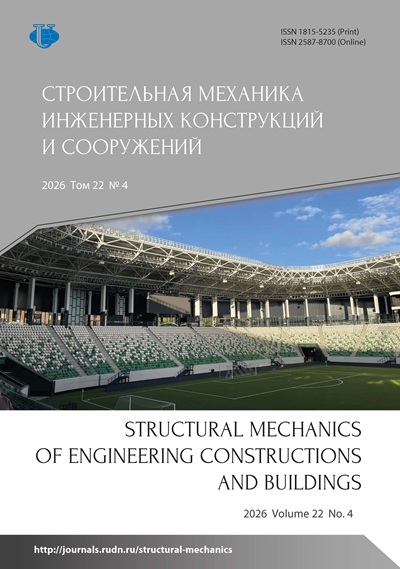
- Year: 2026
- Articles: 8
- URL: https://journals.rudn.ru/structural-mechanics/issue/view/2195
- DOI: https://doi.org/10.22363/1815-5235-2026-22-4
Full Issue

Analytical and numerical methods of analysis of structures
Finite Element Modeling of Dynamic Deformation of Bidirectional Functionally Graded Beams
Abstract
This article presents a finite element algorithm for the numerical solution of boundary value problems for the deformation state of elastic beams made of functionally graded materials. The presented algorithm assumes that the density and elastic properties of the beam depend on the coordinates of the cross-section and on the coordinate along the longitudinal axis. The presented formulation allows to solve static and dynamic problems. The Euler-Bernoulli model and the third-order Reddy model are used to describe the deformation state of the beam. The beam finite element utilizes a Hermitian approximation. Using Hamilton's variational principle, the beam equation of motion is obtained in matrix form. The numerical implementation of the resulting finite element algorithm is carried out in Python using the Numpy and Scipy libraries. As an example, a numerical analysis of the solution to the problem of the natural frequencies of vibrations of a bidirectional functionally graded cantilever beam is performed. The numerical convergence and reliability of the obtained solutions are demonstrated. The possibility of coupling of the longitudinal and transverse vibrations of a beam is demonstrated for certain distributions of the physical properties of the material in the beam’s cross-section. It is shown that distributing the material properties along the longitudinal axis improves the beam’s dynamic properties.
 317-330


Energy Concept of the Force Resistance of Elements of Reinforced Concrete Structures
Abstract
A material (concrete, steel, wood, plastic) is formed by combining its fractions as a result of their mass and energy exchange with the environment. This synergetic process entails the accumulation of energy in a unit volume of the material, binding the fractions into a single whole and being its specific energy of integrity. The failure of a material in the energy aspect represents the reverse process to the formation of its integral structure - the depletion of the integrity energy. The issues of calculating reinforced concrete structures are related to the strength of concrete and steel, the dynamics of which, in order to assess the current and long-term life of the mechanical resistance of reinforced concrete elements, is essential in predicting the safety and survivability of these structures. Based on the concept of integrity energy as a parameter of the energy state of the material, the article identifies estimates of the long-term strength and bending bearing capacity of concrete elements and an energy assessment of the structural safety of reinforced concrete frames. The proposed approach is related to the dissipation of integrity energy under mechanical loads and environmental exposure.
331-347
Comparative Analysis of Linear and Nonlinear Calculation of the Load-Bearing Capacity of Reinforced Concrete Frames in Multi-Storey Buildings
Abstract
Reinforced concrete frame systems are widely used in multi-storey residential and public buildings due to their structural efficiency, durability, fire resistance, and architectural flexibility. However, increasing building height, longer spans, complex planning solutions, and stricter serviceability requirements make structural behavior increasingly sensitive to cracking, stiffness degradation and second-order effects, and a purely linear analysis may no longer adequately describe the real behavior of the system. This study presents a comparative analysis of linear and nonlinear calculations of an RC multi-storey frame. Three parametric models with heights of 36 m, 75 m, and 102 m (12, 25, and 34 storeys) with identical plan dimensions of 18×18 m were analyzed using LIRA-SAPR 2024 (Commercial License), Commercial License using five analysis variants: linear with initial stiffness, linear with code-recommended stiffness reduction, physically nonlinear, geometrically nonlinear and combined (physical + geometric) nonlinear. Structural response was evaluated in terms of internal forces, slab force redistribution, lateral displacements, and serviceability deflections. The results demonstrated that the influence of nonlinear effects increased with building height and structural flexibility. Physical nonlinearity associated with crack-induced stiffness degradation was identified as the dominant source of variation between linear and nonlinear analyses, while geometric nonlinearity became increasingly significant when combined with second-order (P-Δ) effects. Combined nonlinear analysis produced substantial redistribution of internal forces, with support slab moments decreasing by 33-89% and significant changes observed in column forces and lateral displacements. The findings highlight the importance of accounting for both material and geometric nonlinearities in the analysis of medium- and high-rise RC frame-core buildings and provide practical recommendations regarding the selection of appropriate analysis methods for structural design.
348-367
Nonlinear Layered Formulation: Modeling Reinforced Concrete Semi-Precast Slabs
Abstract
Semi-precast reinforced concrete slab systems enhance construction efficiency by substantially reducing on-site formwork. Construction involves two primary phases: (1) off-site fabrication of semi-precast components and (2) on-site casting of a concrete topping. The interfacial bond strength between the precast base and the cast-in-place overlay is a critical factor governing the composite system's performance. This study presents a comprehensive numerical investigation to evaluate the effect of surface treatment techniques on the flexural behavior of semi-precast RC slabs. A novel six-node triangular layered finite element approach is developed, incorporating material nonlinearity through an enhanced global-local plate formulation. The method employs a cross-sectional discretization strategy, decomposing the slab into distinct material layers where concrete and steel are modeled as discrete plate elements with individual constitutive laws. The computational framework utilizes a decoupled treatment of displacement fields and transverse stresses, facilitating accurate nodal stress evaluation via integrated constitutive models. Spatial discretization is achieved using a C ¹-continuous six-node triangular element, with governing equations derived from a partially mixed variation principle. Validation through benchmark cases demonstrates the method’s robustness, with ultimate deflection errors below 4.68% and reaching 0.5% accuracy in optimal scenarios. The proposed triangular layered finite element method achieves superior accuracy and computational efficiency compared to conventional approaches.
368-382
Effect of Geometric Defects on the Service Life of Cylindrical Tanks Made of Aluminium Alloys2
Abstract
The development of resources in the Far North must be accompanied by the establishment of infrastructure for their storage and transport (tanks, gas holders, pipelines). The use of steel for the construction of tanks in low-temperature operating conditions is not always advisable, due to the presence of a cold-shortness threshold and its shift over time towards positive temperatures. As an alternative, the authors propose the use of aluminium alloys, which offer advantages in low-temperature operating conditions. The most cost-effective and technologically advanced method of tank construction has been selected - the coil-forming method, in which the majority of welded joints are pre-fabricated under quality control. However, defects may arise at the construction site during the execution of field welds, which reduce the service life of the welded joints. The number of cycles required for crack initiation in welded joints of a tank wall with defects in the form of angular and linear misalignment of the plate sections has been determined. Analytical calculations were performed based on the results of finite element modelling of the tank and of tank wall fragments with defects. The stress state of the wall fragment models was reduced to the stress state of a tank wall region. Calculations for fragments with defects were performed taking into account geometric and physical non-linearity. The proposed approach enables the service life of joints to be assessed and facilitates the planning of inspections, strengthening, or repair and restoration work.
383-398
Analysis and design of building structures
Methods of Reducing Stress in the Ribs of a Ribbed-Ring Dome in Case of an Accidental Situation
Abstract
Through a review of Russian and international scientific literature, this study investigates potential methods for controlling stress distribution in various structural systems and evaluates their applicability to steel ribbed-ring domes in case of accidental situations involving the failure of a support node. Numerical simulations of the ribbed-ring dome were conducted across various problem settings to account for progressive collapse triggered by the localized failure of a supporting element. These simulations encompass linear static, nonlinear quasi-static, and nonlinear dynamic analyses. Based on the computational results, conclusions are drawn regarding the patterns of stress redistribution within the structural system and the subsequent collapse scenarios of the dome. Furthermore, a comparative analysis was performed on numerical models of the ribbed-ring dome with a damaged support node, alongside models incorporating various techniques for stress distribution control. The efficacy of these techniques in controlling the stress distribution in dome structures under accidental situations was rigorously evaluated. Finally, based on the numerical analysis and through a comparative evaluation of the stress distributions across different configurations equipped with force distribution control systems, a mechanism for the adaptive action of the dome roof system is proposed. This mechanism allows for a tolerable degree of localized damage while preserving the integrity of the load-bearing frame and preventing subsequent progressive collapse.
399-414
Dynamics of structures and buildings
Analysis of the Effectiveness of Friction Dampers in Multi-Storey Buildings with Varying Intensity of Seismic Impacts
Abstract
A numerical study of the dynamic response of a structural frame equipped with an additional damping system under seismic impacts with an intensity of 3 to 9 is presented. The study compares peak displacements and accelerations at the upper floor level for the basic configuration and the configuration with dampers. The results show that the installation of damping devices leads to a significant reduction in peak horizontal displacements: by 40.5% at low intensity and by more than 53% at an extreme seismic load of intensity 9. In addition, the analysis of accelerograms over time shows that the damping system effectively suppresses high-frequency residual vibrations and the effects of “beats” characteristic of an unprotected structure. A friction-type mechanical device is considered. An important conclusion of the study is that the damped structure under an extreme impact of intensity 9 demonstrates a reaction comparable to an unprotected frame under a moderate impact of intensity 5. It was found that the energy dissipative ability of the system ensures a rapid transition from forced to damped vibrations within 12-14 seconds in all tested scenarios. The results obtained confirm the effectiveness and reliability of the proposed damping solution in reducing dynamic loads and preventing structural fatigue during severe seismic events.
415-430
Experimental researches
The Graphical Method of Design for Flexural Members Using the SP 16.13330.2017 Standard
Abstract
The objective of this paper is to propose the graphical design method for doubly symmetric steel beam section under flexural load compliant to the latest draft of the SP 16.13330.2017 standard. There are different design approaches for steel structures, including manual calculation, computer programs and hybrid methods which are used in different design standards for calculating allowable strength of flexural members. The graphical approach is commonly used in American Institute of Steel Construction as an alternative method and aims in improving the design efficiency for elastic and inelastic flexural members. The current method is intended to design flexural members according to the Russian design standards of the steel construction (SP 16.13330.2017) for steel sections commonly used, and available in the Russian Federation. The results consist of graphical demonstration of the relationships between the nominal flexural strength and the effective member length for various crosssectional sizes. Using this graphical method to design flexural members can help the designer to select the optimum steel sections, furthermore it will be more helpful to the steel manufacturer to recommend more new Russian steel sections to narrow the gaps between the consecutive section dimensions. With the increasing demands of slender members, the graphical approach is a quick method of design for engineers and researchers to select an optimum steel beam section. In addition, this paper provides a practical example which confirms the efficiency and simplicity of designing a flexural member using this method.
431-441