




 Email this article
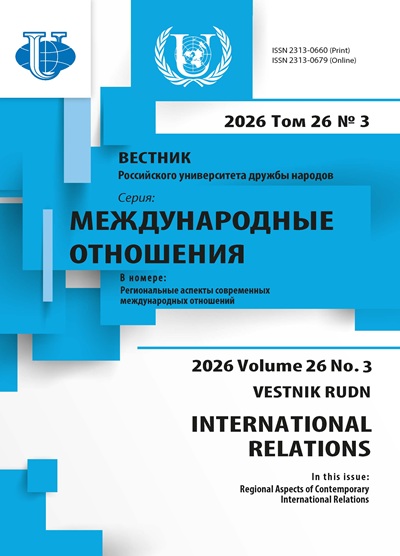
The Taliban and the West: Mutual Perceptions in the Emerging New World Order
- Authors: Machitidze G.G.1
-
Affiliations:
- MGIMO University
- Issue: Vol 26, No 3 (2026): Regional Aspects of Contemporary International Relations
- Pages: 593-606
- Section: BILATERIAL RELATIONS
- URL: https://journals.rudn.ru/international-relations/article/view/52878
- DOI: https://doi.org/10.22363/2313-0660-2026-26-3-593-606
- EDN: https://elibrary.ru/GUDUCR
- ID: 52878
Cite item

Abstract
In the context of the emerging new world order, states such as the Islamic Emirate of Afghanistan (IEA) strive to act within the framework of international law, maintaining a balance of interests based on the sovereign equality of states and the indivisibility of security. The Taliban regime’s positive attitude toward multipolarity and its struggle against Western efforts to complicate and hinder the development of Afghanistan are also important for preserving Afghanistan’s cultural and civilizational identity. In this regard, the objective was to determine how the Afghan theocratic regime and the West perceive each other, which is important for the IEA’s international recognition and its further development as a sovereign state. The study draws on historical descriptive and analytical methods such as comparative data analysis and qualitative content analysis. The results revealed several contradictory aspects of the West’s position on the IEA, particularly the United States’ violation of its previously assumed commitments under the 2020 Doha agreement. However, despite its continued distrust of Western policy and acute sensitivity to Western criticism, the Taliban has not abandoned its engagement with the West. The study argues that Western officials are generally taking a hardline stance toward the Taliban and expanding their demands (including effectively combating terrorist threats, changing social policies, forming an inclusive government, and ensuring financial transparency), making the beginning of the process of international recognition for the Kabul regime contingent on the fulfillment of these demands. At the same time, it notes the emergence of signs among some Western elites indicating a desire to establish interaction with Kabul. This is due to factors such as the Taliban’s provision of relative security and the absence of an effective armed opposition in the country, the IEA leadership’s efforts to combat corruption and drug trafficking, and the recognition that isolating the Afghan regime has failed. The author concludes that fundamental political transformation should not be expected in a country where the regime has become entrenched and enjoys the support of the majority of the population. Instead, the most optimal approach could be to focus on economic development and addressing the urgent needs of Afghan citizens.
Full Text
Introduction
The foundation of the modern world order is based on certain principles of international law[1] and not on the Western-invented[2] “rules-based international order,” which presupposes the legalization of practices of interaction in global politics that are advantageous to the West and used as an instrument of political pressure. Therefore, states of the Global South strive to act within the framework of international law, maintaining a “balance of interests based on the sovereign equality of states and the indivisibility of security” (Lavrov, 2023). In this regard, it is clear that the transition from a liberal to a more just new world order could also contribute to strengthening the sovereignty of the Islamic Emirate of Afghanistan (IEA), especially since the formation of stabilization mechanisms in Eurasia, the largest continent in terms of area and population, as the authors of the report by the Valdai International Discussion Club write,[3] will undoubtedly affect Afghanistan, which should be included in the process of creating a Eurasian system of security cooperation.
The Taliban, who have been in power in Afghanistan since 2021, clearly understand that in the modern world there is no room for the monopoly of individual powers that seek to impose their own rules of the game on others. As IEA Foreign Minister Amir Khan Muttaqi stated, “The world order is moving from a unipolar system to a new structure in which globalization faces resistance, and regional and cultural identities are becoming increasingly important.”[4]
Unlike some Middle Eastern states, such as Iran and Saudi Arabia, which seek regional leadership (Chikrizova & Ivkina, 2023, p. 88), Afghanistan is not in a position to pursue similar goals. Kabul advocates for the sovereign equality of states and strives to maximize its independence in developing and making domestic and foreign policy decisions. The principle of non-interference in Afghanistan’s internal affairs also forms the basis of the 2020 agreement between the United States and the Taliban, signed in Doha, Qatar.[5] Firmly defending its national interests, the de facto Taliban government is increasing its demands on partners in both the West and the East. Kabul prefers a flexible balancing approach that does not involve forming stable alliances. The Taliban is quite satisfied with a multipolar world order, in which underdeveloped states like Afghanistan can rely on various external powers. The Taliban, having observer status in the Shanghai Cooperation Organization (SCO), have expressed the willingness to allow Afghanistan to join BRICS as an observer, a symbol of the emergence of democratic multipolarity.[6] The Taliban’s positive attitude towards multipolarity and the fight against the West’s desire to complicate and slow down the development of Afghanistan are also important from the point of view of preserving the Afghan cultural and civilizational identity. The presence of a strong central government in Kabul can help limit the threats posed by Western subversion in Eurasia.[7]
This study analyzes the issue of mutual perception[8] of the de facto Taliban government in the IEA and the West. The relevance of the research topic stems from the need to form stabilization mechanisms in the Eurasian region, with Afghanistan at the center. The purpose of the study is to identify the factors influencing the formation of the image of the West by the Taliban and the image of the Taliban in the West, as well as to determine the coincidences and divergences in their ideas that influence the formation of the political strategies towards each other. Stereotyping (Lippmann, 1922) of these images is understood in light of the emerging signs of the need to strengthen interaction between the world community and Afghanistan, as well as in the context of the emerging new world order. Such Russian researchers as A.A. Knyazev (2023), O.N. Novikova (2022) and M.A. Konarovsky (2025) draw attention to the stereotypes regarding the Taliban. When assessing the West’s misunderstanding of the Pashtun ethnoreligious identity, it is important to consider the scientific works of V.Ya. Belokrenitsky (2022), Yu.P. Laletin (2024), M.O. Nessar, U.V. Okimbekov, and S. Poya (Nessar, Okimbekov & Poya, 2025).
The chronological scope of the study is limited to 2020–2024.
The study relies on historical descriptive and analytical methods, including comparative data analysis, which helped identify contradictions in the positions of Western countries.
The applied methodology allows us to substantiate the hypothesis that fundamental political transformations should not be expected in a state where the regime has become entrenched and enjoys the support of the majority of the population. An approach based on adequate mutual understanding is proposed as the most optimal development path for Afghanistan, with the goal of strengthening the Afghan economy and meeting the urgent needs of its citizens.
Peculiarities of the Taliban’s Perception of the West
While international attention is currently focused on conflicts in Ukraine and the Middle East, the issue of mutual perceptions between the Taliban and the West remains relevant amid discussions about the international community’s future engagement with the Afghan government. Located in the center of Eurasia, the country remains a key factor in regional security. Over the past four years since the Taliban came to power in Afghanistan, following numerous meetings and negotiations with Western representatives, a certain sense of disappointment and skepticism has emerged in Kabul over the lack of progress toward international recognition of the regime.[9] As Russian academics V.G. Baranovsky and V.V. Naumkin rightly note, in the Islamized countries of the “Greater Middle East,” the population may hold varying attitudes toward democracy, but “is united in their negative attitude toward the West” (Baranovsky & Naumkin, 2018a). Indeed, among the rural and, to some extent, urban populations of Afghanistan, “wariness regarding cultural and religious costs that could lead to the loss of societal identity has traditionally persisted” (Machitidze, 2024a).
The Taliban’s initial mistrust of the United States and its partners stems from Washington’s failure, as they believe, to comply with the terms of the Doha Agreement, which Kabul views as the primary document regulating relations with the United States and its Western allies. In accordance with the agreement’s secret annexes, the Taliban, unlike the United States, strictly adhered to agreements not to attack American troops during their redeployment from forward operating bases in Bagram.[10] At the same time, within 14 months after the signing of the agreement, according to the Taliban, the United States violated it 1,700 times, including air raids on rebel positions..[11] The Taliban believe that intra-Afghan negotiations have been ineffective due to the obstructionist stance of the Western-backed Afghan government, particularly President Ashraf Ghani. This is also confirmed by former US Secretary of Defense M.T. Esper.[12] Numerous violations of the Doha agreement by the Americans were also attested to in an interview with former Taliban spokesman Zabihullah Mujahid.[13]
A number of official representatives of the Islamic Emirate of Afghanistan remain under sanctions, despite American promises to lift them by August 27, 2020, in cooperation with other members of the UN Security Council.[14] Furthermore, foreign troops were withdrawn from Afghanistan later: instead of the originally planned date of May 1, they left the country on August 31, 2021. According to the Doha agreement, the United States also committed to refraining from the threat or use of force against the territorial integrity of Afghanistan, a commitment that was effectively violated in 2022 with the drone strike of al-Qaeda[15] leader Ayman al-Zawahiri in Kabul. Despite this, no terrorist attacks against the United States or its allies were carried out from Afghan territory. Moreover, American drone flights in Afghan airspace continue, which the Taliban perceive as a sign of Washington’s bad faith and a means of pressuring Kabul. The freezing of funds from the National Bank of Afghanistan is also viewed by the Taliban as a violation of the spirit of the Doha agreement. In an interview with the German magazine Der Spiegel, Anas Haqqani[16] condemned US sanctions against the IEA, equating them with collective punishment of the Afghan people.[17]
The Taliban are extremely sensitive to Western moves that fail to take Kabul’s interests into account. In particular, Kabul perceived the creation of the position of coordinator of the UN Special Assessment Mission on Afghanistan as a humiliation. This mistrust was also evident during the attempt to organize the so-called “Doha II” meeting on February 18, 2024, when special envoys for Afghanistan gathered to discuss the report prepared by UN Special Coordinator Feridun Sinirlioğlu. The Taliban also opposed the participation of Afghan civil society representatives in the meeting alongside the IEA delegation.[18]
The Taliban have always been sensitive to public criticism. Western pressure on them regarding gender policy has been particularly irritating for Afghan ultra-conservatives, led by Supreme Leader Heibatullah Akhundzada, who refuse to discuss their domestic policies, governed by Sharia law within the institutionalized version of the Taliban’s understanding of Islam, with foreign governments. In response to the International Criminal Court’s January 2025 decision to issue arrest warrants for senior IEA leaders “for persecuting women and girls,” Supreme Leader Heibatullah Akhundzada stated that “Muslims should not succumb to Western warnings and promised to make every effort to preserve the Islamic system.”[19]
Even some foreign experts of Muslim origin, while acknowledging the Taliban’s gender policy as unjustified, criticize the Western perceptions of Afghan women as subjugated and lacking autonomy, mistakenly assuming that Afghan women should resemble Western feminists. They emphasize that Afghan culture is dominated by communal and group identities, especially in rural areas. Often overcoming the difficulties created by the Taliban regime and widespread poverty, Afghan women try to provide mutual support. For example, in secret home schools, women study not only the Qurʻan, but also foreign languages, biology, and chemistry to a certain extent, and acquire knowledge of sewing, hairdressing, and cooking (Azimi, 2024). Despite the fact that in April 2023 the IEA banned women from working in local UN structures, not a single woman was fired and even new employees were hired under a behind-the-scenes agreement with the Taliban authorities.[20] In this regard, it’s impossible not to notice that the Taliban are not opposed to advice in principle, but try to separate the advice of friends in China, Qatar, and the United Arab Emirates, some of whom the Taliban are willing to heed, from the advice of their enemies, particularly on issues of human rights and freedoms, especially when these rights are routinely violated in the Middle East.
This also applies, to a slightly different extent, to the issue of forming a government based on the principle of inclusiveness. The Taliban argue that the international community lacks a clear definition of what an inclusive government should look like. Thus far, no one has determined what it should look like in Afghanistan—whether it should resemble the “façade democracy” under former presidents Hamid Karzai and Ashraf Ghani, or something entirely different.[21] The Taliban also remind Western officials of how all supporters of the movement, which is now leading the IAE, were dismissed from the Afghan government in the early 2000s. At the same time, the Taliban government retained most of the officials from the previous regime, replacing only the top-level leaders. Officials’ salaries are also being paid on time.[22]
At the same time, the ongoing pressure from the international community on Kabul regarding the issue of inclusiveness is contributing to the emergence of different points of view within the Taliban—from rejection of interference in the country’s internal affairs to denial of the intention to discriminate against any ethnic group and complete non-recognition of the existence of this problem.[23] The Taliban counter Western criticism of the authoritarian nature of the Afghan regime by arguing that most countries in the region are ruled by authoritarian governments, which are often also not inclusive. Meanwhile, ultra-conservatives, unlike the pragmatists in the country’s leadership, stubbornly believe that the Taliban can only achieve international recognition in the difficult dialogue with the West by demonstrating firmness, which will allow them to impose their line of conduct. In this regard, the head of the Penitentiary Commission, Nureddin Torabi, categorically stated that the new authorities in Afghanistan will “follow Islam and establish their laws based on the Quran” (Kicha, 2024). Generally, the Taliban believe that external advice should be confidential and not be presented as public moralizing, which could offend those it is directed towards.
The Taliban are also irritated by the West’s failure to appreciate their main achievements—providing basic security in the country after the end of a 20-year war and preventing the collapse of the Afghan state.[24] The new authorities managed to take control of the territories outside the urban centers, establishing strong ties with rural communities.[25] Moreover, the Taliban have no doubt that their regime possesses internal legitimacy, a key source of which has been their ability to mediate disputes between rural communities in the territories they controlled over the past nearly 20 years (Weigand, 2017). The Taliban’s acute sensitivity to Western criticism also stems from the competition between pragmatists and ultra-conservatives within the Afghan theocratic state over the direction of domestic and foreign policy. Several prominent members of the Afghan government periodically question the Supreme Leader’s policies, but are reluctant to break with him for fear of undermining the unity of their ranks (Weinbaum, 2025). Although EIA Economy Minister Din Mohammad Hanif welcomed humanitarian aid from the European Union, he believes that it is preferable to act in coordination with the Afghan side on this issue.[26] Speaking during a sermon on the occasion of Eid al-Fitr in March 2025, H. Akhundzada rejected Western democracy and suggested relying on Afghanistan’s own Islamic laws.[27] As A.A. Knyazev rightly notes, the confessional factor has come to the forefront in the IEA’s policy (Knyazev, 2024).
However, this does not mean that the Taliban have abandoned cooperation with the West. Moreover, the Taliban are impressed by the West’s recognition of certain positive trends in the Afghan economy.[28] Despite the ultra-conservatives’ denial of the need for external support, the Taliban still sees complete independence from Western, particularly American, dependence as impossible.
How Does the West Perceive the Taliban?
For 20 years (2002–2021), the West unsuccessfully sought to achieve lasting peace in Afghanistan and organize state-building based on liberal democratic ideas (Novikova, 2023, p. 227). Currently, after this failed attempt, the West perceives the new state entity in Afghanistan as a theocratic state led by an ultra-conservative Pashtun clergy that uses authoritarian methods to govern the country. According to V.G. Baranovsky and V.V. Naumkin, it can be argued that the Afghan authorities are attempting to achieve harmony in the country by using Sharia law as a pan-Afghan ideology, “legal system, and behavioral imperative” (Baranovsky & Naumkin, 2018b, p. 11). The Taliban movement is characterized by Western representatives as a nationalist Afghan movement that completely abstracts itself from the ideas of a “pan-Islamic caliphate.”[29] True, in some Western European countries, there are discussions about changing the regime in the country and even calls for active support for the anti-Taliban opposition.[30] In others, on the contrary, they would prefer not to mention Afghanistan at all. The West firmly insists on Kabul fulfilling its demands for a more effective fight against terrorist threats, changes in the regime’s social policies and the creation of an inclusive government, to which, especially in recent months, has been added the demand for financial transparency in the spending of funds from external donors and fiscal policy in general.[31] Fulfillment of the mentioned requirements is firmly linked to the beginning of the process of international recognition of the IEA, however, it is unknown how long it will last and whether new obstacles will appear along this path.
At the same time, it should be kept in mind that the West has always believed that the Taliban movement is committed to a radical Islamist ideology and has maintained relations with militant groups (Jones, 2020). Despite this, the West expects the Taliban to sever all contacts with transnational terrorist organizations and prevent them from using Afghan territory against other states. The West is also concerned about the possible access of terrorist groups based in Afghanistan to large quantities of American weapons held by the Afghan authorities.[32]
In response, the Taliban have developed a specific modus operandi for addressing Western concerns about the presence of armed extremist groups in Afghanistan. Kabul does not physically eliminate militants from these organizations, but rather strictly controls their activities and ensures that they do not defect to ISIS[33]-Khorasan, transferring them from one province to another, facilitating their establishment in new locations, and disrupting their command structures. The only exception is the Pakistani Taliban, based in the eastern provinces of Afghanistan as part of Tehrik-e Taliban Pakistan. Kabul believes it has the right to do so in retaliation for Islamabad’s alleged provision of sanctuary to terrorists from ISIS-Khorasan, a group that is banned in Russia.[34]
Another issue that irritates the West is the human rights situation in Afghanistan, particularly with regard to girls’ secondary education, women’s employment, and the treatment of ethnic minorities. The Taliban have stated the US is constantly pressuring them on these issues.[35] However, Afghanistan’s Islamist leadership cites the Qurʻan and Sharia, which they have always perceived as a kind of constitution (Sikoev, 2002). These gender policy decisions are made within a narrow circle of ultra-conservative members of the religious council (shura) through a set of policy documents known as “Dostur.”[36] It should be noted that such a gender policy is highly unpopular among the pragmatic elements of the Islamic Emirate’s ruling circles. However, they cannot oppose the Supreme Leader for political and ideological reasons and to maintain unity within their ranks. Furthermore, the violation of women’s rights and the harsher attitude toward the Shiʻa Hazara community, which has emerged over the past year, are explained by Kabul’s desire to counter the key elements of the anti-Taliban propaganda of ISIS-Khorasan, which is banned in Russia.[37]
The third concern for Western countries is the composition of the Islamic Emirate’s government, which is not yet inclusive. In other words, the government is being formed on a broad basis, including representation from various ethnic, religious, and political groups. However, Western demands to revisit this issue are viewed in Kabul as interference in the Islamic Emirate’s internal affairs. The Taliban opposes the inclusion of representatives of parties and movements in the interim government, but are willing to attract independent representatives from various ethnic communities. As evidence, the Taliban cite the appointment of five deputy ministers with unconfirmed ties to the Taliban, as well as two ministers with previous ties to the Taliban.[38]
A relatively new problem in relations between the West and Kabul is the lack of information about the financial transparency of the regime’s spending. This concerns both potential ‘leaks’ from external donors and the transformation of the Islamic Emirate’s budget into a ‘black box.’ From September 2021 to May 2023, the influx of external donor funds into Afghanistan through the UN Assistance Mission in Afghanistan (UNAMA) and international non-governmental organizations (NGOs) amounted to almost USD 3 billion.[39] The US and Europe believe the Taliban interferes in humanitarian operations by accessing NGO budgets, collecting taxes and fees from NGO staff for security, and taxing Afghans who receive humanitarian aid, including through harassment and threats. The regime fails to publicly report on spending on healthcare, education, and food. There are also no criteria for awarding government contracts or issuing licenses.[40] The West’s interest in the Taliban’s spending on intelligence and law enforcement agencies stems from its desire to accuse the Taliban of partially diverting humanitarian aid from external donors for these purposes.
In general, the West labels the Kabul regime a theocratic, authoritarian ‘kleptocracy’ due to its “misuse of public funds and humanitarian aid, informal and illicit profits, and extensive tax networks to consolidate control over the country’s resources” in the interests of the ruling elite.[41] This is one reason why, against the backdrop of other global conflicts, major donors are growing fatigued with Afghanistan’s problems. The United States, Great Britain, Germany, and the European Union have significantly reduced their humanitarian aid to Afghanistan,[42] especially since, unlike pragmatists, the regime’s ultra-conservative ruling circles are convinced that international recognition can only be achieved by showing steadfastness and preventing foreign states from interfering in Afghanistan’s internal affairs. It seems that relations between the main Western players and Afghanistan have reached a dead end for the aforementioned reasons, but the situation is not entirely clear-cut.
The West’s Cautious Attempts to Engage with the Taliban
Western countries’ attitudes toward the nature of their engagement with Kabul are not uniform. It appears, in no small part due to the positions of Russia, China, and other regional states, that some Western establishments have begun to acknowledge the need to increase their engagement with the Taliban, albeit while refraining from officially recognizing the regime. In particular, the dominant view in the West has become one of “calibrated engagement with the Taliban to provide humanitarian aid and limited economic support without any strings attached” (Machitidze, 2024b). This view is shared by some US congressmen, members of the British Parliament, prominent military officials, and representatives of US and British intelligence agencies.[43]
The arguments in favor of this approach included the Taliban’s provision of relative security and the absence of an effective armed opposition in the country, as well as the IEA leadership’s fight against corruption and drug trafficking. However, the regime’s anti-drug measures created serious socioeconomic problems for millions of farmers who, with no other alternative, made their living by selling opium poppies. The unprecedented surge in primary school enrollment among girls is also praised. In 2023, 36% more girls aged seven to twelve were enrolled in primary school than before the Taliban came to power.[44] It appears that attempts to completely isolate the Taliban regime could only worsen the socioeconomic and humanitarian situation for the Afghan people. Furthermore, the collapse of the Afghan economy will force hundreds of thousands of Afghans to migrate to the West.
This raises questions about the wisdom of delaying engagement with Kabul, particularly for European countries, and how to strengthen the position of those pragmatists in the country’s leadership, who are committed to maintaining beneficial relations with the West for the sake of the IEA’s economic development, especially since the West has no doubt that many government decisions are made not only for ideological reasons but also due to internal rivalries within the Afghan ruling circles. In this regard, various positive signals could have a positive impact on Kabul. In particular, assistance in allowing international banks to process payments from Afghanistan could help attract foreign investment to the country.[45] In the same vein, one can consider the White House’s positive assessment of the activities of the IEA security bloc in containing ISIS (banned in Russia) and other foreign jihadists.[46] Also significant is the World Bank’s decision to release funds for development in Afghanistan,[47] which the Taliban see as a potential confidence-building measure.
The growing number of supporters of the idea of strengthening Western engagement with Kabul is also driven by concerns over the perceived strengthening of China and Russia’s influence on the IEA leadership. At the same time, internal and external challenges, coupled with Beijing and Moscow’s restrained approach to deepening relations with Afghanistan, have led to the expansion of Taliban ties with the West. The de facto IEA government’s attempts to demonstrate diplomatic flexibility, balancing between various global power centers, are also explained by international uncertainty in the context of the emerging new world order, but with due regard for its own national interests. The West also recognizes that on certain issues, it is easier to reach agreement with the Taliban authorities in the provinces, given the lobbying efforts of NGOs, tribal leaders, and local elders. It appears that communicating information to local authorities in a non-intrusive manner is more effective than threats and ultimatums.[48]
The West continues to search for an acceptable middle ground between cooperating with the Islamic Emirate to develop and provide humanitarian aid to the Afghan people and isolating the country internationally. Clearly, isolating the Afghan regime has failed. Furthermore, the West must reckon with the fact that for 20 years before the Taliban came to power, all fateful government decisions in Afghanistan were made by foreigners. Over the past three to four years, the Taliban regime has grown stronger, and with external influence in Kabul significantly diminishing, the West is forced to find a balance between popular support and pressure on the regime, resort to selective engagement, and explore ways to achieve at least a relative normalization of relations with the Islamic Emirate. However, Western ruling elites are concerned that actively involving Afghanistan in regional cooperation could ease international pressure on Kabul. Officials in the US and its closest allies in Europe are convinced that the Taliban must adhere to international norms if they expect to receive international recognition and financial assistance for the country’s development.[49] Moreover, they call for every effort to demonstrate the Taliban’s misconceptions about the West and to combat the Afghan regime’s determination to maintain a theocratic model of governance, pushing Kabul toward a more accommodating stance of political pragmatism. However, the Taliban are making it clear to their opponents that they are quite content with an authoritarian regime. Therefore, even if there is progress on the gender issue, development assistance to Afghanistan will in any case be limited and will not reach the levels typical of the period before 2021.[50]
There is undeniable consensus within the international community on the need to thoroughly address human rights violations in Afghanistan. However, at the same time, socioeconomic problems cannot be ignored, particularly for women in Afghan society, who are more dependent on ongoing targeted humanitarian aid and small-scale private sector development projects. Advocates for increased engagement with the Kabul regime are confident that the population’s well-being should not depend on the Taliban’s human rights policies. Some hopes are also placed on the revival of the private sector to achieve economic stability in the absence of regular cash flows and humanitarian aid. Funding for humanitarian aid has been cut by 80% by 2024, leading to calls to shift from short-term humanitarian to long-term development assistance, ultimately making Afghanistan economically self-sufficient.[51]
Conclusion
The comparative analysis conducted in this study suggests that each side uses its own, conflicting narratives to explain and interpret certain events, which form the basis for certain political attitudes. Moreover, the mutual perceptions of the West and the Taliban remain inconsistent, stemming from political, cultural, and religious differences.
In the context of the emerging world order, the West’s perception of the Islamic Emirate of Afghanistan, a state in the Global South, is effectively distorted. Resisting the onset of the new world order, the West persists in its attempts to impose its notion of a “correct” political system on Afghanistan, ignoring the country’s cultural and religious traditions. Therefore, the West’s perception of Afghanistan as a state that must conform to Western “universal” values is unrealistic.
As for the Taliban’s perception of the West, the author believes it is more accurate. Countries in the Global South are seeking to resist efforts to maintain a unipolar world dominated by the West, which threatens their sovereign development. The West’s desire to create a global transnational community clashes with Afghanistan’s ideology and policies, which seek to preserve its identity based on its understanding of Islamic values.
At the same time, it appears that the Islamist leadership of the IEA is juggling its political capital, combining a hardline approach to religious and ideological issues related to endogenous factors with a deterministic pragmatism regarding national economic development. The Taliban’s contacts with the West are primarily tactical in nature, aimed at resolving financial and socioeconomic difficulties. Furthermore, the Taliban fear that even if they establish cooperation with the US and its allies, the process of international recognition could be protracted. The West will try to squeeze as many concessions as possible from the Taliban, and with each concession, its demands could escalate. To achieve a more adequate mutual perception, Western officials must decide for themselves whether the Afghan regime represents a threat that must be neutralized, or whether the Taliban are an inevitable partner in regional stability. Amid international turbulence due to the conflicts in Ukraine and Gaza, as well as growing tensions in Syria, the global community cannot afford another failed state in the Greater Middle East, and isolating Afghanistan will only make the Taliban more intransigent.
It is clear that fundamental political transformations should not be expected in a state where the regime has consolidated its position and enjoys the support of the majority of the population. Any Western pressure in this direction will be perceived as interference in the internal affairs of the IEA. The most optimal path to cooperation would be an approach based on adequate mutual perception, allowing for a somewhat expanded cooperation with Kabul to achieve specific goals. Closer Western engagement with the Taliban should likely involve addressing the pressing needs of Afghan citizens, ensuring intra-Afghan security, and contributing to regional stability.
1 The principles of international law include: the non-use or threat of use of force, settlement of international disputes by peaceful means; non-interference in matters within the domestic jurisdiction of states; duties of states to cooperate with each other; equality and the right to self-determination of peoples; sovereign equality of states; good faith fulfillment of obligations under international law; inviolability of state borders; territorial integrity of states; respect for human rights and fundamental freedoms.
2 By the term “West,” the author refers to the countries of Western Europe, the United States, and Canada.
3 Barabanov, O.N., Bordachev, T.V., Lukyanov, F.A., Sushentsov, A.A., Timofeev, I.N. The World from the Bottom Up, or Masterpieces of Eurasian Architecture // Report of the Valdai International Discussion Club. November 4, 2024. (In Russian). URL: https://ru.valdaiclub.com/files/49489/ (accessed: 27.11.2024).
4 Speech by IEA—Foreign Minister of the at the 51st OIC Ministerial Meeting // Islamic Emirate of Afghanistan. Ministry of Foreign Affairs. June 22, 2022. URL: https://mfa.gov.af/en/44454 (accessed: 15.09.2025).
5 Agreement for Bringing Peace to Afghanistan Between the Islamic Emirate of Afghanistan Which is Not Recognized by the United States as a State and is Known as the Taliban and the United States of America // United Nations Peacemaker. February 29, 2020. URL: https://peacemaker.un.org/sites/default/files/document/files/2024/05/agreement-bringing-peace-afghanistan-0229202028229.pdf (accessed: 28.11.2024).
6 Kondratieva V. The Taliban Announced Afghanistan’s Readiness to Join BRICS // Lenta.ru. October 22, 2024. (In Russian). URL: https://lenta.ru/news/2024/10/22/taliby-zayavili-o-gotovnosti-prisoedineniya-afganistana-k-briks/ (accessed: 29.11.2024).
7 Bordachev T.V. Afghanistan Showed the West’s Dead-end Path // Russian International Affairs Council. August 15, 2022. (In Russian). URL: https://russiancouncil.ru/analytics-and-comments/comments/afganistan-pokazal-tupikovyy-put zapada/?sphrase_id=163846858 (accessed: 30.11.2024).
8 Mutual perception is a multifaceted and dynamic process that includes both cognitive and emotional aspects, in which people gain information about each other and can, among other things, influence their perceptions of each other, forming the basis for further interaction. See: Rudenok K. The Law of Inadequacy of Mutual Perception in Management Psychology // Psycho Search. March 1, 2020. (In Russian). URL: https://psychosearch.ru/napravleniya/psikhologiya-upravleniya/751-the-law-of-inadequacy-of-mutual-perception (accessed: 28.08.2024).
9 International Crisis Group. Toward a Self-sufficient Afghanistan // Watch List 2024 for the EU. January 30, 2024. URL: https://www.crisisgroup.org/cmt/asia-pacific/afghanistan/toward-self-sufficient-afghanistan (accessed: 21.01.2026).
10 MacArthur Bosack M. Breaking Down the “Agreement for Bringing Peace to Afghanistan” // Parley Policy Initiative. February 20, 2023. URL: https://www.parleypolicy.com/post/breaking-down-the-agreement-for-bringing-peace-to-afghanistan (accessed: 16.09.2025).
11 Samadi N. Muttaqi: US Violated Doha Deal 1700 Times After Signing // TOLO News. March 1, 2024. URL: https://tolonews.com/index.php/afghanistan-187630 (accessed: 30.11.2024).
12 Esper M. T. A Sacred Oath : Memoirs of a Secretary of Defense During Extraordinary Times. New York : Harper Collins Publishers, 2022. P. 230.
13 Interview with Taliban’s Zabihullah Mujahid: Full Transcript // TOLO News. July 12, 2021. URL: https://tolonews.com/afghanistan-173452 (accessed: 30.08.2025).
14 Agreement for Bringing Peace to Afghanistan Between the Islamic Emirate of Afghanistan Which is Not Recognized by the United States as a State and is Known as the Taliban and the United States of America // United Nations Peacemaker. February 29, 2020. URL: https://peacemaker.un.org/sites/default/files/document/files/2024/05/agreement-bringing-peace-afghanistan-0229202028229.pdf (accessed: 28.11.2024).
15 Here and below, reference is made to an organization included in the Unified Federal List of Organizations, including foreign and international organizations, recognized as terrorist in accordance with the legislation of the Russian Federation.
16 Anas Haqqani is the half-brother of IEA Interior Minister Sirajuddin Haqqani. He was arrested in 2014 and released in 2019 in exchange for two American professors, after which he was included in the negotiating team in Doha. He is a key propagandist for the Haqqani network and its ambassador, primarily in the Arab world.
17 Koelbl S. “You Ask Questions Like an Investigator”: Interview with Taliban Leader Anas Haqqani // Der Spiegel. July 8, 2022. URL: https://www.spiegel.de/international/world/der-spiegel-interview-with-taliban-leader-anas-haqqani-you-ask-questions-like-an-investigator-a-da3d8658-fcce-4865-a4f2-91eb3e1aff93 (accessed:29.08.2025).
18 Shapour R. From Doha to Doha: The Contest over a UN Special Envoy Lingers as Discussions and Disagreements Drag on // Afghanistan Analysts Network. March 1, 2024. URL: https://www.afghanistan-analysts.org/en/reports/international-engagement/from-doha-to-doha-the-contest-over-a-un-special-envoy-lingers-as-discussions-and-disagreemenets-drag-on/ (accessed:17.12.2024).
19 Islamic Emirate of Afghanistan’s Supreme Leader ‘Unfazed’ by the West’s Threats // Ariana News. January 28, 2025. URL: https://www.ariananews.af/islamic-emirate-of-afghanistans-supreme-leader-unfazed-by-the-wests-threats/ (accessed:28.08.2025).
20 Is It Time to Recognise the Taliban Government in Afghanistan? // SciencesPo. January 6, 2025. URL: https://www.sciencespo.fr/en/news/is-it-time-to-recognise-the-taliban-government-in-afghanistan/ (accessed: 30.08.2025).
21 Islamic Emirate to Iran FM: Govt Is Inclusive // Tolo News. December 10, 2023. URL: https://tolonews.com/afghanistan-186432 (accessed: 01.12.2024).
22 Afghanistan Economic Monitor // World Bank. October 31, 2023. URL: https://thedocs.worldbank.org/en/doc/2ab75317f6e86c9bb6fcf342f72e0b64-0310012023/original/Afghanistan-Economic-Monitor-31-October-2023.pdf (accessed: 02.12.2024).
23 Islamic Emirate to Iran FM: Govt Is Inclusive // Tolo News. December 10, 2023. URL: https://tolonews.com/afghanistan-186432 (accessed: 01.12.2024).
24 Speech by IEA Foreign Minister Mawlawi Amir Khan Muttaqi at the 6th Moscow Consultations Format // Islamic Emirate of Afghanistan. Ministry of Foreign Affairs. October 4, 2024. URL: https://mfa.gov.af/en/28693 (accessed: 16.09.2025).
25 Jalil H. The Taliban and the Rural-Urban Dividе // Afghanistan Research Network. June 2023. URL: https://peacerep.org/wp-content/uploads/2023/06/ARN-Reflection-11-The-Taliban-and-the-Rural-Urban-Divide.pdf (accessed: 12.06.2025).
26 Hakimi B. A. EU to Provide €75 Million in Aid to Afghanistan // TOLO News. November 15, 2022. URL: https://tolonews.com/afghanistan-180759 (accessed: 29.08.2025).
27 Taliban Leader Says There Is No Need for Western Laws in Afghanistan // AP. March 30, 2025. URL: https://apnews.com/article/afghanistan-taliban-western-laws-sharia-c11444b20fbb6c77d2632fae84435af2 (accessed: 31.08.2025).
28 Afghanistan Economic Monitor // World Bank. October 31, 2024. URL: https://thedocs.worldbank.org/en/doc/6f829bbf7186481f7eb31fbae459de5e-0310012024/original/Afghanistan-Economic-Monitor-October-2024-Final.pdf (accessed: 02.12.2024).
29 Gopal А., Van Linschoten A. S. Ideology in the Afghan Taliban // Afghanistan Analysts Network. June 2017. URL: https://www.afghanistan-analysts.org/wp-content/uploads/2017/06/201705-AGopal-ASvLinschoten-TB-Ideology.pdf (accessed: 14.06.2025).
30 US Congressional Leader Interested in Dialogue with Taliban’s Opposition // Afghanistan International. January 12, 2024. URL: https://www.afintl.com/en/202401127119 (accessed: 04.12.2024).
31 Immenkamp B. The Situation in Afghanistan: Essential Benchmarks for EU Engagement // European Parliamentary Research Service. September 17, 2021. URL: https://www.europarl.europa.eu/thinktank/en/document/EPRS_BRI(2021)698019 (accessed: 16.09.2025).
32 Mehra T., Demuynck M., Wentworth M. Weapons in Afghanistan: The Taliban’s Spoils of War // International Centre for Counter-Terrorism. February 2022. URL: https://icct.nl/sites/default/files/2022-12/The-Spoils-of-War-final-1.pdf (accessed: 13.06.2025).
33 Here and below, reference is made to an organization included in the Unified Federal List of Organizations, including foreign and international organizations, recognized as terrorist in accordance with the legislation of the Russian Federation.
34 Azami D. China, Russia, and Great Power Politics in Afghanistan and Central Asia // Caspian Policy Center. December 1, 2024. URL: https://www.caspianpolicy.org/research/guest-contributions/china-russia-and-great-power-politics-in-afghanistan-and-central-asia (accessed: 06.12.2024).
35 Kabul, Washington Blame Each Other for Doha Deal Violations // Tolo News. March 1, 2023. URL: https://tolonews.com/afghanistan-182290 (accessed: 05.12.2024).
36 Ahmad J. The Taliban’s Religious Roadmap for Afghanistan // Middle East Institute. January 26, 2022. URL: https://mei.edu/publications/talibans-religious-roadmap-afghanistan (accessed: 05.12.2024).
37 Van der Kroft L. Merkova S., Mosadiq H. The Role of Gender in Taliban and IS-K Recruitment: Evolving Trends // RUSI Whitehall Report. October 31, 2023. URL: https://static.rusi.org/role-of-gender-in-taliban-and-is-k-recruitment-rusi-whitehall-report-oct-23.pdf (accessed: 19.12.2025).
38 Khan S. K. Taliban Bring New Faces to Fill Cabinet Positions in Afghanistan // Anadolu Agency. September 21, 2021. URL: https://www.aa.com.tr/en/asia-pacific/taliban-bring-new-faces-to-fill-cabinet-positions-inafghanistan/2370524 (accessed: 05.12.2024).
39 Byrd W. Afghanistan’s Crisis Requires a Coherent, Coordinated International Response // ReliefWeb. May 16, 2023. URL: https://www.usip.org/publications/2023/05/afghanistans-crisis-requires-coherent-coordinated-international-response (accessed: 06.12.2024).
40 After the Aid Axe: Charting a Path to Self-reliance in Afghanistan // International Crisis Group. Asia Report No. 350. October 2, 2025. URL: https://www.crisisgroup.org/sites/default/files/2025-10/350-afghanistan-self-reliance.pdf (accessed: 06.12.2025).
41 Ludwig J., Torres A. Captured State: Corruption and Kleptocracy in Afghanistan Under the Taliban // George W. Bush Institute. February 2024. https://gwbushcenter.imgix.net/wp-content/uploads/GWBI_2024_Corruption-and-Kleptocracy-in-Afghanistan-Under-the-Taliban.pdf (accessed:18.12.2024).
42 Kent L. The UK, Germany and Canada Have Slashed Foreign Aid This Year, Deepening Damage Done by US Cuts, Analysis Shows // CNN. June 12, 2025. URL: https://edition.cnn.com/2025/06/12/europe/foreign-aid-cuts-uk-germany-canada-intl (accessed: 10.05.2026).
43 Afghanistan: UK Government Policy // UK Parliament. House of Commons. January 10, 2024. URL. https://hansard.parliament.uk/Commons/2024-01-10/debates/19F84C7C-9CD8-4297-9F31-903E6B485644/AfghanistanUKGovernmentPolicy (accessed: 07.12.2024).
44 Afghanistan Welfare Monitoring Survey // World Bank. October 3, 2023. URL: https://thedocs.worldbank.org/en/doc/975d25c52634db31c504a2c6bee44d22-0310012023/original/Afghanistan-Welfare-Monitoring-Survey-3.pdf (accessed: 07.12.2024).
45 Afghanistan: UK Government Policy // UK Parliament. House of Commons. January 10, 2024. URL. https://hansard.parliament.uk/Commons/2024-01-10/debates/19F84C7C-9CD8-4297-9F31-903E6B485644/AfghanistanUKGovernmentPolicy (accessed: 07.12.2024).
46 Dawi A. US Firm on Taliban Sanctions as Experts Call for Easing, Normalization // Voice of America. November 14, 2023. URL: https://www.voanews.com/a/us-firm-on-taliban-sanctions-as-experts-call-for-easing-normalization/7354731.html (accessed: 08.12.2024).
47 The World Bank’s Executive Board approved a new approach to supporting Afghanistan, which includes disbursing approximately USD 300 million from the Bank’s International Development Association fund for poor countries through UN agencies and other international organizations. These funds will remain outside the control of the Taliban leadership in Afghanistan and will complement donor funding for the Afghanistan Resilience Trust Fund (ARTF) in support of critical basic services such as food, water, healthcare, education, and jobs. See: Lawder D. World Bank Approves Shift to Channel IDA Funds to Afghanistan Humanitarian Aid // Reuters. February 15, 2024. URL: https://www.reuters.com/world/asia-pacific/world-bank-approves-shift-channel-ida-funds-afghanistan-humanitarian-aid-2024-02-15/ (accessed: 08.12.2024).
48 Mills P. Taliban Governance in Afghanistan // Institute for the Study of War. March 29, 2024. URL: https://understandingwar.org/wp-content/uploads/2025/05/24-210-0220ISW20Afghanistan20Taliban20Paper_v4.pdf (accessed: 21.08.2026).
49 Afghanistan: Vote on Two Draft Resolutions // Security Council Report. March 15, 2023. URL: https://www.securitycouncilreport.org/whatsinblue/2023/03/afghanistan-vote-on-two-draft-resolutions.php (accessed: 09.12.2024).
50 What We Need to Learn: Lessons from Twenty Years of Afghanistan Reconstruction // Special Inspector General for Afghanistan Reconstruction. August 1, 2021. URL: https://www.govinfo.gov/content/pkg/GOVPUB-S-PURL-gpo159506/pdf/GOVPUB-S-PURL-gpo159506.pdf (accessed: 23.12.2024).
51 Smith G. Afghanistan: Three Years after the Taliban Takeover // International Crisis Group. August 14, 2024. URL: https://www.crisisgroup.org/qna/asia-pacific/afghanistan/afghanistan-three-years-after-taliban-takeover (accessed:19.12.2024).
About the authors
Georgy G. Machitidze
MGIMO University
Author for correspondence.
Email: mggkabul@gmail.com
ORCID iD: 0000-0003-2402-1909
SPIN-code: 5094-7995
PhD (History), Senior Research Fellow, Institute of International Studies
76 Vernadsky Avenue, Moscow, 119454, Russian FederationReferences
- Azimi, P. (2024). Decolonizing the Western perception of Afghan women: A feminist critique [thesis]. Lincoln: University of Nebraska. Retrieved from https://digitalcommons.unl.edu/cgi/viewcontent.cgi?article=1716&context=honorstheses
- Baranovsky, V. G., & Naumkin, V. V. (2018a). The Middle East in a changing global context: The key trends of centennial development. World Economy and International Relations, 62(3), 5–19. (In Russian). https://doi.org/10.20542/0131-2227-2018-62-3-5-19; EDN: YTHIDG
- Baranovsky, V. G., & Naumkin, V. V. (2018b). World of faith and world of disbelief: Expansion and reduction of religiosity. Polis. Political Studies, (6), 8–31. (In Russian). https://doi.org/10.17976/jpps/2018.06.02; EDN: YNKEST
- Belokrenitsky, V. Ya. (2022). Pashtuns and Pashtun tribes of Afghanistan and Pakistan: Their quantity and settlement. Vestnik Instituta Vostokovedeniya RAN, (1), 12–24. (In Russian). https://doi.org/10.31696/2618-7302-2022-1-12-24; EDN: AKADKT
- Chikrizova, O. S., & Ivkina, N. V. (2023). The problem of the “Shiʻa Crescent” in the Middle East: A quantitative analysis. Vestnik RUDN. International Relations, 23(1), 88–104. (In Russian). https://doi.org/10.22363/2313-0660-2023-23-1-88-104; EDN: VCNXUU
- Jones, S. G. (2020). Afghanistan’s future emirate? The Taliban and the struggle for Afghanistan. CTC Sentinel, 13(11), 1–10. Retrieved from https://ctc.westpoint.edu/afghanistans-future-emirate-the-taliban-and-the-struggle-for-afghanistan/
- Kicha, M. V. (2024). Afghanistan: The true history of a legendary country. Moscow: Eksmo publ. (In Russian).
- Knyazev, A. A. (2023). On the issue of evolution of Taliban movement in Afghanistan. Comparative Politics Russia, 14(1–2), 79–96. (In Russian). https://doi.org/10.46272/2221-3279-2023-1-2-14-79-96; EDN: WIWQBE
- Knyazev, A. A. (2024). Afghan identity: Prospects for defragmentation. Journal of International Analytics, 15(1), 210–218. (In Russian). https://doi.org/10.46272/2587-8476-2024-15-1-210-218; EDN: SMYMSM
- Konarovsky, M. A. (2025). The road of seven thousand days: Essays on the history and culture of Afghanistan (2nd rev. and enl. ed.). Moscow: MGIMO publ. (In Russian). https://doi.org/10.63861/2952-6; EDN: XHBVKL
- Laletin, Yu. P. (2024). Formation of the political system of the Islamic Emirate of Afghanistan: Challenges and limitations. Asia and Africa Today, (1), 24–32. (In Russian). https://doi.org/10.31857/S032150750026360-8; EDN: SLDBUM
- Lavrov, S. V. (2023). Genuine multilateralism and diplomacy vs. the “rules-based order”. Rossia v Global’noj Politike, 21(4), 72–81. (In Russian). https://doi.org/10.31278/1810-6439-2023-21-4-72-81; EDN: ENZPHO
- Lippmann, W. (1922). Public opinion. New York: Harcourt, Brace & Co.
- Machitidze, G. G. (2024a). The specificity of Afghan identity in the context of globalization. Vestnik RUDN. International Relations, 24(4), 508–519. (In Russian). https://doi.org/10.22363/2313-0660-2024-24-4-508-519; EDN: LSYOBP
- Machitidze, G. G. (2024b). Lessons from the British presence in Afghanistan (2001–2023). Vostok. Afro-Aziatskie Obshchestva: Istoriia i Sovremennost, (3), 81–92. (In Russian). https://doi.org/10.31696/S086919080030924-3; EDN: UTCVHX
- Nessar, M. O., Okimbekov, U. V., & Poya, S. (2025). Afghanistan: The Taliban in power (2021–2025). Moscow: Institute of Oriental Studies of the Russian Academy of Sciences. (In Russian).
- Novikova, O. N. (2022). Britain’s fourth Afghan war. Current Problems of Europe, (4), 213–233. (In Russian). https://doi.org/10.31249/ape/2022.04.09; EDN: WERRGM
- Novikova, O. N. (2023). Afghanistan: From “democratic authoritarianism” to authoritarianism per se. Current Problems of Europe, (1), 223–243. (In Russian). https://doi.org/10.31249/ape/2023.01.10; EDN: OOXJTZ
- Sikoev, P. P. (2002). The Taliban: A religious and political portrait. Moscow: IV RAN publ. (In Russian).
- Weigand, F. (2017). Afghanistan’s Taliban—Legitimate jihadists or coercive extremists? Journal of Intervention and Statebuilding, 11(3), 359–381. https://doi.org/10.1080/17502977.2017.1353755
- Weinbaum, M. G. (2025). Our knowledge of the Taliban as guide for US policy. Journal of Strategic Security, 18(2), 115–123. https://doi.org/10.5038/1944-0472.18.2.2467; EDN: LEMWCL
Supplementary files

