






Call for papers: Special themes in 2026
TEMPLATE OF ARTICLE IN ENGLISH (up to 40,000 characters with spaces) – https://disk.yandex.ru/i/_UhuBAL4uQ3nAQ.
RUDN Journal of Philosophy is a peer-reviewed academic journal. The journal is included in the international database Scopus (Q1) and the Italian citation database ANVUR (Areas 11 and 14). For many years, the journal has been a space to feature the best research of leading Russian and international scholars in the fields of History of Philosophy, Ontology, Theory of Knowledge, Social Philosophy, and other areas. Our editorial policy also involves the strong support of young talented scientists throughout the world. The experience and traditions of the school of philosophical thought of RUDN University are embodied in the journal. Articles are published in Russian, English, and German.
Special theme of the 1st issue 2026: “The History of Russian Philosophy in China”
We invite you to publish scientific articles for this issue devoted to the study of various aspects of the history of Russian philosophy in China.
Guest editors of the issue: Liu Yayue, Associate Professor, Department of Russian Language and Literature, School of Foreign Languages, Peking University, and Zu Chunming, Associate Research Fellow, Institute of Philosophy, Chinese Academy of Social Sciences.
Articles are accepted until January 01, 2025, and the issue will be published in March 2026.
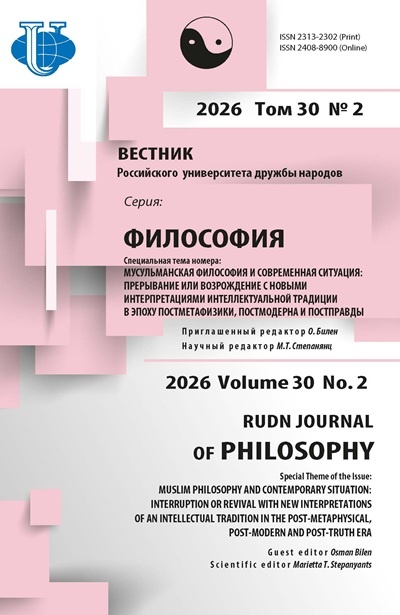
Special theme of the 2nd issue 2026: “Muslim Philosophy and Contemporary Situation: Interruption or Revival with New Interpretations of an Intellectual Tradition in the Post-Metaphysical, Post-Modern and Post-Truth Era”
We invite you to publish scientific researches in this issue.
A natural and rational philosophy flourished in 9th century in the cultural centers of Muslim world. Translating several works Muslims inherited ancient philosophical material both from the East and the West and integrated all into a new philosophical system. The tradition of Muslim or Arabic philosophy occupies a critical part of general history of philosophy. In other words, Islamic Philosophy has its own ebbs and flows that continues to be encountering critical engagements with mystical and theological movements. However, through mutual concessions and adaptations, a synthesis has emerged, allowing different philosophical perspectives to coexist and still studied in several modern languages. In the past Muslims philosophers Guided with the view that as an incremental development philosophy is a common universal heritage of humanity, classical Muslim philosophers made a unique contribution by trying to harmonize Islamic faith with rational scrutiny of philosophy, to combine natural philosophy with abstract metaphysics and ethics with politics to satisfy the demands of time and human conditions. In fact, early encounter Muslim intellectuals with the modern philosophical doctrines were more or less positive engagement based on the view that modern philosophy and sciences owed much of their premises that developed in classical Arabic-Muslim philosophical tradition.
This positive attitude gave way to a skeptical and oppositional attitude against philosophical theories that excluded religion, such as positivism, relativism, and materialism. While academic philosophy studies in the West only cover local movements, philosophical studies in the contemporary Islamic world are not limited to philosophy in the West. Therefore, in this special issue on contemporary Islamic philosophy, which philosophical perspectives in the Islamic world in the fields of epistemology, ontology, ethics, and political philosophy are being approached in a period when postmodern, post-truth, artificial intelligence, and post-human are being pointed out? Articles will be included on questions such as whether Islamic philosophy still exists as a viable tradition in the last century, and whether the views of important philosophers can be revived with new interpretations.
The issue’s co-editors are professor Osman Bilen (Dokuz Eylul University) and professor M. Stepanyants (Institute of Philosophy of the Russian Academy of Sciences).
Articles are accepted until 01 February 2026 and the issue will be published in June 2026.
Special theme of the 3rd issue 2026: “The Philosophy of Ernst Cassirer”
We invite you to publish scientific researches in this issue devoted to the study of various aspects of Ernst Cassirer’s philosophy.
The editors of the issue are leading experts in the philosophy of Ernst Cassirer Professor Massimo Ferrari of the University of Turin (Italy) and Professor Maja Soboleva of the University of Marburg (Germany).
Articles are accepted until 01 May 2026 and the issue will be published at the end of September 2026.
Special theme of the 4th issue 2026: “Philosophical problems of Artificial Intelligence”
This special topic is dedicated to examining the role and place of philosophical problems arising from the development of artificial intelligence (AI), including those of methodological, ethical, ontological, and epistemological nature. We invite discussions on the hypothesis of the fundamental possibility of creating AI, its significance for modern society, as well as the main challenges, risks, and threats associated with its development.
An analysis of the philosophical aspects of artificial intelligence reveals several key areas requiring philosophical reflection:
- The Nature and Definition of Artificial Intelligence: This area encompasses questions concerning the essential attributes and characteristics of AI, particularly its fundamental distinctions from modern generative AI models and LLMs. It also involves examining AI in relation to other types of intelligence.
- Methodological Foundations for Creating AI: This line of inquiry addresses the question of its fundamental feasibility. It also involves a search for the necessary foundational principles for AI development, within the scope of various scientific disciplines and philosophy.
- Ethical, Axiological, and Socio-Philosophical Implications of AI Development: This area focuses on modeling the ethical and social consequences of AI integration. It encourages a critical re-evaluation of the very necessity of its development in light of potential outcomes and risks. Research within this area should undertake a critical assessment of the prospects and risks of deep AI integration into human life – a process that implies not only socio-economic changes but also transformations in human thinking and creativity.
Guest Editor of the Issue:
Vladislav Aleksandrovich Lektorsky, academician of the Russian Academy of Sciences (Institute of Philosophy of the Russian Academy of Sciences).
Submission Guidelines:
- Submission Deadline: August 1, 2026.
- Issue Publication Date: December 2026.
TEMPLATE OF ARTICLE IN ENGLISH (up to 40,000 characters with spaces) – https://disk.yandex.ru/i/_UhuBAL4uQ3nAQ.
Our team look forward to your contributions!
Sincerely yours,
Editor in Chief
Vladimir N. Belov