






Call for papers: Special themes in 2027
TEMPLATE OF ARTICLE IN ENGLISH (up to 40,000 characters with spaces) – https://disk.yandex.ru/i/_UhuBAL4uQ3nAQ.
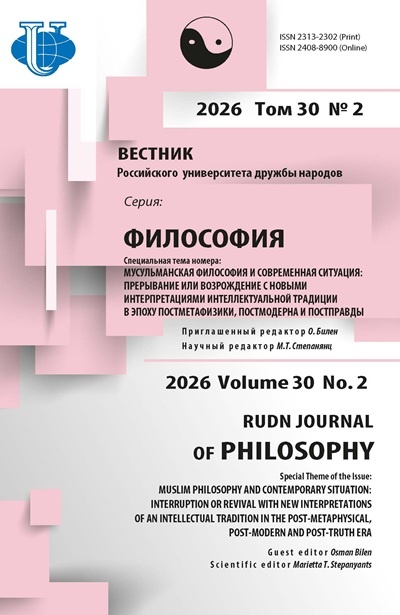
RUDN Journal of Philosophy is a peer-reviewed academic journal included in the international database Scopus (Q1) and the Italian citation database ANVUR (Areas 11 and 14). For many years, the journal has been a space to feature the best research of leading Russian and international scholars in the fields of History of Philosophy, Ontology, Epistemology, Social Philosophy, Ethics, and related disciplines. Articles are published in Russian, English, and German.
Special theme of the 1st issue 2027: “The Philosophy of Heinrich Rickert”
We invite you to publish scientific articles for this issue devoted to the study of various aspects of H. Rickert’s philosophy.
The editor of the issue is the expert in the philosophy of Heinrich Rickert, Professor of the Vrije Universiteit Amsterdam (Netherlands) Christian Krijnen.
Articles are accepted until November 1, 2026. The issue will be published at the end of March 2027.
TEMPLATE OF ARTICLE IN ENGLISH (up to 40,000 characters with spaces) – https://disk.yandex.ru/i/_UhuBAL4uQ3nAQ.
Special theme of the 2nd issue 2027: “Modern problems of ethical thought”
Editorial board of the RUDN Journal of Philosophy invites authors to participate in a special section dedicated to ethical issues. The release is scheduled for the second quarter of 2027.
The section is devoted to a new perspective on classical philosophical issues and approaches in the field of ethics, theory and practice of professional ethics, as well as new problems generated by scientific and technological progress, digitalization, and changes in the social structure.
Considering modern problems of ethical theory and current ethical issues of our time, we can identify the following areas that require ethical and philosophical reflection:
- Issues of ethical theory and professional ethics: understanding the ethical categories of the good, justice, freedom, conscience, duty, responsibility and others; development of ideas within the framework of classical ethical thought: deontological ethics, consequentialism, virtue ethics. Development of professional ethics in the context of digitalization of social and professional spheres.
- Education and upbringing as a process of formation of traditional values. The educational process today includes not only the acquisition of knowledge, skills and competencies, but also upbringing at all levels of education. The ethical problems of education today are not less acute than the methodological ones. Instilling traditional values in schools and universities is an important component of the State Policy of the Russian Federation for the preservation and strengthening of traditional Russian spiritual and moral values.
- Digitalization, information technology and artificial intelligence systems: ethical issues. Within the framework of this direction, it is proposed to consider the rapid development of digital technologies and AI systems through the prism of social nature of human beings’ analysis, modern social and cultural reality, humanistic goals and values of modern society. The current lack of generally accepted ethical standards regarding the application of developments and innovations in the field of artificial intelligence indicates the need for active and focused work by the philosophical community in this field.
- Bioethics and biotechnology: bioengineering has achieved significant results in recent decades, seriously exacerbating issues related to genome editing and the limits of acceptable interventions in human and animal nature; ethical assessment of genetic engineering, principles of biomedical ethics in the technological era.
Guest Editor of the Issue: Abdusalam Abdulkerimovich Guseinov, Academician of the Russian Academy of Sciences (Institute of Philosophy of the Russian Academy of Sciences).
Сo-editor: Vladimir Anatol’evich Tsvyk, Professor, Head of the Department of Ethics (RUDN University).
Submission Guidelines:
- Article Length: up to 40,000 characters (with spaces).
- Submission Deadline: February 1, 2027.
- Issue Publication Date: June 2027.
TEMPLATE OF ARTICLE IN ENGLISH (up to 40,000 characters with spaces) – https://disk.yandex.ru/i/_UhuBAL4uQ3nAQ.
Special theme of the 3rd issue 2027: “Martin Heidegger's Magnum Opus 'Being and Time': Meanings, Interpretations, Reception”
We invite authors to submit research articles in this special section dedicated to the 100th anniversary of the publication of Martin Heidegger's principal work. The foundational text Sein und Zeit (Being and Time) became one of the most influential works of the 20th century, profoundly impacting the development of European philosophy, particularly phenomenology, existentialism, and hermeneutics. Despite ongoing critique, debate, and discussion, the book is recognized as an innovative and profound philosophical composition that fundamentally reshaped the very formulation of questions in humanistic thought.
The editors of the issue are distinguished scholars in the philosophy of Martin Heidegger:
- Prof. Gian Paolo Cammarota, University of Salerno (Italy);
- Prof. Svetlana A. Konacheva, Russian State University for the Humanities (Russia).
Submission Guidelines:
- Article Length: up to 40,000 characters (with spaces)
- Submission Deadline: May 1, 2027
- Issue Publication Date: June 2027
TEMPLATE OF ARTICLE IN ENGLISH (up to 40,000 characters with spaces) – https://disk.yandex.ru/i/_UhuBAL4uQ3nAQ.
Special theme of the 4th issue 2027: “Justice in a Changing World: Philosophical Aspects”
The editorial board of the RUDN Journal of Philosophy invites authors to participate in a special section devoted to the philosophical understanding of the phenomenon of justice. The issue is scheduled for the fourth quarter of 2027.
The section is dedicated to the philosophical study of the phenomenon of justice, the history of the concept, the analysis and critique of theories of justice, as well as the prospects for their further evolution amid intensifying social, cultural, technological, and linguistic transformations. We propose to discuss the ontological, epistemological, ethical, and socio-philosophical foundations of the idea of justice and the practices of its establishment, the philosophical evolution of this concept, its contemporary interpretations, and possible future modifications.
Considering the philosophical aspects of the problem of justice, several groups of questions requiring philosophical reflection can be identified:
• The essence and definition of justice: questions related to the search for universal and culturally specific characteristics of justice, its relationship with the concepts of equality, law, freedom, and the good, as well as a critical analysis of classical theories of justice (from Aristotle to J. Rawls) in light of contemporary challenges.
• Epistemological and methodological aspects of justice: how are facts of violation, restoration, or implementation of justice established; what is the role of scientific knowledge and expert communities in their discovery and justification; is it possible to judge justice objectively, especially under conditions of value pluralism and relativism?
• Socio-philosophical and ethical implications of justice in the context of global changes: questions related to the rethinking of principles of justice in the context of digitalization, artificial intelligence, biotechnologies, climate change, migration processes, and growing social inequality. Within this direction, it is proposed to critically examine the prospects of intergenerational, global, and environmental justice, as well as the role of justice as a regulator of social interaction and a foundation for sustainable development.
The editors of the issue are Professor Aleksandar Fatić (Institute of Philosophy and Social Theory, University of Belgrade) and Doctor of Philosophical Sciences, Corresponding Member of the Russian Academy of Sciences Alexander V. Pavlov (Higher School of Economics).
Articles (up to 40,000 characters with spaces) are accepted until August 01, 2027;
Issue Publication Date – December 2027.
TEMPLATE OF ARTICLE IN ENGLISH (up to 40,000 characters with spaces) – https://disk.yandex.ru/i/_UhuBAL4uQ3nAQ.
We look forward to receiving your submissions!
Sincerely yours,
Editor in Chief
Vladimir N. Belov