

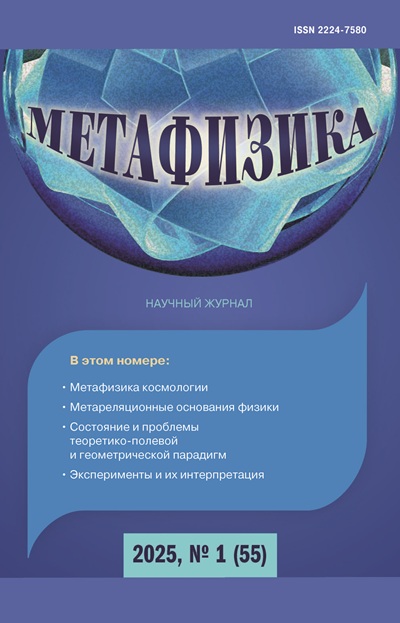
No 1 (2025)

EDITORIAL NOTE

ЕDIТОRIАL NОТЕ

Vladimirov Y.S.
Metaphysics. 2025;(1):6-7
pages 6-7 views

METAPHYSICS OF COSMOLOGY

FOUNDATIONS OF FUNDAMENTAL PHYSICS, MACH’S PRINCIPLE AND COSMOLOGY

Vladimirov Y.S.

Abstract

The article shows that the process of revising the foundations of fundamental physics is currently underway. It is necessary to take into account that modern physics is based on the established concepts of macrophysics, which extend to microphysics and megaphysics, while at present there is a conviction that it is necessary to develop an independent system of concepts and patterns inherent in the physics of the microworld and megaworld, from which the concepts of the macroworld follow. In this case, it is most important to derive from the sought-after concepts of the microand megaworld the concepts of classical space-time, which underlies macrophysics. It is proposed to use the theory of binary systems of complex relations as the initial concepts of the microworld, which also affect the foundations of the physics of the megaworld. It is shown that in the theory of the megaworld, the key role is played by Mach’s principle, which is not properly taken into account in modern cosmology.
Metaphysics. 2025;(1):8-30
pages 8-30 views

“ACCELERATION OF THE EXPANSION OF THE UNIVERSE” AND SNIa-TYPE SUPERNOVAE IN THE THEORY OF MEASUREMENT PROBLEMS

Levin S.F.

Abstract

A brief description of the theory of measurement problems as physical and mathematical problems for the solution of which the initial data are obtained by measurements is given. The results of applying this theory to the analysis of data on the redshift of SNIa supernovae in the format of the cosmological distance scale model used as evidence of the “acceleration of the expansion of the Universe” using the programs “MMK-stat” are considered. An alternative interpretation of these data can be the action of gravitational dipoles of large-scale inhomogeneity of the Universe.
Metaphysics. 2025;(1):31-53
pages 31-53 views

ON OPTICAL CORRECTION OF NEWTON'S LAW OF INERTIA: FUNDAMENTAL RESULTS

Antipenko L.G.

Abstract

In classical mechanics, the motion of a body is characterized by scalar and vector measures of motion. The scalar measure of motion is kinetic energy, the vector measure is momentum. Both of these measures obey the conservation law. In the theory of relativity, a formula is derived that gives the relationship between the mass of a body and its energy (E = mc2 ) . This formula fits the value of the kinetic energy of a moving body, but there is still no answer to the question of how to interpret the energy, which is equivalent to the mass of a body at rest, i.e. when m = m0 . An attempt to answer it led the author to the conclusion that in the energy balance of a physical body one must take into account its external and internal energy, which, in turn, should be seen as a combination of kinetic and potential energy. To draw such a conclusion, we had to turn to the analysis of Newton’s law of inertia, and then to its generalization based on the study of the phenomenon of red shift of electromagnetic radiation in astrophysics. The article describes a quantum approach to the phenomenon of redshift in the spectra of galaxies, and then this approach is complemented by conclusions that follow from the two-spin interpretation of the solution to the quantum relativistic Dirac equation, which describes the free motion of an electron. Among the fundamental results is a new, unorthodox approach to constructing a cosmological picture of the world.

Metaphysics. 2025;(1):54-68
pages 54-68 views

METARELATIONAL FOUNDATIONS OF PHYSICS

BINARY SYSTEMS OF COMPLEX RELATIONS AS MATERIAL PROJECTIONS OF LEIBNIZ’S MONADS

Zhilkin A.G.

Abstract

The paper considers the analogy between binary complex systems of relations in binary geometrophysics and monads in Leibniz’s philosophical system. It is shown that in physical reality, elementary processes described by binary systems of complex relations play the role of material projections of monads. The interpretation of various types of monads from the point of view of binary geometrophysics is discussed. A model of the multiverse based on the formation of successive chains of elementary processes is proposed.
Metaphysics. 2025;(1):69-83
pages 69-83 views

PYTHAGORAS, LEIBNIZ, MACH

Babenko I.A.

Abstract

The article analyzes the development of the metaphysical approach from Pythagoras to Leibniz and Mach. The general trend in the views of these great thinkers on the foundations and structure of the surrounding world is discussed.
Metaphysics. 2025;(1):84-97
pages 84-97 views

MACH'S PRINCIPLE AND METARELATIVE INTERPRETATION OF THE METRIC

Molchanov A.B.

Abstract

One of the main tasks of the metarelational approach to the description of spacetime and physical interactions is the derivation of space-time quantities from more fundamental laws describing the most basic physical processes in the microworld. Such processes, in particular, include acts of emission and absorption of electromagnetic radiation by elementary particles. It was previously shown that statistical accounting of all possible acts of electromagnetic interactions in a system of particles with discrete spectra of hydrogen atoms leads to the possibility of determining the scales of distances and time in such a system. This result was compared with the presence of accompanying and proper coordinates in cosmology, and also led to an expression for the scale factor linking these systems. In this paper, this result is generalized: it is shown that the distribution function of emitter and absorber configurations is related to the metric in the classical theory of gravity, and the key role of the extended (strong) Mach principle is demonstrated.
Metaphysics. 2025;(1):98-106
pages 98-106 views

STATE AND PROBLEMS OF FIELD-THEORETICAL AND GEOMETRIC PARADIGMS

FROM QUARKS TO PARTONS AND FROM THEM TO QUANTUM CHROMODYNAMICS

Vizgin V.P.

Abstract

The article examines the history of the creation of quantum chromodynamics (QCD), which is a modern theory of strong interactions and part of the standard model in elementary particle physics. The main stages in this development associated with the turning events on the way to QCD are identified and studied: 1) the creation of the quark model (1964); 2) detection of quasipoint objects inside nucleons in experiments on deep-inelastic scattering of leptons on nucleons and the hypothesis of partons (1968-1969); 3) proof of the renormalizability of gauge theories (1971); 1. the creation of the gauge theory of quarks and gluons (the achievement of M. Gell-Mann with colleagues, 1971-1973); 5) the discovery of the phenomenon of asymptotic freedom as the physical basis of QCD (D. Gross et al., 1973). The conclusion is made about the importance and consistency of the achievements of each of these groups at the end of the QCD.
Metaphysics. 2025;(1):107-127
pages 107-127 views

SHOULD WE PUT UP WITH THE PARADOX’S OF THE MICROCOSM?

Kononov V.G.

Abstract

The article demonstrates how the properties of the quantum world can be noncontradictory explained without using mathematical apparatus. They are generally considered incompatible with the logic of classical macroscopic physics. Indeed, wave-particle duality, magnetic pulses, negative energy, non-locality, entanglement, and other phenomena are not fit into the usual picture of the world. However, just one assumption provides the key to understanding most quantum paradoxes. If we assume that there is real and equal forward and backward in time movement in the microcosm, then we can find a simple explanation that is compatible with the principles of causality, conservation and symmetry.
Metaphysics. 2025;(1):128-136
pages 128-136 views

PROPERTIES OF GRAVITATIONALLY BOUND QUANTUM SYSTEMS

Fil’chenkov M.L., Laptev Y.P.

Abstract

Gravitationally bound systems in curved space-time are considered. The objects subject to quantization are graviatoms, the early Universe, external fields, geometry in general, and space-time itself.
Metaphysics. 2025;(1):137-139
pages 137-139 views

EXPERIMENTS AND THEIR INTERPRETATION

ON THE POSSIBILITY OF HIGH-FREQUENCY LONGITUDINAL ELECTROMAGNETIC WAVES IN A FRESHWATER ENVIRONMENT

Panchelyuga V.A., Panchelyuga M.S., Tomilin A.K.

Abstract

A brief review of experimental works is given, which lead to the idea of the existence of longitudinal-scalar waves. Experiments performed on the Mozhaisk reservoir are considered in detail, and demonstrating the possibility of propagation of electromagnetic waves between the transmitting and receiving modules at a distance of 150-200 m (1000 or more wavelengths) at a depth of 4 m (27 wavelengths). The obtained result and the design of the antenna system used allow us to assume that the communication between the transmitting and receiving modules was carried out using longitudinal-scalar waves. The possibility of signal propagation through the “water- air ” and “air-water ” interfaceis shown.
Metaphysics. 2025;(1):140-148
pages 140-148 views

LONGITUDINAL ELECTROMAGNETIC WAVES

Tomilin A.K., Panchelyuga V.A.

Abstract

The initial idea of potential-vortex electrodynamics theory is discussed. Differential equations of generalized electrodynamics and wave equations describing both transverse and longitudinal electromagnetic waves are presented. The process of radiation of both types of waves by a half-wave Hertz vibrator is described. It is shown that longitudinal electromagnetic waves propagate in electrically conducting media. A short review of publications containing the results of experiments with longitudinal waves is given.
Metaphysics. 2025;(1):149-156
pages 149-156 views

HIGH-FREQUENCY ELECTROMAGNETIC WAVES IN THE MARINE ENVIRONMENT: A BRIEF REVIEW

Lukin A.F.

Abstract

The article presents the results of the most significant theoretical and experimental works in the field of using electromagnetic high-frequency waves in the marine environment, published in the 20th and early 21st centuries. The main characteristics of wave propagation, observed effects, and recommendations for the development and design of effective underwater antennas are briefly described.
Metaphysics. 2025;(1):157-166
pages 157-166 views

IN MEMORY OF OUR COLLEAGUES

PERMINOV VASILY YAKOVLEVICH (1938-2024)

Shaposhnikov V.A., Vladimirov Y.S.
Metaphysics. 2025;(1):167-168
pages 167-168 views

SBYTOV YURI GRIGORIEVICH (1936-2024)

Vladimirov Y.S., Panov V.F.
Metaphysics. 2025;(1):169-170
pages 169-170 views